You're viewing free preview questions. Upgrade to access more Maths AI SL questions.Upgrade
Arithmetic Sequences and Series · Paper 2 — Free Maths AI SL Practice Questions
1MasterySAQ-SDefinition and general term of arithmetic sequences6 marksPaper 2~9 min

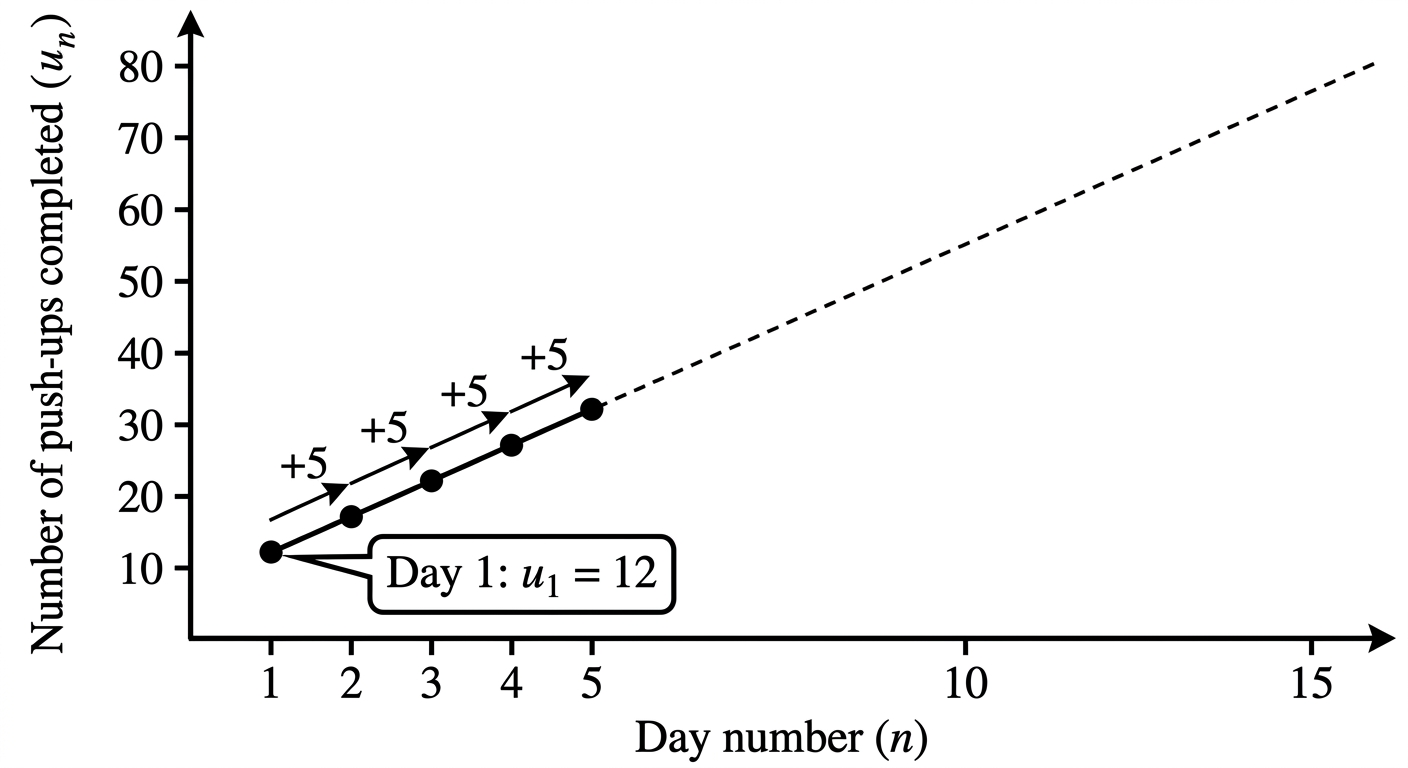
A new smartphone app records the number of push-ups a user completes each day. On the first day, the user completes push-ups. Each subsequent day, the user completes more push-ups than the previous day. The number of push-ups completed on day is denoted by .
(a)
Write down an expression for in terms of . [1 mark]
(b)
Calculate the number of push-ups the user completes on day . [2 marks]
(c)
Determine the first day on which the user completes at least push-ups. [3 marks]

Solutions
2MasterySAQ-SDefinition and general term of arithmetic sequences6 marksPaper 2~9 min
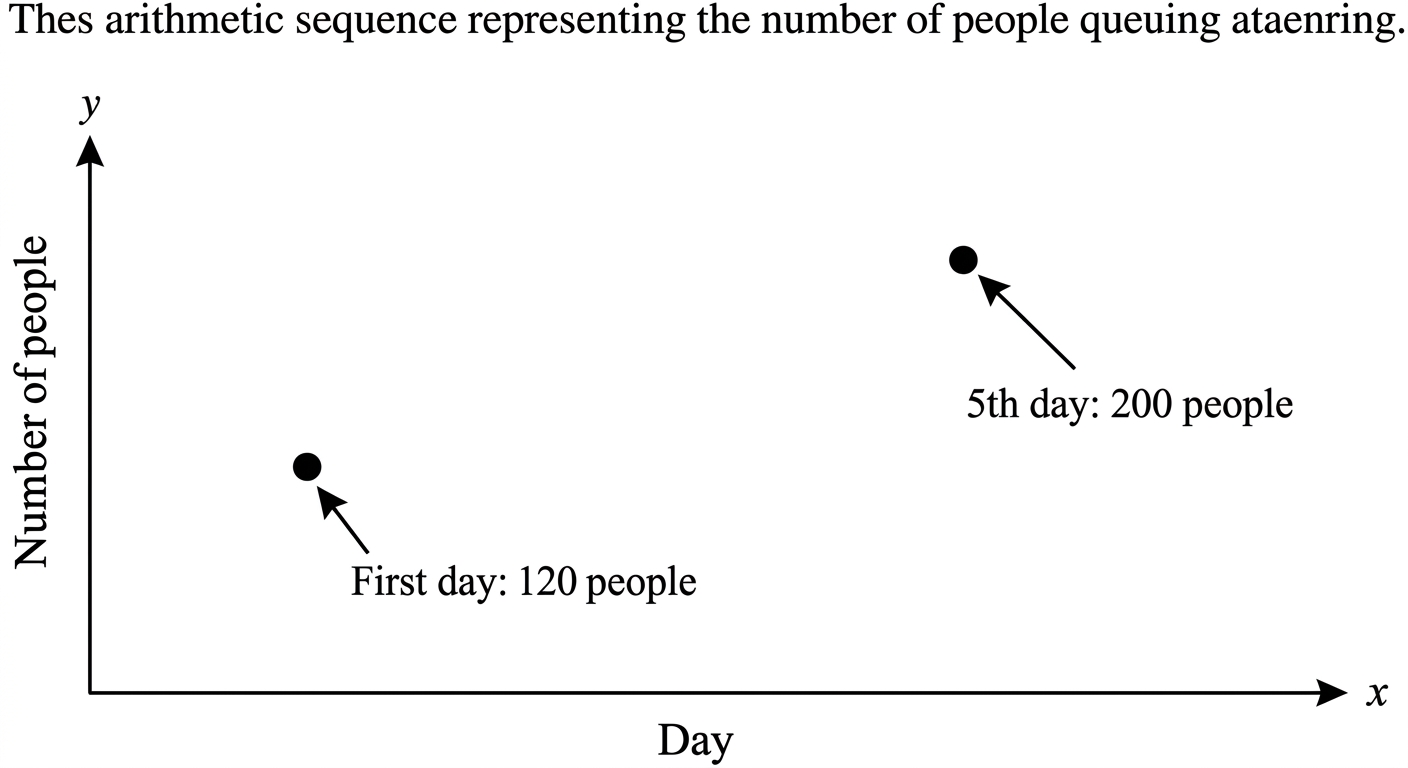
A theme park has a queue for a new ride. On the first day, people queue. The park managers predict that each subsequent day, the number of people queuing will increase by a constant amount.
On the 5th day, people queue.
(a)
Calculate the common difference in the number of people queuing each day. [2 marks]
(b)
Calculate the number of people predicted to queue on the 12th day. [2 marks]
(c)
The ride can accommodate a maximum of people per day. Determine the first day on which the predicted number of people queuing exceeds this capacity. [2 marks]
Solutions
3MasterySAQ-SDefinition and general term of arithmetic sequences6 marksPaper 2~9 min
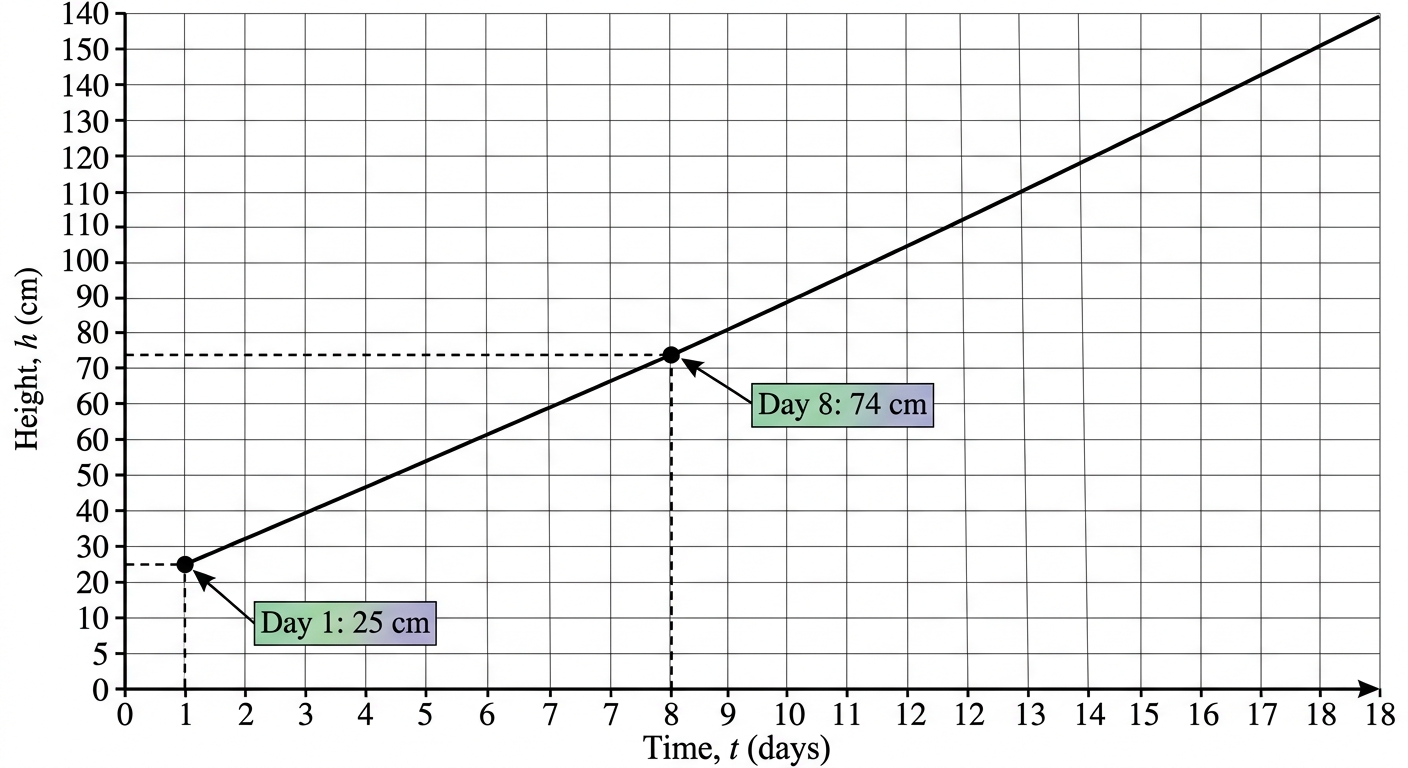
A biologist is studying the growth of a bamboo plant. On the first day of measurement, the plant is tall. The biologist models the height as an arithmetic sequence, where the plant grows by a constant amount each day.
(a)
On the 8th day, the plant is tall. Calculate the daily growth rate. [2 marks]
(b)
Calculate the height of the plant on the 15th day. [2 marks]
(c)
A second bamboo plant also starts at on day 1 and grows according to the model , where is the day number. Determine the first day on which the second plant is taller than the first plant, and evaluate whether the arithmetic model or the exponential model predicts a greater height on day 30. [2 marks]
Solutions
4MasterySAQ-SDefinition and general term of arithmetic sequences6 marksPaper 2~9 min
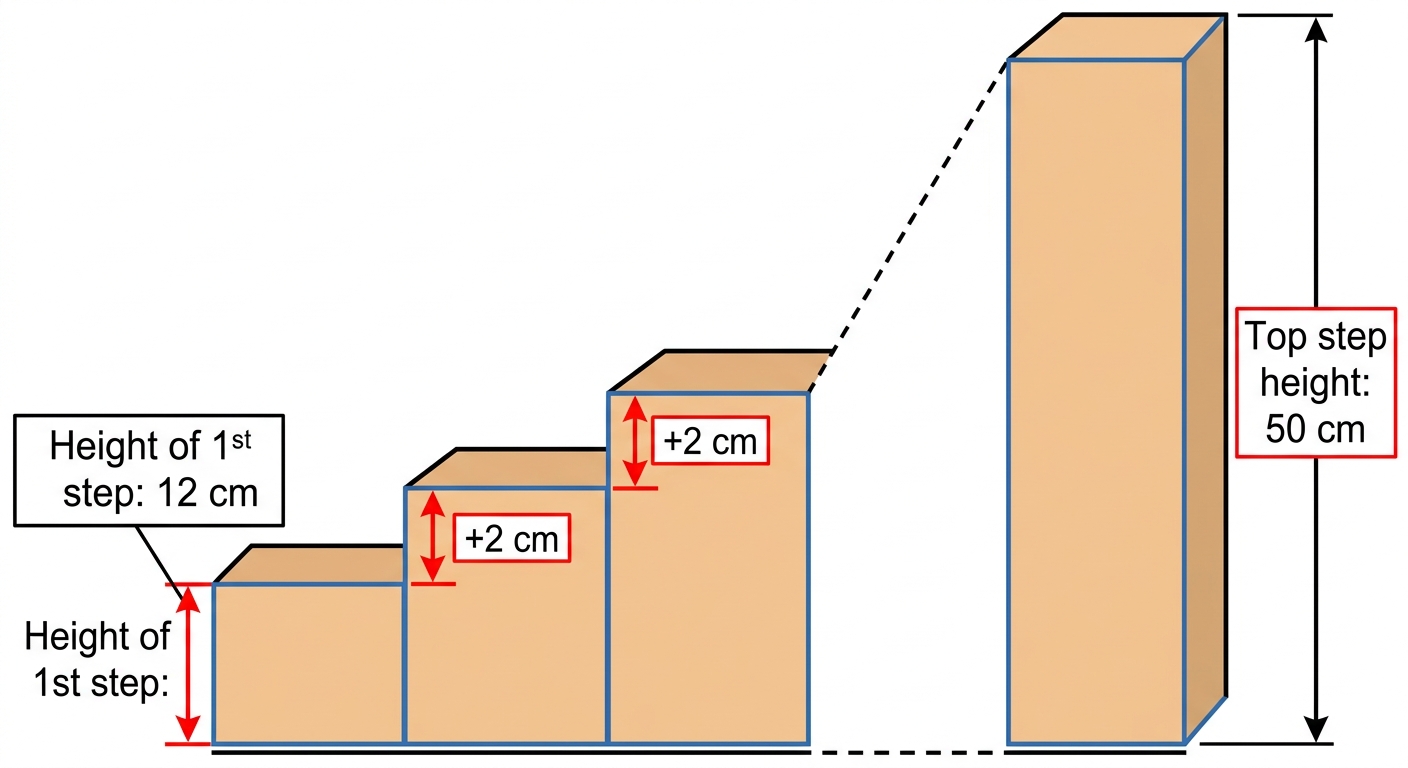
A construction company is building a staircase. The first step has a height of . Each subsequent step is higher than the previous step.
(a)
Show that the heights of the steps form an arithmetic sequence with common difference . [1 mark]
(b)
Calculate the height of the th step. [2 marks]
(c)
The total combined height of all steps must equal exactly . Determine the number of steps in the staircase. [3 marks]
Solutions
5MasterySAQ-SDefinition and general term of arithmetic sequences6 marksPaper 2~9 min
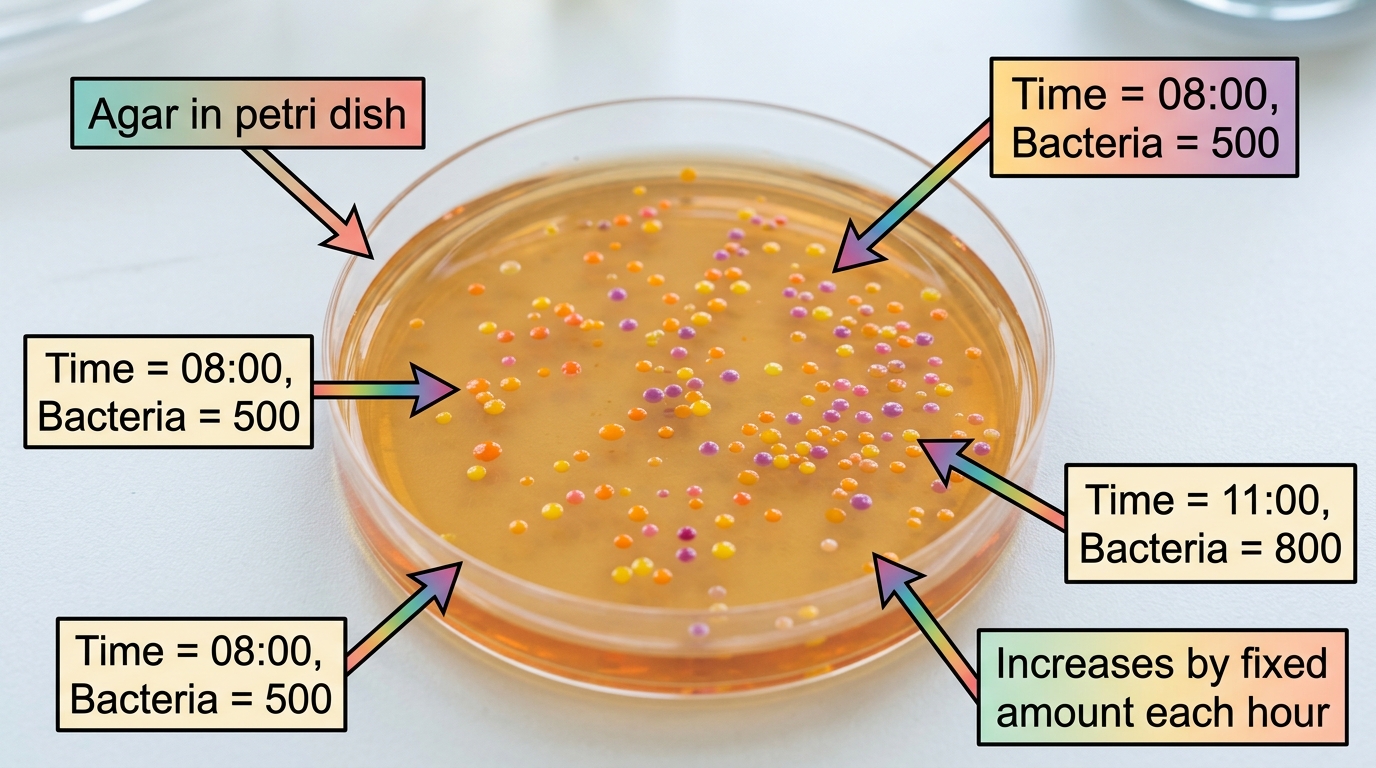
A biologist is studying a population of bacteria in a petri dish. At 08:00, there are bacteria. The number of bacteria increases by a fixed amount each hour. At 11:00, there are bacteria.
(a)
Calculate the common difference of this arithmetic sequence. [2 marks]
(b)
Calculate the number of bacteria at 15:00. [2 marks]
(c)
The petri dish has a maximum capacity of bacteria. The biologist claims the dish will reach capacity before 20:00 on the same day.
Determine whether the biologist's claim is correct, showing all working. [2 marks]
Solutions
6MasterySAQ-SDefinition and general term of arithmetic sequences6 marksPaper 2~9 min
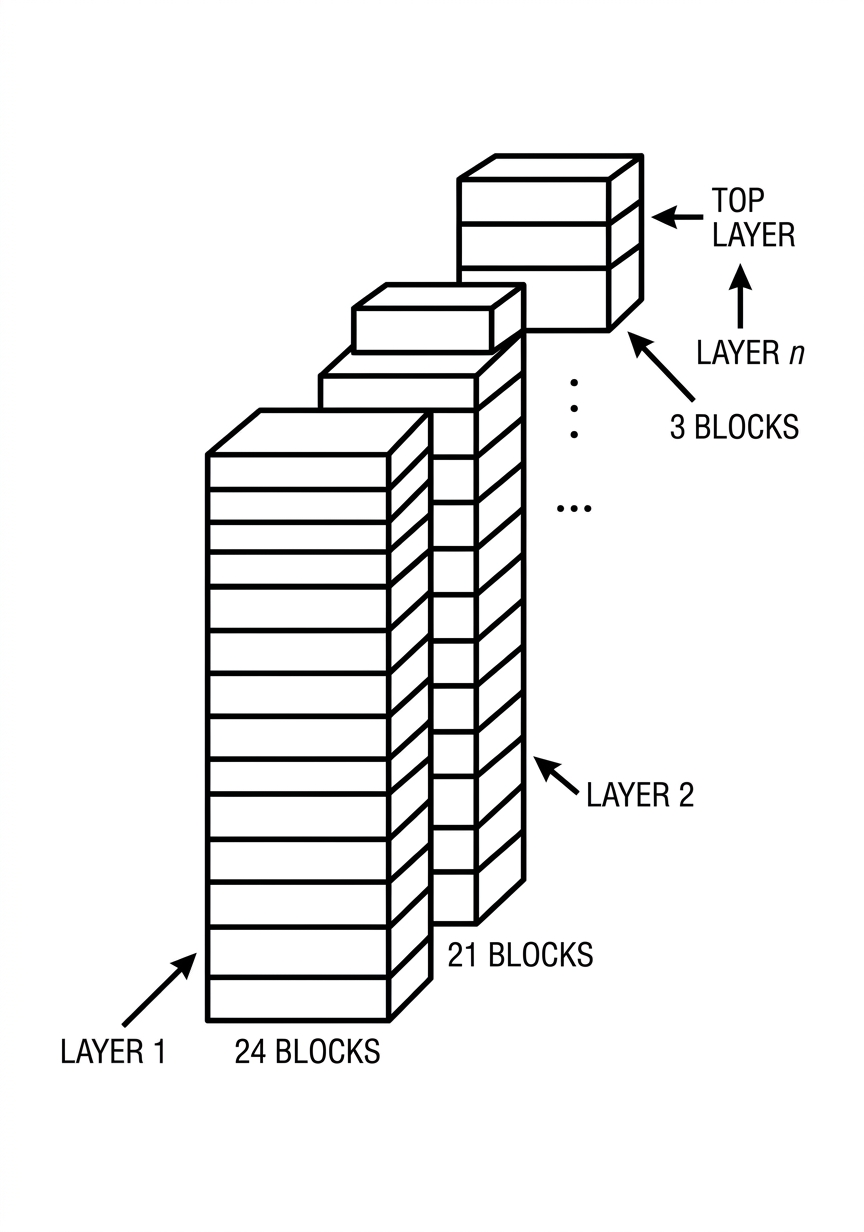
A construction company is building a tower of concrete blocks. The base layer (layer 1) contains blocks. Each subsequent layer contains fewer blocks than the layer below it. The top layer contains exactly blocks.
(a)
Determine the number of layers in the tower. [3 marks]
(b)
Calculate the total number of blocks used to build the tower. [2 marks]
(c)
Each concrete block has a mass of . The construction company can transport a maximum of of blocks per trip. Determine the minimum number of trips required to transport all the blocks needed to build the tower. [1 mark]
Solutions
7MasterySAQ-SDefinition and general term of arithmetic sequences6 marksPaper 2~9 min
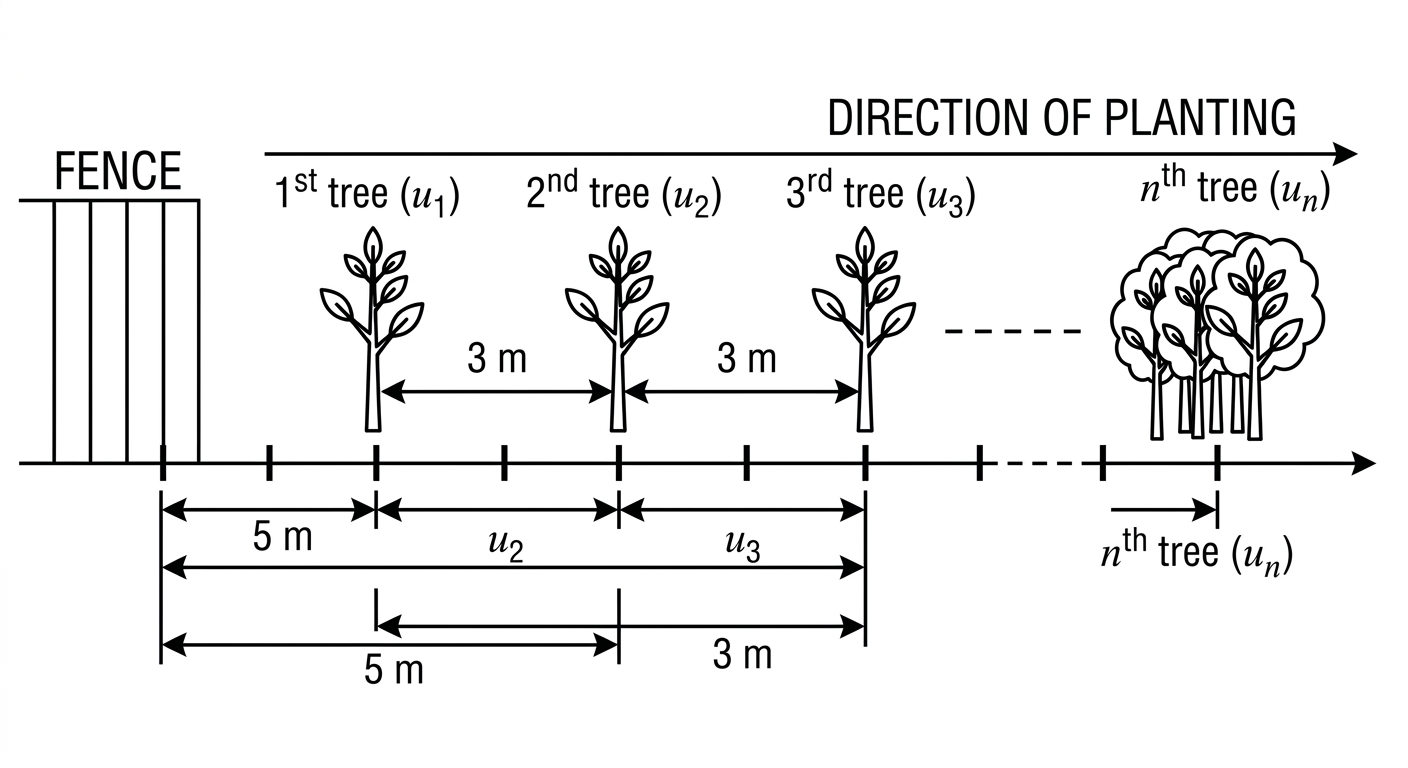
A gardener plants trees in a straight line. The first tree is planted metres from a fence. Each subsequent tree is planted metres further from the fence than the previous tree. The distance from the fence to the tree is metres.
(a)
Write down the value of and the value of . [1 mark]
(b)
Calculate the distance from the fence to the tree. [2 marks]
(c)
The last tree is metres from the fence. The gardener claims the total distance of all trees from the fence exceeds metres. Determine whether the gardener's claim is correct. [3 marks]
Solutions
8MasterySAQ-SDefinition and general term of arithmetic sequences8 marksPaper 2~12 min
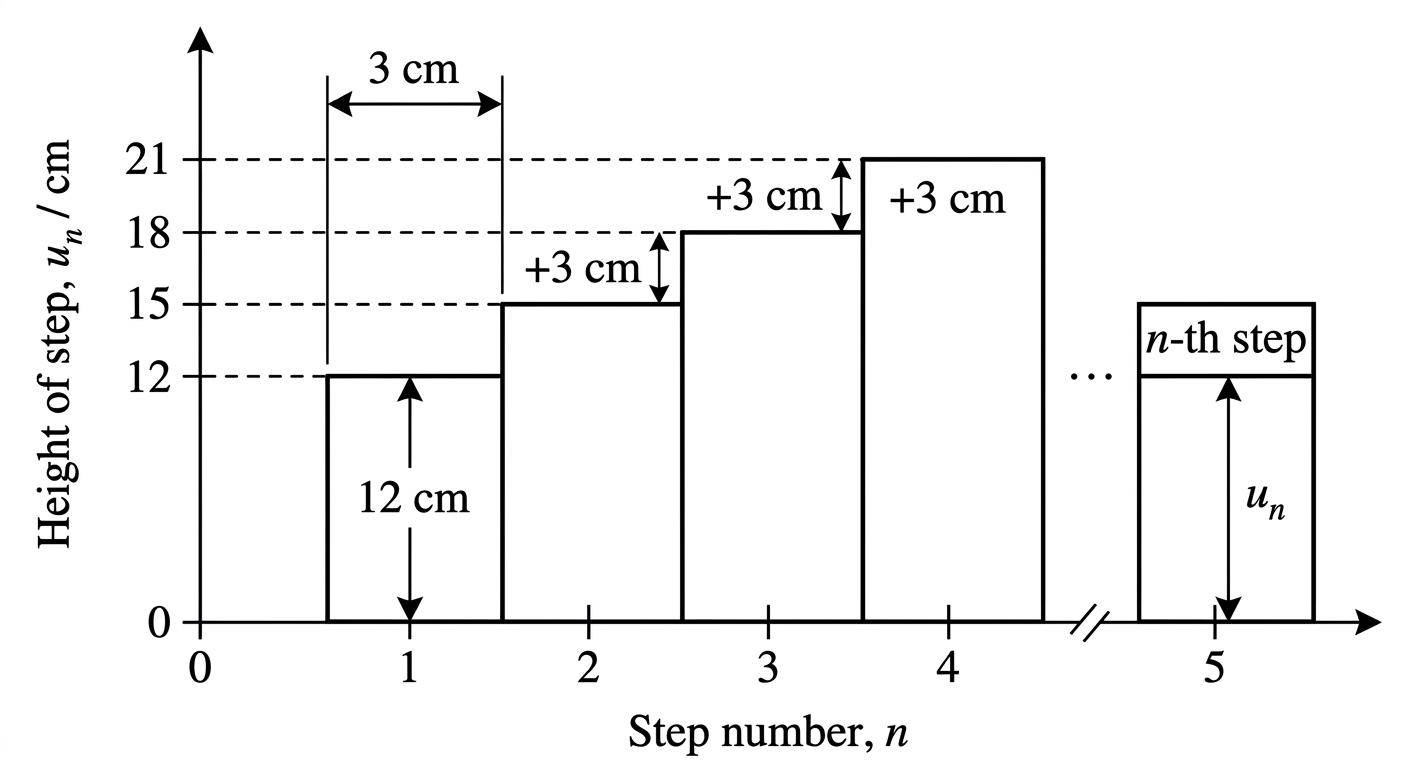
A construction company is building a staircase. The first step has a height of . Each subsequent step has a height that is more than the previous step. The staircase has steps.
(a)
Show that the height of the th step is given by . [2 marks]
(b)
Calculate the height of the th step. [2 marks]
(c)
The total height of the staircase is the sum of the heights of all steps. A building regulation states that the total height of a staircase must not exceed . Determine whether this staircase satisfies the regulation. [4 marks]
Solutions
9MasterySAQ-SDefinition and general term of arithmetic sequences9 marksPaper 2~14 min
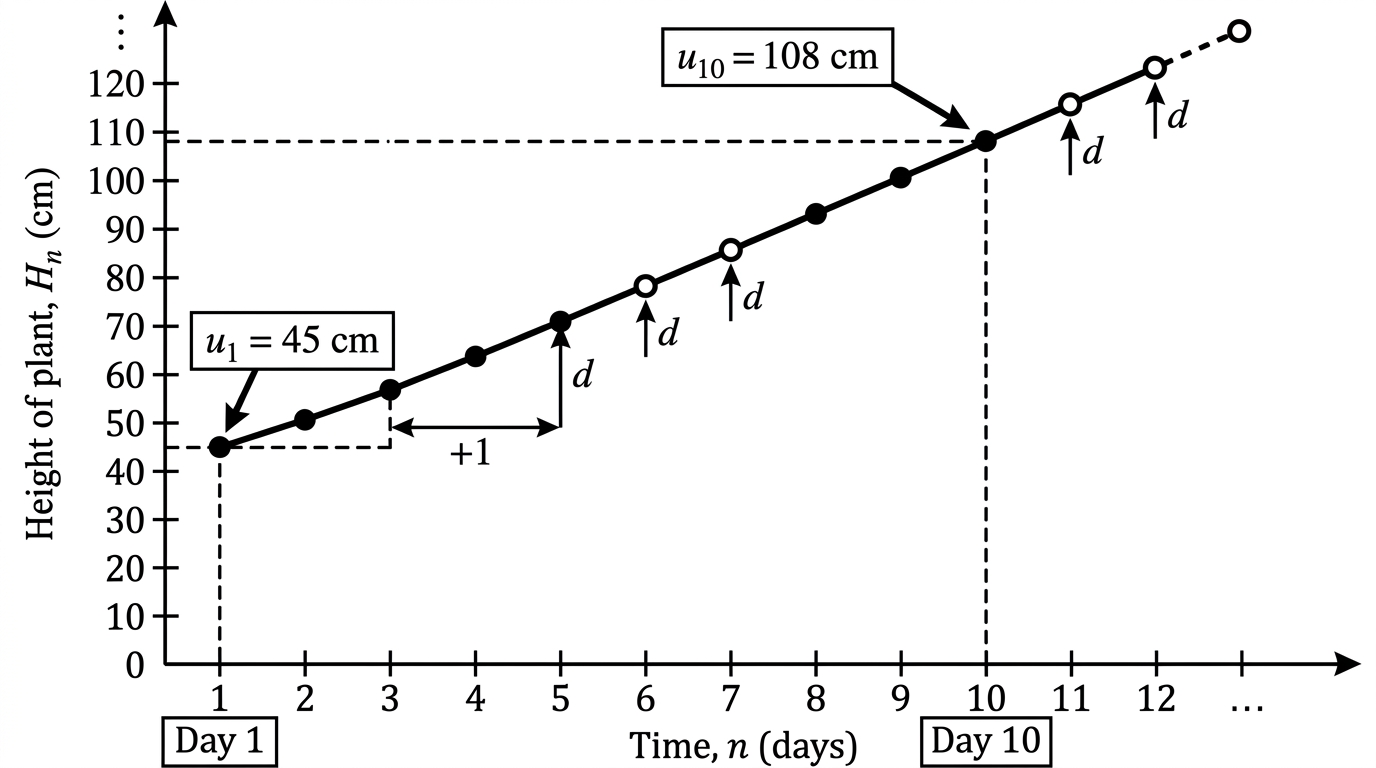
A biologist is studying the growth of a bamboo plant. On the first day of measurement, the plant is tall. Each subsequent day, it grows by a constant amount. On the 10th day, the plant is tall.
(a)
Find the common difference, , for the daily height increase of the plant. [3 marks]
(b)
Hence, calculate the height of the plant on the 20th day. [2 marks]
(c)
A greenhouse has a maximum internal height of . Determine on which day the plant first exceeds this limit, and hence evaluate whether the plant will fit inside the greenhouse for at least three weeks from the first day of measurement. [4 marks]
Solutions
10MasterySAQ-SSum of an arithmetic sequence6 marksPaper 2~9 min
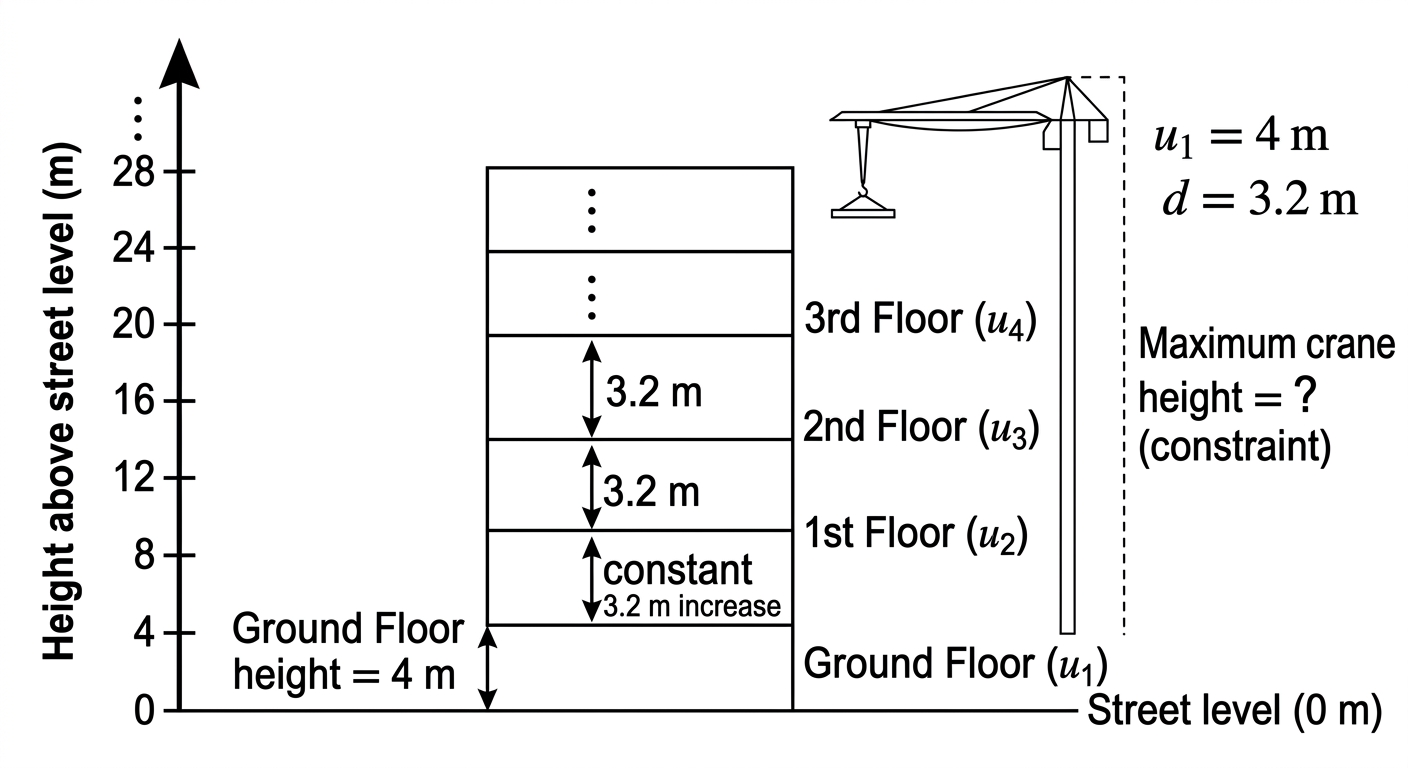
A construction company is building a new office tower. The ground floor is at a height of above street level. Each subsequent floor is higher than the floor directly below it. The heights of the floors above street level form an arithmetic sequence.
(a)
Write down the values of and for this sequence. [1 mark]
(b)
Calculate the height above street level of the 15th floor. [2 marks]
(c)
The construction crane can only reach floors whose height above street level is less than . Determine the maximum number of complete floors that can be built so that the crane can reach all of them. [3 marks]
Solutions
11MasterySAQ-SDefinition and general term of arithmetic sequences6 marksPaper 2~9 min
A cinema has seats in the first row. Each subsequent row has more seats than the row in front of it. The last row has seats.
(a)
Determine the number of rows in the cinema. [3 marks]
(b)
Calculate the total number of seats in the cinema. [3 marks]
Solutions
12MasterySAQ-SSum of an arithmetic sequence6 marksPaper 2~9 min
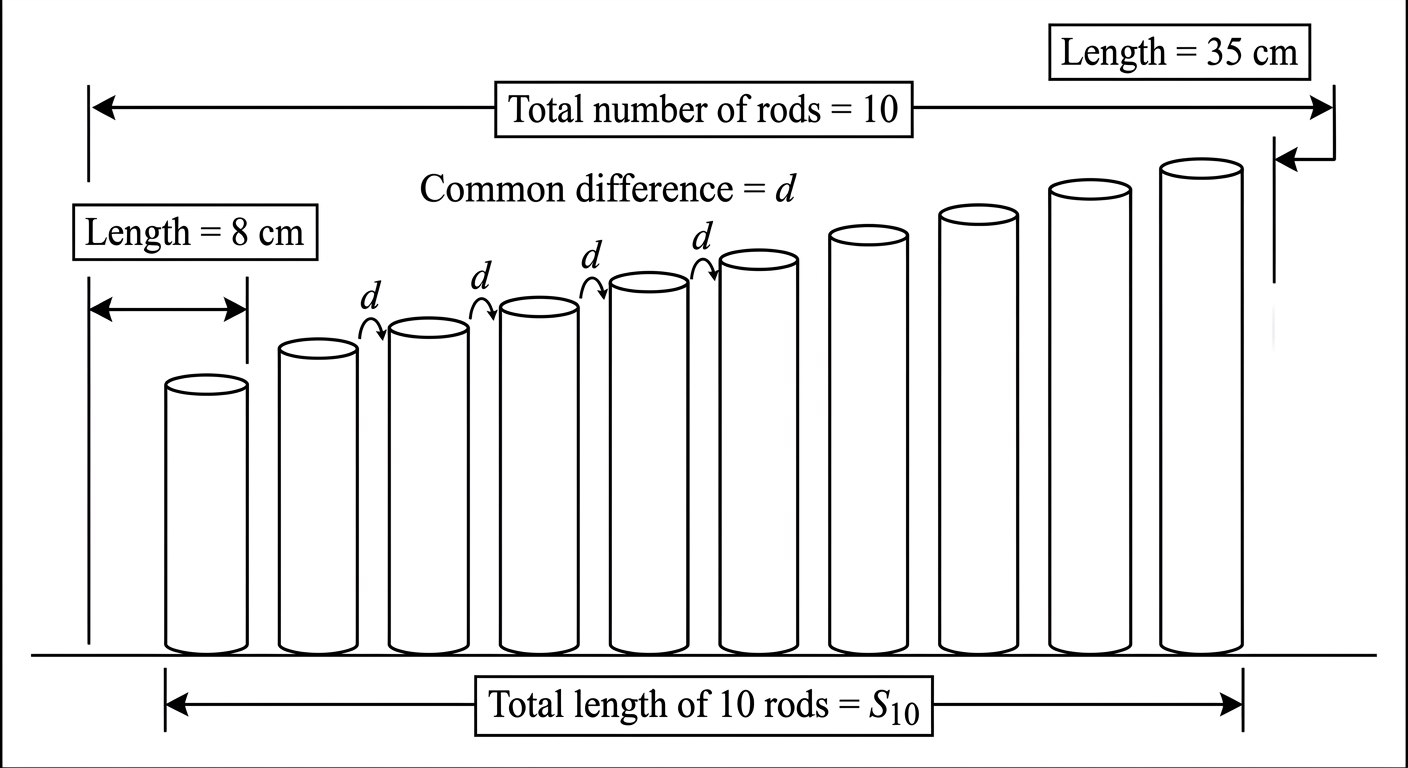
A company is manufacturing cylindrical metal rods. The lengths of the rods (in cm) form an arithmetic sequence. The shortest rod has a length of and the longest rod has a length of . There are rods in total.
(a)
Calculate the common difference between consecutive rod lengths. [2 marks]
(b)
Calculate the total length of all rods placed end to end.
The company receives an order for rods with a total combined length of exactly . The rods must form an arithmetic sequence with the same shortest rod length of and the same common difference found in part (a). [2 marks]
(c)
Determine the number of rods required to achieve a total length of exactly . [2 marks]
Solutions
13MasterySAQ-SSum of an arithmetic sequence6 marksPaper 2~9 min
Data
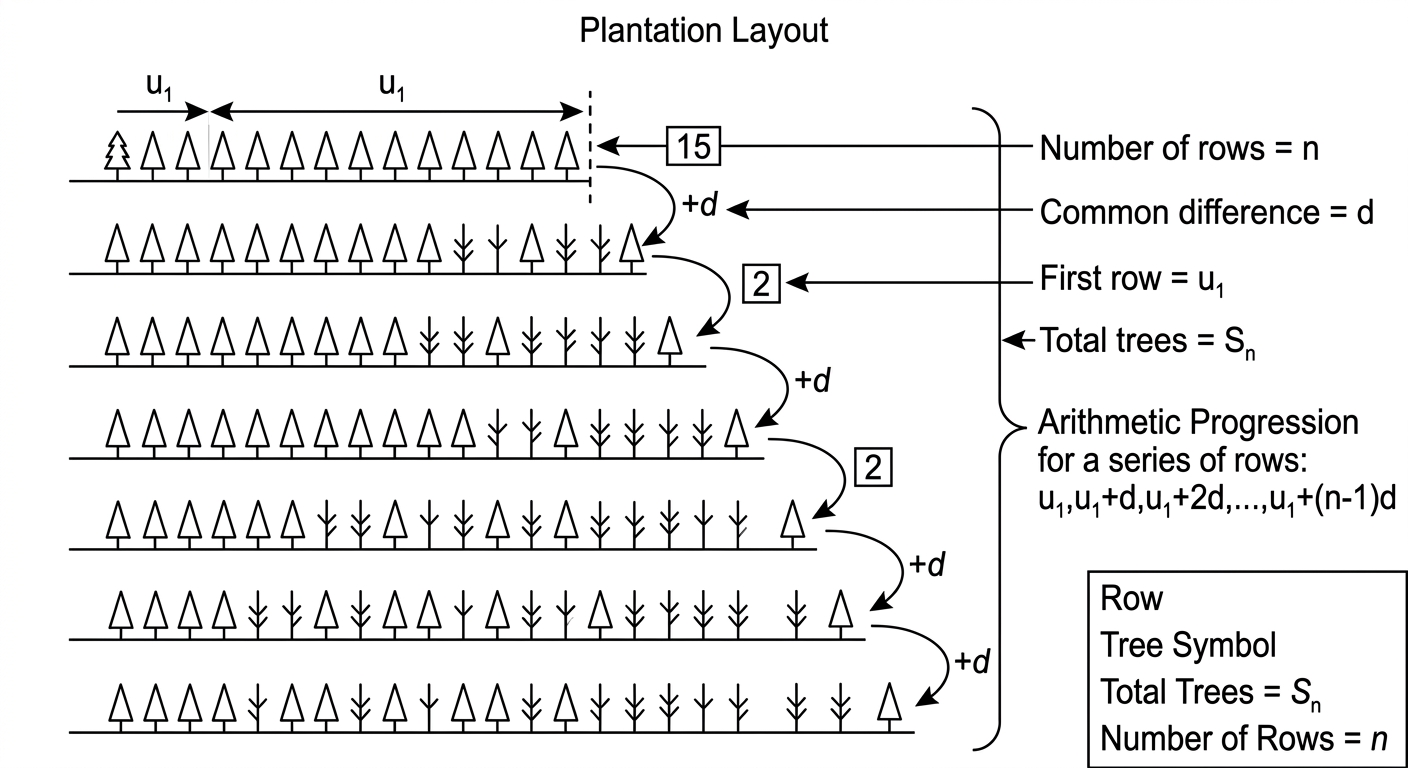
A gardener plants trees in rows. The first row contains trees. Each subsequent row contains more trees than the previous row. The gardener wishes to plant at least trees.
(a)
Show that the total number of trees planted in complete rows is given by . [3 marks]
(b)
Hence, find the minimum number of complete rows needed to plant at least trees. [2 marks]
(c)
Determine the number of trees planted in the final (minimum) row, and hence evaluate whether the gardener plants exactly trees or more. [1 mark]
Solutions
14MasterySAQ-SDefinition and general term of arithmetic sequences6 marksPaper 2~9 min
Data
A biologist is studying the growth of a bacterial colony. On day 1, the colony covers an area of . Each subsequent day, the area increases by a constant amount. On day 10, the area is .
(a)
Calculate the daily increase in area. [2 marks]
(b)
Determine on which day the area first exceeds . [2 marks]
(c)
The biologist's petri dish has a total area of . She claims the colony will fill the dish within 50 days of day 1. Determine whether claim is correct. [2 marks]
Solutions
15MasterySAQ-SDefinition and general term of arithmetic sequences6 marksPaper 2~9 min
A cinema has 25 rows of seats. The first row has 18 seats. Each subsequent row has 4 more seats than the row in front of it. The number of seats in row is given by .
(a)
Write down an expression for in terms of . [1 mark]
(b)
Calculate the number of seats in row 15. [2 marks]
(c)
The cinema sells tickets for USD 12 per seat. Every seat in every row from row 1 to row is sold. Given that the total number of seats in rows 1 to must first exceed 800, find the value of and hence calculate the total ticket revenue. [3 marks]
Solutions
16MasterySAQ-SDefinition and general term of arithmetic sequences6 marksPaper 2~9 min
A small business sells handmade candles. In the first month, they sell candles. The business plans to increase sales by a constant number of candles each month.
(a)
In the th month, they sell candles. Calculate the monthly increase in sales. [2 marks]
(b)
Calculate the number of candles predicted to be sold in the th month. [2 marks]
(c)
Each candle sells for USD 4.50 and costs USD 2.10 to make. The business has fixed monthly costs of USD 312.
Determine whether the business makes a profit in month , showing all working. [2 marks]
Solutions
17MasterySAQ-SDefinition and general term of arithmetic sequences6 marksPaper 2~9 min
A library has a membership drive. In the first month, new members join. The library expects the number of new members each month to increase by a constant amount .
(a)
In the th month, new members join. Calculate . [2 marks]
(b)
Calculate the number of new members predicted to join the th month. [2 marks]
(c)
The library's goal is to reach a cumulative total of at least new members. Determine the first month by the end of which this goal is met. [2 marks]
Solutions
18MasterySAQ-SSum of an arithmetic sequence6 marksPaper 2~9 min
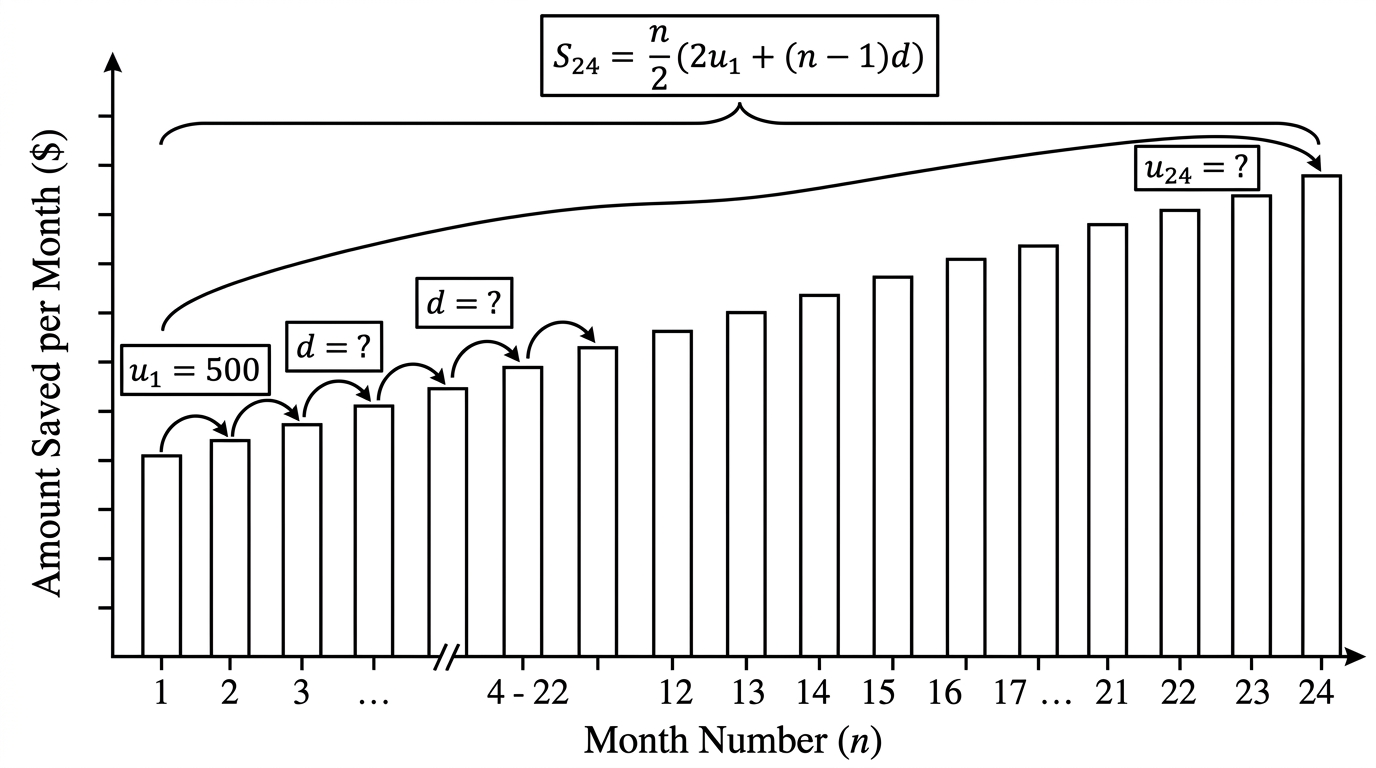
A small business owner saves money for equipment upgrades. In the first month she saves USD 500. Each subsequent month she increases her savings by a fixed amount compared to the previous month. After 24 months she has saved a total of USD 21 600.
(a)
Show that the amount saved in the 24th month is USD 1300. [3 marks]
(b)
Determine the first month in which her monthly savings exceed USD 1000. [3 marks]
Solutions
19MasterySAQ-SSum of an arithmetic sequence9 marksPaper 2~14 min
Data
,
A theatre has seats arranged in rows. The first row has seats. Each subsequent row has more seats than the previous row. The last row has seats.
(a)
Determine the number of rows in theatre. [3 marks]
(b)
Calculate the total number of seats in theatre. [2 marks]
(c)
The theatre manager claims that more than of the total seats are in the last rows. Determine whether this claim is correct, showing all working. [4 marks]
Solutions
20MasterySAQ-SSum of an arithmetic sequence8 marksPaper 2~12 min
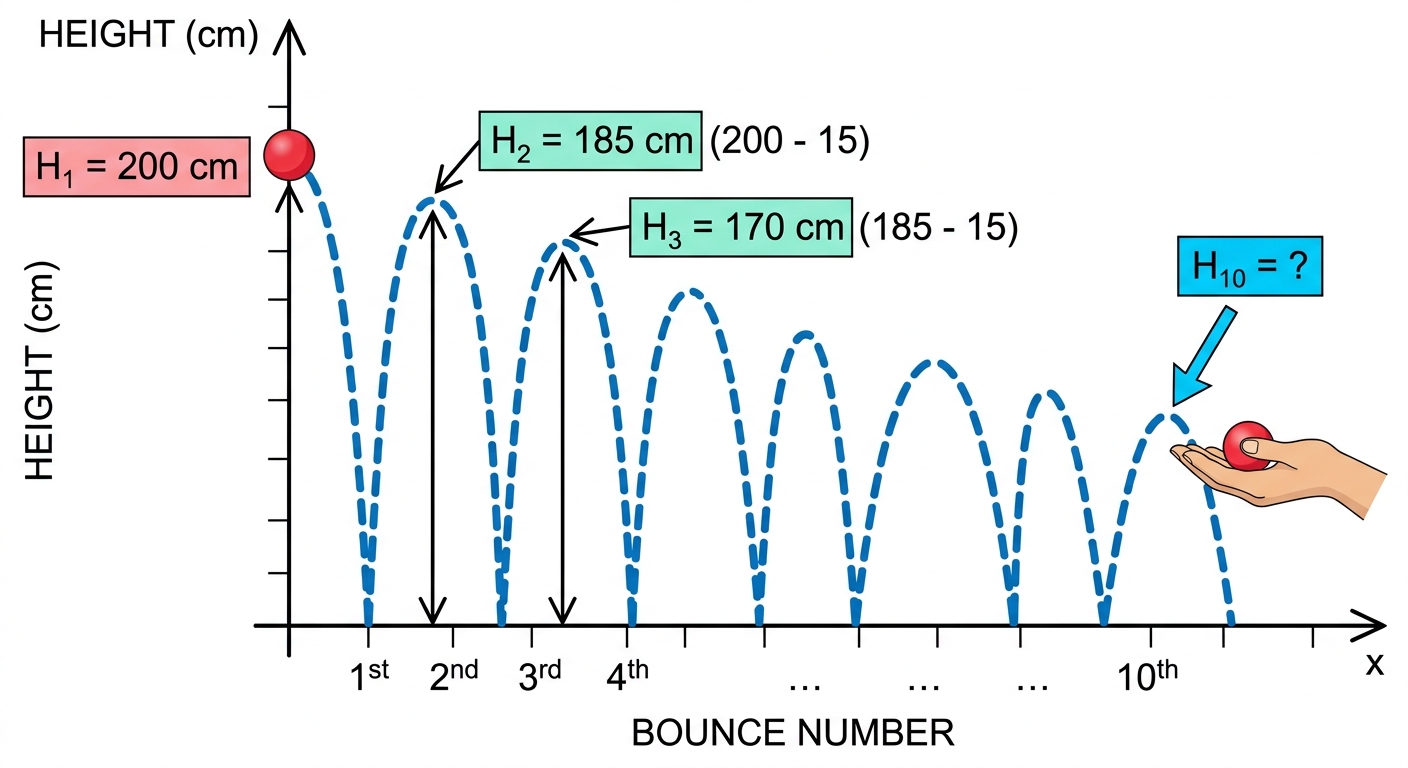
A ball is dropped from a height of . On each bounce, it rises to a height that is less than the previous height. The ball is caught after it rises on the 10th bounce.
(a)
Calculate the height the ball reaches on the 10th bounce. [2 marks]
(b)
Show that the total vertical distance travelled by the ball, from the moment is dropped until it is caught, is . [4 marks]
(c)
The ball is instead dropped from a height of , with all other conditions unchanged. Given that the ball must still complete 10 bounces before being caught (i.e. the height on the 10th bounce must be positive), determine the range of values of . [2 marks]
Solutions
Showing 20 of 75 free questions