Forces and Momentum · Paper 1 — Free Physics HL Practice Questions
Free questions
Open in full, with answers, mark scheme and examiner insights.
Newton's three laws of motion
A constant horizontal force of is applied to a trolley on a level, frictionless track. The mass of the trolley is changed and the acceleration is found with a motion sensor with an uncertainty of (Table 1).
Table 1
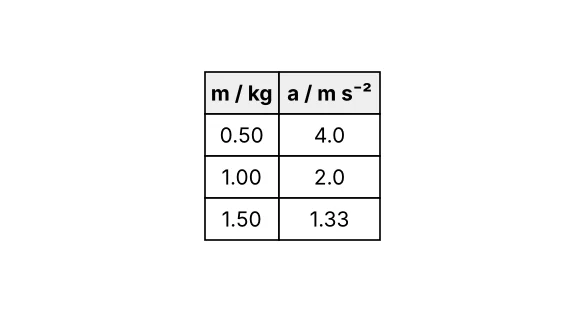
Calculate the product for each mass.
Determine the percentage uncertainty in the acceleration for .
Deduce what the results show about the relationship between and for a constant force.
revisionprep.com
Summary Answer
Not available for this question.
Model Answer
Not available for this question.
Marking Scheme
Not available for this question.
Examiner Insights
Not available for this question.
Free-body diagrams, resultant force and translational equilibrium
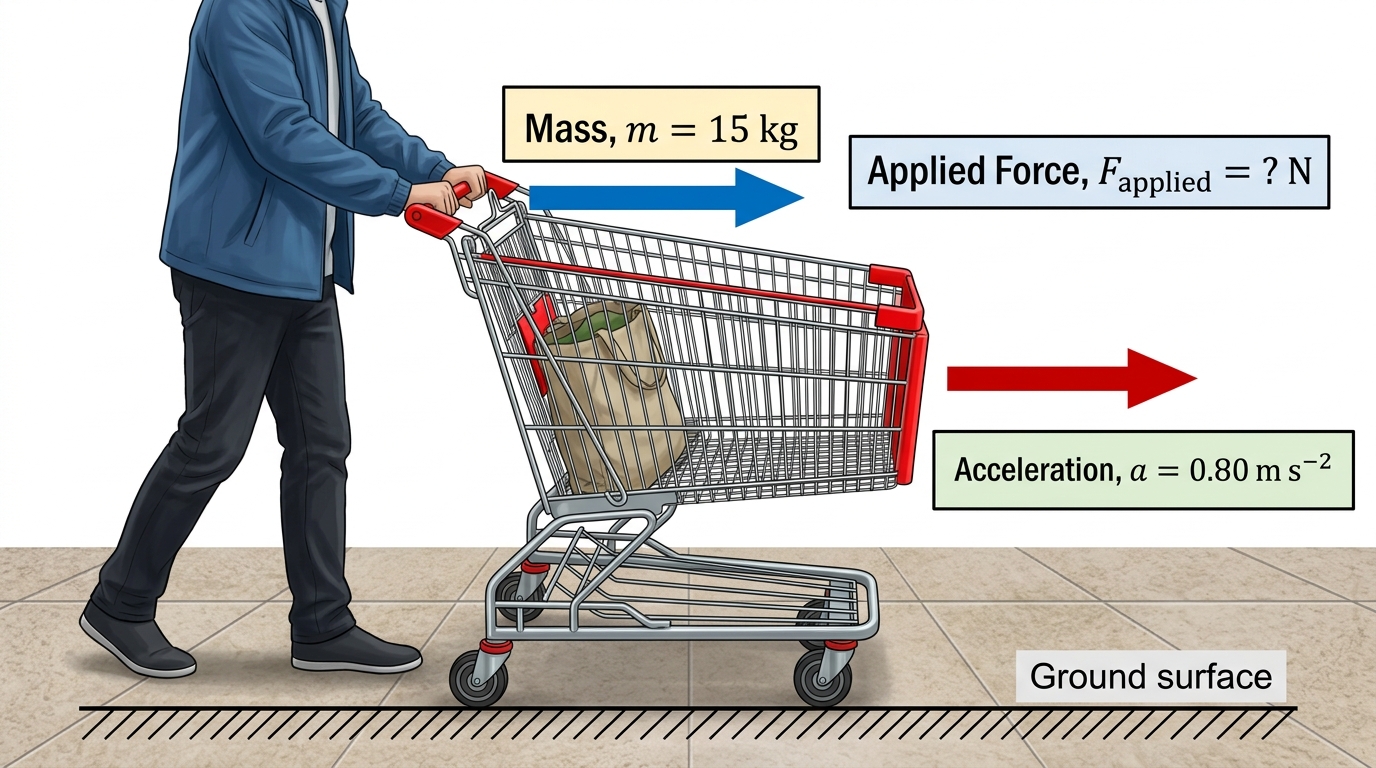
A shopping trolley of mass is pushed from rest along a horizontal surface by a single constant horizontal force. The trolley accelerates at . What is the magnitude of the net horizontal force acting on the trolley?
revisionprep.com
Summary Answer
Not available for this question.
Model Answer
Not available for this question.
Marking Scheme
Not available for this question.
Examiner Insights
Not available for this question.
Newton's three laws of motion
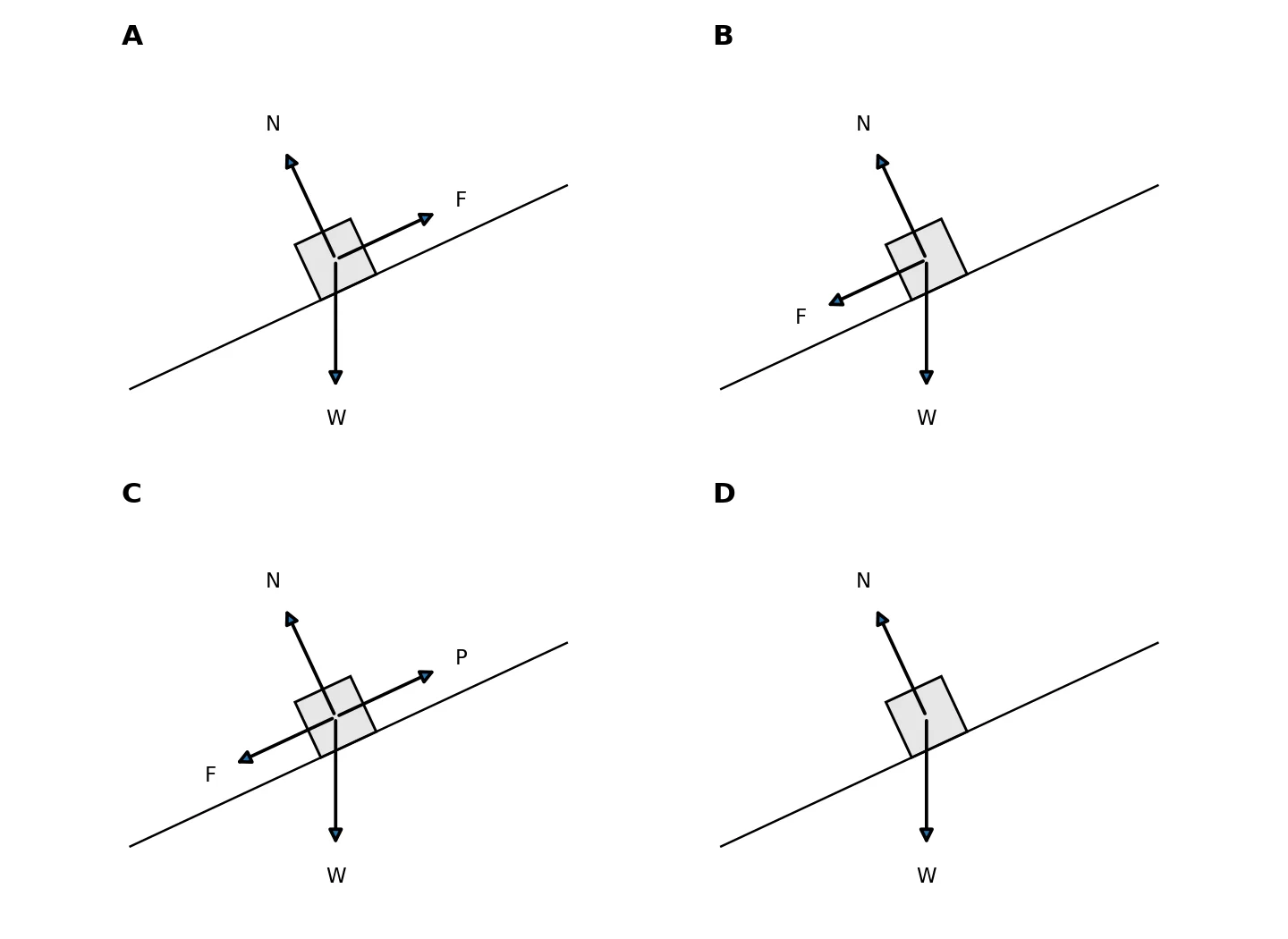
A tennis ball of mass is struck by a racket and leaves it horizontally at . The ball was at rest before contact, and the contact time is . What is the magnitude of the average force exerted by the racket on the ball?
revisionprep.com
Summary Answer
Not available for this question.
Model Answer
Not available for this question.
Marking Scheme
Not available for this question.
Examiner Insights
Not available for this question.
Free-body diagrams, resultant force and translational equilibrium
A trolley on a horizontal runway is pulled by a string attached to a force sensor, which measures the constant resultant pulling force along the string. The acceleration of the trolley is found from light gates. The uncertainty in each force is and the uncertainty in each acceleration is . The results are plotted in Figure 1.
Figure 1
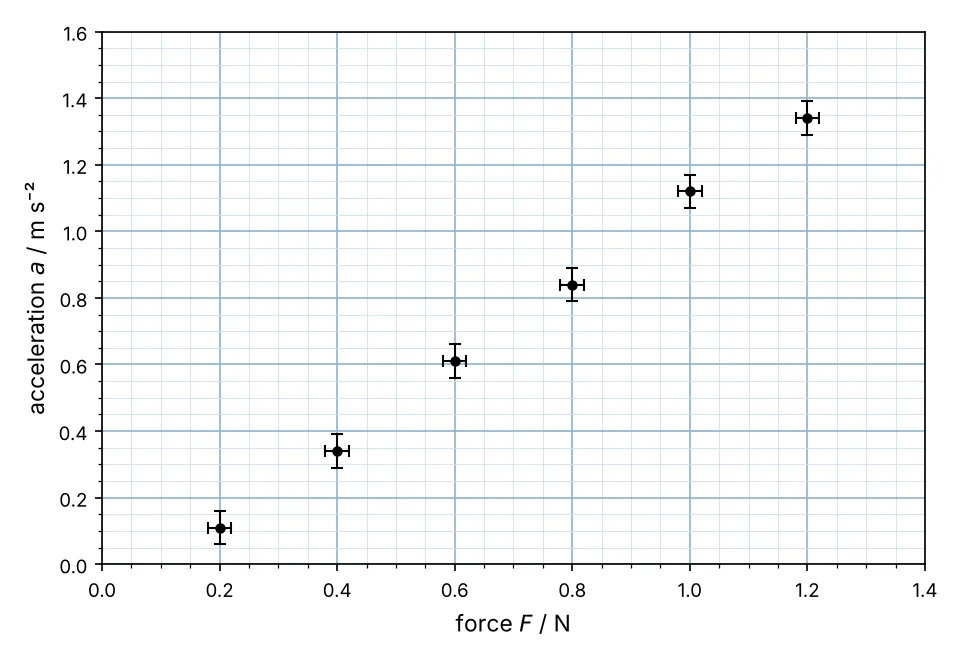
Draw a line of best fit and determine its gradient with its absolute uncertainty from the steepest and shallowest lines.
Determine the mass of the trolley with its absolute uncertainty.
Determine the force at which the line crosses the -axis.
Explain why the line does not pass through the origin, and suggest one change to the runway that would remove this effect.
revisionprep.com
Summary Answer
Not available for this question.
Model Answer
Not available for this question.
Marking Scheme
Not available for this question.
Examiner Insights
Not available for this question.
Newton's three laws of motion
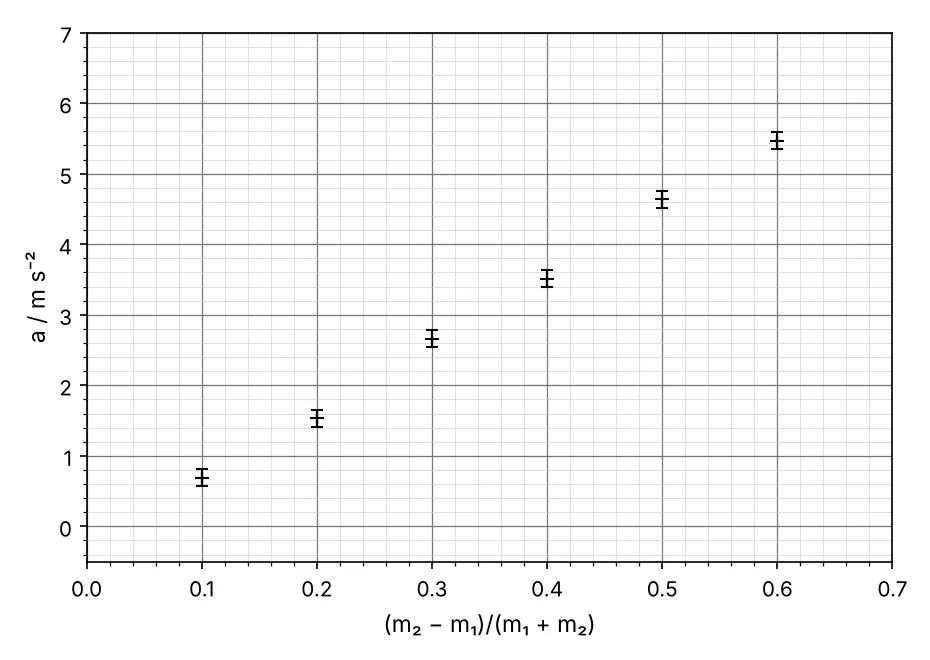
Two masses and () hang from a light string over a pulley with a small constant frictional torque that is equivalent to a constant retarding force. The acceleration of the masses is found from a motion sensor for six pairs of masses with kept constant. The uncertainty in each acceleration is and the uncertainty in the mass ratio is negligible. Figure 1 shows plotted against .
Figure 1
Derive the following result: with no friction, .
Draw a line of best fit on Figure 1 and determine its gradient. Include the absolute uncertainty in the gradient, found from the steepest and shallowest lines that pass through all of the error bars.
Determine the value of given by the gradient.
Use the vertical intercept of the line of best fit to determine the retardation produced by the friction in the pulley.
Evaluate whether the gradient supports the accepted value of taking the uncertainty into account.
revisionprep.com
Summary Answer
Not available for this question.
Model Answer
Not available for this question.
Marking Scheme
Not available for this question.
Examiner Insights
Not available for this question.
Viscous drag (Stokes' law), buoyancy and Hooke's law
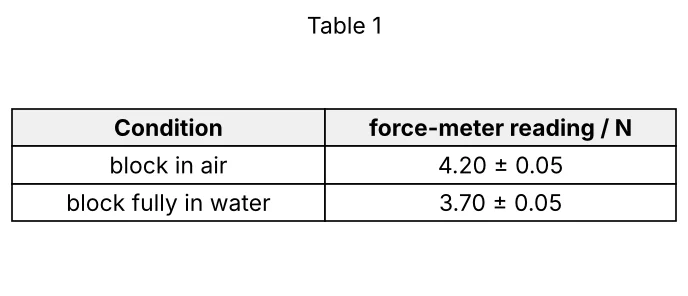
A student hangs a metal block from a force meter and records its reading in air and when it is completely submerged in water of density (Table 1). The upthrust found from Table 1 is . Take . What is the volume of the block, with its absolute uncertainty?
revisionprep.com
Summary Answer
Not available for this question.
Model Answer
Not available for this question.
Marking Scheme
Not available for this question.
Examiner Insights
Not available for this question.
That's every free question here — 6 of 257.
+251 more questions, plus Mock Papers & Worksheets, are waiting in Premium.