Rigid Body Mechanics · Paper 1 — Free Physics HL Practice Questions
Free questions
Open in full, with answers, mark scheme and examiner insights.
Torque, couples and rotational equilibrium
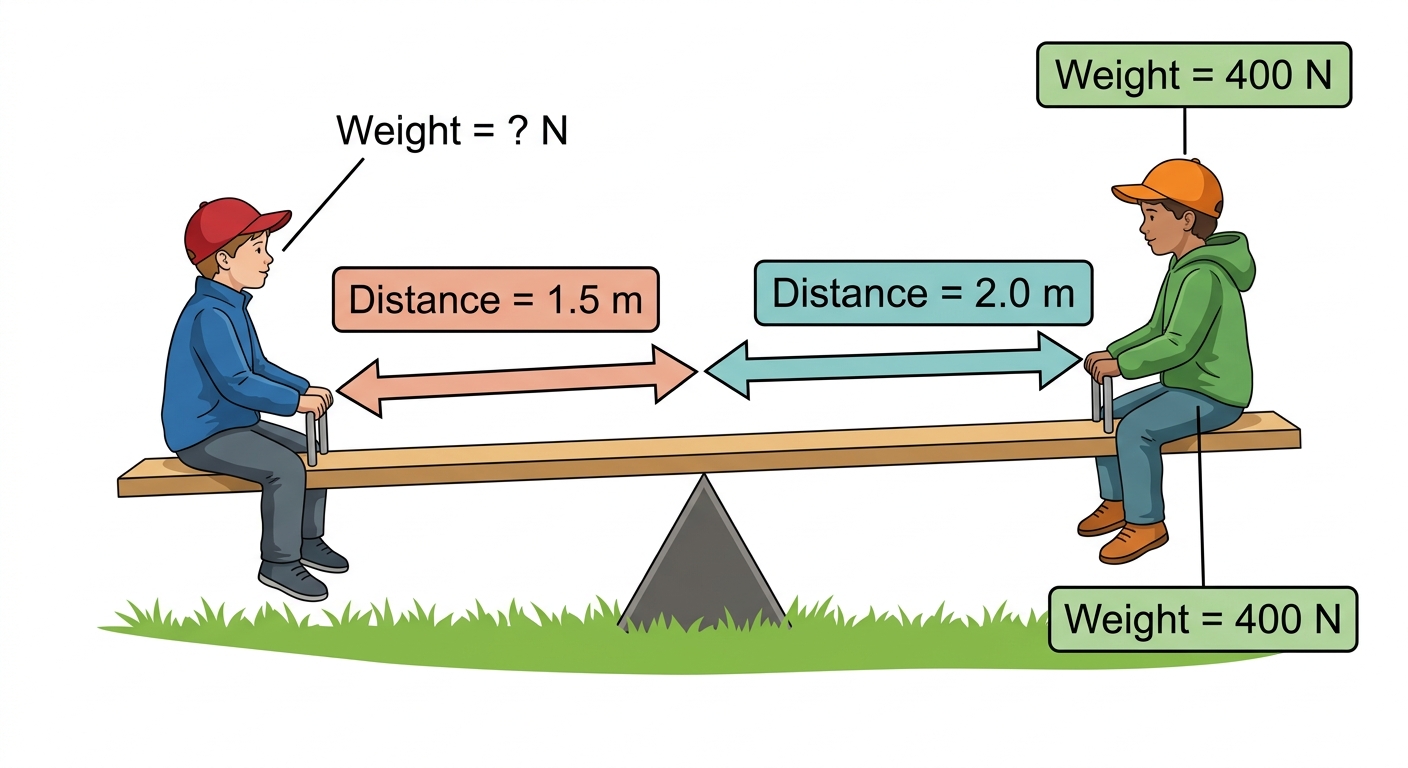
A child of unknown weight sits on a seesaw at a distance of from the pivot. A second child of weight sits on the opposite side at from the pivot. The seesaw is in rotational equilibrium. What is the weight of the first child?
revisionprep.com
Summary Answer
Not available for this question.
Model Answer
Not available for this question.
Marking Scheme
Not available for this question.
Examiner Insights
Not available for this question.
Rotational kinematics: angular displacement, velocity and acceleration
A drill chuck rotates at 300 revolutions per minute. What is its angular velocity?
revisionprep.com
Summary Answer
Not available for this question.
Model Answer
Not available for this question.
Marking Scheme
Not available for this question.
Examiner Insights
Not available for this question.
Rotational kinematics: angular displacement, velocity and acceleration
A tilted turntable carries an accelerometer fixed at distance from the axis. The turntable is driven at a constant angular velocity for each measurement, so its angular acceleration is zero, and the accelerometer reads the centripetal acceleration . Figure 1 shows against . Error bars show the absolute uncertainty in ; the uncertainty in is negligible.
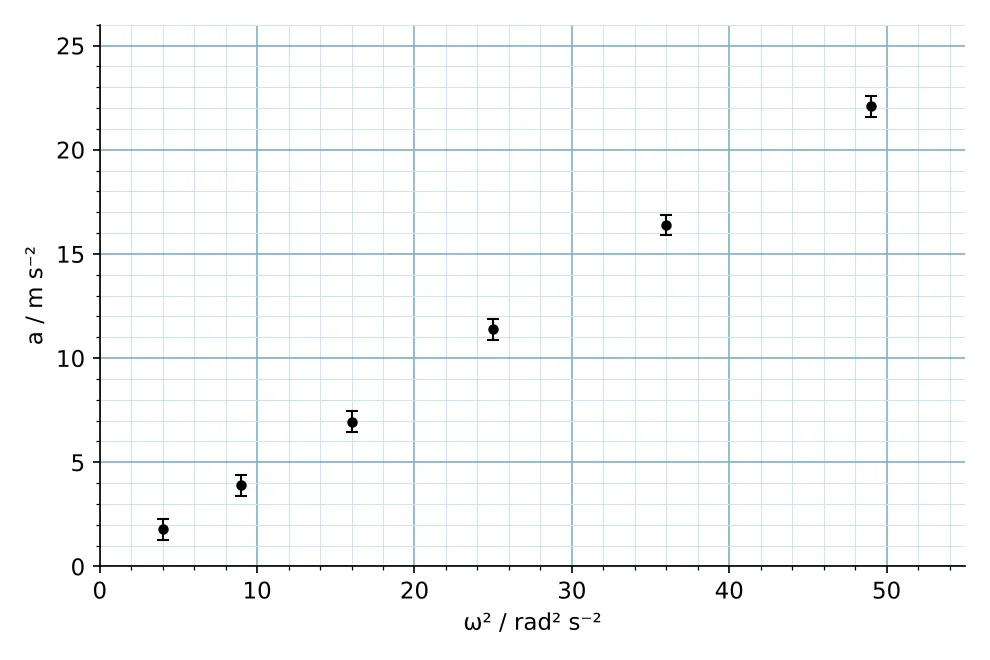
State the absolute uncertainty in at = 25 rad² s⁻², as shown by the error bar.
Determine the gradient of the line of best fit for the data in Figure 1. Include the absolute uncertainty in the gradient.
Use the gradient to determine the distance of the accelerometer from the axis. Hence determine the speed of the accelerometer at .
The accelerometer is accidentally fixed slightly closer to the axis for the last two readings. Describe the effect on the line of best fit and suggest how the student could detect the mistake from the data.
revisionprep.com
Summary Answer
Not available for this question.
Model Answer
Not available for this question.
Marking Scheme
Not available for this question.
Examiner Insights
Not available for this question.
Moment of inertia and Newton's second law for rotation (τ = Iα)
A uniform beam of length 1.20 m is hinged at a wall. A vertical force meter supports the free end so that the beam stays horizontal. A load of fixed mass is hung at distance from the hinge and the force meter reading is recorded. Figure 1 shows the data. Error bars show the absolute uncertainty in ; the uncertainty in is negligible.
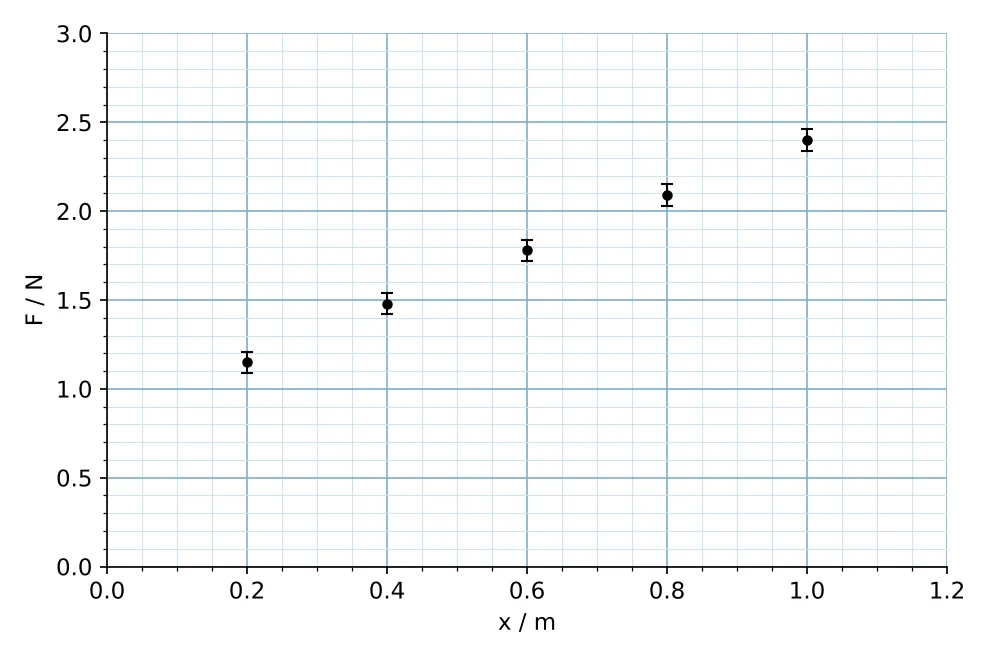
Calculate the percentage uncertainty in for the data point at = 0.60 m.
Determine the gradient of the line of best fit for the data in Figure 1. Include the absolute uncertainty in the gradient.
In rotational equilibrium, moments about the hinge give , where is the length of the beam and its weight. Use the gradient to determine the mass of the load. Take .
Explain the physical meaning of the non-zero vertical intercept of the line of best fit and use it to estimate the weight of the beam.
revisionprep.com
Summary Answer
Not available for this question.
Model Answer
Not available for this question.
Marking Scheme
Not available for this question.
Examiner Insights
Not available for this question.
Torque, couples and rotational equilibrium
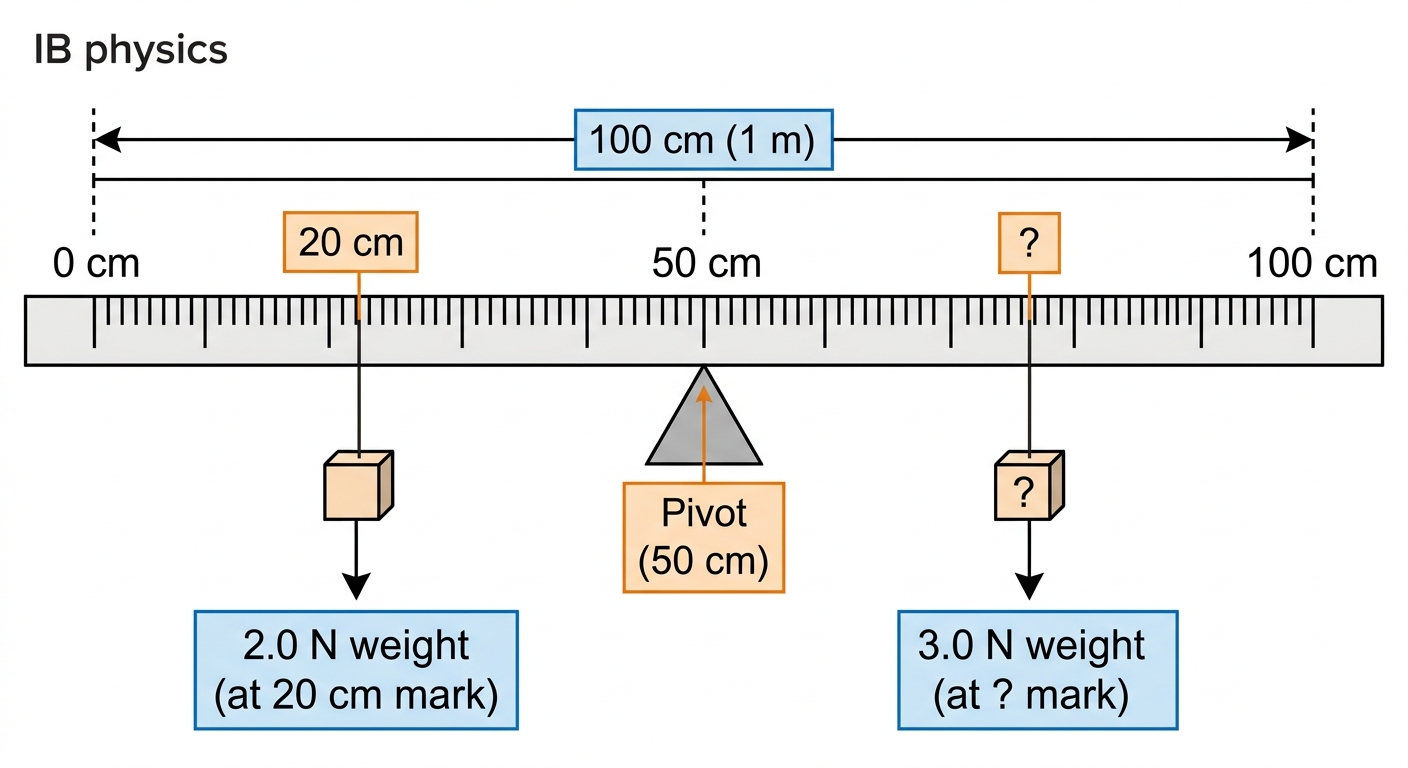
A uniform metre ruler is pivoted at its centre. A weight hangs at the mark. A weight is placed on the opposite side of the pivot to restore rotational equilibrium. At which mark on the ruler must the weight be placed?
revisionprep.com
Summary Answer
Not available for this question.
Model Answer
Not available for this question.
Marking Scheme
Not available for this question.
Examiner Insights
Not available for this question.
Rotational kinematics: angular displacement, velocity and acceleration
A tangential accelerometer on a rotating arm measures the tangential acceleration of a point at distance from the axis while the arm speeds up with constant angular acceleration. Figure 1 shows against . Error bars show the absolute uncertainty in ; the uncertainty in is negligible.
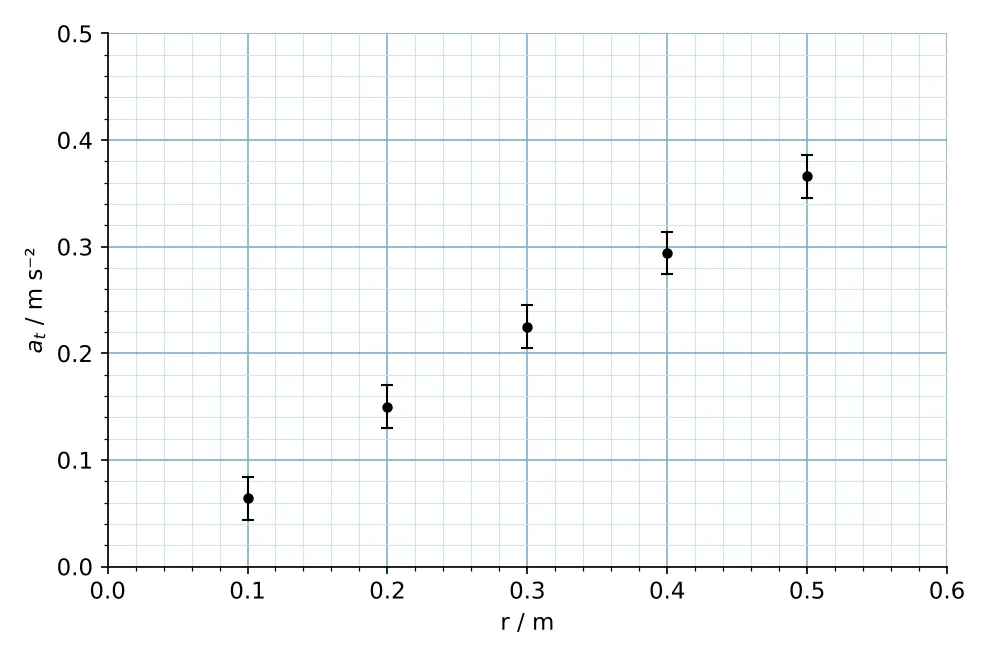
Calculate the percentage uncertainty in for the data point at = 0.30 m.
Determine the gradient of the line of best fit for the data in Figure 1. Include the absolute uncertainty in the gradient.
Use the gradient to determine the angular acceleration of the arm, and the angular velocity reached after starting from rest.
Evaluate whether the accelerometer would also detect the centripetal acceleration and explain how this could cause a systematic error in if the sensor axis is not exactly tangential.
revisionprep.com
Summary Answer
Not available for this question.
Model Answer
Not available for this question.
Marking Scheme
Not available for this question.
Examiner Insights
Not available for this question.
That's every free question here — 6 of 195.
+189 more questions, plus Mock Papers & Worksheets, are waiting in Premium.