Work, Energy, and Power · Paper 1 — Free Physics HL Practice Questions
Free questions
Open in full, with answers, mark scheme and examiner insights.
Work done by a force and the work–energy principle
A student stretches a spring with a force meter and records the force for each extension . The spring obeys Hooke's law within the range shown. Figure 1 shows the results. Each force has an uncertainty of .
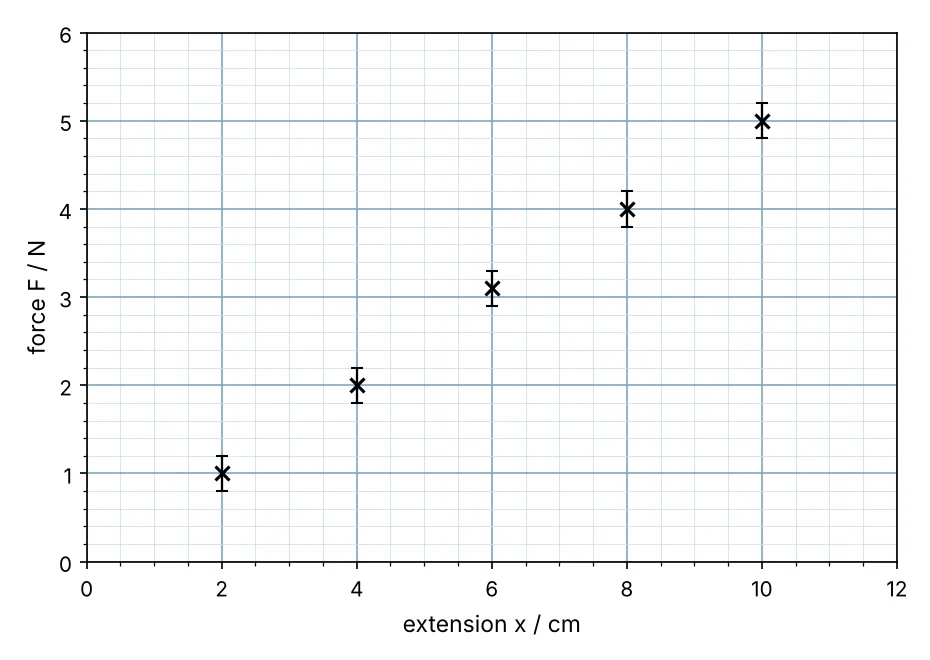
State what the area under a graph of force against extension represents.
Determine the work done in stretching the spring to an extension of .
Suggest one way to reduce the effect of random error on the work calculated in (b).
revisionprep.com
Summary Answer
Not available for this question.
Model Answer
Not available for this question.
Marking Scheme
Not available for this question.
Examiner Insights
Not available for this question.
Kinetic, gravitational potential and elastic potential energy
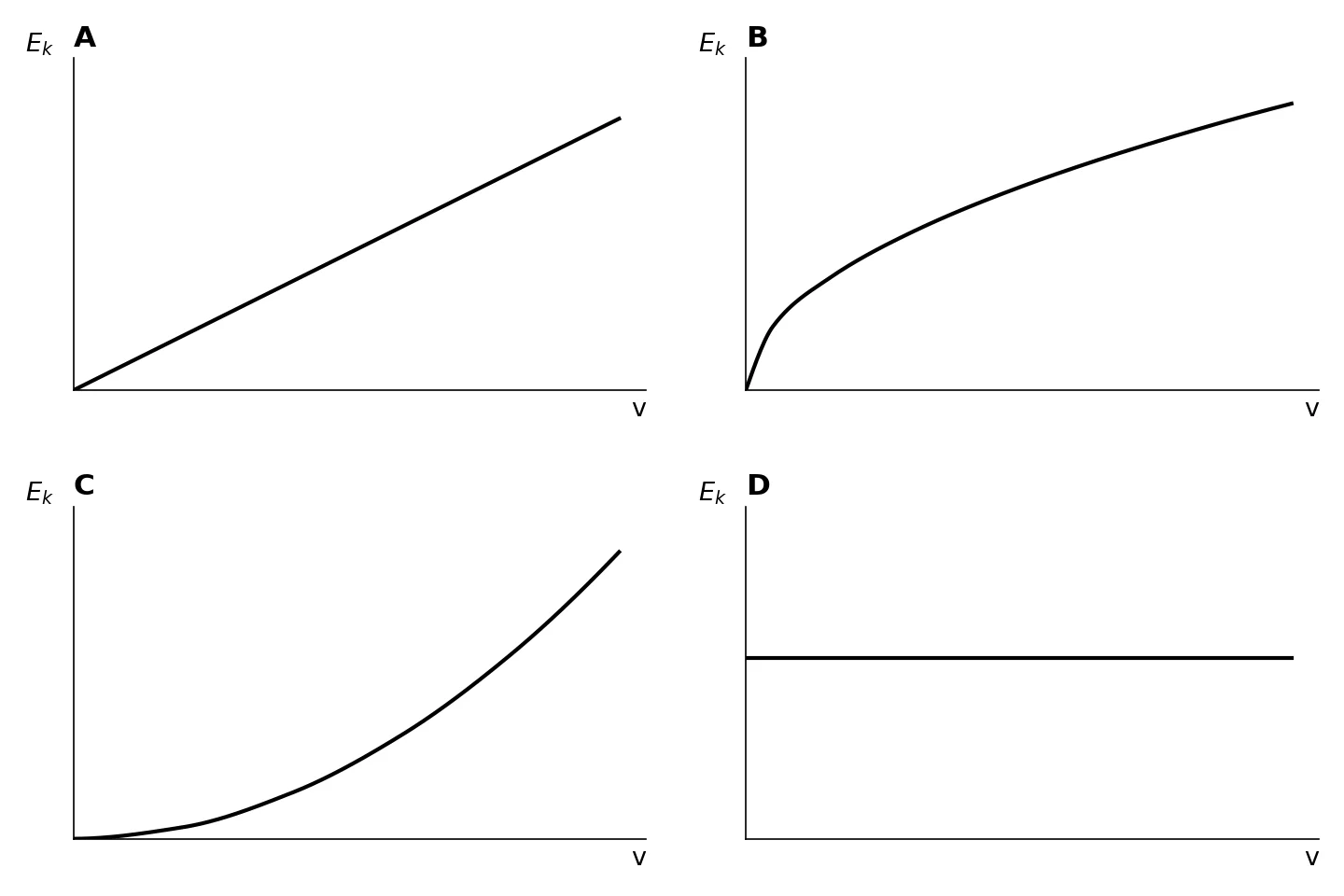
Which graph shows how the kinetic energy of an object of constant mass varies with its speed ?
revisionprep.com
Summary Answer
Not available for this question.
Model Answer
Not available for this question.
Marking Scheme
Not available for this question.
Examiner Insights
Not available for this question.
Work done by a force and the work–energy principle
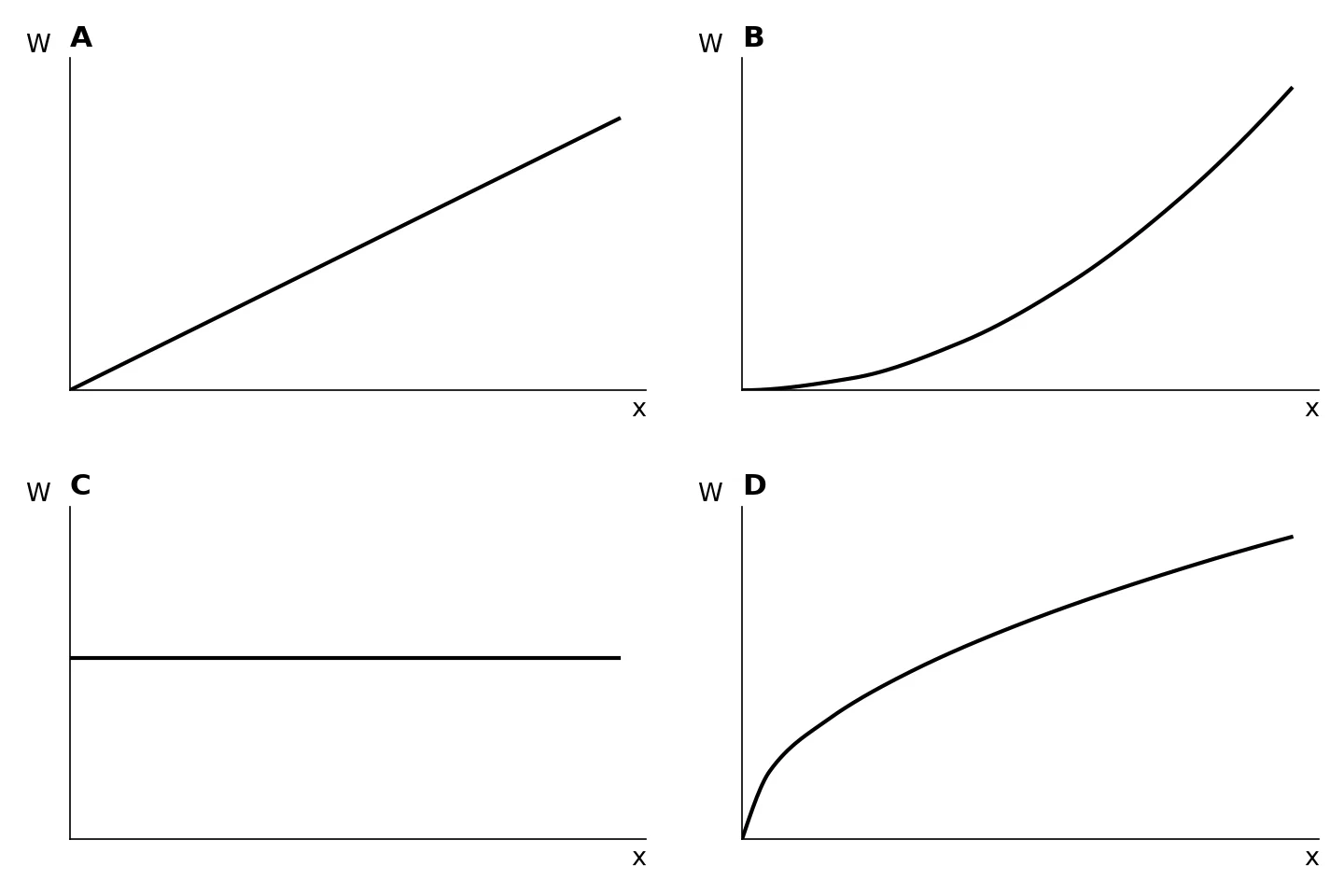
A spring that obeys Hooke's law is stretched from its natural length. Which graph shows how the work done in stretching the spring varies with the extension ?
revisionprep.com
Summary Answer
Not available for this question.
Model Answer
Not available for this question.
Marking Scheme
Not available for this question.
Examiner Insights
Not available for this question.
Kinetic, gravitational potential and elastic potential energy
A trolley of mass is released from rest at different heights on a smooth track. A light gate at the bottom measures the speed of the trolley, from which its kinetic energy is calculated. Figure 1 shows against . The uncertainty in each value of is . Take .
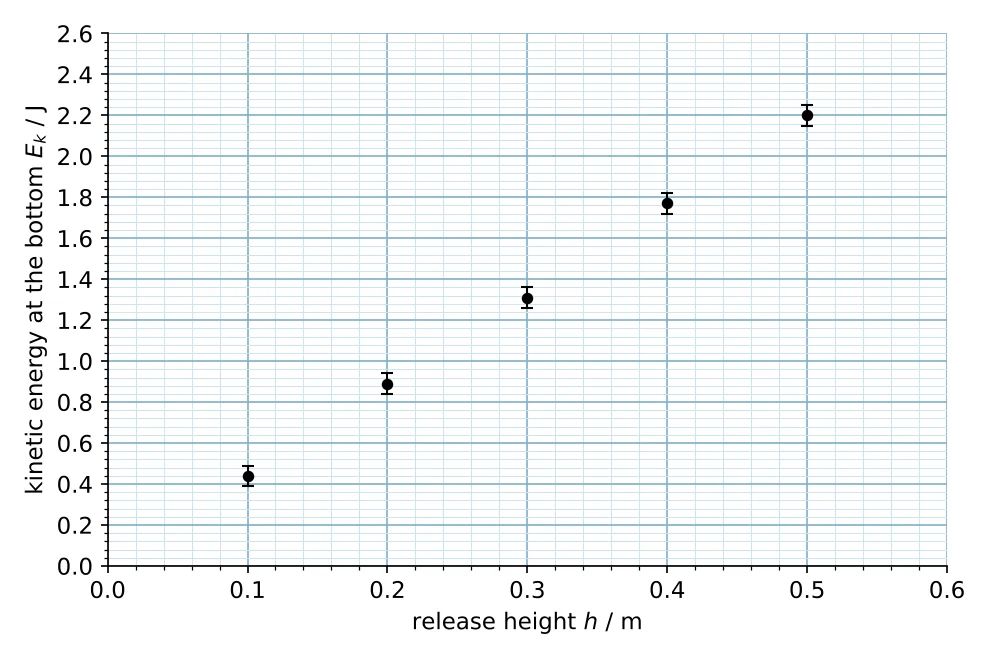
State the relationship between and that is expected if no energy is dissipated.
Determine the gradient of the line of best fit, using the first and last points.
Determine the fraction of the gravitational potential energy lost that is transferred to kinetic energy.
Use the error bars to estimate the absolute uncertainty in the gradient.
Evaluate whether the data are consistent with no energy being dissipated.
Suggest one way to reduce the dissipation of energy, with a reason.
revisionprep.com
Summary Answer
Not available for this question.
Model Answer
Not available for this question.
Marking Scheme
Not available for this question.
Examiner Insights
Not available for this question.
Work done by a force and the work–energy principle
A student measures the force needed to stretch a rubber band by an extension . Figure 1 shows the results, joined by straight lines. The uncertainty in each force reading is .
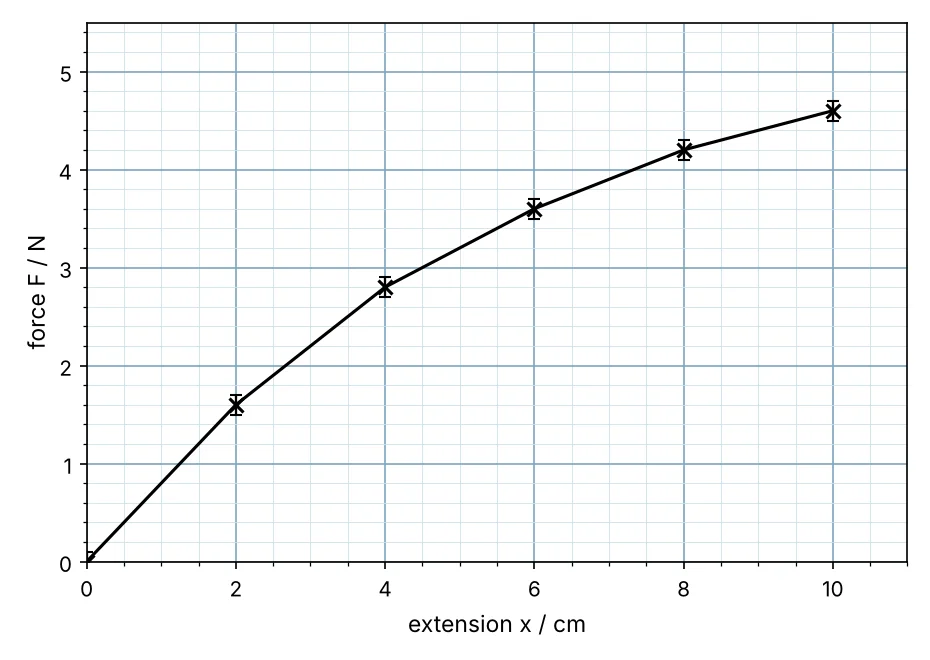
Explain why the work done in stretching the band to is not equal to .
Estimate the work done in stretching the band from to .
The stretched band launches a pellet of mass horizontally. Only of the work done in (b) becomes kinetic energy of the pellet. Determine the launch speed.
Suggest one reason why not all the stored energy is transferred to the pellet.
State one way of reducing the uncertainty in the estimate in (b).
revisionprep.com
Summary Answer
Not available for this question.
Model Answer
Not available for this question.
Marking Scheme
Not available for this question.
Examiner Insights
Not available for this question.
Kinetic, gravitational potential and elastic potential energy
A student compresses a spring by a distance and uses it to launch a trolley of mass along a level track. A light gate measures the launch speed for each compression. Figure 1 shows the results, with uncertainties of in .
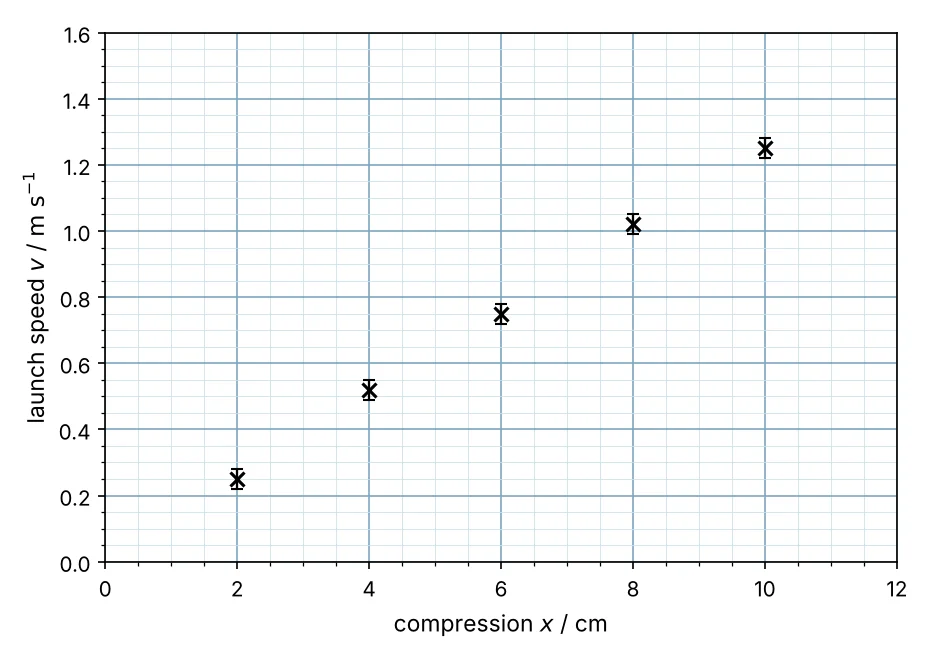
Deduce that, if no energy is dissipated, , where is the spring constant.
Use the data for to calculate .
Determine the gradient of the graph, using the first and last points, and hence determine .
Suggest why the value of from (c) is more reliable than the value from (b).
Estimate the absolute uncertainty in the gradient and hence the percentage uncertainty in .
Evaluate whether the data show that energy is dissipated while the trolley is launched.
revisionprep.com
Summary Answer
Not available for this question.
Model Answer
Not available for this question.
Marking Scheme
Not available for this question.
Examiner Insights
Not available for this question.
That's every free question here — 6 of 185.
+179 more questions, plus Mock Papers & Worksheets, are waiting in Premium.