Forces and Momentum · Paper 2 — Free Physics HL Practice Questions
Free questions
Open in full, with answers, mark scheme and examiner insights.
Newton's three laws of motion
Two blocks, A and B, are placed in contact on a smooth horizontal surface. Block A has mass 2.0 kg and block B has mass 3.0 kg. A horizontal force of 15 N is applied to block A directed toward block B, causing both blocks to accelerate to the right.
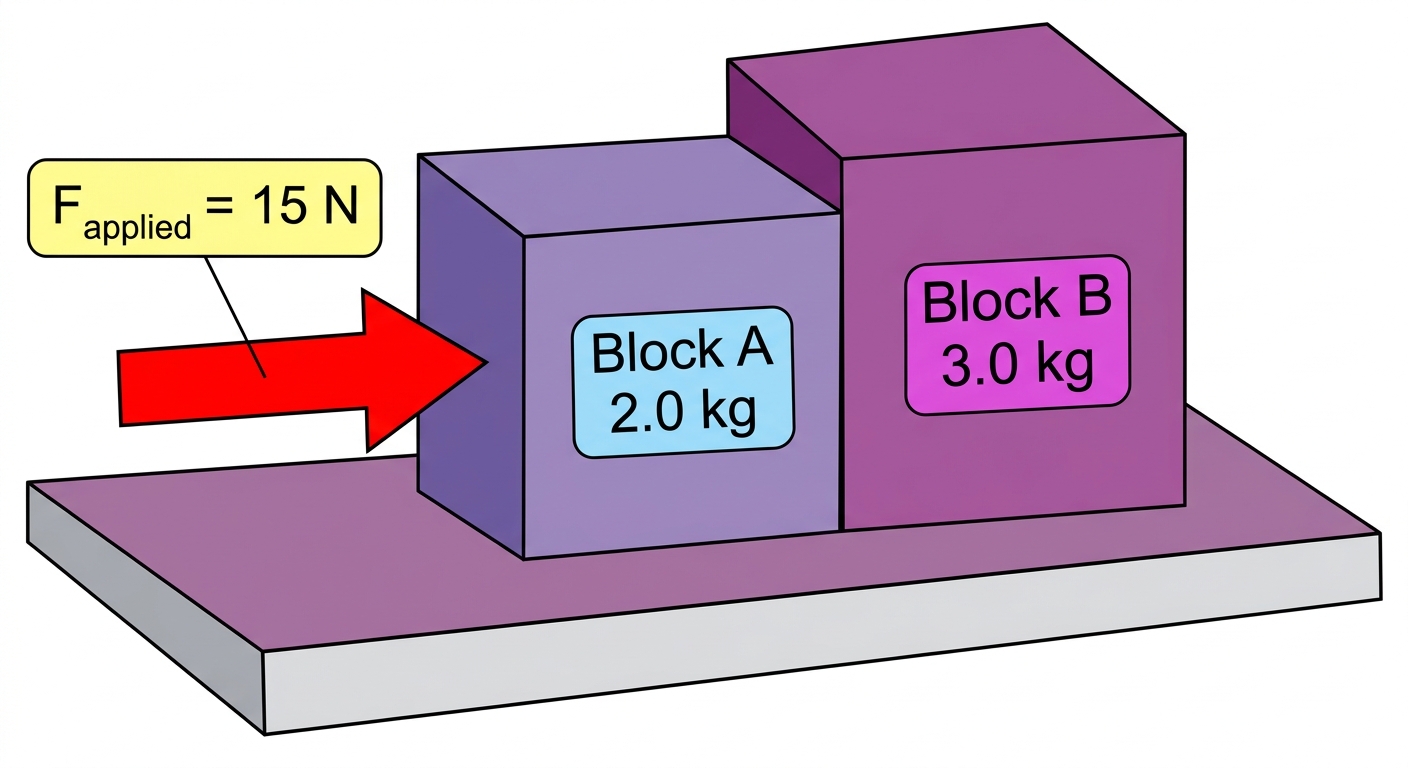
State Newton's third law of motion.
Calculate the acceleration of the two-block system.
Determine the magnitude of the contact force that block A exerts on block B.
Explain why the contact force on block B is less than 15 N.
revisionprep.com
Summary Answer
Not available for this question.
Model Answer
Not available for this question.
Marking Scheme
Not available for this question.
Examiner Insights
Not available for this question.
Viscous drag (Stokes' law), buoyancy and Hooke's law
A research submarine has a volume of and, with its crew, a mass of when the ballast tanks are empty. It is fully submerged in sea water of density . Take .
Calculate the upthrust on the submarine.
Determine the resultant force on the submarine and state its direction.
Calculate the mass of water that must be admitted to the ballast tanks for the submarine to hover at constant depth.
Explain why the submarine sinks if more water than this is taken in.
revisionprep.com
Summary Answer
Not available for this question.
Model Answer
Not available for this question.
Marking Scheme
Not available for this question.
Examiner Insights
Not available for this question.
Free-body diagrams, resultant force and translational equilibrium
A velocity-time graph for a 3.0 kg object moving in a straight line consists of a straight line from to and then a horizontal line from to , where velocity is in and time is in s.
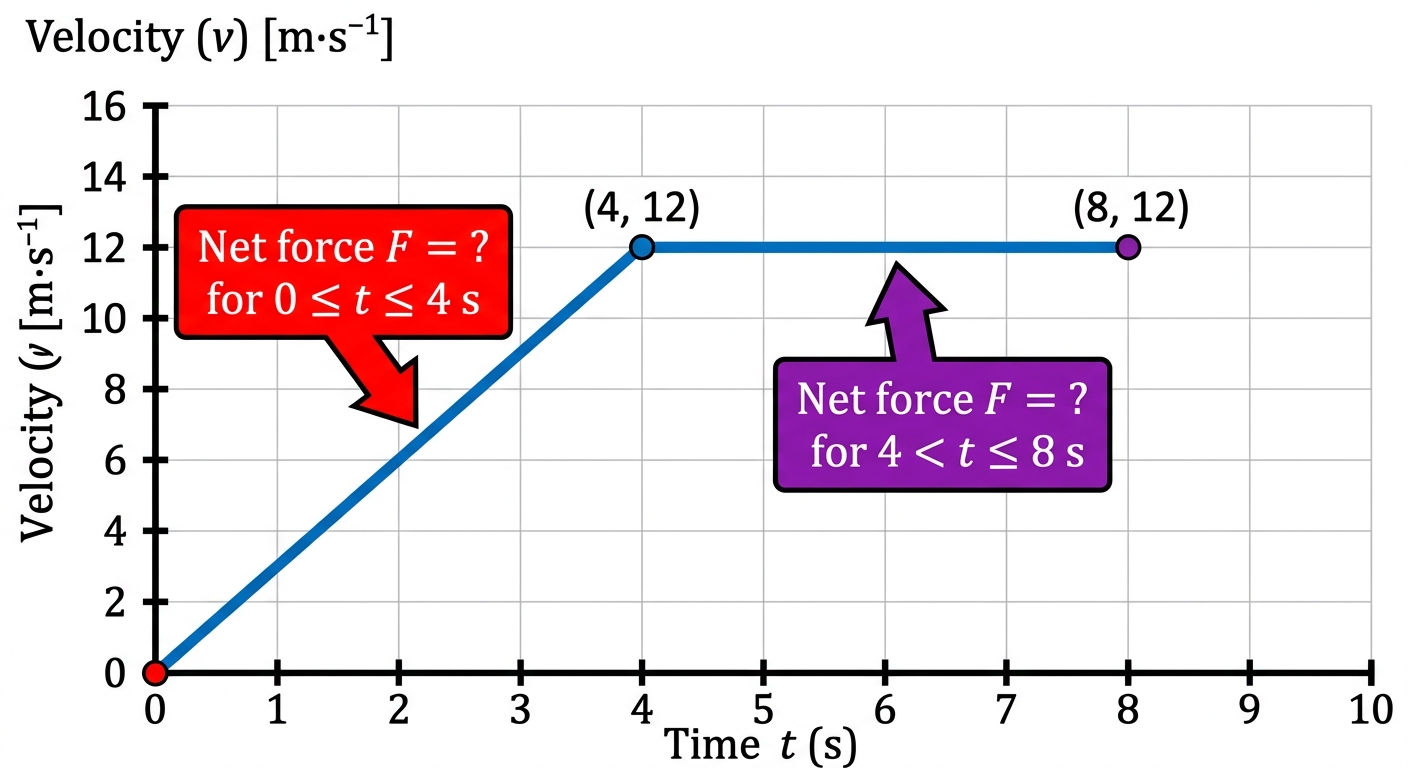
Determine the net force acting on the object during the first 4 seconds.
Calculate the impulse delivered to the object between and s.
The object then decelerates uniformly to rest over a further 6 seconds. Deduce whether the magnitude of the net force during this deceleration phase is greater than, equal to, or less than the net force found in (a).
Determine the average net force acting on the object during the first and explain why it differs from the net force found in (a).
revisionprep.com
Summary Answer
Not available for this question.
Model Answer
Not available for this question.
Marking Scheme
Not available for this question.
Examiner Insights
Not available for this question.
Linear momentum, impulse and F = Δp/Δt
A 0.50 kg block slides on a frictionless horizontal surface at . It collides head-on with a stationary 0.30 kg block. After the collision, the 0.50 kg block continues in its original direction at .
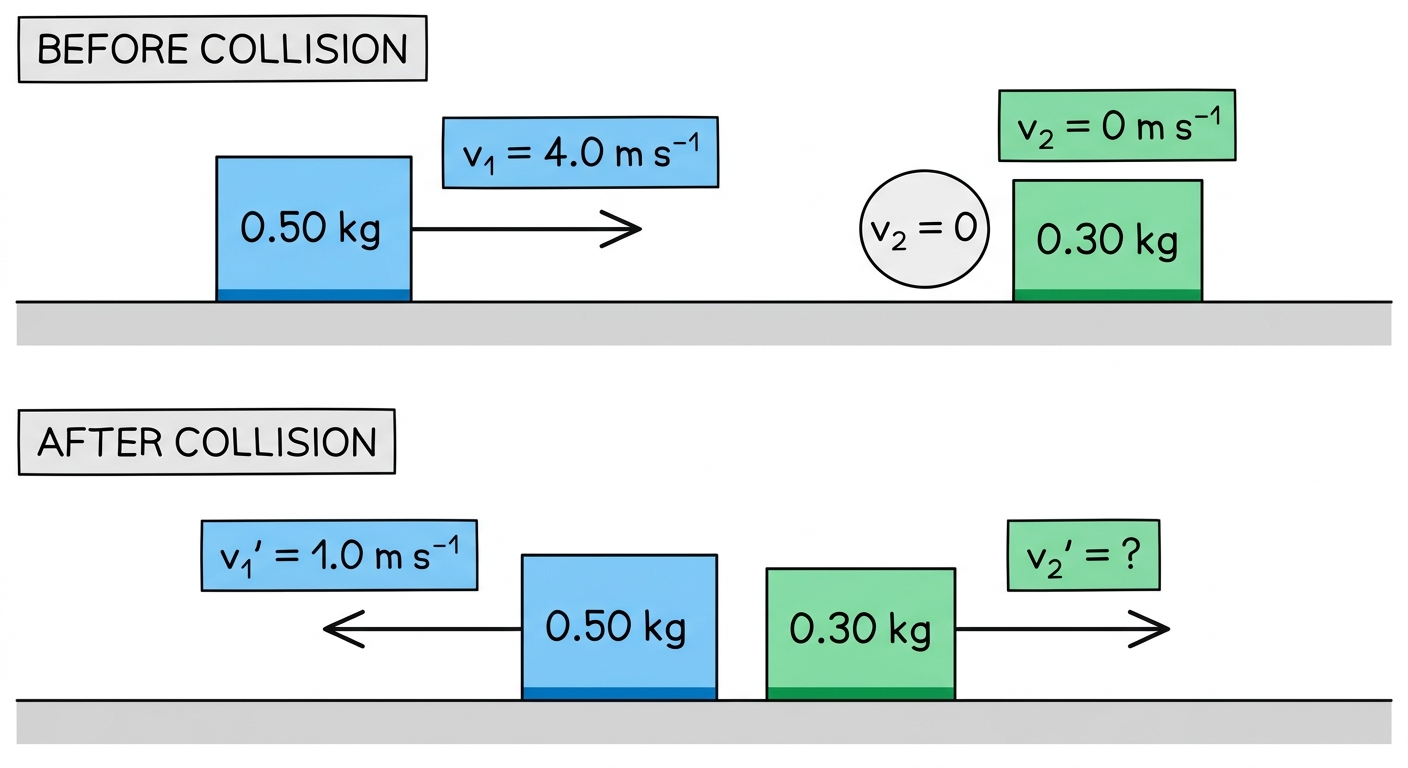
Determine the velocity of the 0.30 kg block immediately after the collision.
Show, using kinetic energy calculations, that the collision is inelastic.
Evaluate whether the assumption of a frictionless surface is necessary for momentum conservation to hold during the collision.
The collision lasts . Calculate the magnitude of the average force that the block exerts on the block and state the magnitude of the average force that the block exerts on the block.
revisionprep.com
Summary Answer
Not available for this question.
Model Answer
Not available for this question.
Marking Scheme
Not available for this question.
Examiner Insights
Not available for this question.
Contact forces: normal force, tension and friction (static and dynamic)
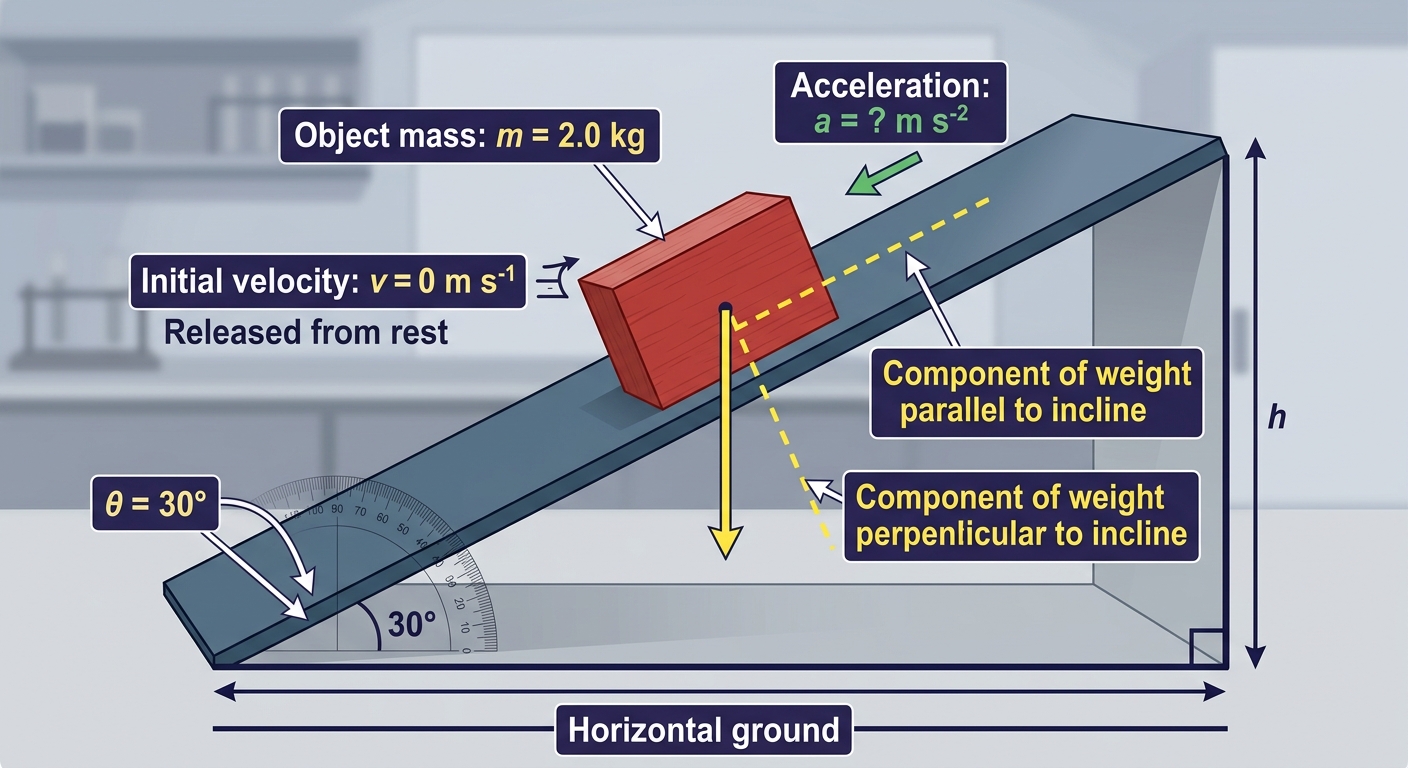
A 2.0 kg object is placed on a frictionless inclined plane that makes an angle of 30° with the horizontal. The object is released from rest.
revisionprep.com
Summary Answer
Not available for this question.
Model Answer
Not available for this question.
Marking Scheme
Not available for this question.
Examiner Insights
Not available for this question.
Conservation of linear momentum
In a goods yard, truck A of mass rolls at along a straight, level track towards truck B of mass , which is at rest. The two trucks couple together. The coupled trucks then collide with truck C of mass , which is also at rest, and all three trucks couple together. Friction and air resistance are negligible.
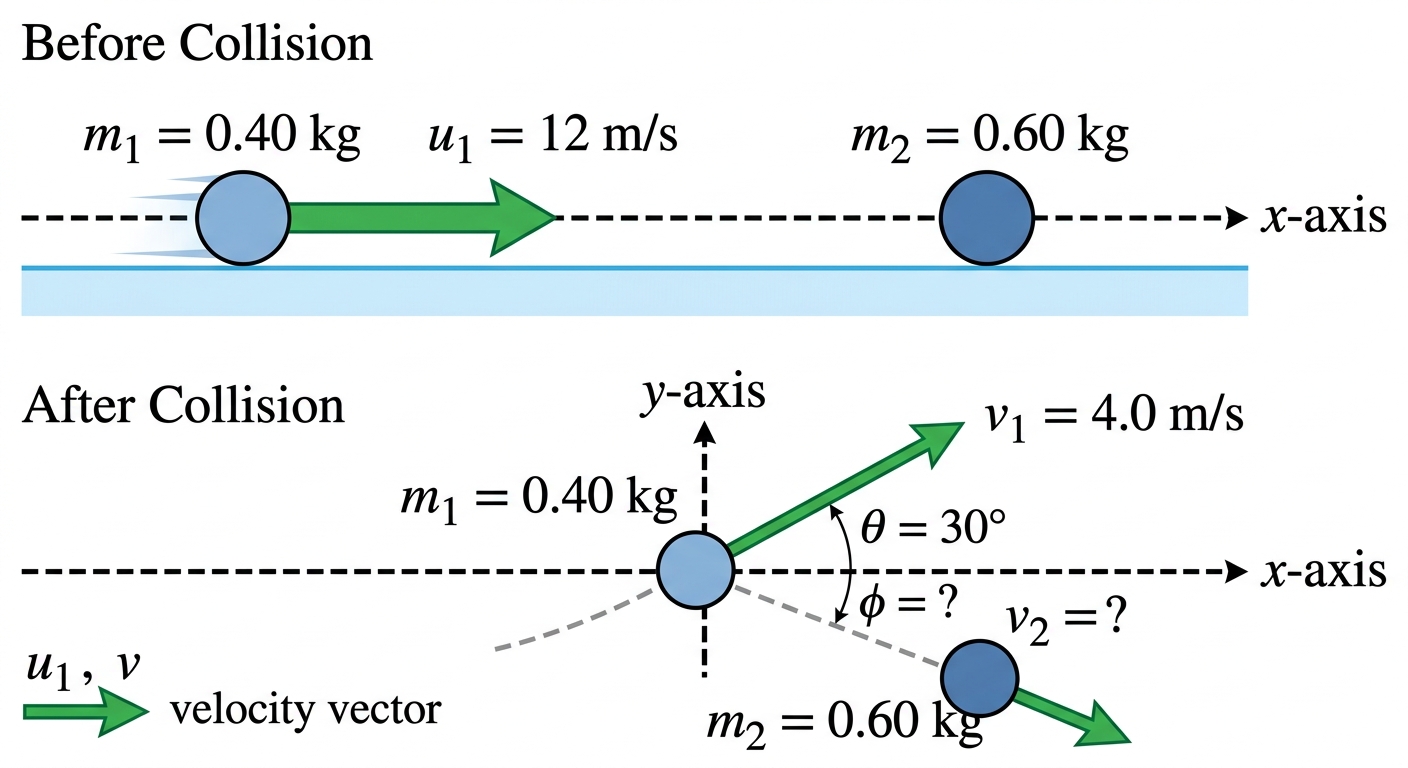
Determine the speed of trucks A and B immediately after they couple.
Determine the speed of all three trucks immediately after the second coupling.
Calculate the total kinetic energy lost in the two couplings.
The second coupling lasts . Determine the average force exerted on truck C during the coupling.
Evaluate the claim that the final speed of the three trucks and the total kinetic energy lost would be the same if trucks A and C had coupled first and truck B had been added second.
revisionprep.com
Summary Answer
Not available for this question.
Model Answer
Not available for this question.
Marking Scheme
Not available for this question.
Examiner Insights
Not available for this question.
That's every free question here — 6 of 290.
+284 more questions, plus Mock Papers & Worksheets, are waiting in Premium.