Galilean and Special Relativity · Paper 2 — Free Physics HL Practice Questions
Free questions
Open in full, with answers, mark scheme and examiner insights.
Reference frames and Galilean transformation
A trolley runs along a straight laboratory track. Frame is an inertial frame moving at in the direction relative to inertial frame ; the origins coincide at . In , event 1 is at , and event 2 is at , . Use Galilean transformations.
Calculate the coordinate of event 1 in .
Calculate the distance between the two events in .
A particle moves at in the direction in . Determine its velocity in .
revisionprep.com
Summary Answer
Not available for this question.
Model Answer
Not available for this question.
Marking Scheme
Not available for this question.
Examiner Insights
Not available for this question.
Spacetime diagrams, simultaneity and the invariant spacetime interval
Figure 1 shows the spacetime diagram of inertial frame with event A at the origin, event B and the dashed light lines. Two buoys detect a passing probe. In inertial frame event A is at the origin (, ) and event B has and . Frame moves at in the direction relative to and the origins coincide at .
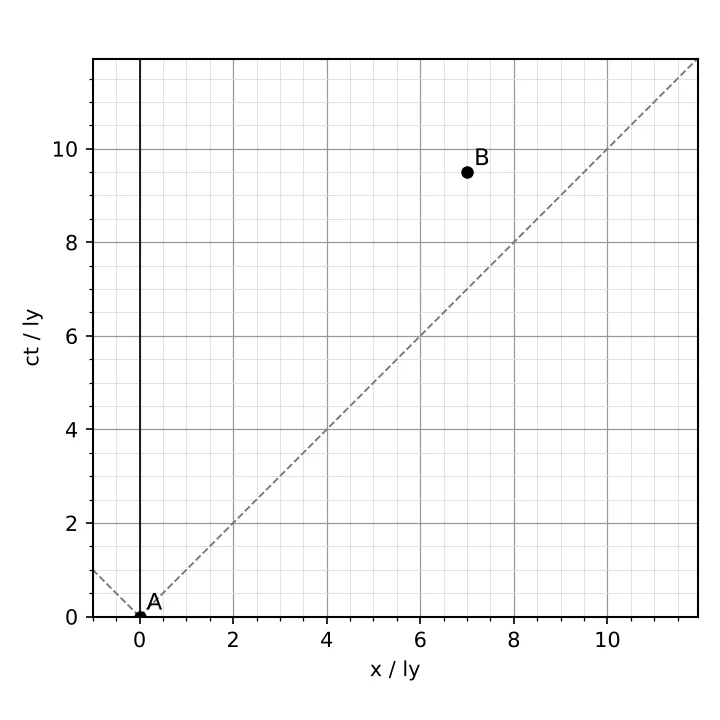
Calculate the Lorentz factor for frame .
Calculate the coordinate of event B in using the Lorentz transformation .
revisionprep.com
Summary Answer
Not available for this question.
Model Answer
Not available for this question.
Marking Scheme
Not available for this question.
Examiner Insights
Not available for this question.
Reference frames and Galilean transformation
A long train moves on a straight level track. Frame is an inertial frame moving at in the direction relative to inertial frame ; the origins coincide at . In , event 1 is at , and event 2 is at , . Use Galilean transformations. The measurements are made with a calibrated digital timer whose delay is negligible. Use the constants as given in the data booklet.
Calculate the coordinate of event 1 in .
Calculate the distance between the two events in .
A particle moves at in the direction in . Determine its velocity in .
The particle accelerates uniformly at in . Show that its acceleration in has the same value.
A light pulse moves in the direction in at . Calculate the speed of the pulse in predicted by the Galilean transformation.
revisionprep.com
Summary Answer
Not available for this question.
Model Answer
Not available for this question.
Marking Scheme
Not available for this question.
Examiner Insights
Not available for this question.
Postulates of special relativity, Lorentz transformations and velocity addition
A transmitter sends two pulses along a line. In inertial frame event A is at the origin (, ) and event B has and . Frame moves at in the direction relative to and the origins coincide at .
Calculate the Lorentz factor for frame .
Calculate the coordinate of event B in using the Lorentz transformation .
Calculate the coordinate of event B in .
Show that the quantity has the same value in and .
revisionprep.com
Summary Answer
Not available for this question.
Model Answer
Not available for this question.
Marking Scheme
Not available for this question.
Examiner Insights
Not available for this question.
Postulates of special relativity, Lorentz transformations and velocity addition
Two bursts are observed by a deep-space array. In inertial frame event A is at the origin (, ) and event B has and . Frame moves at in the direction relative to and the origins coincide at . A single rangefinder, checked before every run, supplies all of the distance data. Use the constants as given in the data booklet.
Calculate the Lorentz factor for frame .
Calculate the coordinate of event B in using the Lorentz transformation .
Calculate the coordinate of event B in .
Show that the quantity has the same value in and .
State whether the interval between A and B is timelike or spacelike, and whether all observers agree on which event happens first.
revisionprep.com
Summary Answer
Not available for this question.
Model Answer
Not available for this question.
Marking Scheme
Not available for this question.
Examiner Insights
Not available for this question.
Time dilation, length contraction, proper time and proper length; muon decay
Muons from a cosmic shower are detected on a mountain slope. The muon has a proper mean lifetime of and moves at relative to the laboratory, which may be treated as an inertial frame. Take . The set-up was checked by a supervisor before data were taken. State any assumption that you make.
Calculate the Lorentz factor for the muon.
Calculate the mean lifetime of the muon measured in the laboratory.
Calculate the mean distance the muon travels in the laboratory before decaying.
The muon travels a distance of as measured in the laboratory. Calculate this distance as measured in the rest frame of the muon.
Explain how an observer in the laboratory and an observer travelling with the muon each account for the muon being able to cover in the lab.
Calculate the fraction of the muons that survive to travel in the laboratory, using , and compare with the value predicted without time dilation.
Evaluate whether counts of the muon at the end of the path provide evidence for time dilation.
revisionprep.com
Summary Answer
Not available for this question.
Model Answer
Not available for this question.
Marking Scheme
Not available for this question.
Examiner Insights
Not available for this question.
That's every free question here — 6 of 154.
+148 more questions, plus Mock Papers & Worksheets, are waiting in Premium.