You're viewing free preview questions. Upgrade to access more Physics HL questions.Upgrade
Kinematics · Paper 2 — Free Physics HL Practice Questions
1MasterySAQ-SGraphical analysis of motion5 marksPaper 2~8 min

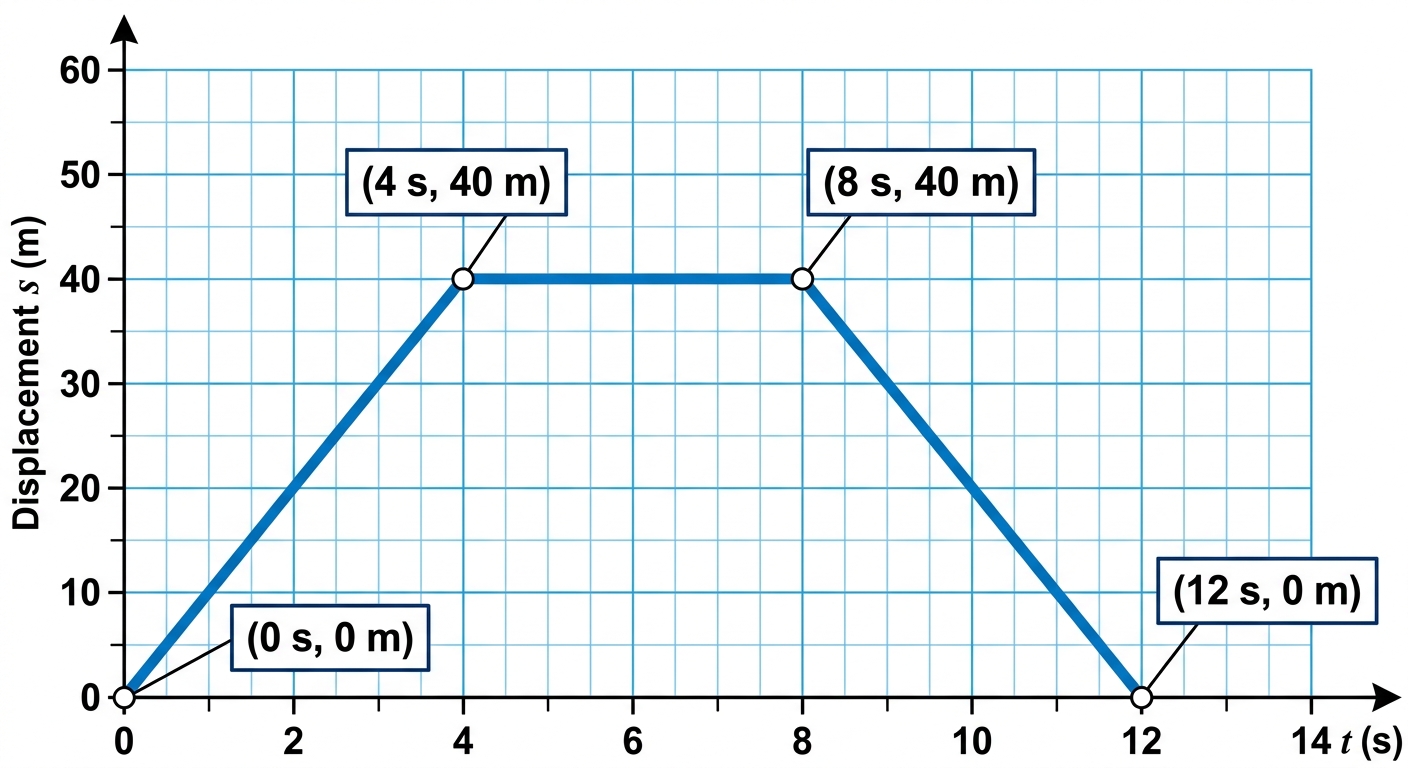
A car moves along a straight road. The displacement-time graph of the car is shown below.
(a)
State the velocity of the car during the time interval to . [1 mark]
(b)
Calculate the average speed of the car over the entire 12 seconds of motion. [2 marks]
(c)
The average velocity of the car over the 12 seconds is . Explain, with reference to the graph, why the average speed and the magnitude of the average velocity are not equal in this case, and state the condition under which they would be equal. [2 marks]

Solutions
2MasterySAQ-SGraphical analysis of motion6 marksPaper 2~9 min
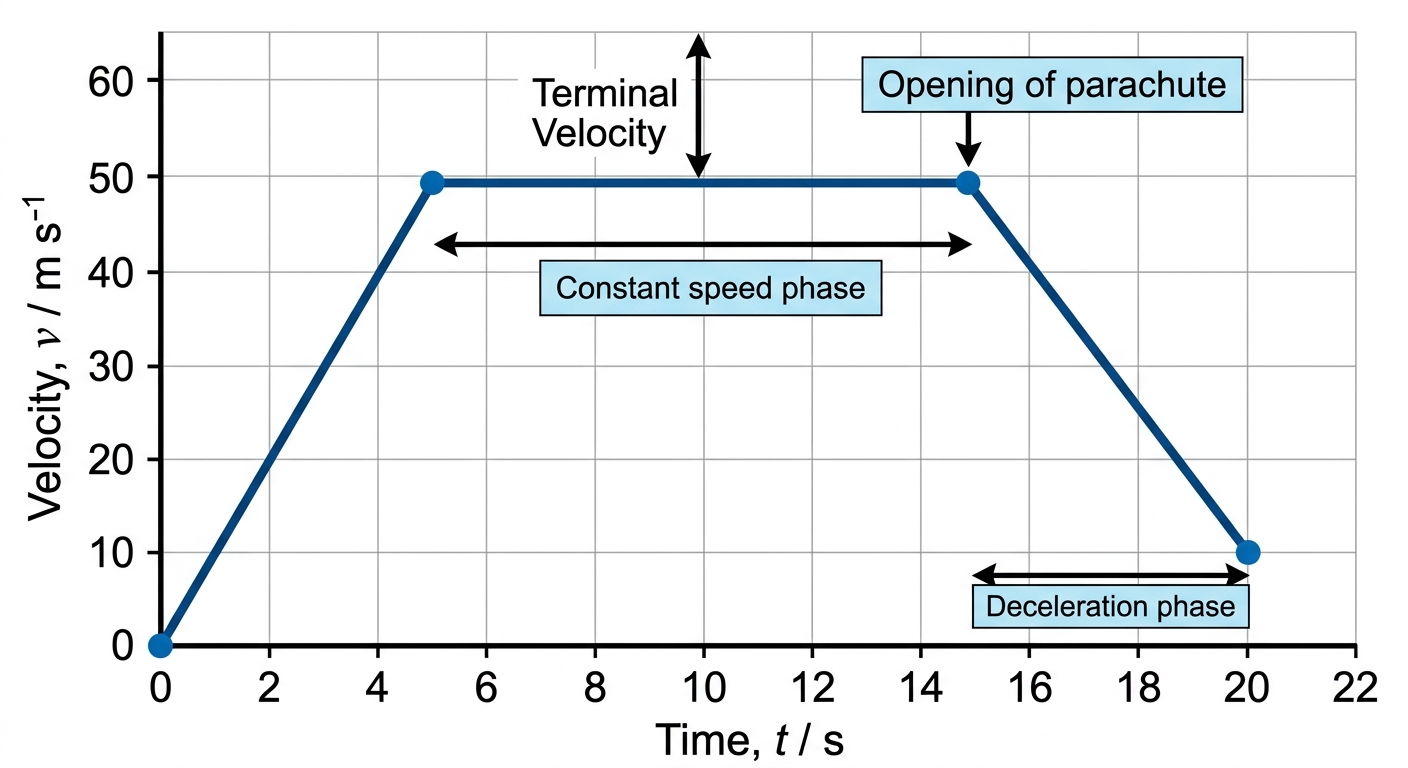
A skydiver jumps from a stationary balloon and falls vertically downward. The velocity-time graph of the skydiver is shown below.
(a)
(i) State the type of motion of the skydiver during the first 5 seconds. [1]
(ii) Calculate the acceleration of the skydiver during the first 5 seconds. [1 mark]
(ii) Calculate the acceleration of the skydiver during the first 5 seconds. [1 mark]
(b)
Calculate the distance fallen by the skydiver during the first 5 seconds. [2 marks]
(c)
The magnitude of the skydiver's acceleration during the first 5 seconds is less than . Explain why this is the case. [1 mark]
(d)
The skydiver has a mass of 75 kg. Determine the magnitude of the air resistance force acting on the skydiver during the first 5 seconds. [2 marks]
Solutions
3MasterySAQ-SGraphical analysis of motion5 marksPaper 2~8 min
Data
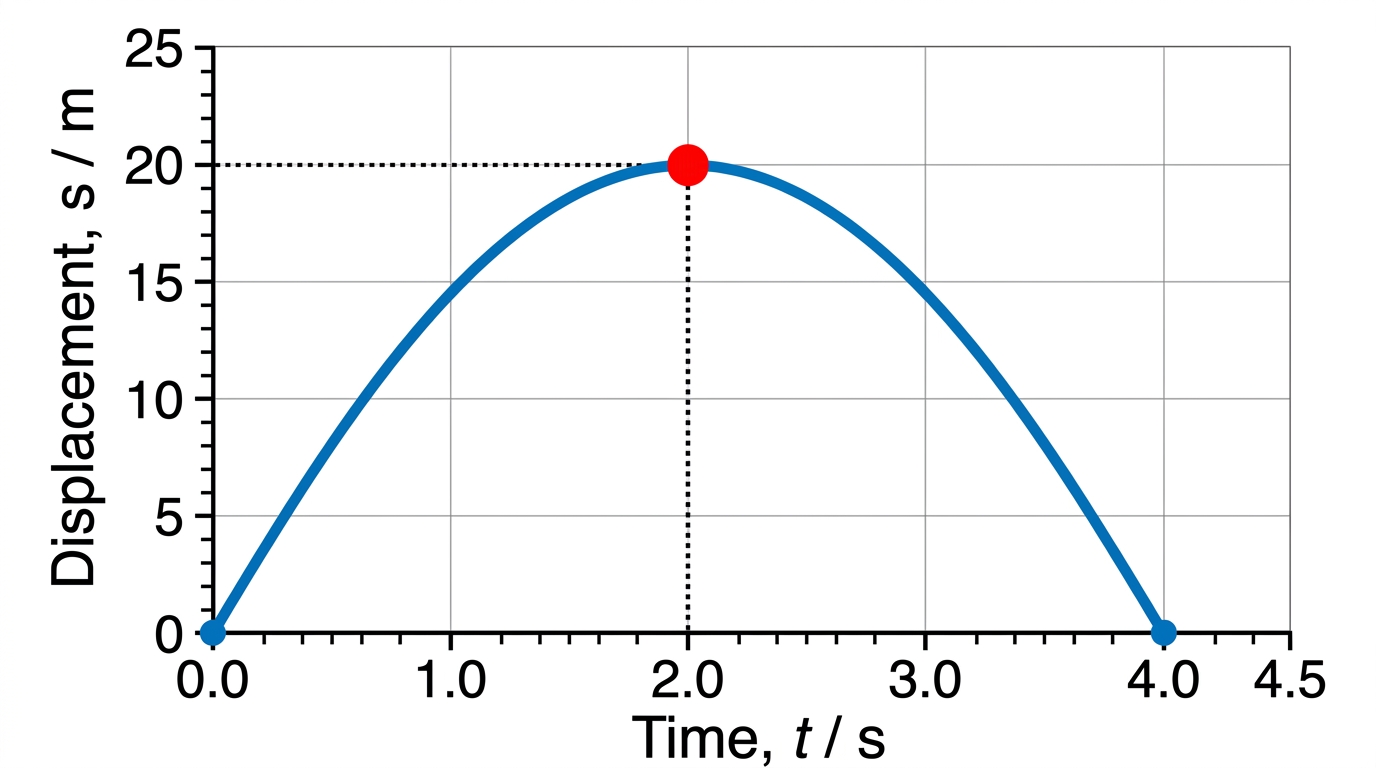
A ball is thrown vertically upward from the ground. The displacement–time graph of the ball is shown below.
(a)
Describe the velocity of the ball during the interval to s, including both its direction and how its magnitude changes. [2 marks]
(b)
Calculate the initial speed of the ball. [3 marks]
Solutions
4MasterySAQ-SScalars and vectors4 marksPaper 2~6 min
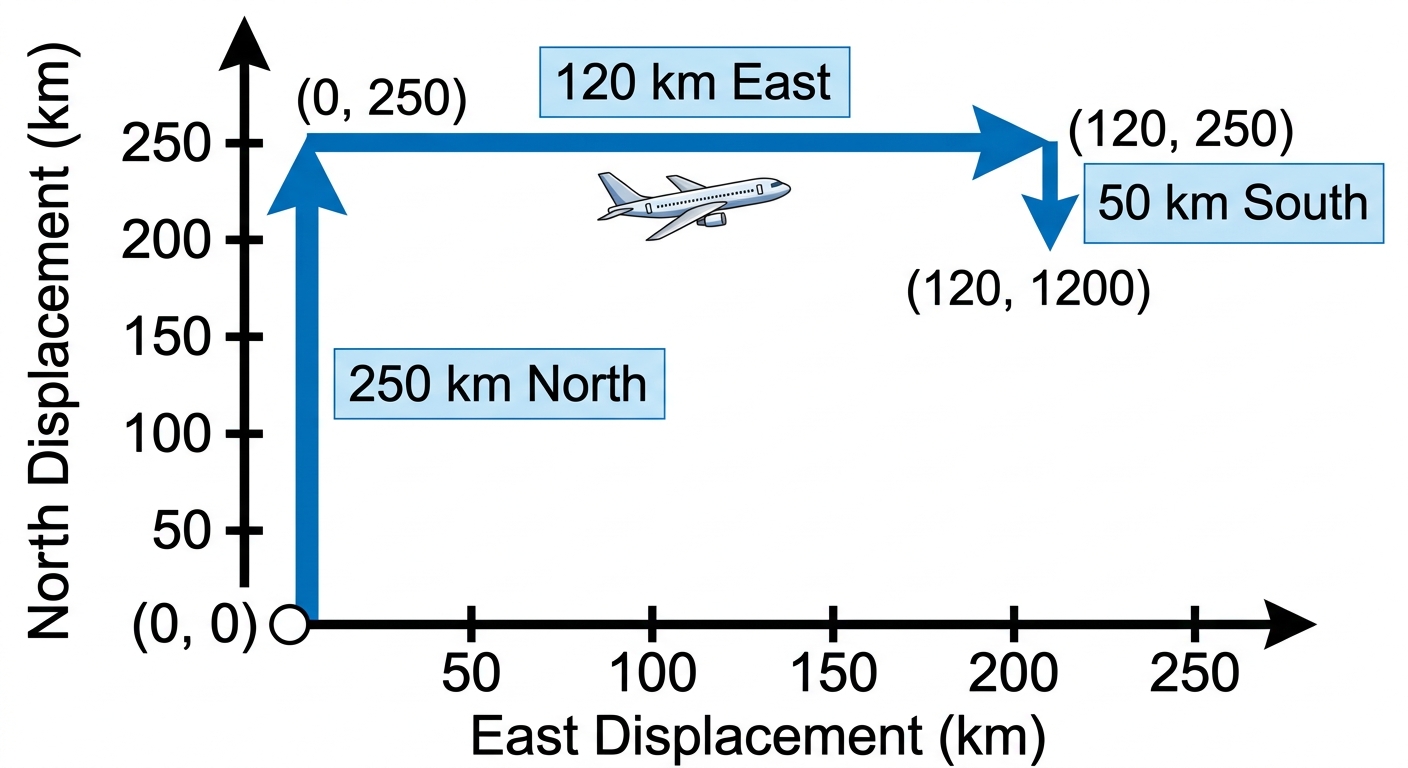
A plane flies 250 km north, then 120 km east, then 50 km south.
(a)
(i) State what is meant by a vector quantity. [1]
(ii) Identify the displacement of the plane during the first leg of the journey, stating both its magnitude and direction. [1 mark]
(ii) Identify the displacement of the plane during the first leg of the journey, stating both its magnitude and direction. [1 mark]
(b)
Calculate the magnitude of the plane's resultant displacement from its starting point. [3 marks]
Solutions
5MasterySAQ-SEquations of motion (constant acceleration)7 marksPaper 2~11 min
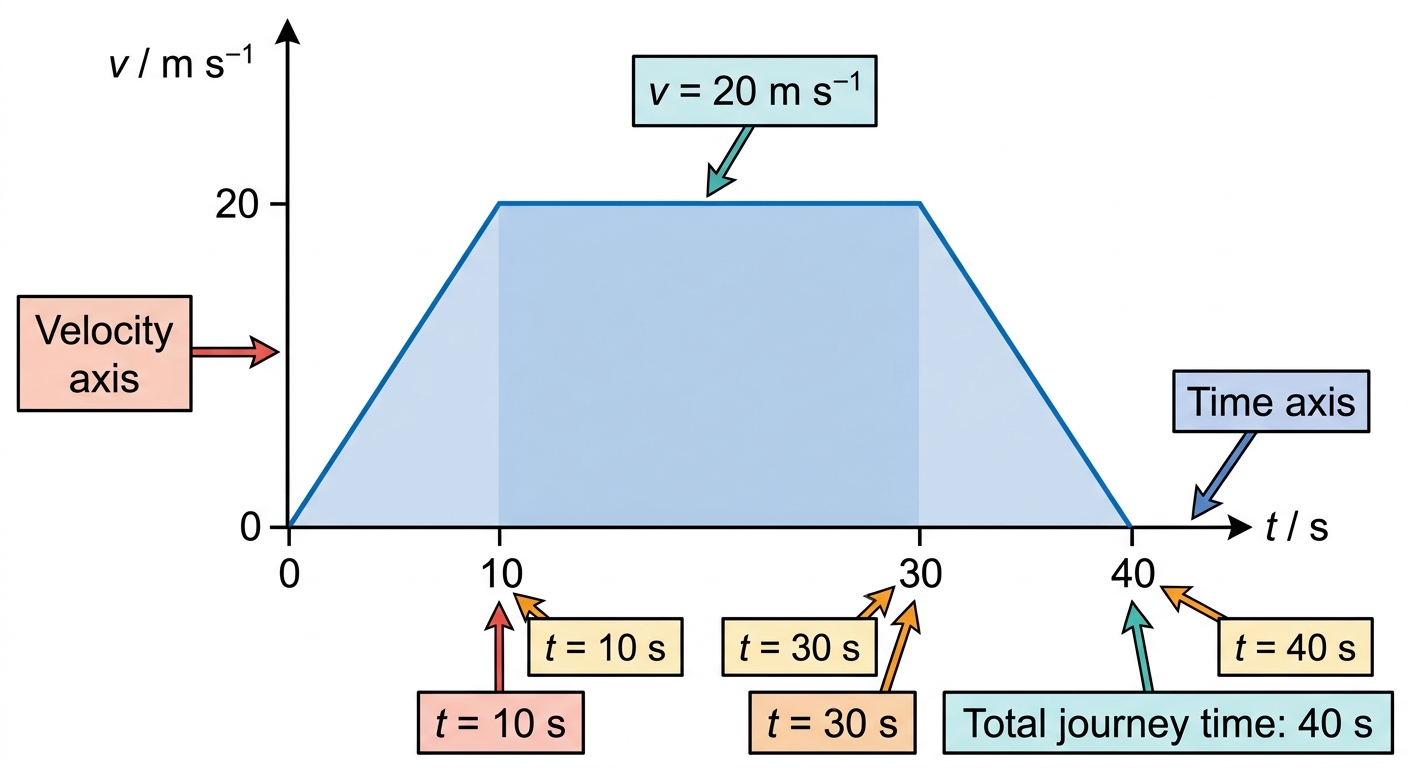
The velocity–time graph shows the motion of a train travelling along a straight track.
(a)
State the magnitude of the acceleration of the train during the first . [1 mark]
(b)
Describe the motion of the train during the interval . [1 mark]
(c)
Calculate the total displacement of the train during the journey. [3 marks]
(d)
The train decelerates uniformly to rest during the final . A passenger of mass stands on a scale inside the train during this interval. Determine the reading on the scale during deceleration and compare it to the reading when the train travels at constant velocity. [2 marks]
Solutions
6MasterySAQ-SScalars and vectors5 marksPaper 2~8 min
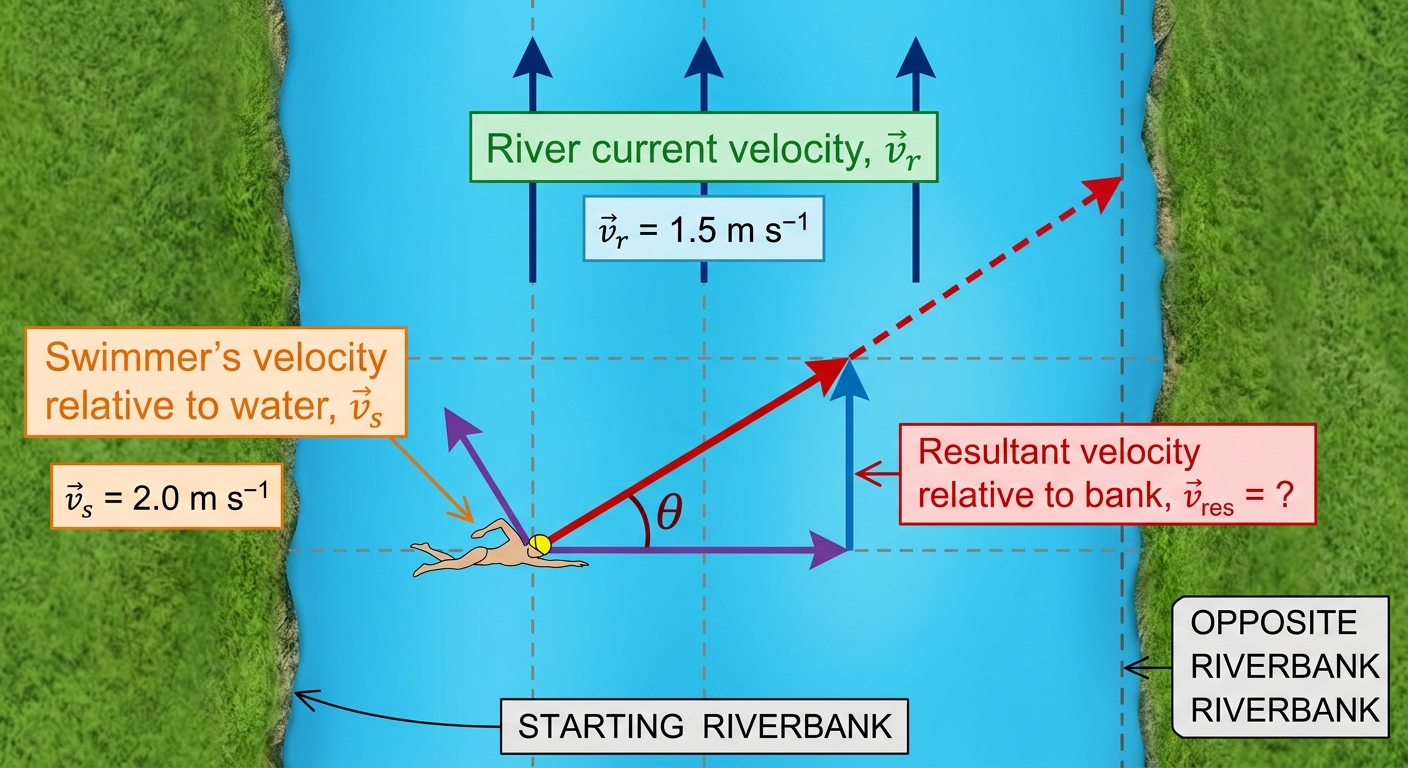
A swimmer heads directly across a river, swimming at relative to the water, perpendicular to the riverbank. The river flows at parallel to the bank.
(a)
State the two velocity vectors that combine to give the swimmer's resultant velocity relative to the riverbank. [1 mark]
(b)
Calculate the angle of the swimmer's resultant velocity relative to the direction straight across the river. [2 marks]
(c)
Explain why a swimmer wishing to travel straight across the river must aim upstream. [1 mark]
(d)
Determine the angle upstream of the perpendicular at which the swimmer must aim in order to travel straight across, given the same speeds. [1 mark]
Solutions
7MasterySAQ-SEquations of motion (constant acceleration)5 marksPaper 2~8 min
A car travelling at along a straight road applies its brakes and decelerates uniformly to rest. The magnitude of the deceleration is .
(a)
State what is meant by uniform deceleration. [1 mark]
(b)
Describe how the velocity of the car changes from the moment the brakes are applied until the car comes to rest. [2 marks]
(c)
Calculate the total distance travelled by the car while braking. [2 marks]
Solutions
8MasterySAQ-SEquations of motion (constant acceleration)8 marksPaper 2~12 min
A ball is thrown vertically upwards from the edge of a cliff with an initial speed of . The ball takes to reach the ground at the base of the cliff. Air resistance is negligible. Take .
(a)
State the magnitude and direction of the acceleration of the ball throughout its flight. [1 mark]
(b)
Show that the ball is still rising at and determine the speed of the ball at that instant. [2 marks]
(c)
Calculate the height of the cliff. [3 marks]
(d)
A student claims: "Because the ball is thrown upward, it must spend more than half of its total flight time rising." Using your results, evaluate this claim. [2 marks]
Solutions
9MasterySAQ-SEquations of motion (constant acceleration)6 marksPaper 2~9 min
A cyclist accelerates uniformly from rest along a straight, horizontal road. After , she has travelled .
(a)
State what is meant by the term uniform acceleration. [1 mark]
(b)
Show that the average velocity of the cyclist over the interval is . [1 mark]
(c)
Calculate the magnitude of the acceleration of the cyclist. [2 marks]
(d)
The cyclist has a total mass (including bicycle) of . The road exerts a constant resistive force of on the cyclist. Determine the magnitude of the driving force exerted by the cyclist during the interval. [2 marks]
Solutions
10MasterySAQ-SEquations of motion (constant acceleration)7 marksPaper 2~11 min
Data
A hot-air balloon ascends vertically at a constant velocity of . When the balloon is above the ground, a stone is released from rest relative to the balloon. Air resistance is negligible.
(a)
State the velocity and the acceleration of the stone immediately after release. [2 marks]
(b)
The stone initially moves upward after release. Using Newton's first law, explain how the stone's velocity changes from the moment of release until it reaches the ground. [2 marks]
(c)
Calculate the time taken for the stone to reach the ground after release. [3 marks]
Solutions
11MasterySAQ-SDisplacement, velocity, and acceleration4 marksPaper 2~6 min
A train decelerates uniformly along a straight horizontal track. Its speed decreases from to over a distance of .
(a)
State what is meant by uniform deceleration. [1 mark]
(b)
Calculate the magnitude of the deceleration of the train. [2 marks]
(c)
The total time for the train to travel the is divided into two equal halves.
(i) State, with a reason, whether the displacement covered in the first half of the time is greater than, equal to, or less than the displacement covered in the second half. [1]
(ii) Calculate the displacement covered in each half of the time. [1 mark]
(ii) Calculate the displacement covered in each half of the time. [1 mark]
Solutions
12MasterySAQ-SGraphical analysis of motion4 marksPaper 2~6 min
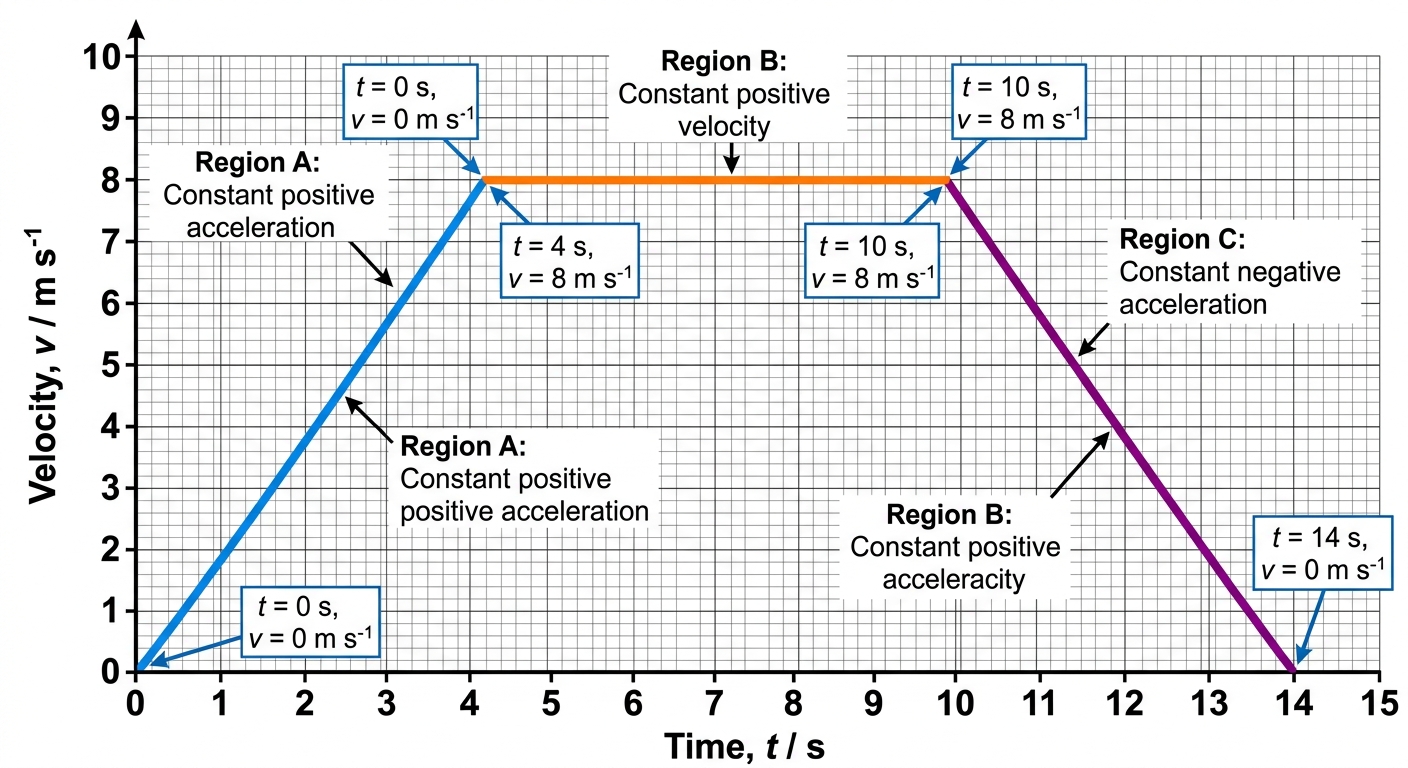
A student investigates the motion of a toy car on a straight track. The velocity-time graph of the car is shown below.
(a)
- (i) State one feature of the car's motion during the time interval s to s. [1]
-
(ii) Determine the acceleration of the car during the interval s to s. [1 mark]
(ii) Determine the acceleration of the car during the interval s to s. [1 mark]
(b)
Calculate the total displacement of the car during the 14 seconds of motion. [3 marks]
Solutions
13MasterySAQ-SGraphical analysis of motion4 marksPaper 2~6 min
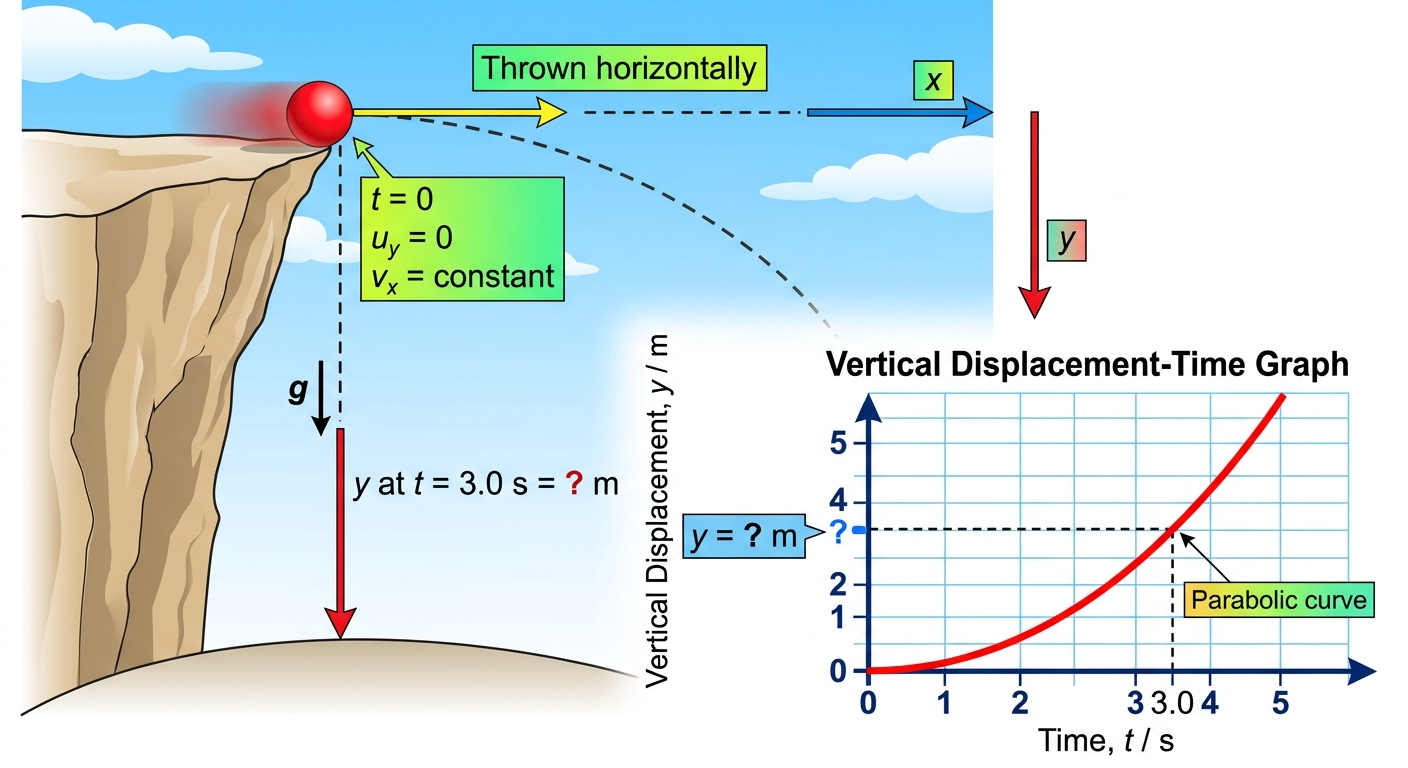
A ball is thrown horizontally from a cliff. The horizontal displacement–time graph is a straight line through the origin with gradient . The vertical displacement–time graph is a parabola. The ball is initially at rest in the vertical direction.
(a)
(i) State what the gradient of the horizontal displacement–time graph represents. [1]
(ii) State what the shape of the horizontal displacement–time graph tells you about the horizontal acceleration of the ball. [1 mark]
(ii) State what the shape of the horizontal displacement–time graph tells you about the horizontal acceleration of the ball. [1 mark]
(b)
Calculate the vertical displacement of the ball after . [3 marks]
Solutions
14MasterySAQ-SEquations of motion (constant acceleration)4 marksPaper 2~6 min
A stone is dropped from rest from a cliff of height 80 m. Exactly 1.0 s later, a second stone is thrown vertically downward from the same point with an initial speed of . Air resistance is negligible throughout. Take .
(a)
State the acceleration of each stone during its fall. [1 mark]
(b)
Calculate the time taken for the first stone to reach the base of the cliff. [2 marks]
(c)
(i) Calculate the time taken for the second stone to reach the base of the cliff, measured from the moment the first stone was released. [2]
(ii) State which stone reaches the base of the cliff first. [1 mark]
(ii) State which stone reaches the base of the cliff first. [1 mark]
Solutions
15MasterySAQ-SEquations of motion (constant acceleration)10 marksPaper 2~15 min
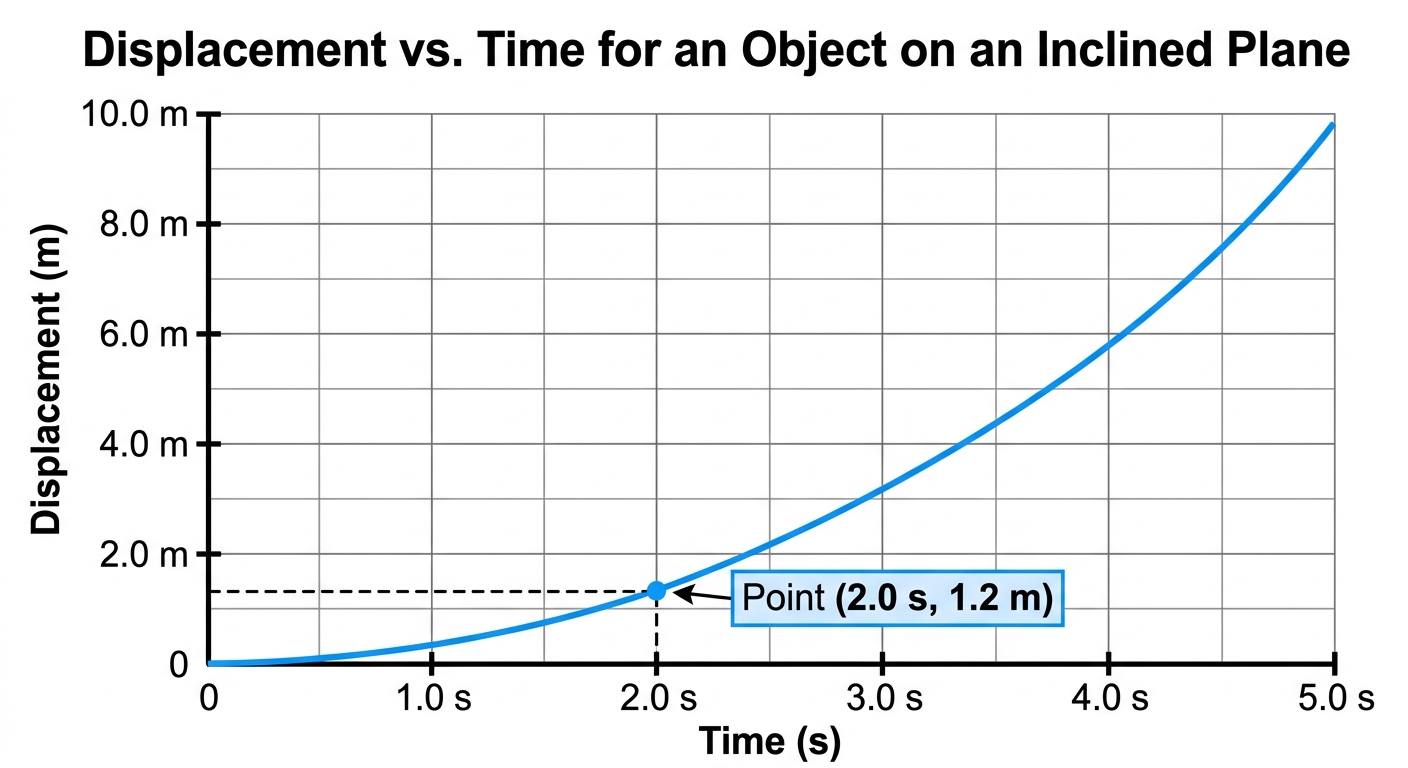
A ball rolls from rest down a straight inclined plane with constant acceleration. It travels 1.2 m in the first 2.0 s.
The displacement–time graph for the motion is shown.
(a)
State the shape of the displacement–time graph and identify the feature that shows the ball starts from rest. [2 marks]
(b)
Calculate the acceleration of the ball. [2 marks]
(c)
The ball continues rolling beyond s. Deduce how the gradient of the displacement–time graph changes, and state the physical quantity this gradient represents. [2]
Total: [6 marks]
Solutions
16MasterySAQ-SEquations of motion (constant acceleration)5 marksPaper 2~8 min
A car accelerates uniformly from to in along a straight road.
(a)
State one condition, other than straight-line motion, that must be satisfied for the equations of uniform acceleration to be valid. [1 mark]
(b)
Calculate the displacement of the car during this interval. [2 marks]
(c)
(i) State whether the equation would give a valid result for displacement if the acceleration were not uniform over the , but the initial and final speeds remained and respectively. [1]
(ii) Justify your answer to (c)(i) by explaining the physical meaning of in the context of non-uniform acceleration. [2 marks]
(ii) Justify your answer to (c)(i) by explaining the physical meaning of in the context of non-uniform acceleration. [2 marks]
Solutions
17MasterySAQ-SEquations of motion (constant acceleration)4 marksPaper 2~6 min
A car accelerates uniformly along a straight track. It passes point A with a velocity of and point B with a velocity of . The distance between A and B is .
(a)
State what is meant by uniform acceleration. [1 mark]
(b)
Calculate the acceleration of the car between A and B. [2 marks]
(c)
(i) Describe how the displacement of the car from point A varies with time . [1]
(ii) Explain why this relationship between and has the form you described. [1 mark]
(ii) Explain why this relationship between and has the form you described. [1 mark]
Solutions
18MasterySAQ-SDisplacement, velocity, and acceleration6 marksPaper 2~9 min
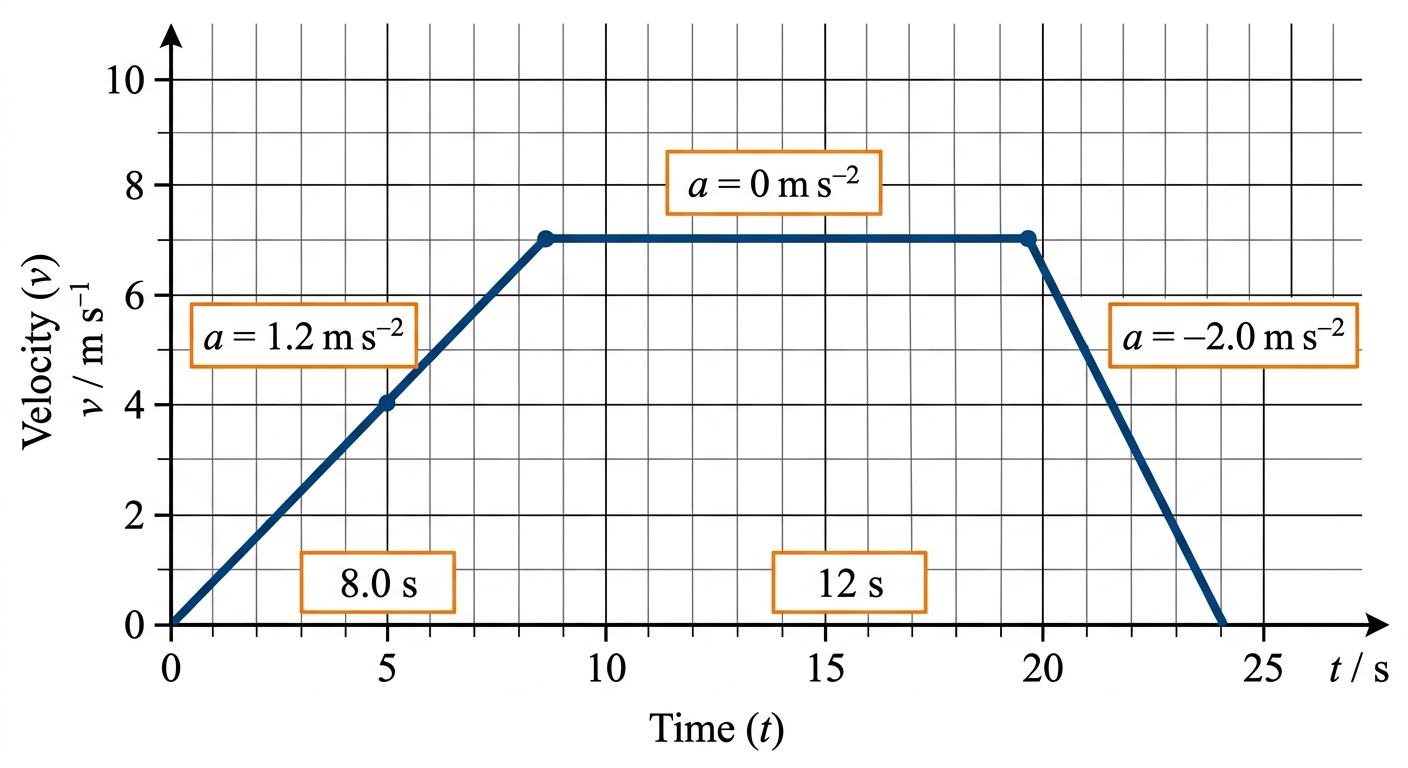
A cyclist is training on a straight, flat road. She starts from rest and accelerates uniformly at for . She then maintains a constant velocity for . Finally, she applies the brakes and decelerates uniformly at until she comes to rest.
(a)
(i) State the relationship between the gradient of a velocity–time graph and acceleration. [1]
(ii) Explain what a negative gradient on a velocity–time graph indicates about the motion of the cyclist. [1 mark]
(ii) Explain what a negative gradient on a velocity–time graph indicates about the motion of the cyclist. [1 mark]
(b)
Calculate the total distance travelled by the cyclist. [3 marks]
(c)
The cyclist claims that, had she decelerated at instead of , her total journey distance would have been reduced by more than . Determine whether this claim is correct. [2 marks]
Solutions
19MasterySAQ-SGraphical analysis of motion6 marksPaper 2~9 min
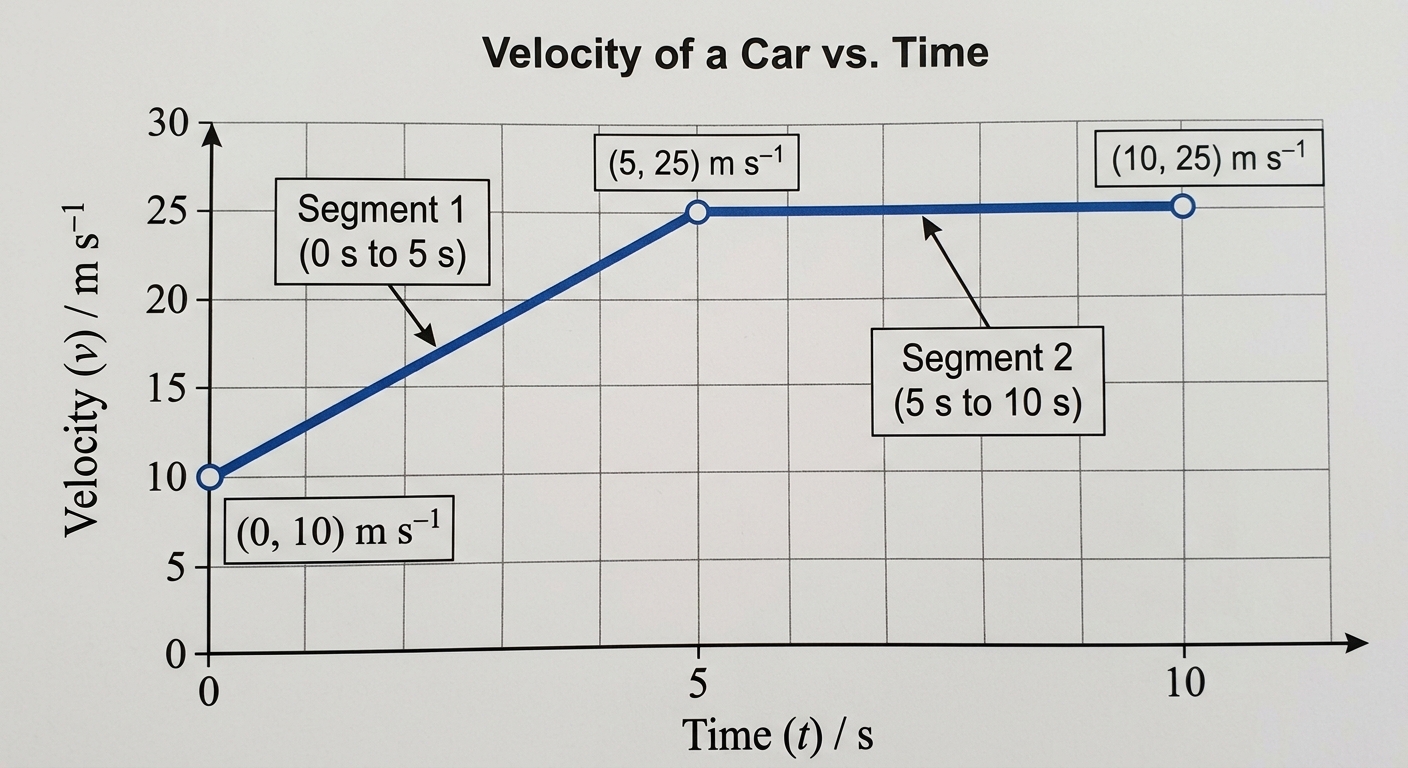
A car moves along a straight road. The velocity-time graph shows a straight line from to , then a horizontal line from to , where velocity is in and time is in s.
(a)
(i) State the motion of the car during the first 5 seconds. [1]
(ii) State the motion of the car during the next 5 seconds. [1 mark]
(ii) State the motion of the car during the next 5 seconds. [1 mark]
(b)
Calculate the average velocity of the car over the full 10 s journey. [3 marks]
(c)
The car's instantaneous velocity at equals . Deduce whether the average velocity over the first 5 seconds is greater than, equal to, or less than , and justify your answer without calculation. [2 marks]
Solutions
20MasterySAQ-SDisplacement, velocity, and acceleration4 marksPaper 2~6 min
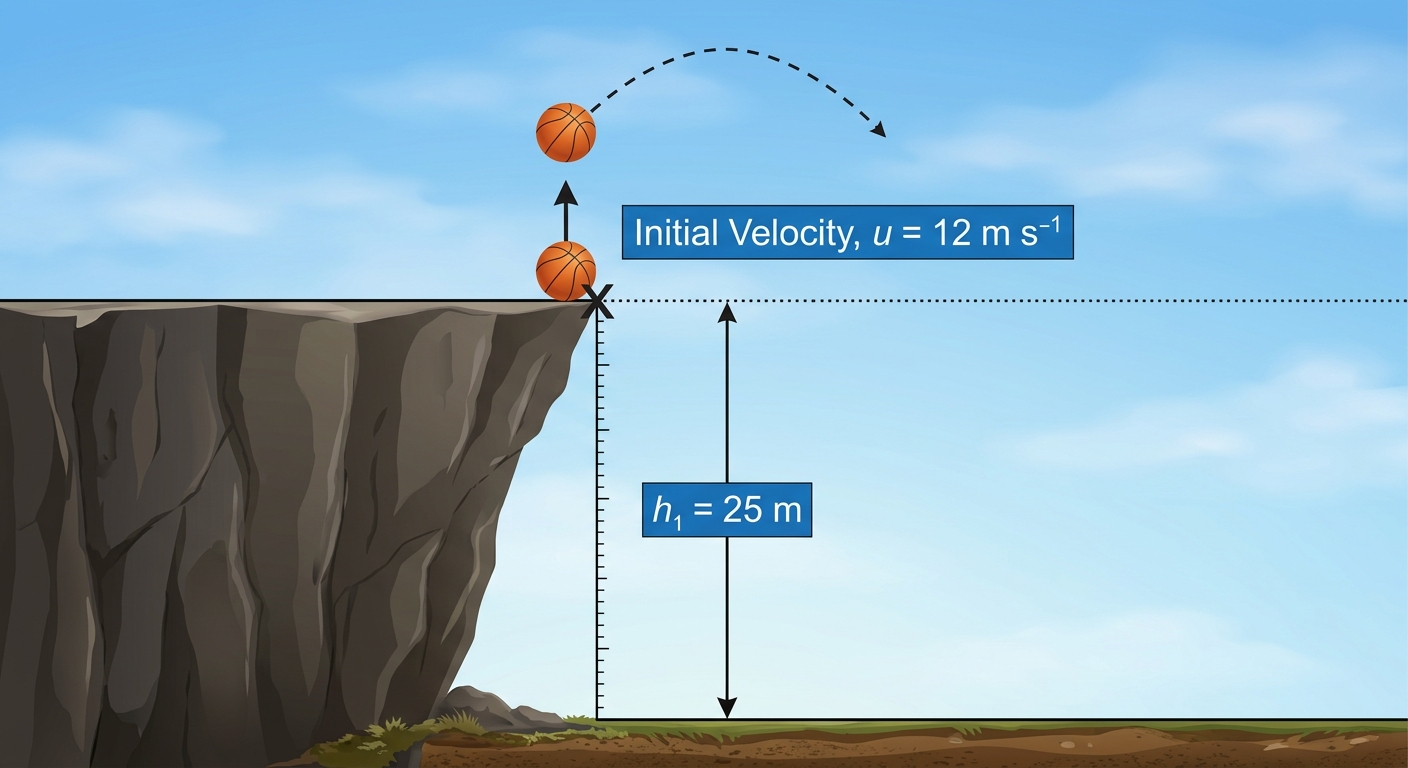
A ball is thrown vertically upwards from the edge of a cliff with an initial speed of . The top of the cliff is above its base. Air resistance is negligible.
(a)
State the magnitude and direction of the acceleration of the ball at the highest point of its flight. [1 mark]
(b)
Calculate the maximum height reached by the ball above the point of release. [2 marks]
(c)
(i) Calculate the speed of the ball when it reaches the base of the cliff. [2]
(ii) State whether this speed is greater than, equal to, or less than . Justify your answer by reference to energy. [1 mark]
(ii) State whether this speed is greater than, equal to, or less than . Justify your answer by reference to energy. [1 mark]
Solutions
Showing 20 of 141 free questions