You're viewing 3 free preview questions for Physics HL — subscribe to unlock 425 more, plus the Full Question Bank, Mock Papers & Worksheets.Upgrade
Rigid Body Mechanics · Paper 2 — Free Physics HL Practice Questions
1ChallengeSAQ-LMoment of inertia and angular acceleration9 marksPaper 2~14 min

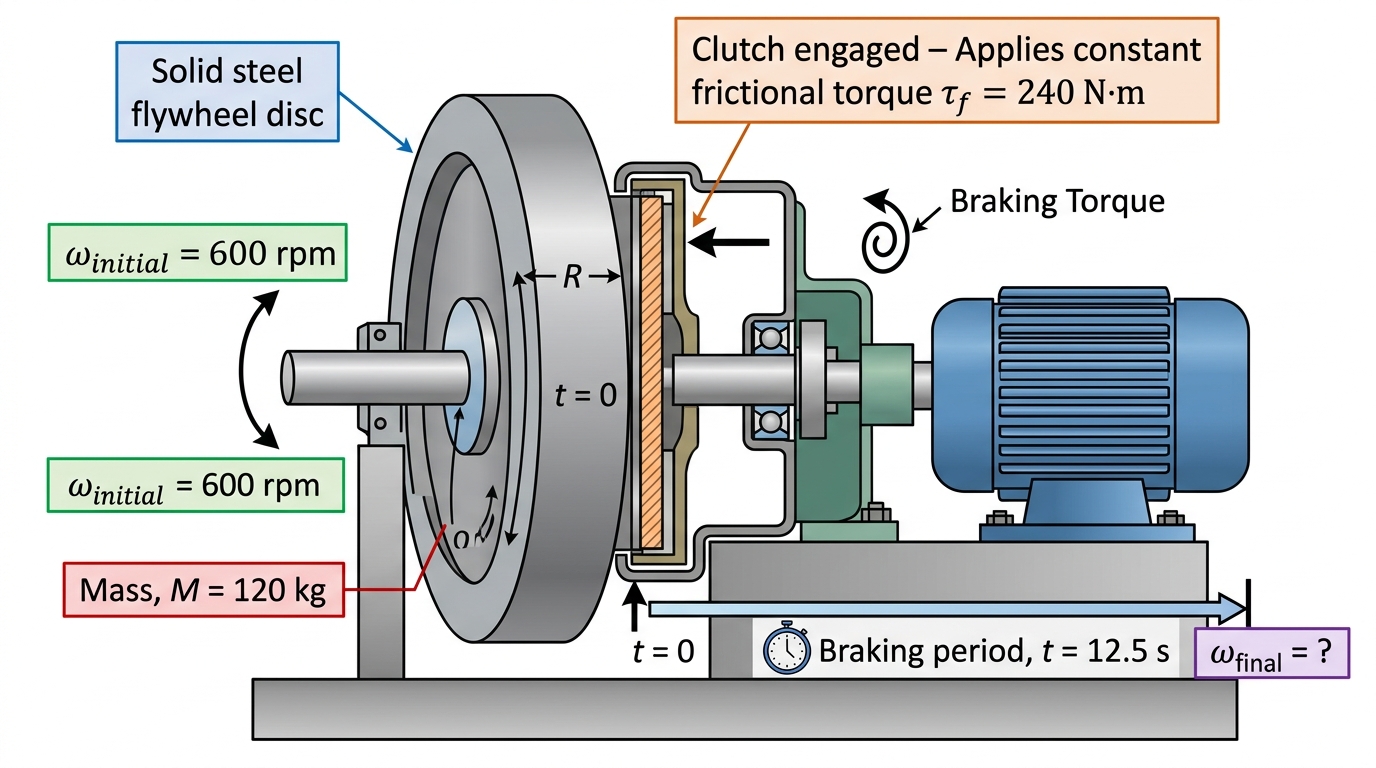
A flywheel used in a stamping press is a solid steel disc of radius 0.40 m and mass 120 kg. It rotates at 600 revolutions per minute (rpm). The press engages a clutch that applies a constant frictional torque of 240 N m, bringing the flywheel to rest in 12.5 s.
Moment of inertia of a solid disc about its central axis:
Moment of inertia of a thin ring (all mass at rim) about its central axis:
(a)
Calculate the moment of inertia of the flywheel modelled as a solid disc. [1 mark]
(b)
Show that the magnitude of the angular deceleration of the flywheel is approximately . [3 marks]
(c)
Calculate the number of complete revolutions the flywheel makes during the braking period. [2 marks]
(d)
An engineer proposes redesigning the flywheel so that the same total mass of 120 kg is concentrated entirely at the rim at radius 0.40 m, keeping the same operating speed and applied braking torque. Calculate the ratio of the rotational kinetic energy stored in the rim design to that stored in the solid disc design, and hence evaluate whether this redesign improves the energy available for stamping. [3 marks]

Solutions
2ChallengeLAQTime dilation and length contraction7 marksPaper 2~11 min
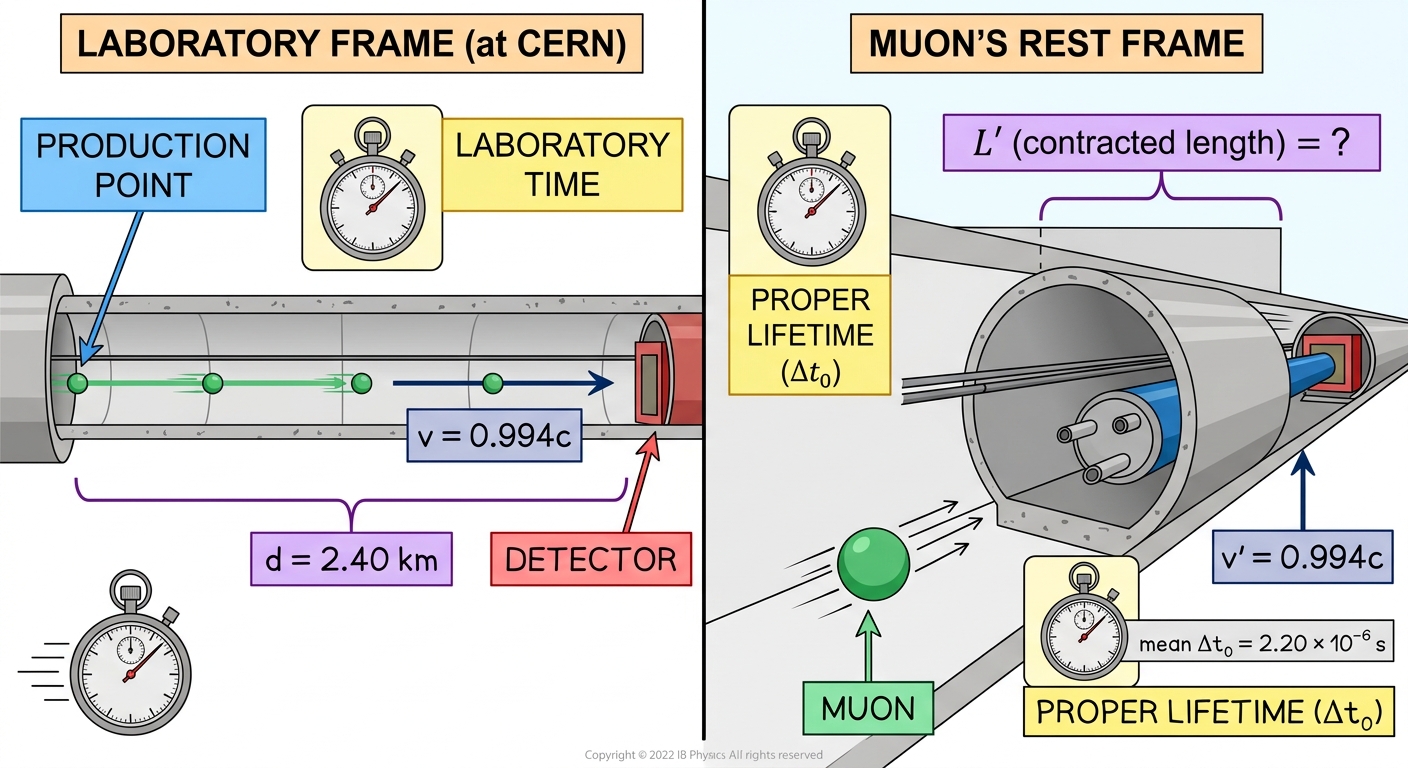
A high-energy physics experiment at CERN involves a beam of muons travelling at relative to the laboratory. In the laboratory frame, the muon beam travels a distance of from the production point to the detector. The mean proper lifetime of a muon is .
(a)
Calculate the Lorentz factor for the muons. [1 mark]
(b)
Calculate the mean lifetime of the muons as measured in the laboratory frame. [2 marks]
(c)
Determine the maximum distance a muon can travel in the laboratory frame before decaying, and state whether the muons reach the detector. [3 marks]
(d)
Calculate the contracted length of the path as measured in the muon rest frame, and determine the time for the detector to reach the muon in that frame. [3]
(e) Explain why the results of (c) and (d) are consistent with the principle of relativity. [1 mark]
Solutions
3ChallengeLAQTime dilation and length contraction10 marksPaper 2~15 min
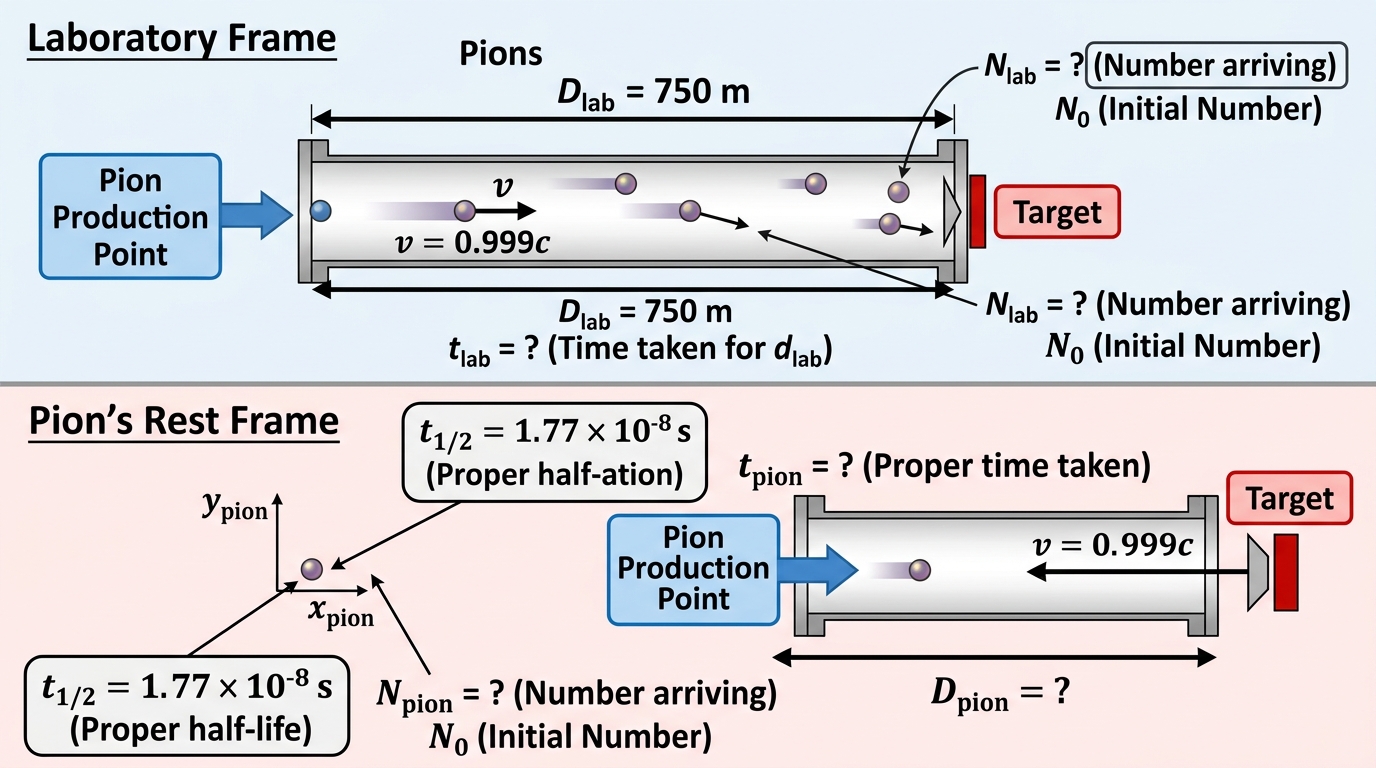
A particle accelerator produces pions travelling at relative to the laboratory. The proper half-life of a pion is . The pions travel a distance of from the production point to a detector.
(a)
Calculate the Lorentz factor for the pions. [1 mark]
(b)
Using time dilation, calculate the fraction of pions that survive the journey to the detector as measured in the laboratory frame. [4 marks]
(c)
Show that length contraction in the pion rest frame gives the same fraction of surviving pions. [3 marks]
(d)
The travel time measured in the laboratory frame and the proper time experienced by the pions are different. Discuss why the fraction of surviving pions must nevertheless be the same in both frames, identifying which quantities are frame-dependent and which are invariant.
Data for use in this question:
[2 marks]
Solutions
That's every free question here — 3 of 428.
+425 more questions, plus Mock Papers & Worksheets, are waiting in Premium.