You're viewing 1 free preview question for Physics HL — subscribe to unlock 156 more, plus the Full Question Bank, Mock Papers & Worksheets.Upgrade
Thermodynamics · Paper 2 — Free Physics HL Practice Questions
1ChallengeSAQ-LHeat engines and efficiency7 marksPaper 2~11 min

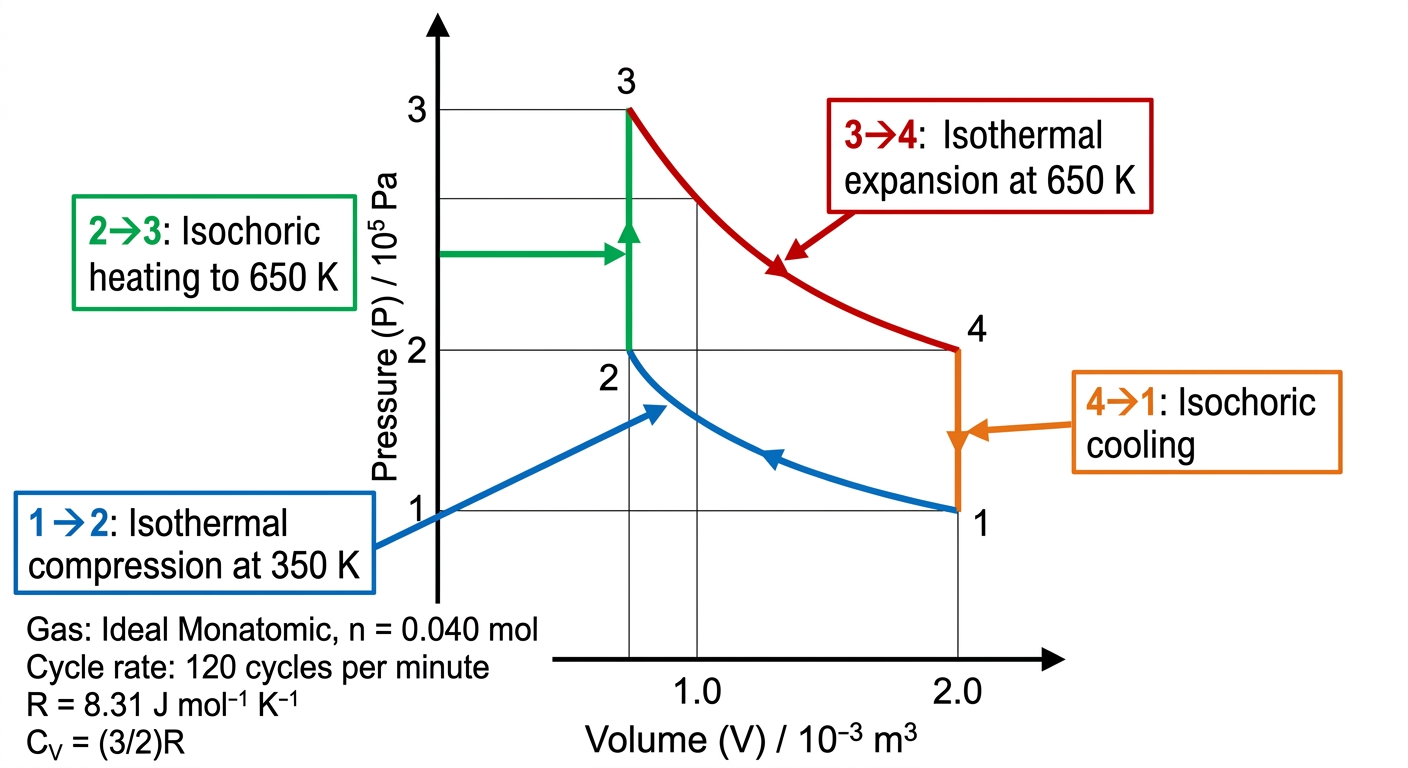
A Stirling engine operates with of an ideal monatomic gas undergoing four processes per cycle:
- : Isothermal compression at , volume from to
- : Isochoric heating from to
- : Isothermal expansion at , volume from to
- : Isochoric cooling from to
Use and isothermal work .
(a)
Calculate the net work done per cycle by the engine. [3 marks]
(b)
The Stirling cycle is represented on a – . Explain, by reference to the areas enclosed on this , why the net work output per cycle is positive. [2 marks]
(c)
The engine is reversed to operate as a refrigerator between the same two temperatures. Calculate the maximum (ideal) coefficient of performance of this reversed cycle, and evaluate one thermodynamic and one engineering reason why the actual COP would be lower than this ideal value. [2 marks]

Solutions
That's every free question here — 1 of 157.
+156 more questions, plus Mock Papers & Worksheets, are waiting in Premium.