Tools and Data-Based Skills (Paper 1B) · Paper 2 — Free Physics HL Practice Questions
Free questions
Open in full, with answers, mark scheme and examiner insights.
Measurement, SI units, significant figures and orders of magnitude
A sprinter of mass 72 kg runs at a speed of 9.5 m s⁻¹. The momentum of the sprinter is the product of mass and velocity.
State the unit of momentum in SI base units.
Show, using the definition of force as rate of change of momentum, that the newton second (N s) is equivalent to the unit in (a).
revisionprep.com
Summary Answer
Not available for this question.
Model Answer
Not available for this question.
Marking Scheme
Not available for this question.
Examiner Insights
Not available for this question.
Uncertainties: absolute, fractional, percentage and propagation; error bars
Two students measure the speed of sound in air by timing an echo from a distant wall. Their teacher says that one set of results is precise but not accurate.
Distinguish between accuracy and precision in a set of measurements.
State one way of reducing the effect of random errors in this experiment.
revisionprep.com
Summary Answer
Not available for this question.
Model Answer
Not available for this question.
Marking Scheme
Not available for this question.
Examiner Insights
Not available for this question.
Measurement, SI units, significant figures and orders of magnitude
A red blood cell is a disc with a diameter of 8.0 μm. The diameter of the Earth is 1.3 × 10⁷ m.
State the diameter of the red blood cell in metres.
Calculate the number of red blood cells that would fit side by side across a distance of 1.0 cm.
Determine the order of magnitude of the ratio of the diameter of the Earth to the diameter of a red blood cell.
revisionprep.com
Summary Answer
Not available for this question.
Model Answer
Not available for this question.
Marking Scheme
Not available for this question.
Examiner Insights
Not available for this question.
Uncertainties: absolute, fractional, percentage and propagation; error bars
Water in a beaker is heated. A student reads the initial temperature as (21.5 ± 0.5) °C and the final temperature as (36.0 ± 0.5) °C using the same thermometer.
Calculate the change in temperature with its absolute uncertainty.
Calculate the percentage uncertainty in the change in temperature.
Explain why the percentage uncertainty in a difference can be much larger than the percentage uncertainty in each reading.
revisionprep.com
Summary Answer
Not available for this question.
Model Answer
Not available for this question.
Marking Scheme
Not available for this question.
Examiner Insights
Not available for this question.
Measurement, SI units, significant figures and orders of magnitude
Atmospheric pressure at the surface of the Earth is about 1.0 × 10⁵ Pa. The radius of the Earth is 6.4 × 10⁶ m and its mass is 6.0 × 10²⁴ kg. A student uses these values to estimate the mass of the whole atmosphere.
Calculate the surface area of the Earth.
Explain why the weight of the atmosphere is approximately equal to the force exerted by atmospheric pressure on the whole surface of the Earth.
Determine the mass of the atmosphere.
State the order of magnitude of the mass of the atmosphere.
Determine the order of magnitude of the ratio of the mass of the Earth to the mass of its atmosphere.
Suggest one reason why the estimate in (c) is likely to differ from the true value.
revisionprep.com
Summary Answer
Not available for this question.
Model Answer
Not available for this question.
Marking Scheme
Not available for this question.
Examiner Insights
Not available for this question.
Graphical analysis: best-fit lines, gradients, intercepts and linearisation
The orbital radius r and orbital period T of four moons of Jupiter are: Io, 4.22 × 10⁸ m and 1.77 days; Europa, 6.71 × 10⁸ m and 3.55 days; Ganymede, 1.07 × 10⁹ m and 7.15 days; Callisto, 1.88 × 10⁹ m and 16.7 days. Figure 1 shows a graph of lg(T / days) against lg(r / m) for these moons.
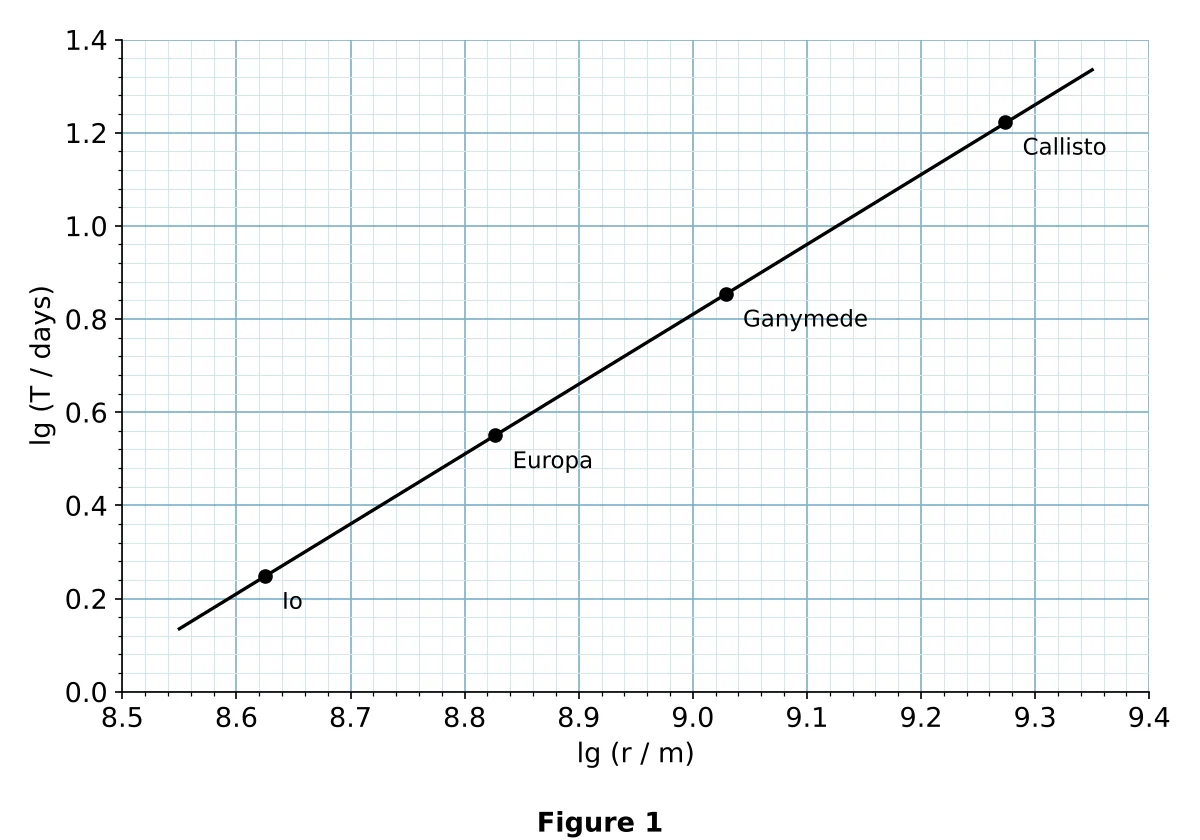
A relationship of the form T = k rⁿ is proposed. Explain how a graph of lg T against lg r can test this relationship and give n.
Calculate lg(r / m) and lg(T / days) for Ganymede.
Determine the gradient of the line in Figure 1.
Hence state the relationship between T and r.
For a moon in a circular orbit, , where M is the mass of Jupiter. Determine M using the data for Io.
Evaluate the use of a graph of lg T against lg r, rather than a graph of T² against r³, to analyse these data.
Suggest why data from only four moons limit the confidence in the value of n.
revisionprep.com
Summary Answer
Not available for this question.
Model Answer
Not available for this question.
Marking Scheme
Not available for this question.
Examiner Insights
Not available for this question.
That's every free question here — 6 of 26.
+20 more questions, plus Mock Papers & Worksheets, are waiting in Premium.