Electric and Magnetic Fields · Paper 1 — Free Physics SL Practice Questions
Free questions
Open in full, with answers, mark scheme and examiner insights.
Electric charge, charging, Millikan's experiment and Coulomb's law
A student rubs a polythene rod with a dry cloth and measures the charge on the rod with a coulombmeter after different numbers of rubs. Figure 1 shows the results; each charge has an uncertainty of .
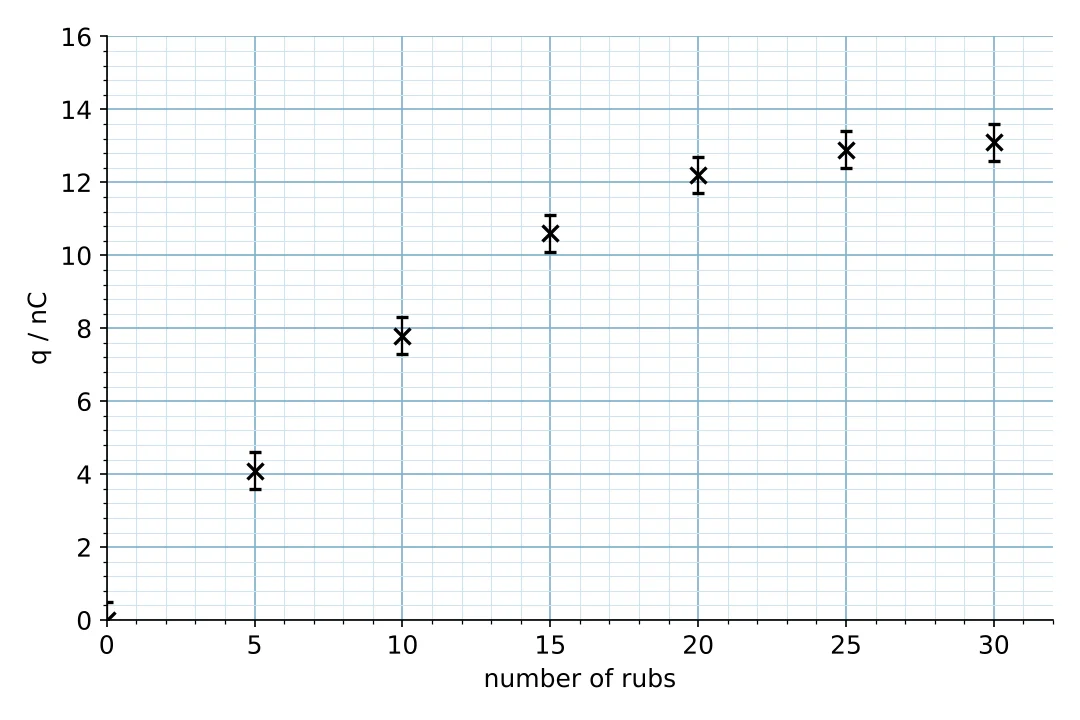
Determine the charge on the rod after 10 rubs.
Calculate the number of electrons transferred to the rod by 10 rubs.
Suggest why the charge levels off after about 25 rubs.
Identify one variable that should be controlled in this experiment.
revisionprep.com
Summary Answer
Not available for this question.
Model Answer
Not available for this question.
Marking Scheme
Not available for this question.
Examiner Insights
Not available for this question.
Electric field strength, field lines and uniform fields between plates
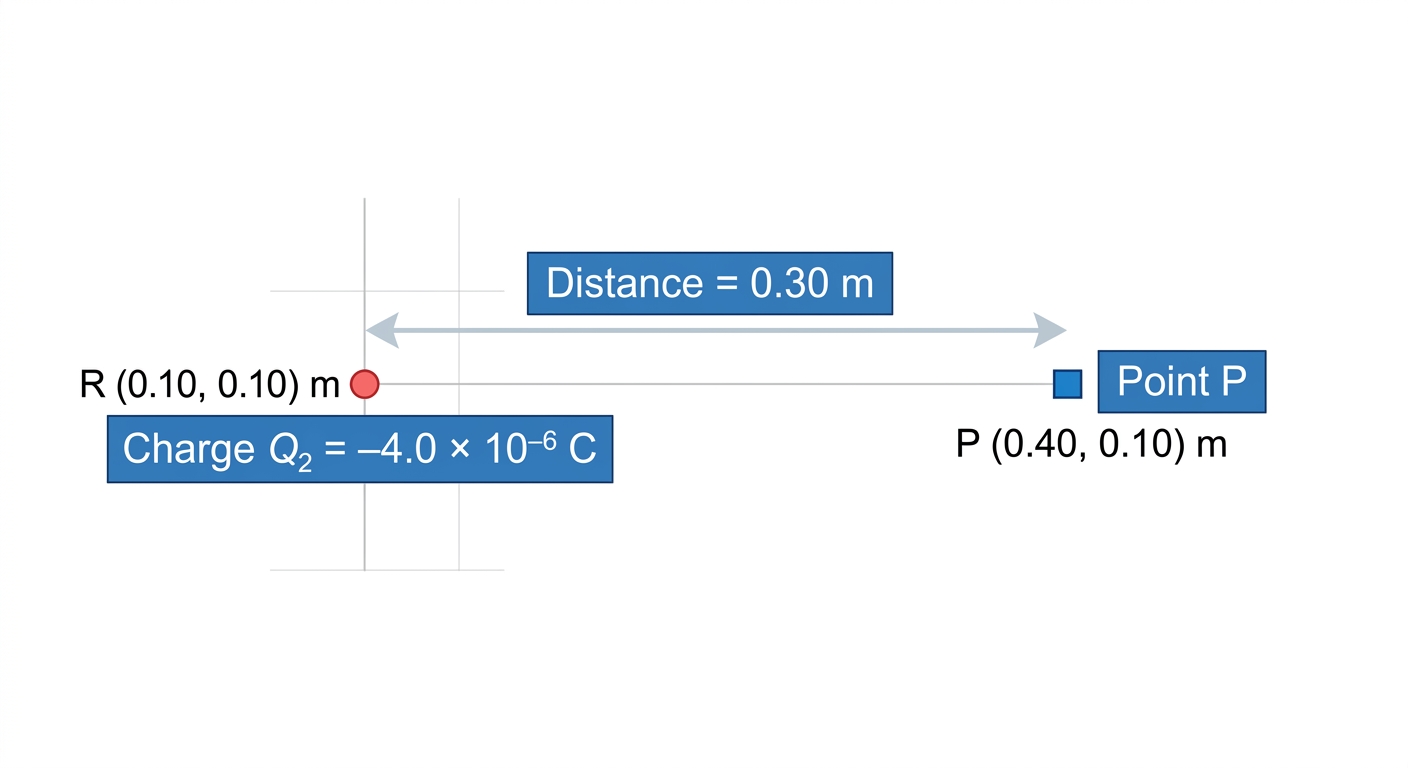
A point charge of is fixed at point R. Point P is from R. What is the magnitude of the electric field strength at P due to this charge? (Use .)
revisionprep.com
Summary Answer
Not available for this question.
Model Answer
Not available for this question.
Marking Scheme
Not available for this question.
Examiner Insights
Not available for this question.
Electric charge, charging, Millikan's experiment and Coulomb's law
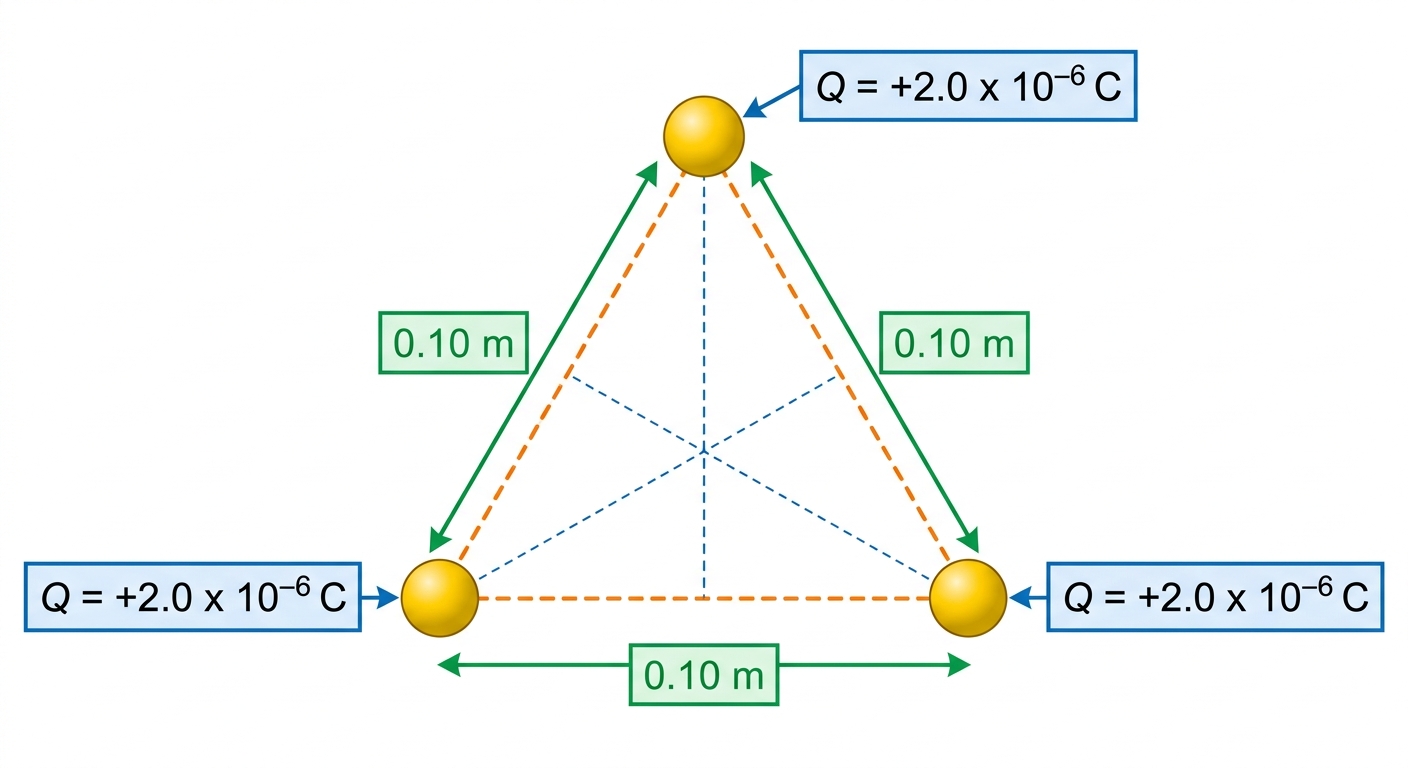
Three point charges, each of C, are placed at the vertices of an equilateral triangle of side m. What is the magnitude of the net electrostatic force acting one of the charges?
revisionprep.com
Summary Answer
Not available for this question.
Model Answer
Not available for this question.
Marking Scheme
Not available for this question.
Examiner Insights
Not available for this question.
Electric field strength, field lines and uniform fields between plates
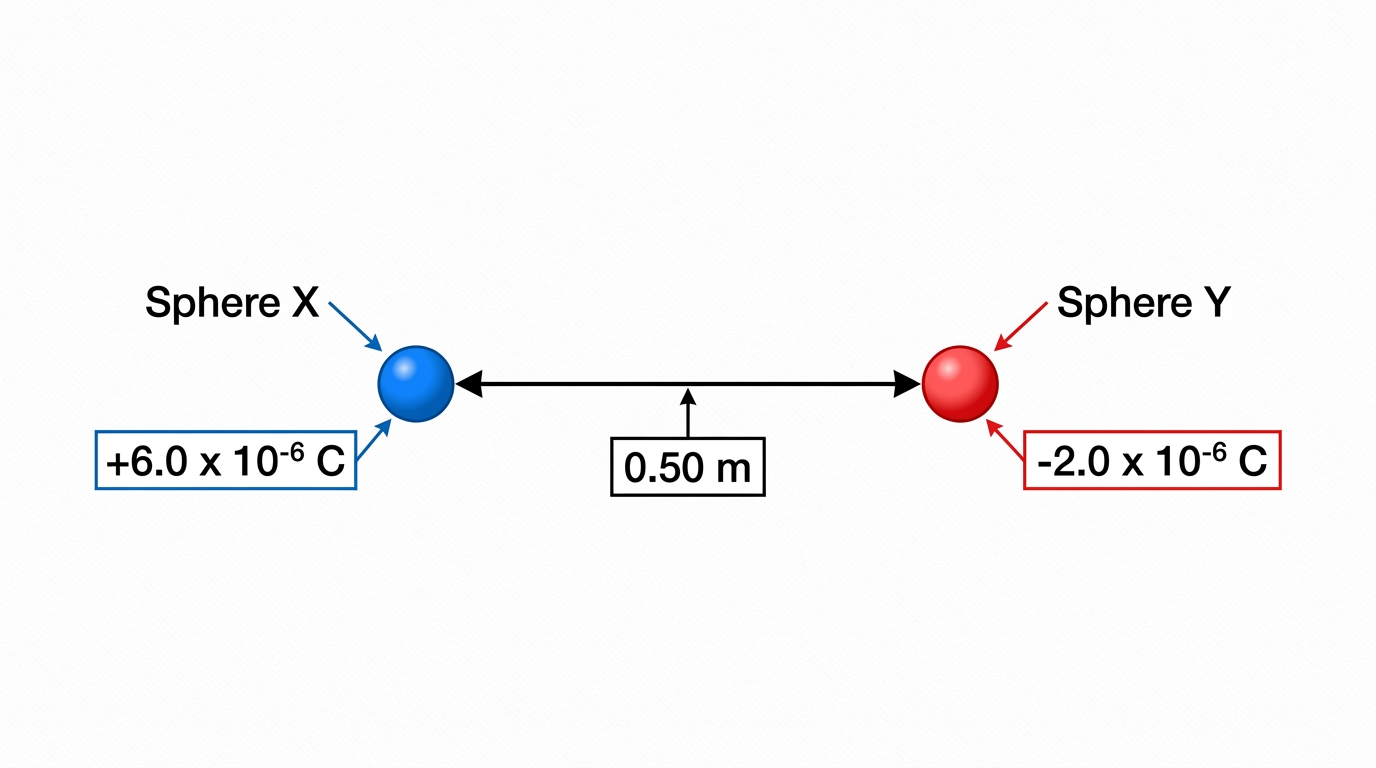
The shows two identical conducting spheres, X and Y, before contact. Sphere X carries charge and sphere Y carries charge . The spheres are briefly brought into contact and then separated to a centre-to-centre distance of . What is the magnitude of the electrostatic force between the spheres? (Use .)
revisionprep.com
Summary Answer
Not available for this question.
Model Answer
Not available for this question.
Marking Scheme
Not available for this question.
Examiner Insights
Not available for this question.
Electric charge, charging, Millikan's experiment and Coulomb's law
In a Millikan-type experiment, charged oil drops are held stationary between two horizontal metal plates apart. Drop P has a mass of , a negative charge, and is held stationary when the potential difference between the plates is . The charges found for six drops, including P, are given in Table 1. Each value has an uncertainty of .
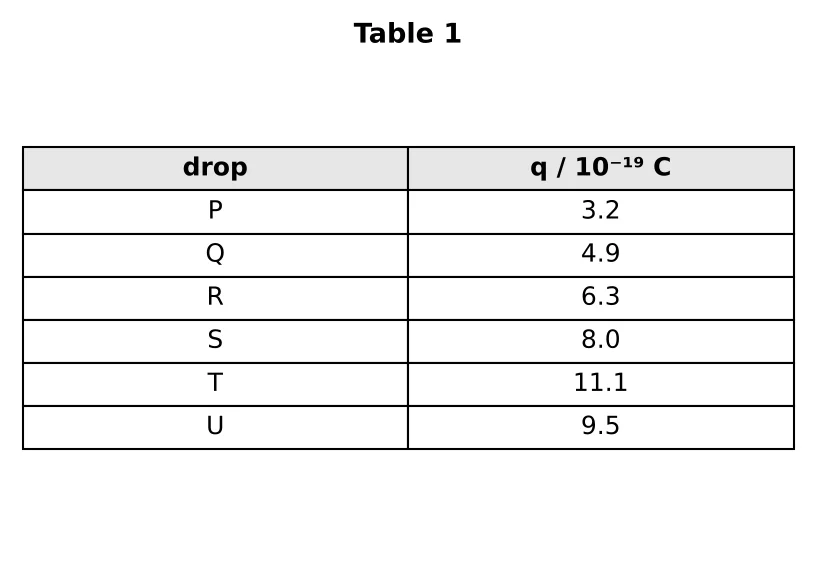
State which plate, upper or lower, is positive. Give a reason.
Show that the magnitude of the charge on drop P is about .
Explain how the data in Table 1 support the idea that electric charge is quantised.
Determine, using all the data, a value for the elementary charge.
A student claims that the elementary charge is , the smallest charge in Table 1. Justify whether the data support this claim.
revisionprep.com
Summary Answer
Not available for this question.
Model Answer
Not available for this question.
Marking Scheme
Not available for this question.
Examiner Insights
Not available for this question.
Electric field strength, field lines and uniform fields between plates
In a model electrostatic precipitator, smoke particles pass between two vertical plates apart. The particles gain a charge and are attracted to one plate. Figure 1 shows the percentage of the dust collected for different potential differences between the plates. Each value has an uncertainty of .
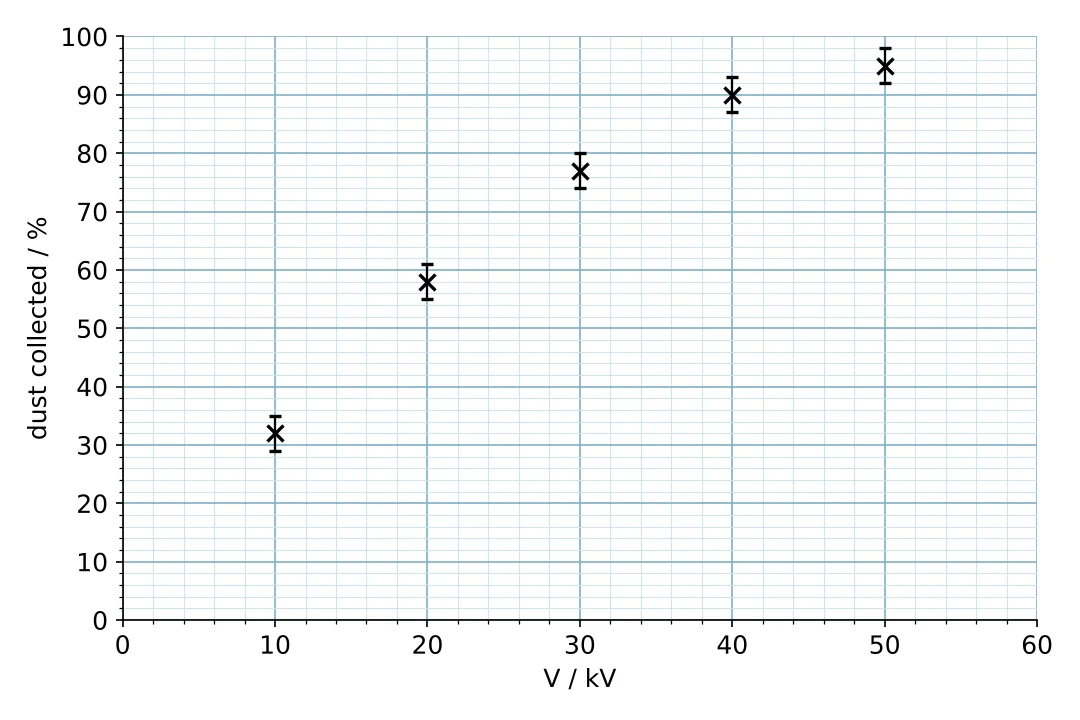
Calculate the electric field strength between the plates when .
A particle carries a charge of . Determine the electric force on it at .
Describe how the percentage collected varies with .
Explain why increasing increases the percentage collected.
The owner wants to collect at least 98 % of the dust. Evaluate whether increasing is likely to achieve this.
revisionprep.com
Summary Answer
Not available for this question.
Model Answer
Not available for this question.
Marking Scheme
Not available for this question.
Examiner Insights
Not available for this question.
That's every free question here — 6 of 147.
+141 more questions, plus Mock Papers & Worksheets, are waiting in Premium.