Gravitational Fields · Paper 1 — Free Physics SL Practice Questions
Free questions
Open in full, with answers, mark scheme and examiner insights.
Newton's law of gravitation, field strength and field lines
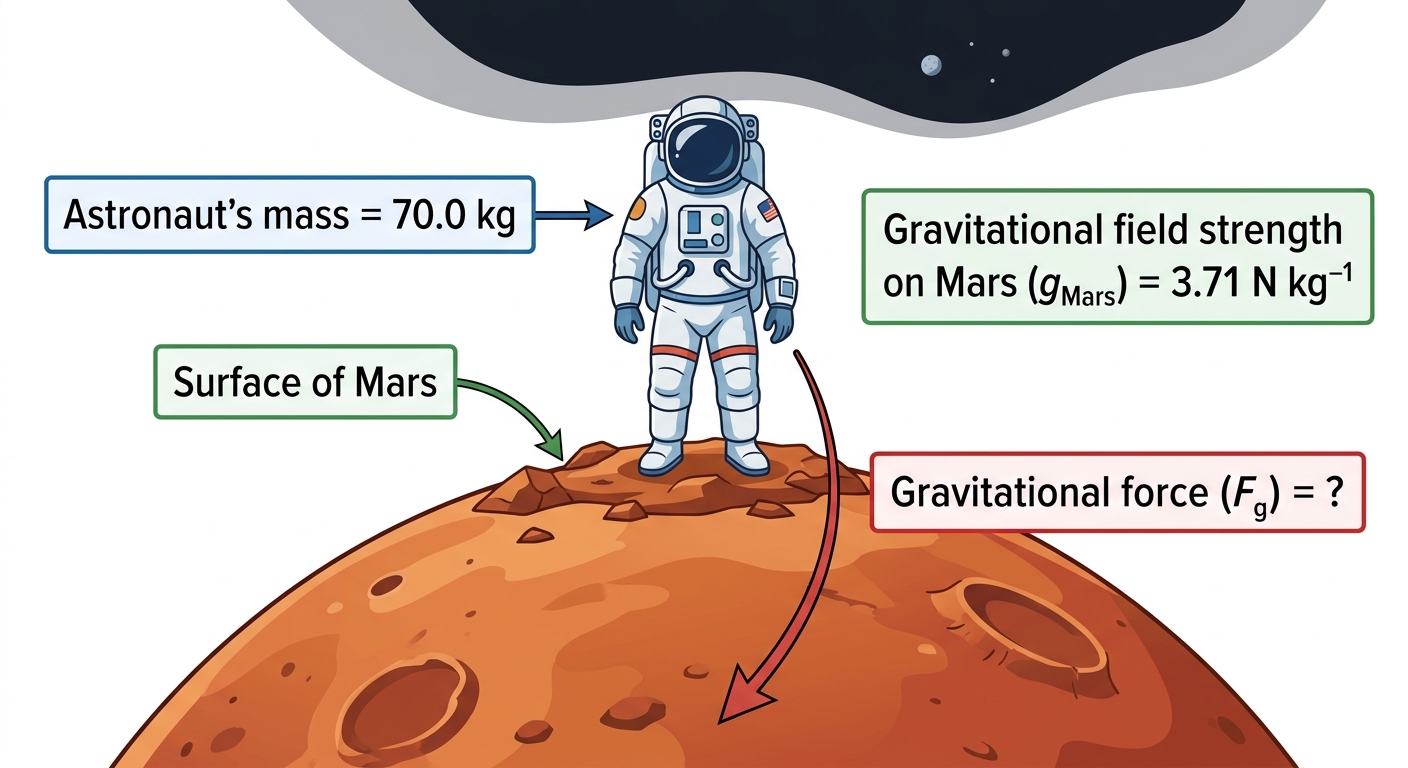
A astronaut stands on the surface of Mars, where the gravitational field strength is . What is the gravitational force exerted on the astronaut by Mars?
revisionprep.com
Summary Answer
Not available for this question.
Model Answer
Not available for this question.
Marking Scheme
Not available for this question.
Examiner Insights
Not available for this question.
Kepler's three laws of orbital motion
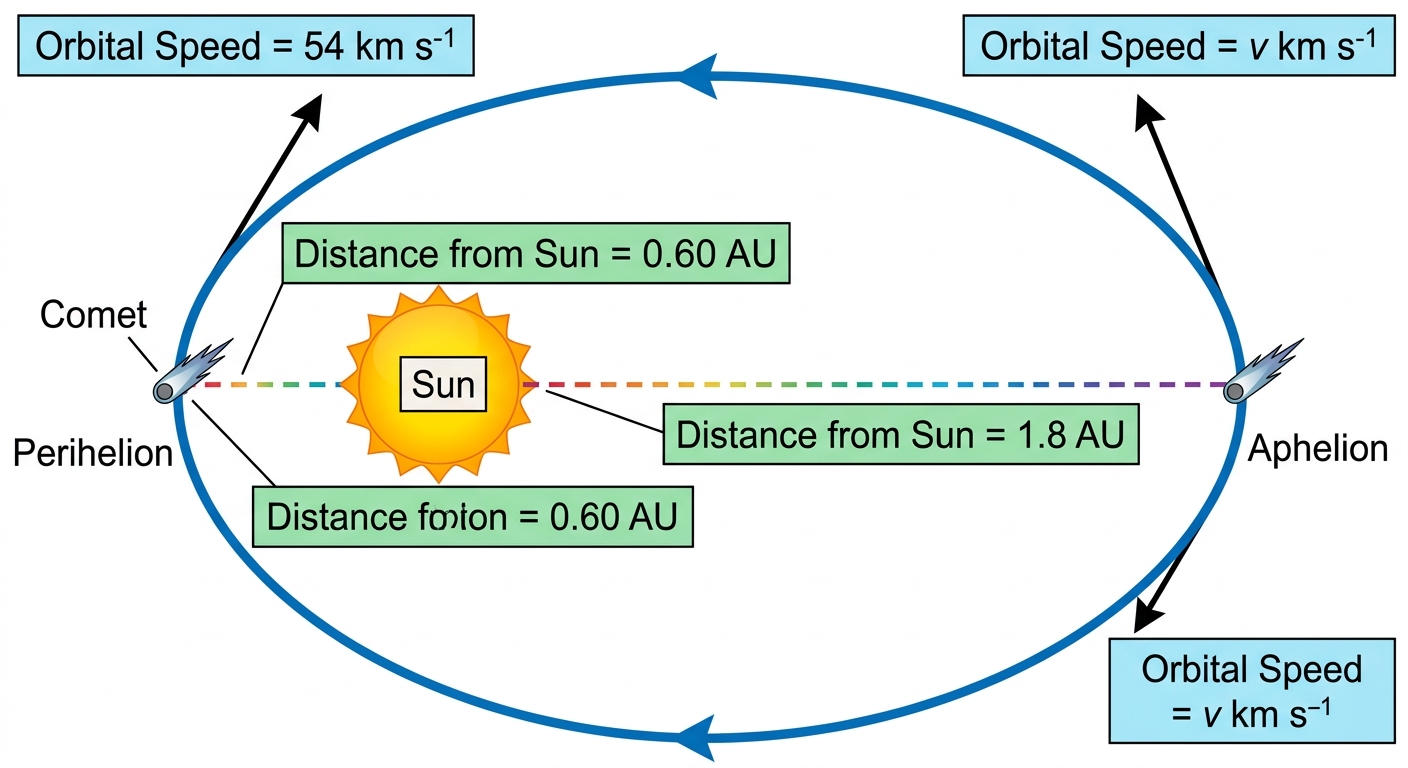
A comet orbits the Sun in a highly elliptical orbit. At perihelion, the comet is from the Sun and has an orbital speed of . At aphelion, the comet is from the Sun. What is the orbital speed of the comet at aphelion?
revisionprep.com
Summary Answer
Not available for this question.
Model Answer
Not available for this question.
Marking Scheme
Not available for this question.
Examiner Insights
Not available for this question.
Newton's law of gravitation, field strength and field lines
A student measures the gravitational field strength in the laboratory using a simple pendulum of length . She times 20 complete oscillations five times. Table 1 shows her readings. For a simple pendulum, .
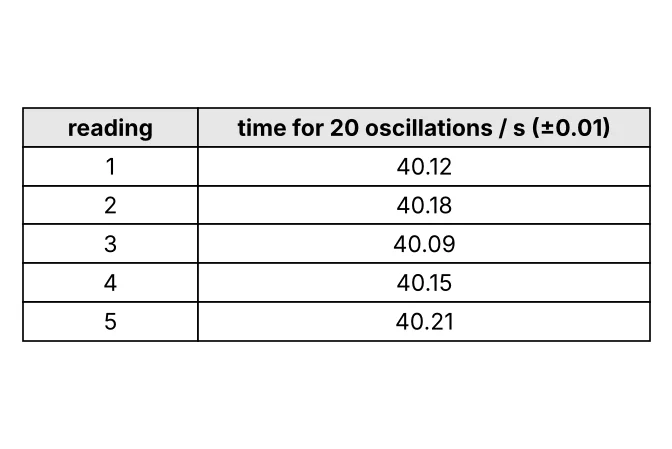
Determine the mean time for 20 oscillations and its absolute uncertainty.
Determine .
Determine the percentage uncertainty in your value of .
revisionprep.com
Summary Answer
Not available for this question.
Model Answer
Not available for this question.
Marking Scheme
Not available for this question.
Examiner Insights
Not available for this question.
Kepler's three laws of orbital motion
A student uses published data for five moons of Saturn. Figure 1 shows a graph of against , where is the orbital period and the orbital radius of each moon. Each radius has an uncertainty of ; the uncertainties in are too small to show.
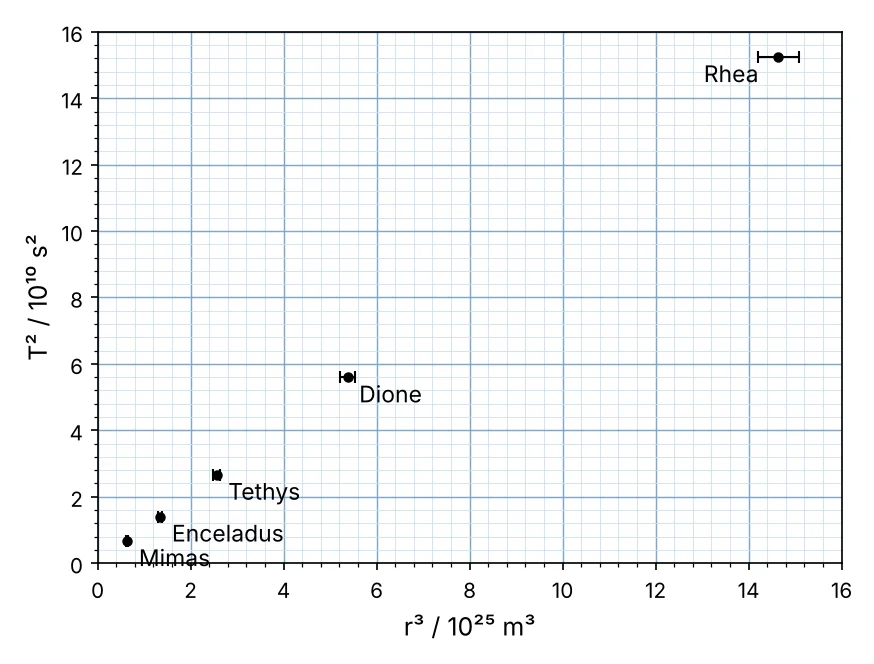
Outline why Kepler's third law predicts that the graph is a straight line through the origin.
Draw the line of best fit and determine its gradient.
Determine the mass of Saturn.
State the percentage uncertainty in , and explain why the error bars are longest for Rhea.
Titan orbits Saturn at a radius of . Use your gradient to determine Titan's orbital period, in days.
revisionprep.com
Summary Answer
Not available for this question.
Model Answer
Not available for this question.
Marking Scheme
Not available for this question.
Examiner Insights
Not available for this question.
Newton's law of gravitation, field strength and field lines
A lander on Titan, the largest moon of Saturn, carries a pendulum whose length can be changed. For each length the period is measured. Figure 1 shows a graph of against ; the error bars show in and in . For a simple pendulum, .
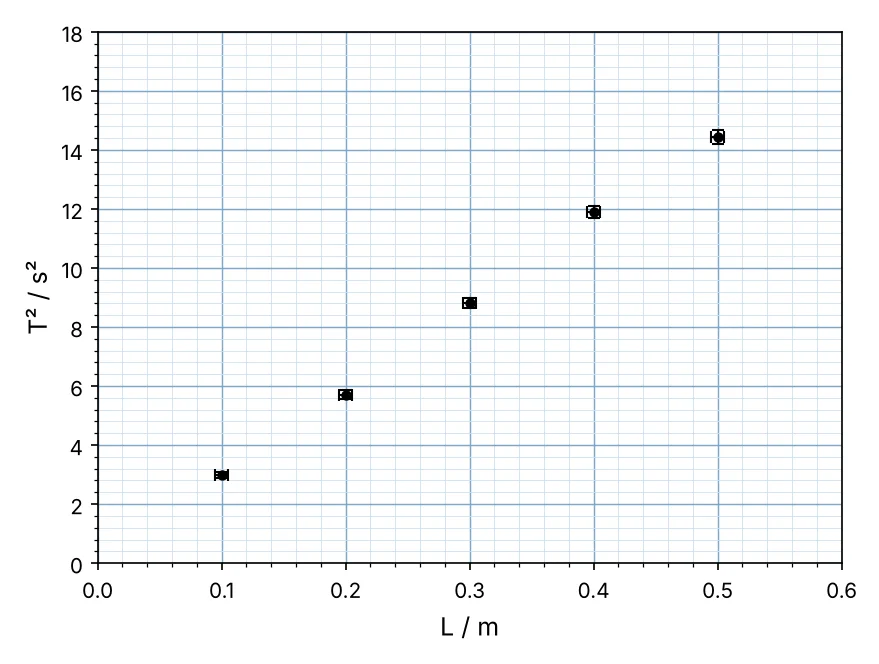
Explain why the graph is expected to be a straight line through the origin, and state an expression for its gradient.
Draw the line of best fit and determine the gravitational field strength at the surface of Titan.
The radius of Titan is . Determine the mass of Titan.
Lines of maximum and minimum gradient give a gradient of . Determine the absolute uncertainty in the mass of Titan, assuming the radius is exact.
Titan has a dense atmosphere. Suggest how the atmosphere could affect the measured periods, and hence the value of found.
revisionprep.com
Summary Answer
Not available for this question.
Model Answer
Not available for this question.
Marking Scheme
Not available for this question.
Examiner Insights
Not available for this question.
Kepler's three laws of orbital motion
Figure 1 shows a graph of against for six satellites in circular orbits around Earth, from a low orbit to a geostationary orbit. is the orbital period in seconds and the orbital radius in metres. The uncertainties are too small to show.
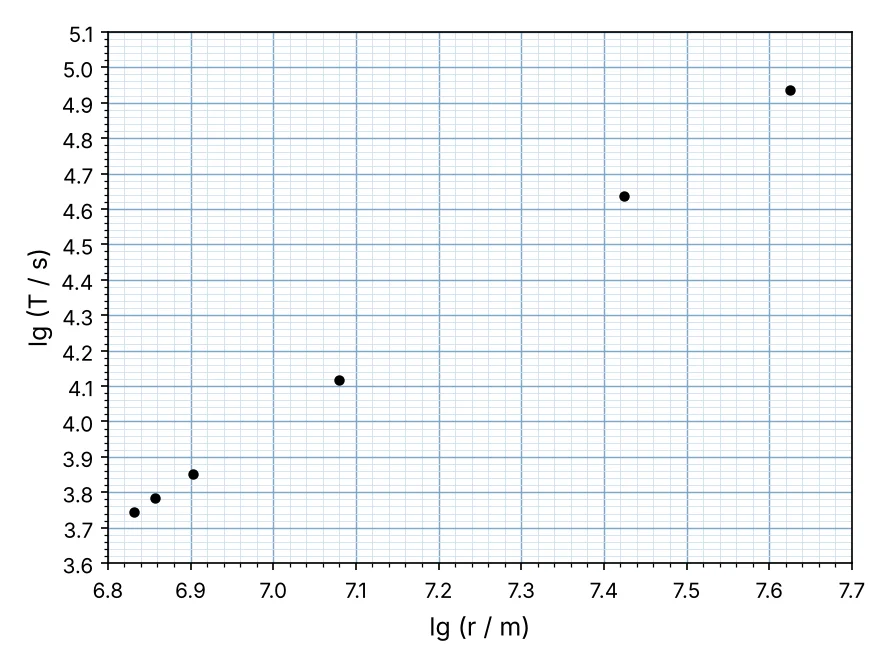
Show that Kepler's third law predicts a straight line of gradient 1.5.
Determine the gradient of the line through the points.
The relation can be written . Use a point on the line to determine the mass of Earth.
Explain why a graph of against is more useful for these data than a graph of against .
revisionprep.com
Summary Answer
Not available for this question.
Model Answer
Not available for this question.
Marking Scheme
Not available for this question.
Examiner Insights
Not available for this question.
That's every free question here — 6 of 111.
+105 more questions, plus Mock Papers & Worksheets, are waiting in Premium.