Electric and Magnetic Fields · Paper 2 — Free Physics SL Practice Questions
Free questions
Open in full, with answers, mark scheme and examiner insights.
Electric charge, charging, Millikan's experiment and Coulomb's law
Figure 1 shows two parallel metal plates apart in a vacuum. The top plate carries and the bottom plate . The plates are charged by connecting them to a supply.
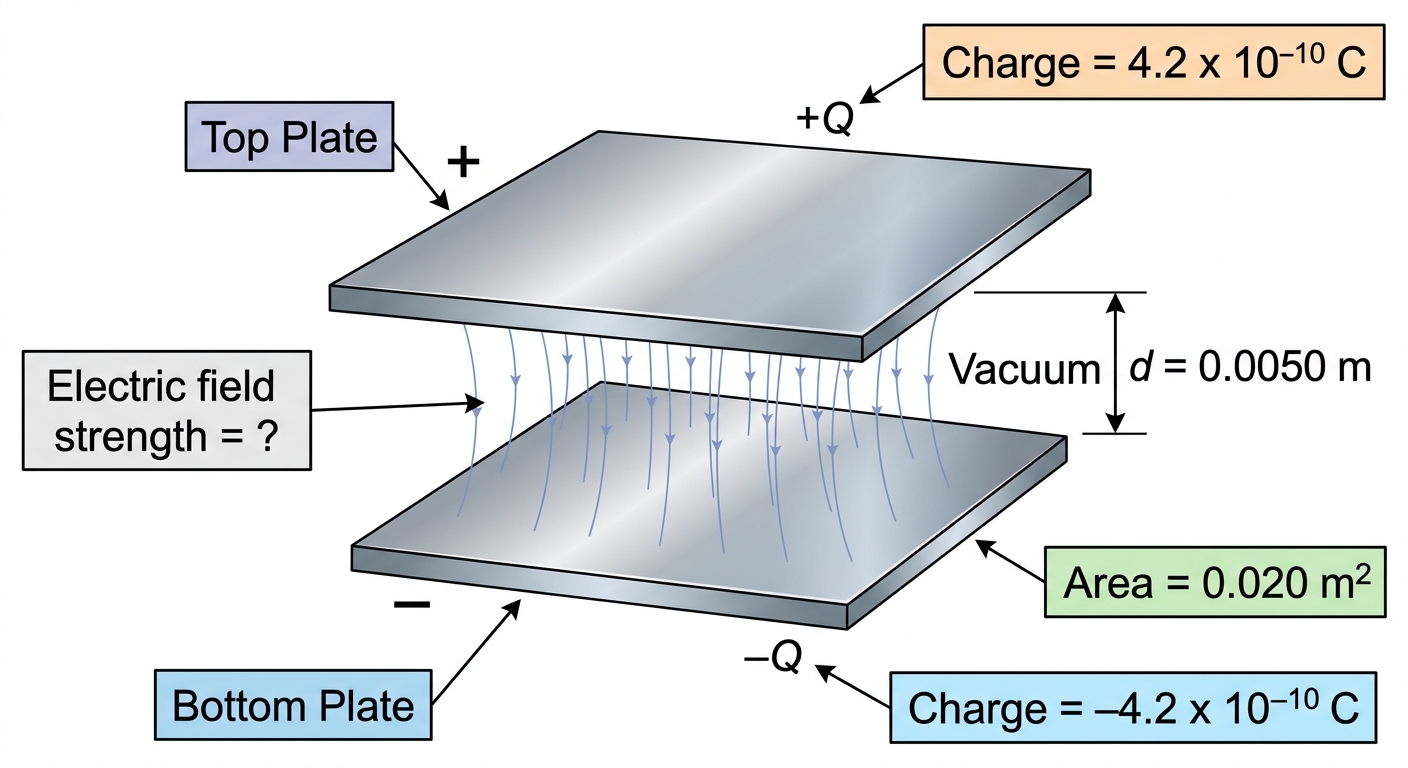
Calculate the number of electrons transferred to the bottom plate.
Calculate the electric field strength between the plates.
Calculate the force on an electron between the plates.
Describe the field-line pattern between the plates, including near the edges.
revisionprep.com
Summary Answer
Not available for this question.
Model Answer
Not available for this question.
Marking Scheme
Not available for this question.
Examiner Insights
Not available for this question.
Electric field strength, field lines and uniform fields between plates
In an electrostatic precipitator a dust particle of charge moves in the uniform field between two plates, as shown. It moves from a point at a potential of to a point at , both measured relative to the negative plate.
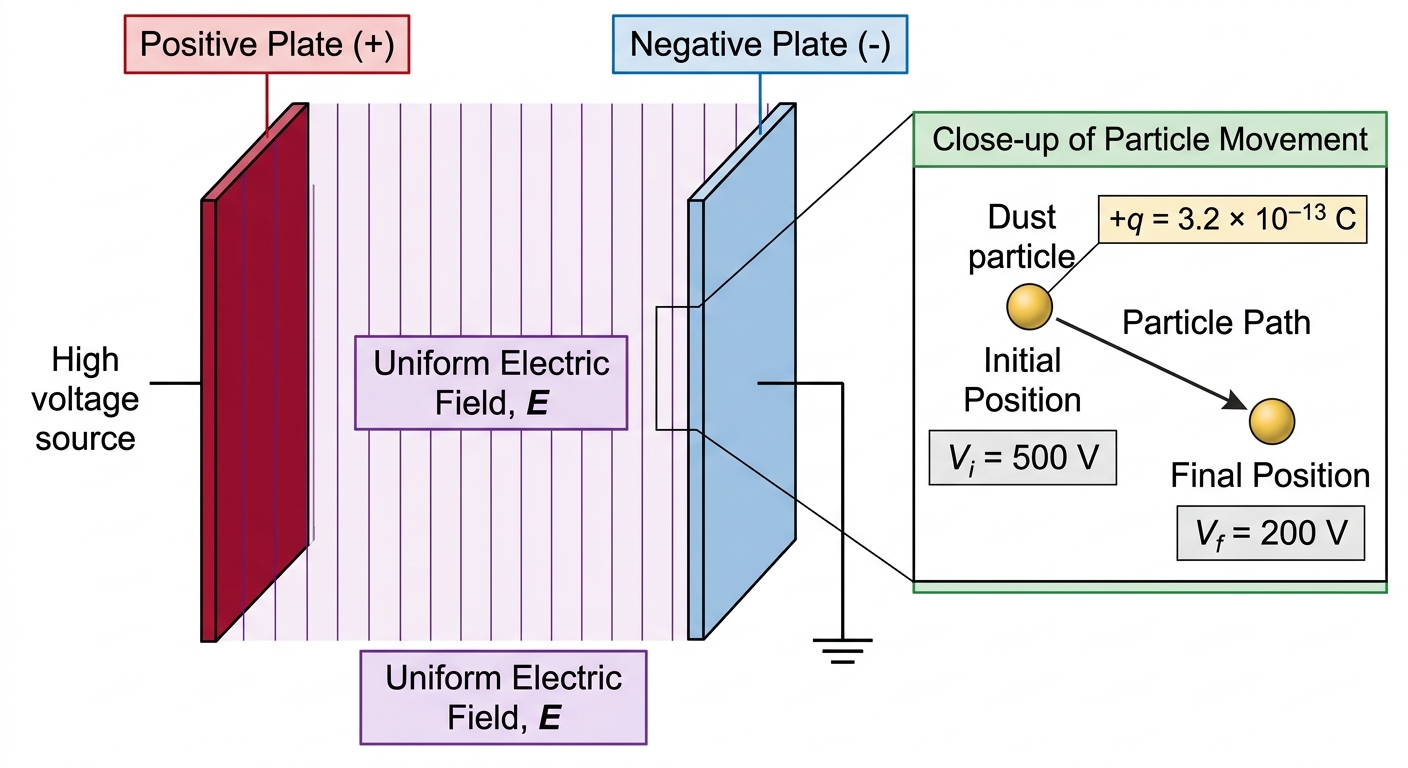
State what is meant by the potential difference between two points.
Calculate the work done on the particle by the electric field.
Deduce whether the particle is moving towards the positive plate or towards the negative plate.
revisionprep.com
Summary Answer
Not available for this question.
Model Answer
Not available for this question.
Marking Scheme
Not available for this question.
Examiner Insights
Not available for this question.
Electric charge, charging, Millikan's experiment and Coulomb's law
Figure 1 shows two point charges, and , held apart.
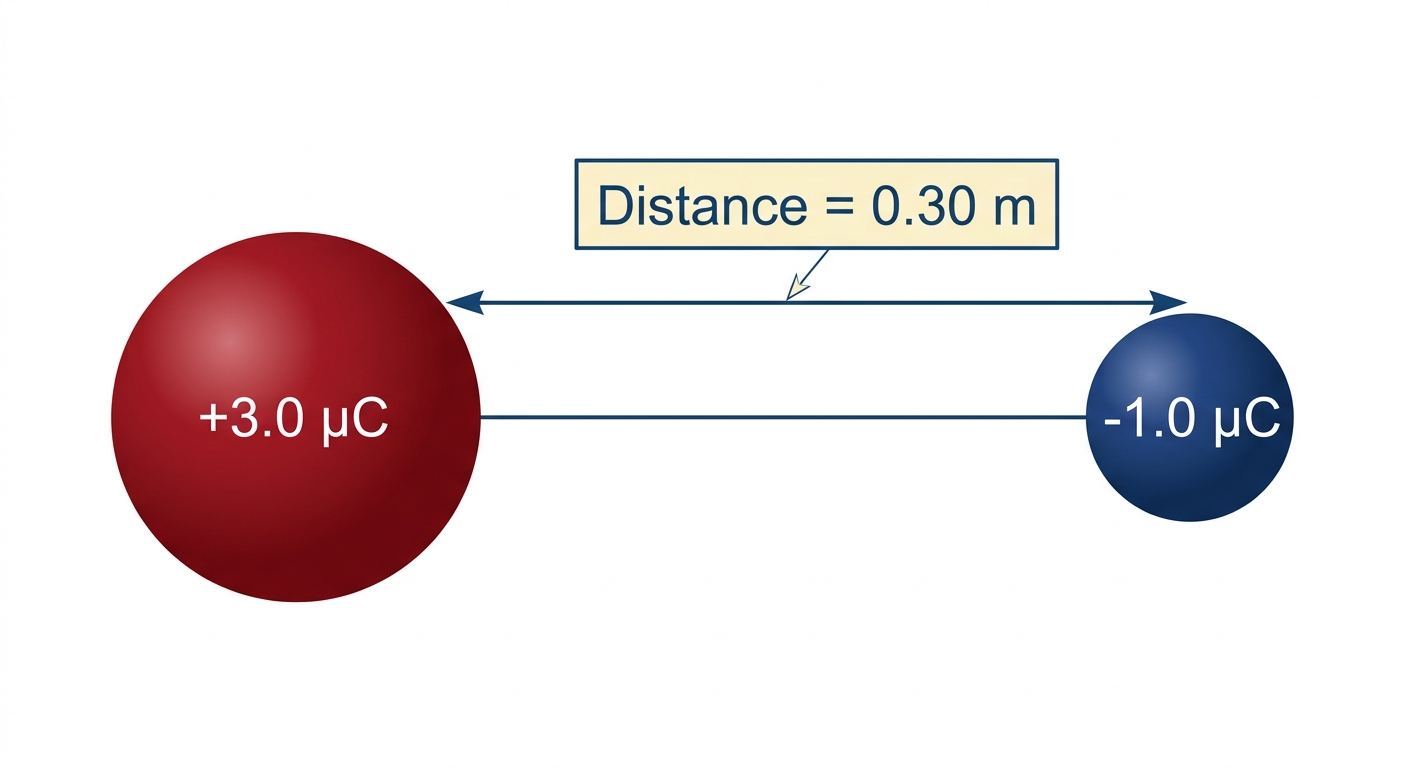
Calculate the force between the charges.
Determine the magnitude of the electric field at the midpoint between them.
Determine the distance from the charge of the point on the line where the field is zero.
revisionprep.com
Summary Answer
Not available for this question.
Model Answer
Not available for this question.
Marking Scheme
Not available for this question.
Examiner Insights
Not available for this question.
Electric field strength, field lines and uniform fields between plates
A small conducting sphere of mass hangs from an insulating thread between two vertical parallel metal plates apart. A potential difference of is applied across the plates. The sphere carries a charge of and hangs at rest with the thread at an angle to the vertical, as shown.
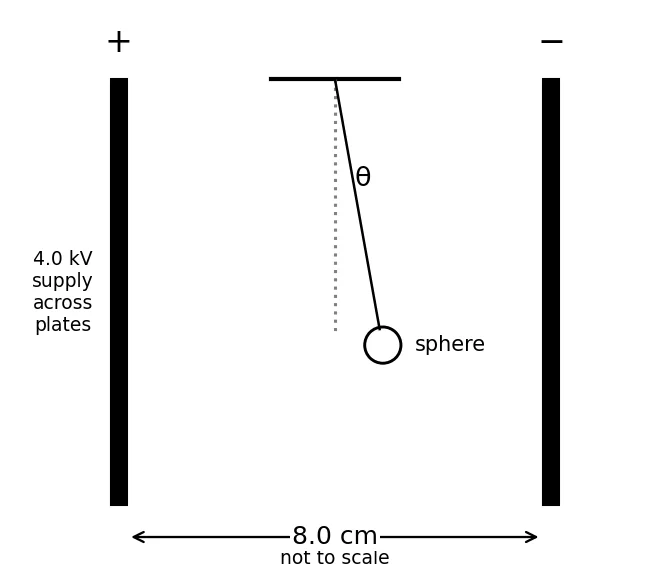
Determine the electric field strength between the plates.
Calculate the electric force on the sphere.
Determine .
The separation of the plates is halved while the potential difference stays the same. Predict, with a reason, the new value of .
revisionprep.com
Summary Answer
Not available for this question.
Model Answer
Not available for this question.
Marking Scheme
Not available for this question.
Examiner Insights
Not available for this question.
Electric charge, charging, Millikan's experiment and Coulomb's law
Three small charged spheres A, B and C are fixed in a vacuum at the positions shown. A carries , B carries and C carries . A is at the origin, B is from A along the -axis and C is from A along the -axis.
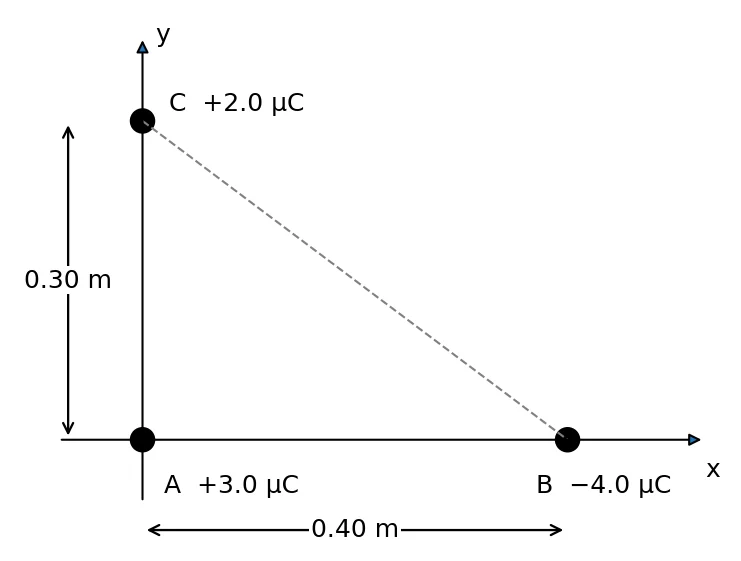
Calculate the magnitude of the force on C due to A, and state its direction.
Calculate the magnitude of the force on C due to B.
Determine the magnitude of the resultant electric force on C.
Hence determine the electric field strength at the position of C due to A and B.
revisionprep.com
Summary Answer
Not available for this question.
Model Answer
Not available for this question.
Marking Scheme
Not available for this question.
Examiner Insights
Not available for this question.
Magnetic field patterns: wires, coils, solenoids and bar magnets
A student compares electric field lines with magnetic field lines. She sets up (i) two parallel metal plates apart with a potential difference of , and (ii) a long solenoid carrying a steady current.
Calculate the electric field strength between the plates.
Compare the field-line patterns between the plates and inside the solenoid.
Distinguish between where electric field lines begin and end and where magnetic field lines begin and end.
A small positive test charge is placed between the plates and a small compass inside the solenoid. State the direction of the force on the charge and the direction in which the compass points, relative to the field lines.
The student says: 'A magnet broken in half gives a separate north pole and a separate south pole.' Discuss this statement using the idea of field lines.
Explain why the density of field lines can represent field strength for both kinds of field.
The potential difference is doubled and the separation is halved. Determine the new field strength.
revisionprep.com
Summary Answer
Not available for this question.
Model Answer
Not available for this question.
Marking Scheme
Not available for this question.
Examiner Insights
Not available for this question.
That's every free question here — 6 of 151.
+145 more questions, plus Mock Papers & Worksheets, are waiting in Premium.