Gravitational Fields · Paper 2 — Free Physics SL Practice Questions
Free questions
Open in full, with answers, mark scheme and examiner insights.
Newton's law of gravitation, field strength and field lines
A rover of mass is designed to drive on Mars. Mars has mass and radius . Engineers test the wheels on Earth () using a lighter test model.
Calculate the gravitational field strength at the surface of Mars.
Calculate the weight of the rover on Mars and on Earth.
The test model has the same weight on Earth as the real rover has on Mars. Determine the mass of the test model.
Explain why the test model cannot show how quickly the real rover speeds up on Mars when its wheels exert the same driving force.
revisionprep.com
Summary Answer
Not available for this question.
Model Answer
Not available for this question.
Marking Scheme
Not available for this question.
Examiner Insights
Not available for this question.
Kepler's three laws of orbital motion
The semi-major axis and orbital period of four planets are: Mercury AU, years; Venus AU, years; Mars AU, years; Jupiter AU, years.
State Kepler's third law.
Calculate for Mercury and for Jupiter, in .
Saturn's semi-major axis is AU. Determine its orbital period.
Outline why is equal to 1 in these units.
For a planet of mass in a circular orbit of radius around the Sun (mass ), derive the relation .
revisionprep.com
Summary Answer
Not available for this question.
Model Answer
Not available for this question.
Marking Scheme
Not available for this question.
Examiner Insights
Not available for this question.
Newton's law of gravitation, field strength and field lines
The graph shows how the gravitational field strength due to Earth varies with distance from Earth's centre, for from to , where is Earth's radius.
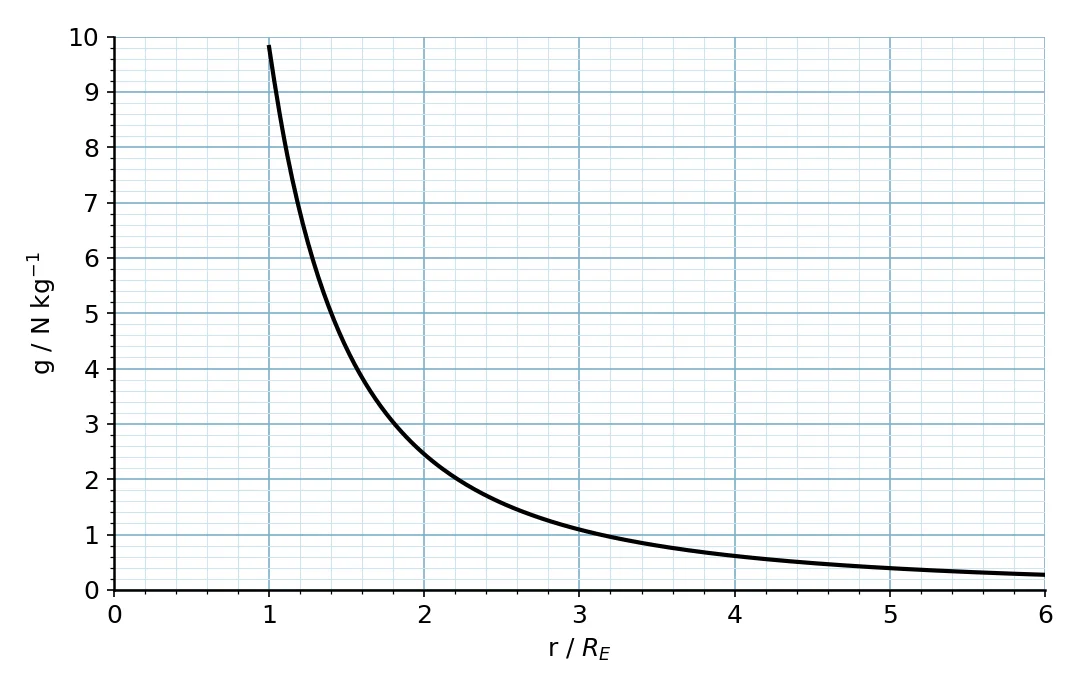
Write down the value of at .
Use two points on the graph to show that is inversely proportional to .
Determine the distance from Earth's centre, in metres, at which .
A second planet has the same mass as Earth but half its radius. Describe how its graph of against compares with the one shown.
revisionprep.com
Summary Answer
Not available for this question.
Model Answer
Not available for this question.
Marking Scheme
Not available for this question.
Examiner Insights
Not available for this question.
Kepler's three laws of orbital motion
The diagram shows a comet's orbit around the Sun. At perihelion the comet is from the Sun and moves at . At aphelion it is from the Sun. The Sun's mass is .
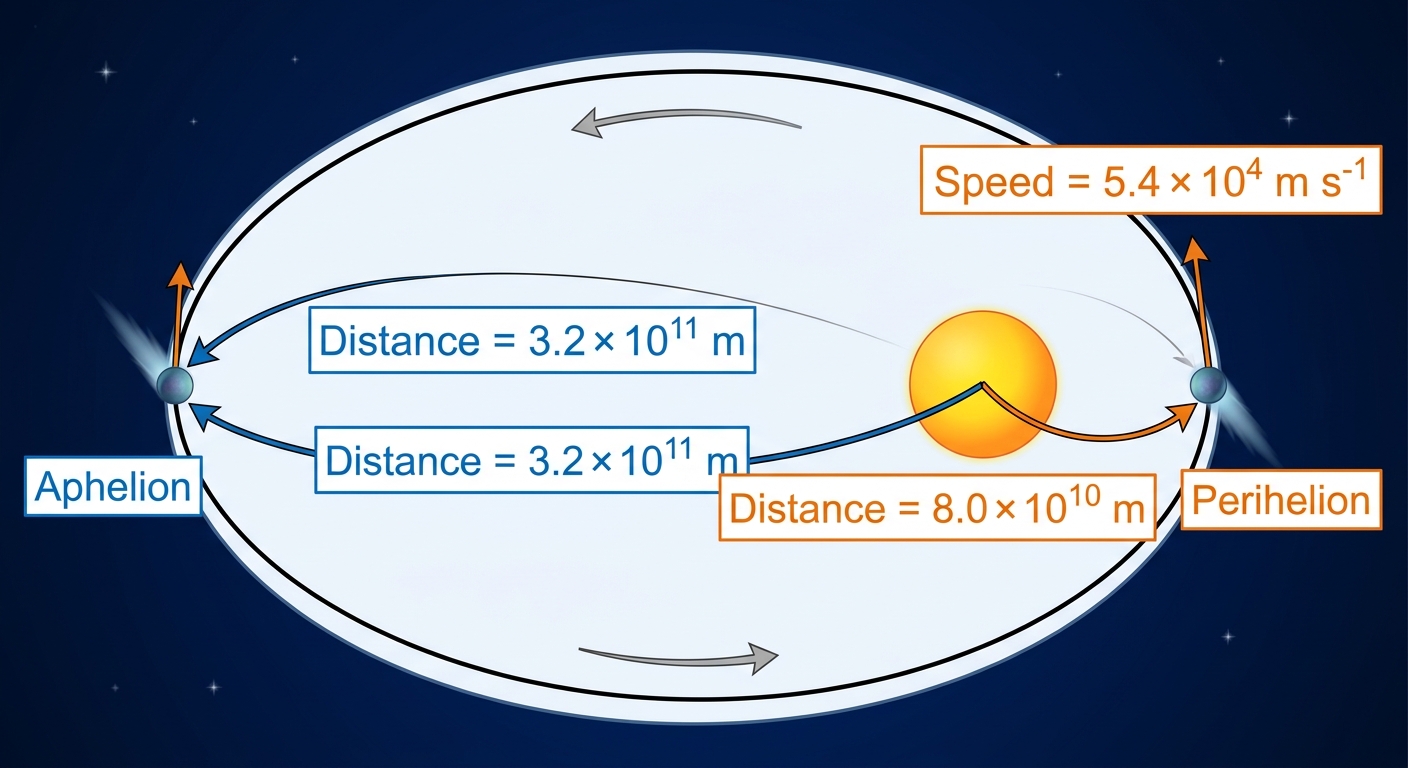
State Kepler's second law.
Explain, in terms of the work done by the Sun's gravitational force, why the comet speeds up as it travels from aphelion to perihelion.
Use Kepler's second law to determine the comet's speed at aphelion.
Determine the orbital period of the comet, in years ().
Determine the ratio of the Sun's gravitational field strength at perihelion to that at aphelion.
revisionprep.com
Summary Answer
Not available for this question.
Model Answer
Not available for this question.
Marking Scheme
Not available for this question.
Examiner Insights
Not available for this question.
Newton's law of gravitation, field strength and field lines
The diagram shows a binary star system. Star X has mass and star Y has mass . Their centres are apart, and both stars move in circular orbits about their common centre of mass.
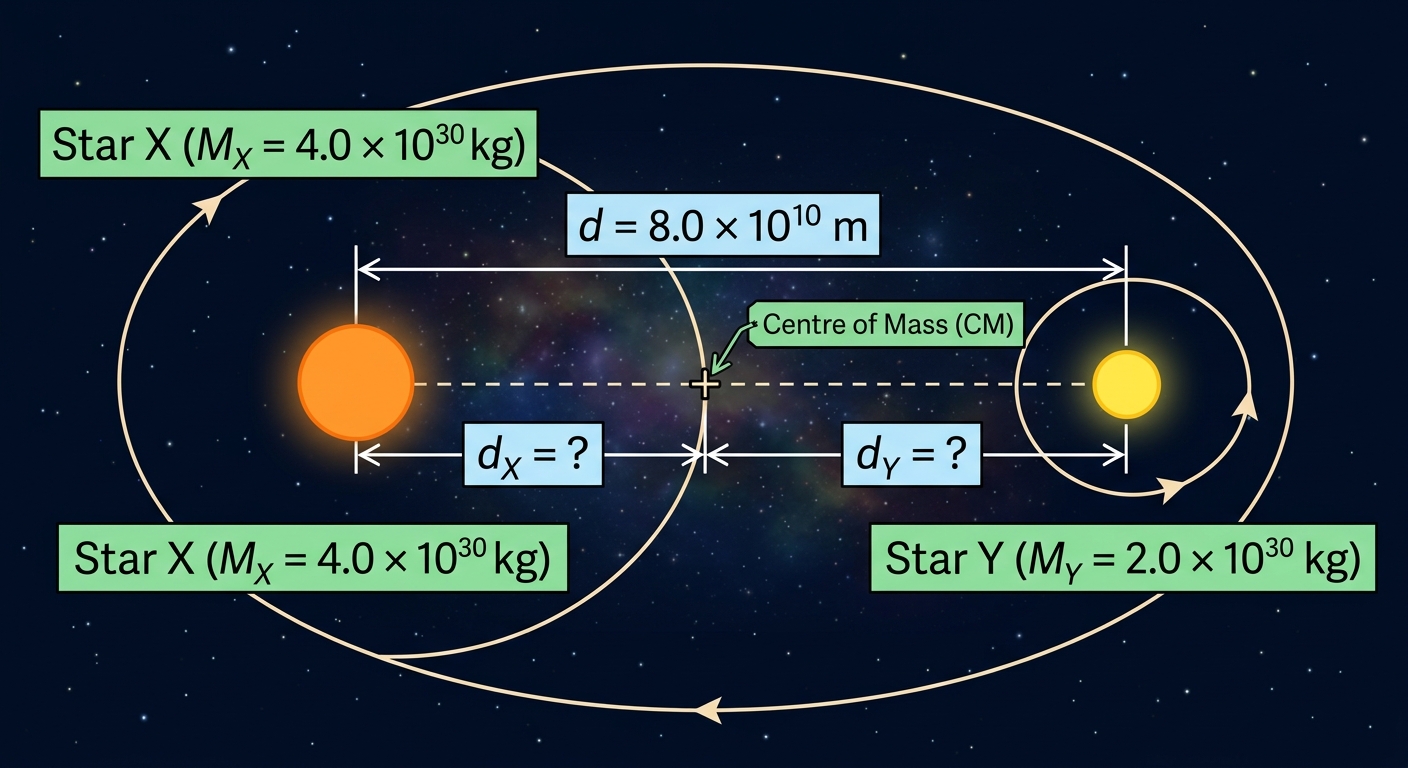
Calculate the distance from the centre of X to the centre of mass of the system.
Calculate the magnitude of the resultant gravitational field strength at the centre of mass, and state its direction.
A student says that a small object placed at rest at the centre of mass would stay there. Explain why the student is wrong.
Determine the distance from the centre of X of the point between the stars where the resultant field strength is zero.
Both stars have the same orbital period. By considering the force on star Y, determine this period in years ().
Discuss whether Kepler's third law in the form , with the mass of X and the radius of Y's orbit, gives the correct period for star Y.
revisionprep.com
Summary Answer
Not available for this question.
Model Answer
Not available for this question.
Marking Scheme
Not available for this question.
Examiner Insights
Not available for this question.
Gravitational potential, potential energy and equipotentials (HL content — moving to HL only)
The diagram shows two circular orbits around Earth for a satellite of mass , at altitudes of (orbit 1) and (orbit 2). Earth has mass and radius .
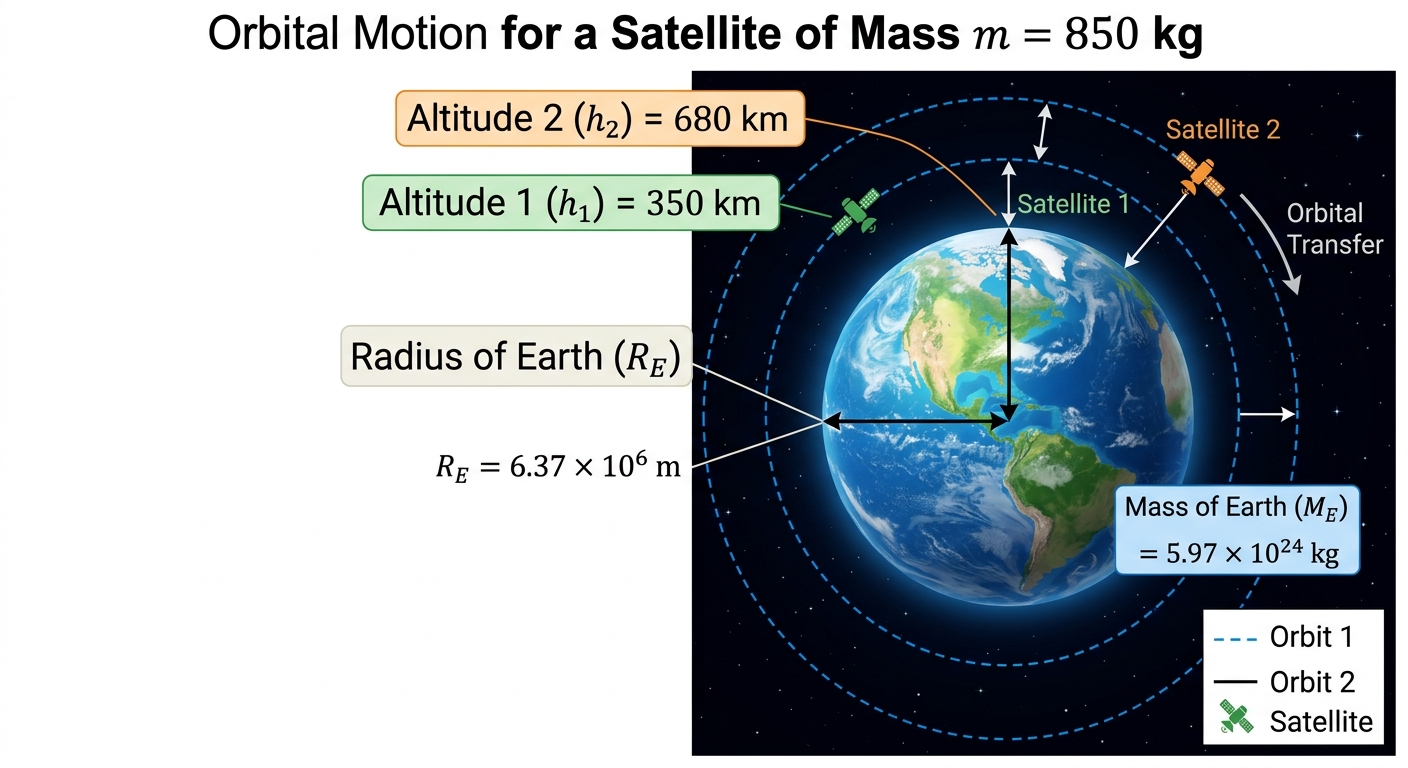
Calculate the gravitational field strength at each orbit.
Determine the orbital period of each orbit, in minutes.
A student estimates the energy needed to raise the satellite from orbit 1 to orbit 2 as , using at Earth's surface. Explain why this overestimates the gain in gravitational potential energy.
Determine the change in the satellite's orbital speed when it moves from orbit 1 to orbit 2.
Explain why the satellite's acceleration is smaller in orbit 2 than in orbit 1, and why the satellite is in free fall in both orbits.
revisionprep.com
Summary Answer
Not available for this question.
Model Answer
Not available for this question.
Marking Scheme
Not available for this question.
Examiner Insights
Not available for this question.
That's every free question here — 6 of 112.
+106 more questions, plus Mock Papers & Worksheets, are waiting in Premium.