Motion in Electromagnetic Fields · Paper 2 — Free Physics SL Practice Questions
Free questions
Open in full, with answers, mark scheme and examiner insights.
Motion of charged particles in uniform electric fields
A proton is released from rest at the positive plate of a pair of parallel plates apart. The potential difference between the plates is . ; .
Calculate the electric field strength between the plates.
Calculate the force on the proton.
Calculate the acceleration of the proton.
Calculate the speed of the proton when it reaches the negative plate.
revisionprep.com
Summary Answer
Not available for this question.
Model Answer
Not available for this question.
Marking Scheme
Not available for this question.
Examiner Insights
Not available for this question.
Motion of charged particles in uniform magnetic fields (F = qvB sin θ)
A positron (charge , mass ) moves at at right angles to a uniform magnetic field of .
Calculate the magnitude of the magnetic force on the positron.
Calculate the radius of its path.
An electron moves with the same velocity in the same field. Compare its path with that of the positron.
revisionprep.com
Summary Answer
Not available for this question.
Model Answer
Not available for this question.
Marking Scheme
Not available for this question.
Examiner Insights
Not available for this question.
Motion of charged particles in uniform magnetic fields (F = qvB sin θ)
The diagram shows a metal rod PQ moving at along its own length, from P towards Q, in a uniform magnetic field of directed into the page. .
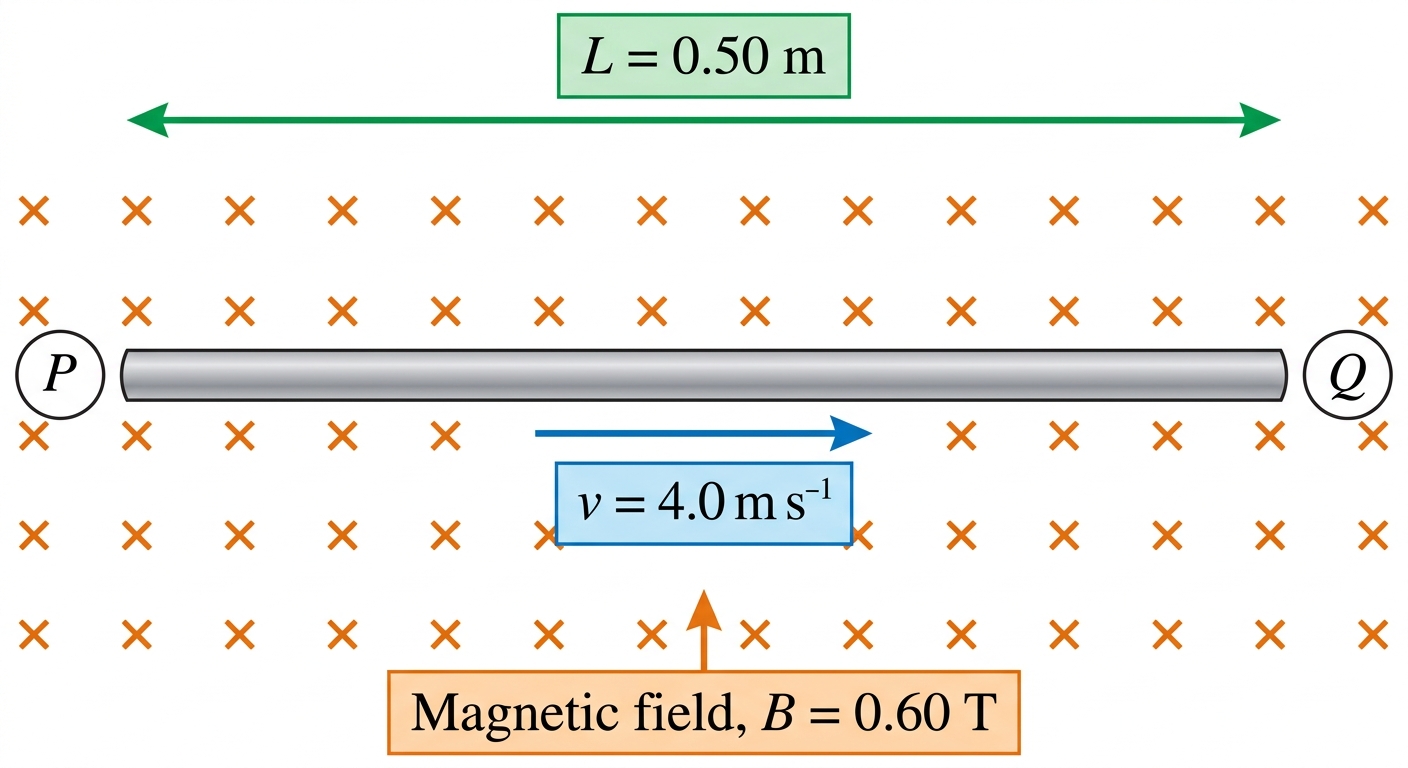
Calculate the magnitude of the magnetic force on a free electron in the rod.
State the direction of this force.
Explain why no charge builds up at the ends P and Q.
The rod is turned so that it moves at right angles to its length, up the page, with P on the left. State which end of the rod the free electrons are pushed towards.
revisionprep.com
Summary Answer
Not available for this question.
Model Answer
Not available for this question.
Marking Scheme
Not available for this question.
Examiner Insights
Not available for this question.
Crossed electric and magnetic fields (velocity selector)
The diagram shows a velocity selector. Alpha particles move horizontally to the right between two plates. The uniform electric field is directed down the page and the uniform magnetic field of is directed into the page. Alpha particles with speed pass through undeflected. Charge of alpha particle ; mass .
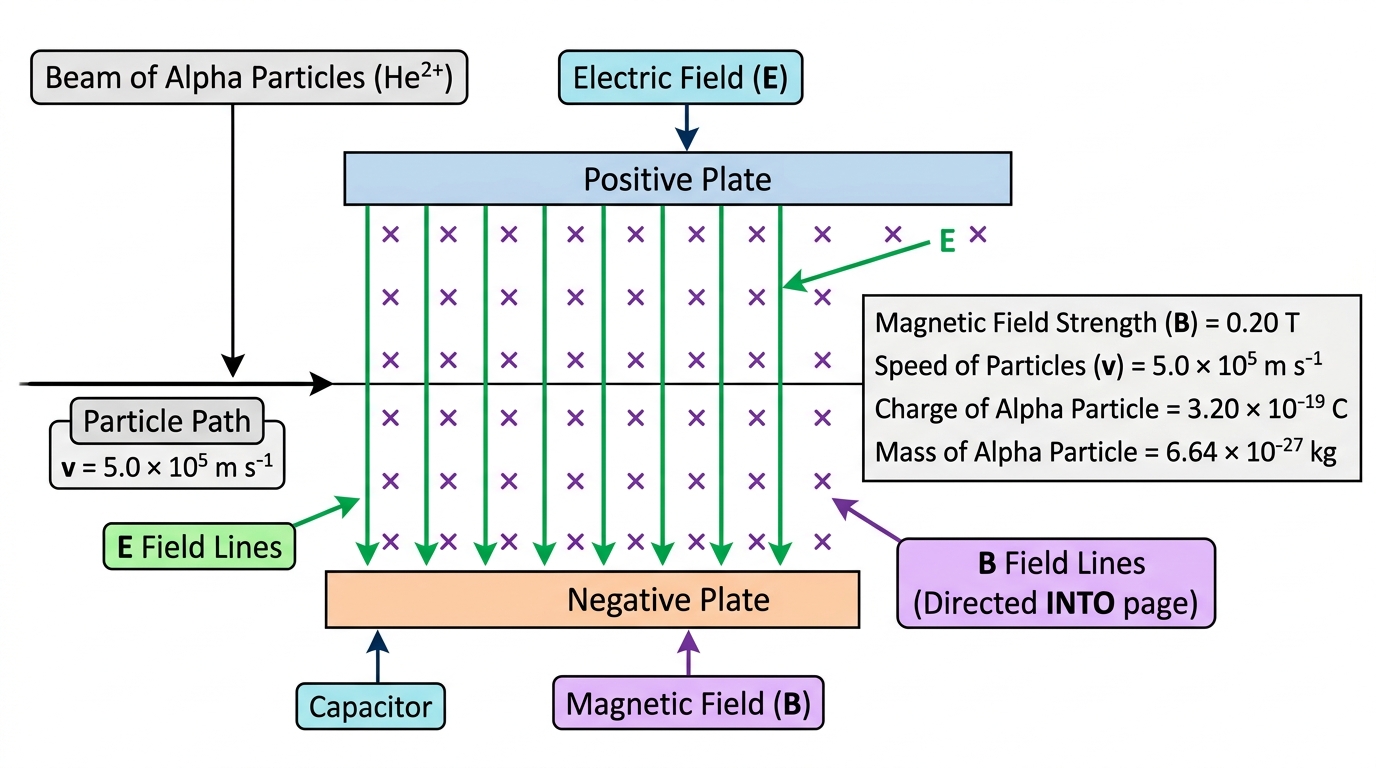
State the direction of the electric force and of the magnetic force on an alpha particle.
Calculate the electric field strength.
The electric field is switched off. Calculate the radius of the path of the alpha particles in the magnetic field.
With both fields on, protons of the same speed are sent through the selector. Explain whether they are deflected.
revisionprep.com
Summary Answer
Not available for this question.
Model Answer
Not available for this question.
Marking Scheme
Not available for this question.
Examiner Insights
Not available for this question.
Motion of charged particles in uniform magnetic fields (F = qvB sin θ)
An electron enters the region between two horizontal parallel plates at , moving parallel to the plates midway between them. The plates are long and apart, with a potential difference of between them. ; .
Show that the electric field strength between the plates is .
Calculate the acceleration of the electron between the plates.
Determine the vertical deflection the electron would have at the end of the plates.
Deduce whether the electron leaves the region between the plates.
revisionprep.com
Summary Answer
Not available for this question.
Model Answer
Not available for this question.
Marking Scheme
Not available for this question.
Examiner Insights
Not available for this question.
Force on a current-carrying conductor and between parallel wires
The diagram shows two long, straight, parallel wires 1 and 2, apart in a vacuum. Each carries a current of in the same direction. .
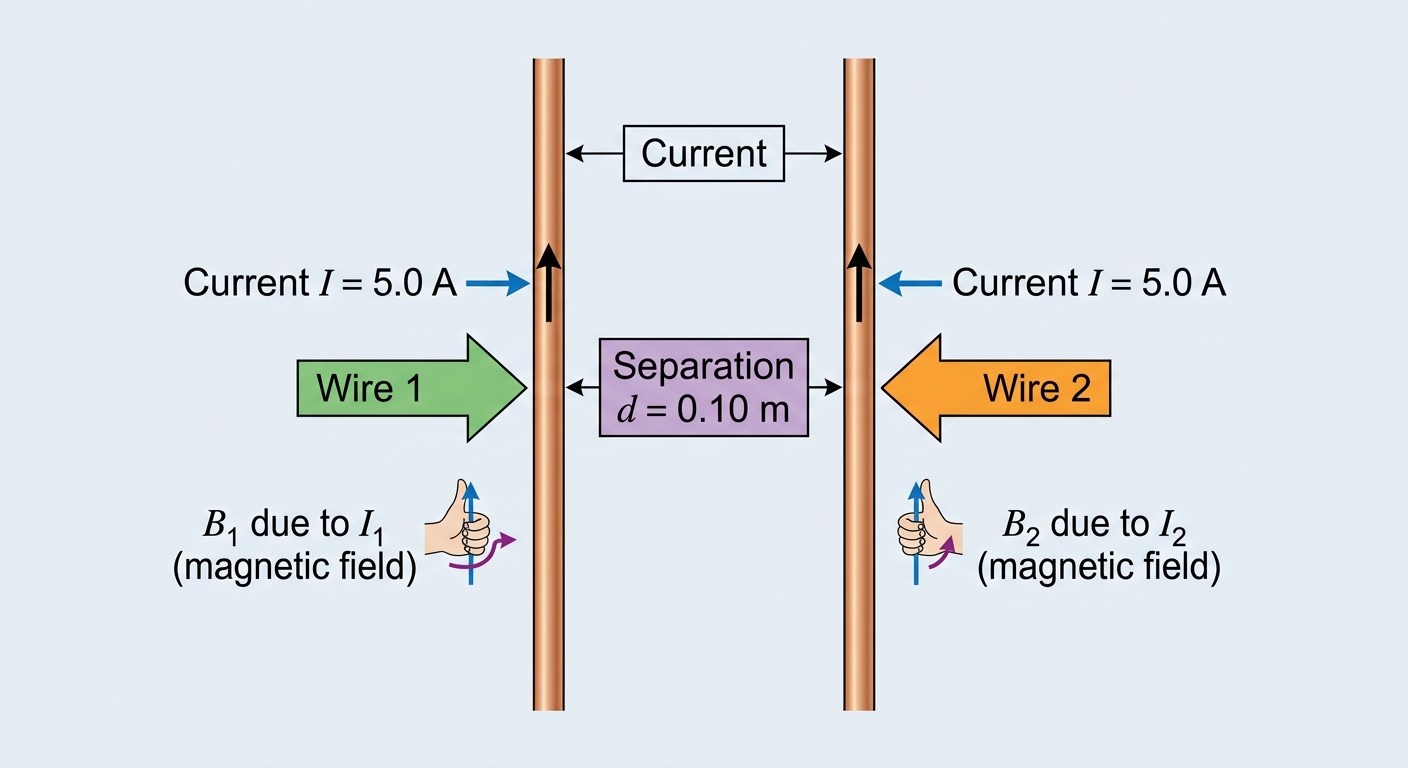
Calculate the force per unit length on wire 2 and state whether the wires attract or repel.
Explain, using the magnetic field of wire 1, why wire 2 experiences this force.
The current in wire 1 is doubled. Compare the forces on the two wires.
With both currents at , a third parallel wire carrying in the opposite direction is placed in the plane of the wires, from wire 2 and from wire 1. Determine the magnitude and direction of the resultant force per unit length on the third wire.
Discuss why the conductors of a high-current busbar system must be firmly supported along their length.
revisionprep.com
Summary Answer
Not available for this question.
Model Answer
Not available for this question.
Marking Scheme
Not available for this question.
Examiner Insights
Not available for this question.
That's every free question here — 6 of 141.
+135 more questions, plus Mock Papers & Worksheets, are waiting in Premium.