Fission · Paper 1 — Free Physics SL Practice Questions
Free questions
Open in full, with answers, mark scheme and examiner insights.
Spontaneous and neutron-induced fission; energy release
A uranium-235 nucleus absorbs a slow neutron and undergoes nuclear fission. Which statement describes what happens to the nucleus?
revisionprep.com
Summary Answer
Not available for this question.
Model Answer
Not available for this question.
Marking Scheme
Not available for this question.
Examiner Insights
Not available for this question.
Chain reactions and critical mass
A nuclear fission reactor operates at a steady power output. The multiplication factor is defined as
Which condition describes a critical reactor?
revisionprep.com
Summary Answer
Not available for this question.
Model Answer
Not available for this question.
Marking Scheme
Not available for this question.
Examiner Insights
Not available for this question.
Spontaneous and neutron-induced fission; energy release
When uranium-235 undergoes neutron-induced fission, the two fragments have a range of mass numbers. Figure 1 shows the measured yield (the percentage of fissions that produce a fragment of each mass number) for thermal-neutron fission. The error bars show an uncertainty of .
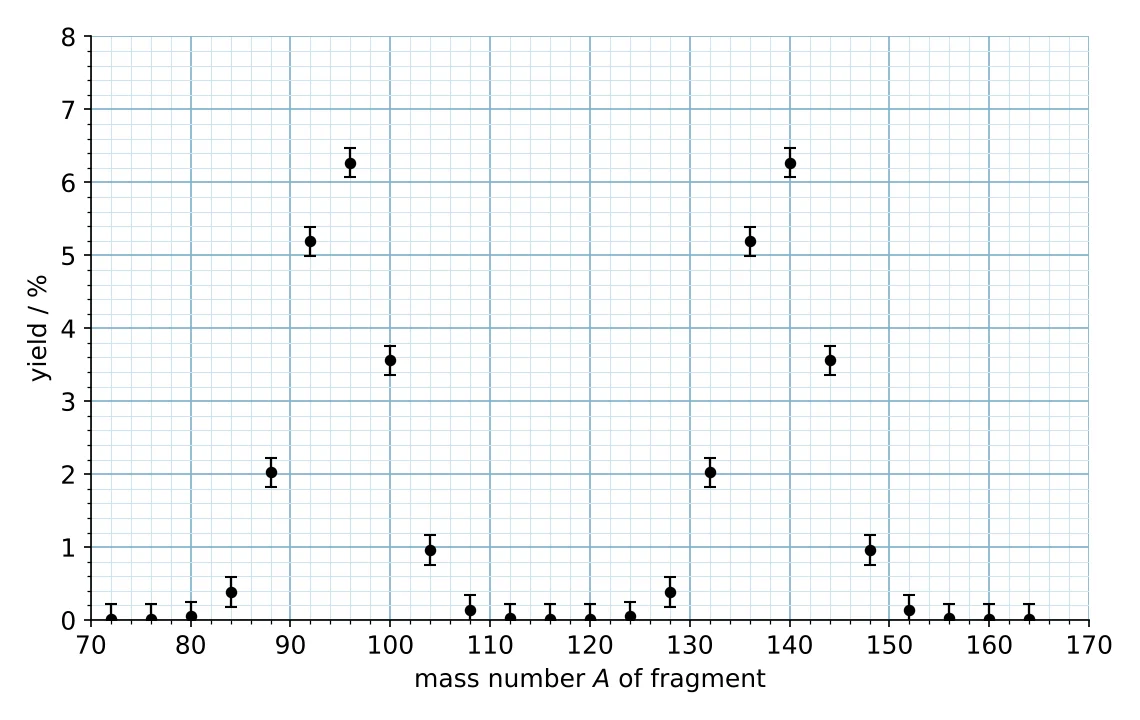
State the mass numbers of the most likely light fragment and the most likely heavy fragment.
Deduce the number of neutrons released in a fission that produces these two fragments.
Use Figure 1 to compare the probability of fission into two equal fragments with that of fission into the most likely pair.
The yields over all mass numbers add up to . Explain why.
revisionprep.com
Summary Answer
Not available for this question.
Model Answer
Not available for this question.
Marking Scheme
Not available for this question.
Examiner Insights
Not available for this question.
Chain reactions and critical mass
In a reactor, each fission releases 2.5 neutrons, and the probability that a neutron causes another fission is 0.40. The control rods are partly withdrawn, raising this probability to 0.44. What is the new multiplication factor and the state of the reactor?
revisionprep.com
Summary Answer
Not available for this question.
Model Answer
Not available for this question.
Marking Scheme
Not available for this question.
Examiner Insights
Not available for this question.
Spontaneous and neutron-induced fission; energy release
In an experiment, the kinetic energies of the light and heavy fragments from single fission events of uranium-236 are measured, together with their mass numbers and . Table 1 shows four events. Each kinetic energy has an uncertainty of . The fragments start from rest.
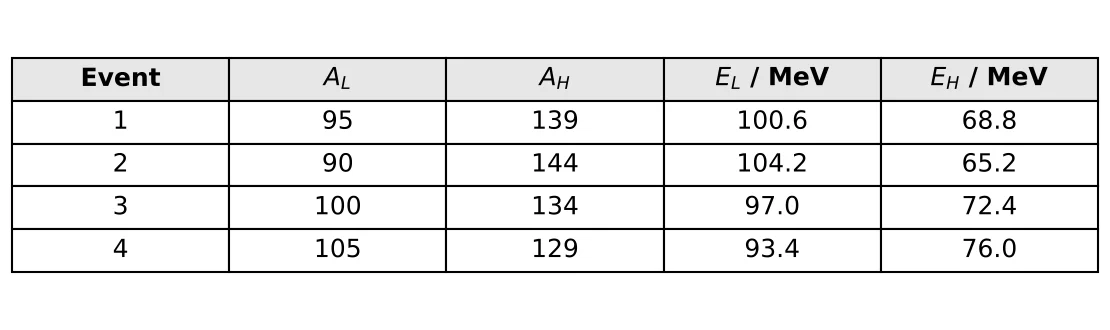
Explain why, if momentum is conserved, .
Determine for event 2, with its absolute uncertainty.
Deduce whether event 2 is consistent with the conservation of momentum.
revisionprep.com
Summary Answer
Not available for this question.
Model Answer
Not available for this question.
Marking Scheme
Not available for this question.
Examiner Insights
Not available for this question.
Chain reactions and critical mass
A new reactor core is loaded with fuel in steps. A neutron source in the core and a detector are used: as fuel is added, the count rate of the detector rises, and it would become very large if the core reached critical mass. Figure 1 shows plotted against the mass of fuel loaded. The error bars show an uncertainty of in each value.
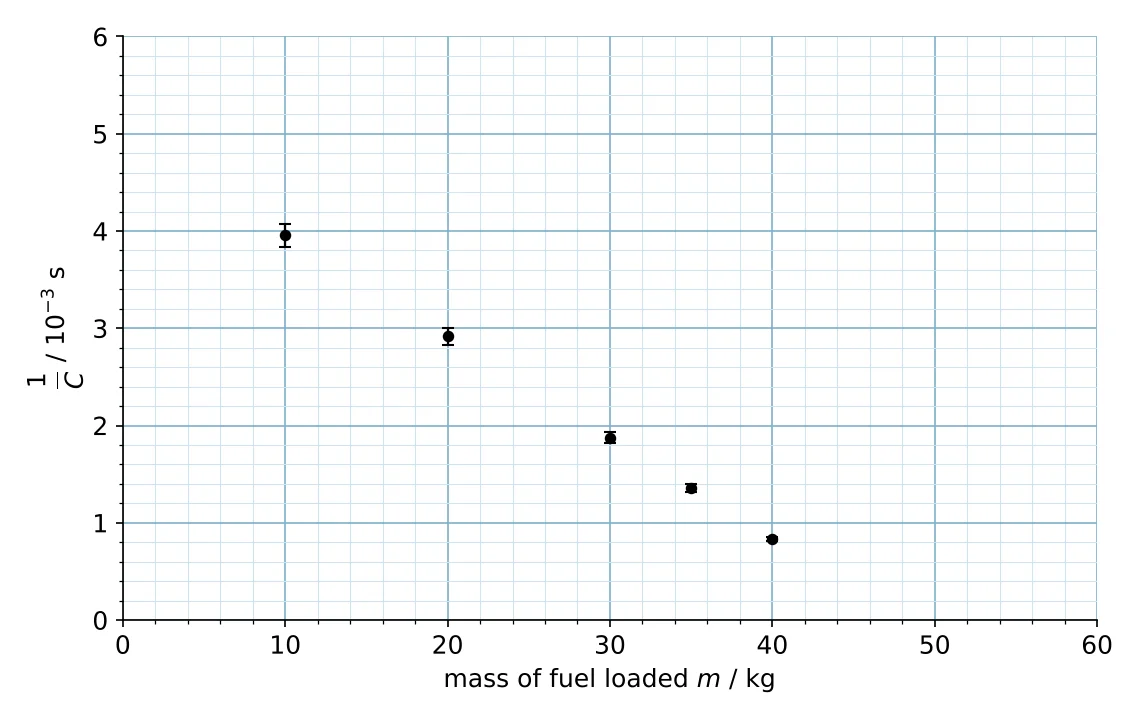
Explain why , rather than , is plotted against .
Draw a line of best fit and determine the critical mass of the core.
Determine the gradient of your line, with its unit.
Estimate the uncertainty in your value of the critical mass.
Suggest why the fuel is added in smaller steps as the count rate increases.
revisionprep.com
Summary Answer
Not available for this question.
Model Answer
Not available for this question.
Marking Scheme
Not available for this question.
Examiner Insights
Not available for this question.
That's every free question here — 6 of 127.
+121 more questions, plus Mock Papers & Worksheets, are waiting in Premium.