Radioactive Decay · Paper 1 — Free Physics SL Practice Questions
Free questions
Open in full, with answers, mark scheme and examiner insights.
Strong nuclear force and nuclear stability
Which statement about the strong nuclear force is correct?
revisionprep.com
Summary Answer
Not available for this question.
Model Answer
Not available for this question.
Marking Scheme
Not available for this question.
Examiner Insights
Not available for this question.
Activity, count rate, half-life and background radiation
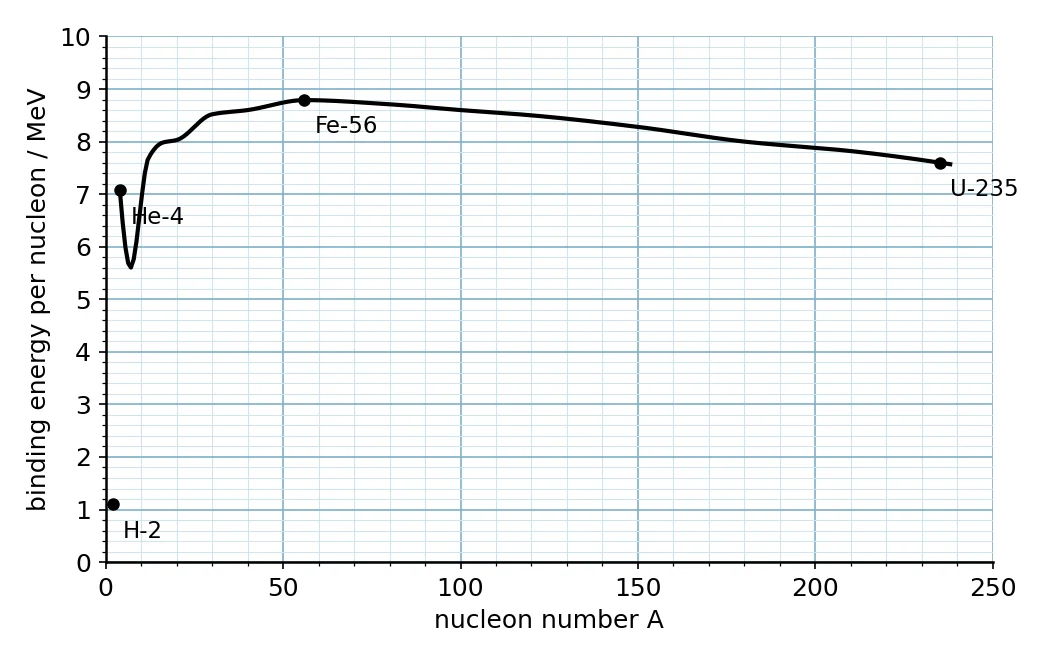
The graph shows binding energy per nucleon against nucleon number. Which nucleus is the most stable?
revisionprep.com
Summary Answer
Not available for this question.
Model Answer
Not available for this question.
Marking Scheme
Not available for this question.
Examiner Insights
Not available for this question.
Mass defect, binding energy and binding energy per nucleon
Table 1 gives measured masses with their absolute uncertainties. They are used to find the binding energy of helium-4.

Calculate the mass defect of helium-4.
Determine the absolute uncertainty in the mass defect.
Calculate the percentage uncertainty in the binding energy of helium-4.
revisionprep.com
Summary Answer
Not available for this question.
Model Answer
Not available for this question.
Marking Scheme
Not available for this question.
Examiner Insights
Not available for this question.
Alpha, beta and gamma decay: equations, neutrinos and properties
The lengths of six alpha-particle tracks from the same source are measured in a cloud chamber (Table 1).

Calculate the mean track length.
Estimate the absolute uncertainty in the mean track length.
Calculate the percentage uncertainty in the mean track length.
Explain what the near-equal lengths show about the alpha particles emitted by this source.
revisionprep.com
Summary Answer
Not available for this question.
Model Answer
Not available for this question.
Marking Scheme
Not available for this question.
Examiner Insights
Not available for this question.
Alpha, beta and gamma decay: equations, neutrinos and properties
A student investigates an unknown source using absorbers (Table 1). Each count rate is uncertain by about . The background count rate is . The source is 3 cm from the detector.

Deduce, with reasons, which types of radiation the source emits.
Estimate the count rate due to gamma radiation alone.
Explain why the data cannot rule out the emission of alpha particles.
Suggest one improvement to the procedure that would test for alpha particles.
revisionprep.com
Summary Answer
Not available for this question.
Model Answer
Not available for this question.
Marking Scheme
Not available for this question.
Examiner Insights
Not available for this question.
Activity, count rate, half-life and background radiation
In a school experiment the counts from a protactinium-234m source are recorded for at the times shown in Table 1. A separate long measurement gives a background of 5 counts in 10 s.

Correct the counts for background.
Determine the half-life of protactinium-234m.
The random uncertainty in a count of is about . Determine the percentage uncertainty in the corrected count at 210 s.
Explain whether the readings between 0 and 70 s or those between 140 and 210 s give the more reliable half-life.
Suggest two improvements to the experiment.
revisionprep.com
Summary Answer
Not available for this question.
Model Answer
Not available for this question.
Marking Scheme
Not available for this question.
Examiner Insights
Not available for this question.
That's every free question here — 6 of 111.
+105 more questions, plus Mock Papers & Worksheets, are waiting in Premium.