Fission · Paper 2 — Free Physics SL Practice Questions
Free questions
Open in full, with answers, mark scheme and examiner insights.
Spontaneous and neutron-induced fission; energy release
A fission reaction of uranium-235 can be represented as:
Describe how the energy released in this fission reaction is distributed among the products immediately after the reaction.
The kinetic energy of the two fission fragments (xenon-140 and strontium-94) is 168 MeV. Each neutron has kinetic energy of 2 MeV, and gamma radiation carries 7 MeV. Determine the total energy released in this reaction in MeV.
Convert your answer from (b) into joules.
revisionprep.com
Summary Answer
Not available for this question.
Model Answer
Not available for this question.
Marking Scheme
Not available for this question.
Examiner Insights
Not available for this question.
Chain reactions and critical mass
The diagram shows the mass of uranium-235 in a reactor core as fuel is gradually added. The critical mass for this reactor geometry is 48 kg.
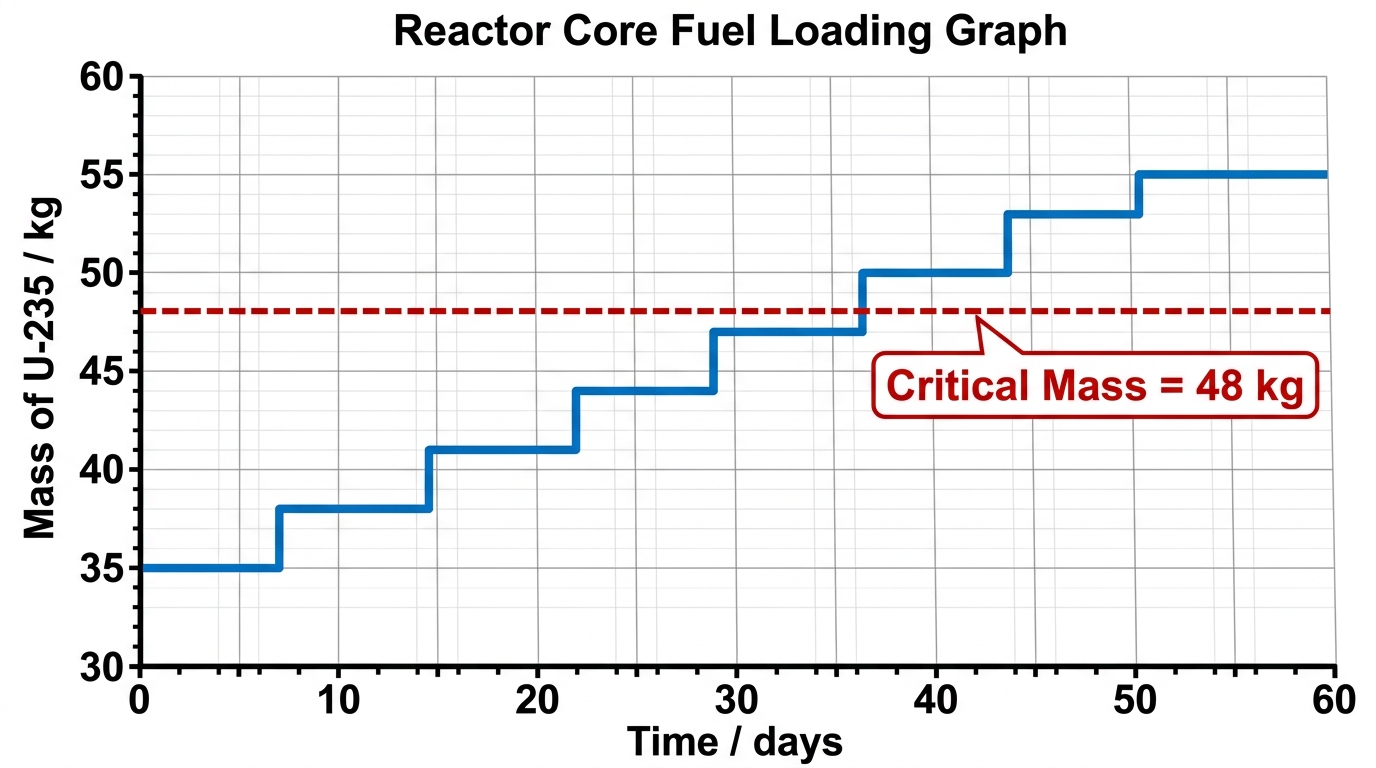
State what is meant by critical mass and explain why it depends on the geometry of the reactor core.
Using the graph, determine the additional mass of uranium-235 that must be added when the core contains 42 kg in order to reach criticality.
The core is loaded to a total mass of 55 kg of uranium-235. Deduce whether the core is subcritical, critical, or supercritical, and explain the consequence for the neutron population over time.
revisionprep.com
Summary Answer
Not available for this question.
Model Answer
Not available for this question.
Marking Scheme
Not available for this question.
Examiner Insights
Not available for this question.
Spontaneous and neutron-induced fission; energy release
Figure 1 shows how the binding energy per nucleon varies with nucleon number .
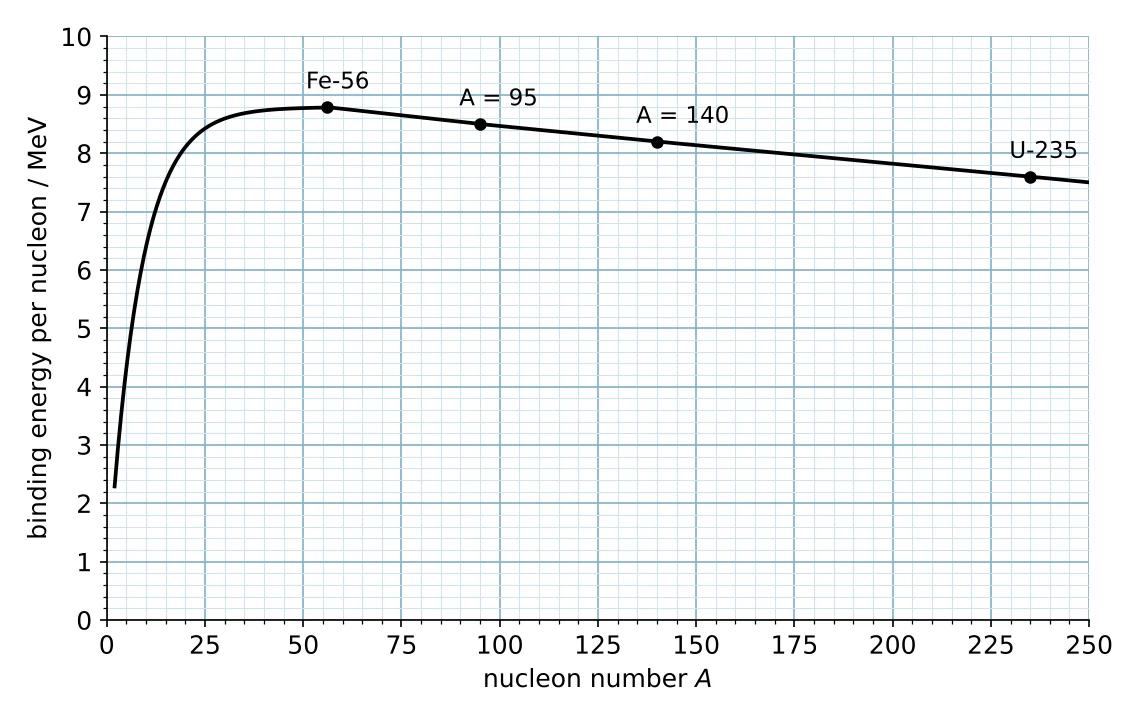
Explain, with reference to Figure 1, why energy is released when a heavy nucleus such as uranium-235 undergoes fission.
In one fission, a uranium-235 nucleus absorbs a neutron and splits into fragments with nucleon numbers 140 and 95, with the release of one neutron. The binding energy per nucleon is for uranium-235, for the fragment with and for the fragment with . Calculate the energy released in this fission.
revisionprep.com
Summary Answer
Not available for this question.
Model Answer
Not available for this question.
Marking Scheme
Not available for this question.
Examiner Insights
Not available for this question.
Chain reactions and critical mass
Figure 1 shows a bare sphere of uranium-235 with a critical mass of , and a sphere surrounded by a neutron reflector, for which the critical mass is only .
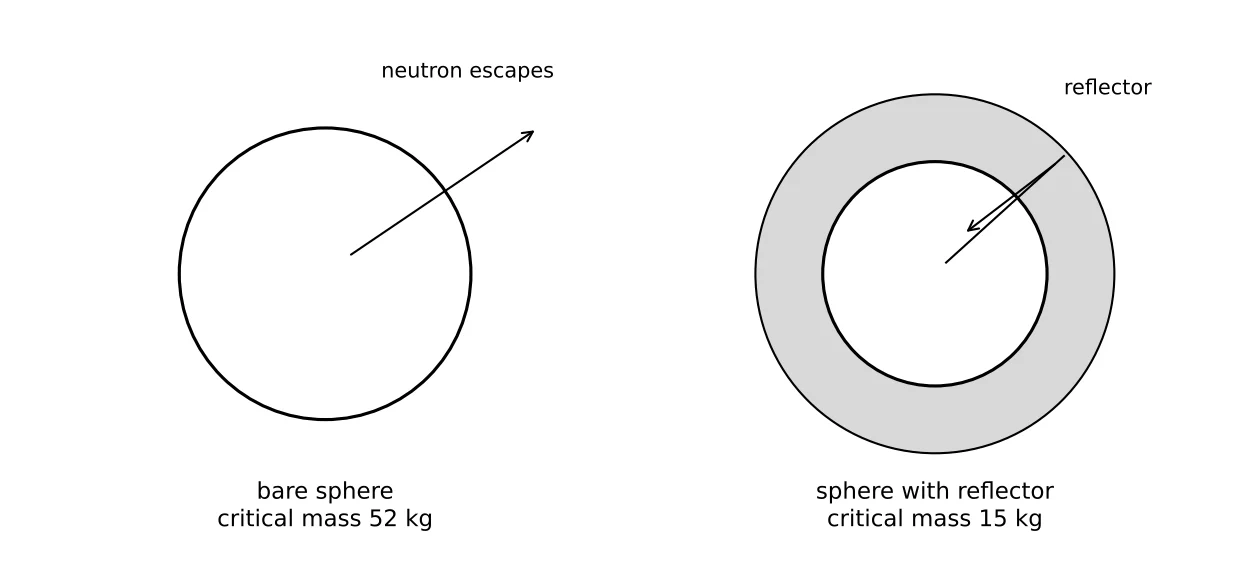
Explain why a neutron reflector reduces the critical mass.
Calculate the percentage reduction in the critical mass produced by the reflector.
An engineer states: \"A smaller critical mass makes an accidental chain reaction easier to start.\" Evaluate this statement.
revisionprep.com
Summary Answer
Not available for this question.
Model Answer
Not available for this question.
Marking Scheme
Not available for this question.
Examiner Insights
Not available for this question.
Spontaneous and neutron-induced fission; energy release
Data
The uranium-235 fuel rods in a thermal neutron reactor absorb slow neutrons and undergo fission. One such fission event is represented by:
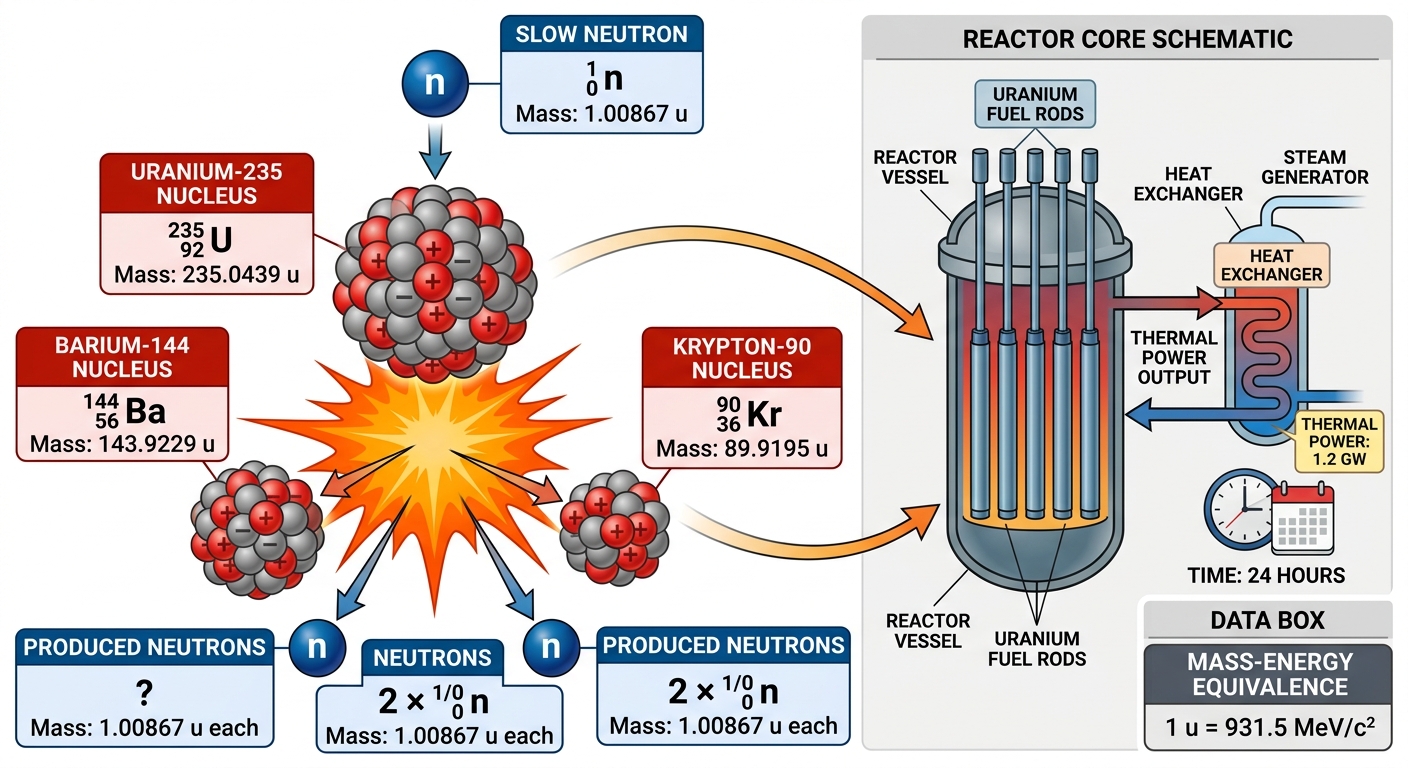
Calculate the energy released in this single fission event. Give your answer in MeV.
The reactor operates at a thermal power of . Assuming each fission event releases the energy calculated in (a), calculate the mass of consumed in hours of continuous operation. Give your answer in grams.
The neutrons produced in this fission event have kinetic energies of order . Discuss why these neutrons must be slowed to thermal energies () before they can sustain the chain reaction, and explain what determines whether the chain reaction remains self-sustaining rather than dying out or becoming explosive.
The fuel is uranium enriched to 3.5 % uranium-235. Determine the mass of fuel that contains the uranium-235 used in 24 hours.
Outline the role of the heat exchanger shown in Figure 1.
revisionprep.com
Summary Answer
Not available for this question.
Model Answer
Not available for this question.
Marking Scheme
Not available for this question.
Examiner Insights
Not available for this question.
Nuclear reactors: moderator, control rods, heat exchanger, shielding and waste
A small modular reactor uses UO fuel enriched to 19.75 % U-235 by mass of uranium. Each fission releases . The thermal efficiency is 35 % and the electrical output is . The fuel load is of UO (molar mass ; uranium ).
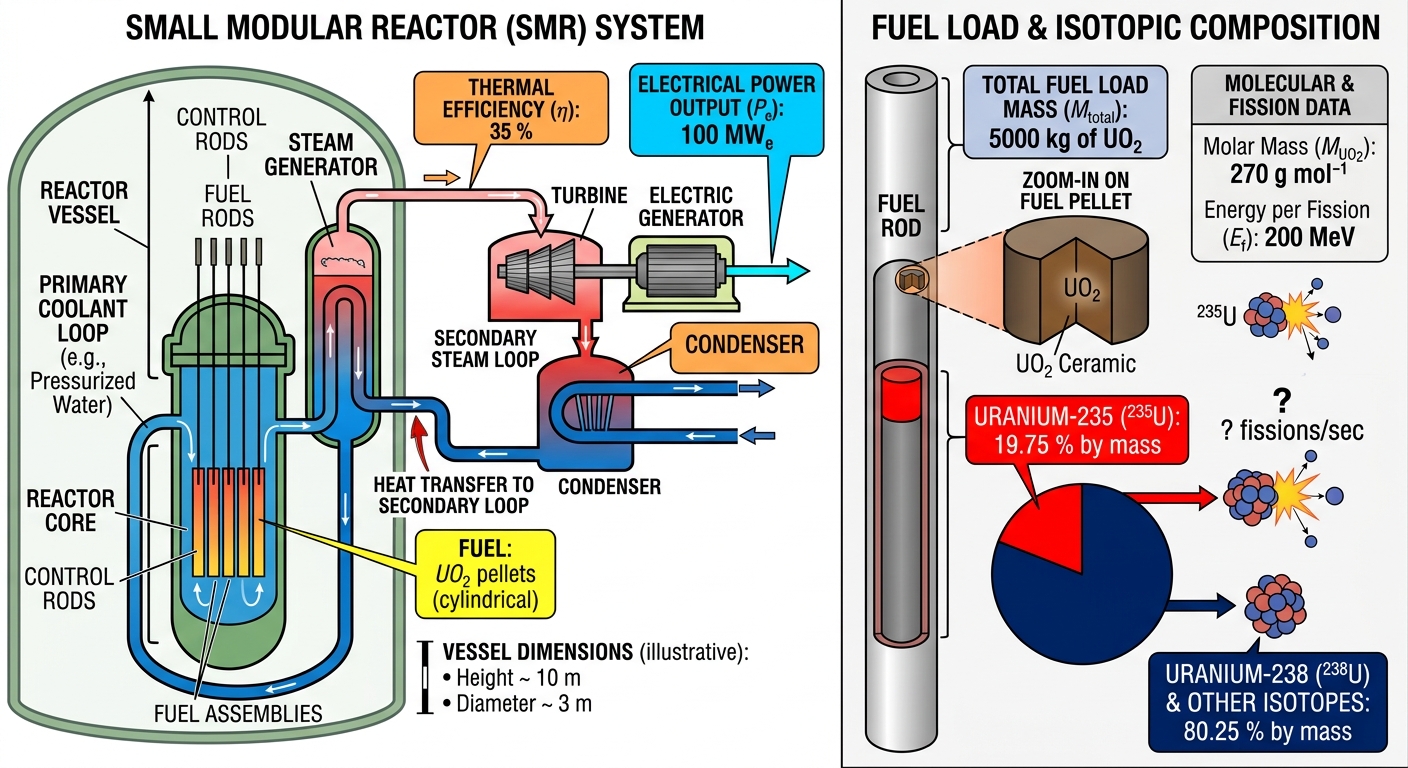
Determine the thermal power and the number of fissions per second.
State one advantage of the higher enrichment in a small reactor.
The reactor is designed to run for 5 years without refuelling. Determine the percentage of its U-235 used in this time, and comment.
The primary coolant warms by as it passes through the core. Its specific heat capacity is . Determine the mass of coolant that must flow through the core each second.
Discuss one advantage and one disadvantage of using fuel enriched to 19.75 % rather than the usual 4 %.
revisionprep.com
Summary Answer
Not available for this question.
Model Answer
Not available for this question.
Marking Scheme
Not available for this question.
Examiner Insights
Not available for this question.
That's every free question here — 6 of 142.
+136 more questions, plus Mock Papers & Worksheets, are waiting in Premium.