You're viewing 3 free preview questions for Physics SL — subscribe to unlock 83 more, plus the Full Question Bank, Mock Papers & Worksheets.Upgrade
Fusion and Stars · Paper 2 — Free Physics SL Practice Questions
1FoundationSAQ-SNuclear fusion and energy production in stars7 marksPaper 2~11 min

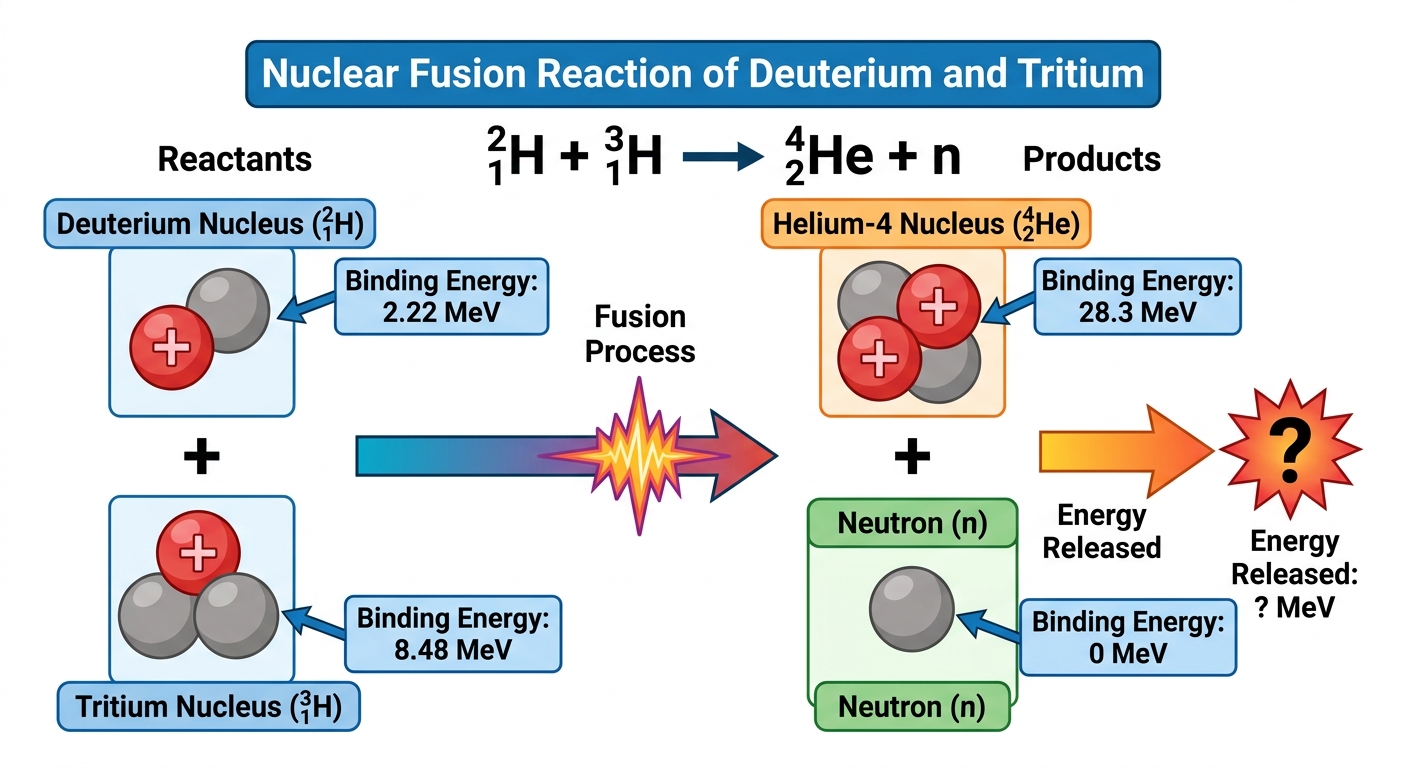
Consider the fusion of deuterium () and tritium () in a reactor:
The binding energies per nucleus are: deuterium = 2.22 MeV, tritium = 8.48 MeV, helium-4 = 28.3 MeV, neutron = 0 MeV.
(a)
Explain why energy is released in this fusion reaction using the concept of binding energy. [2 marks]
(b)
Calculate the energy released per fusion event, in MeV. [2 marks]
(c)
A reactor undergoes fusion events per second. Determine the power output of the reactor in watts. [3 marks]

Solutions
2MasterySAQ-SLife cycle of stars6 marksPaper 2~9 min
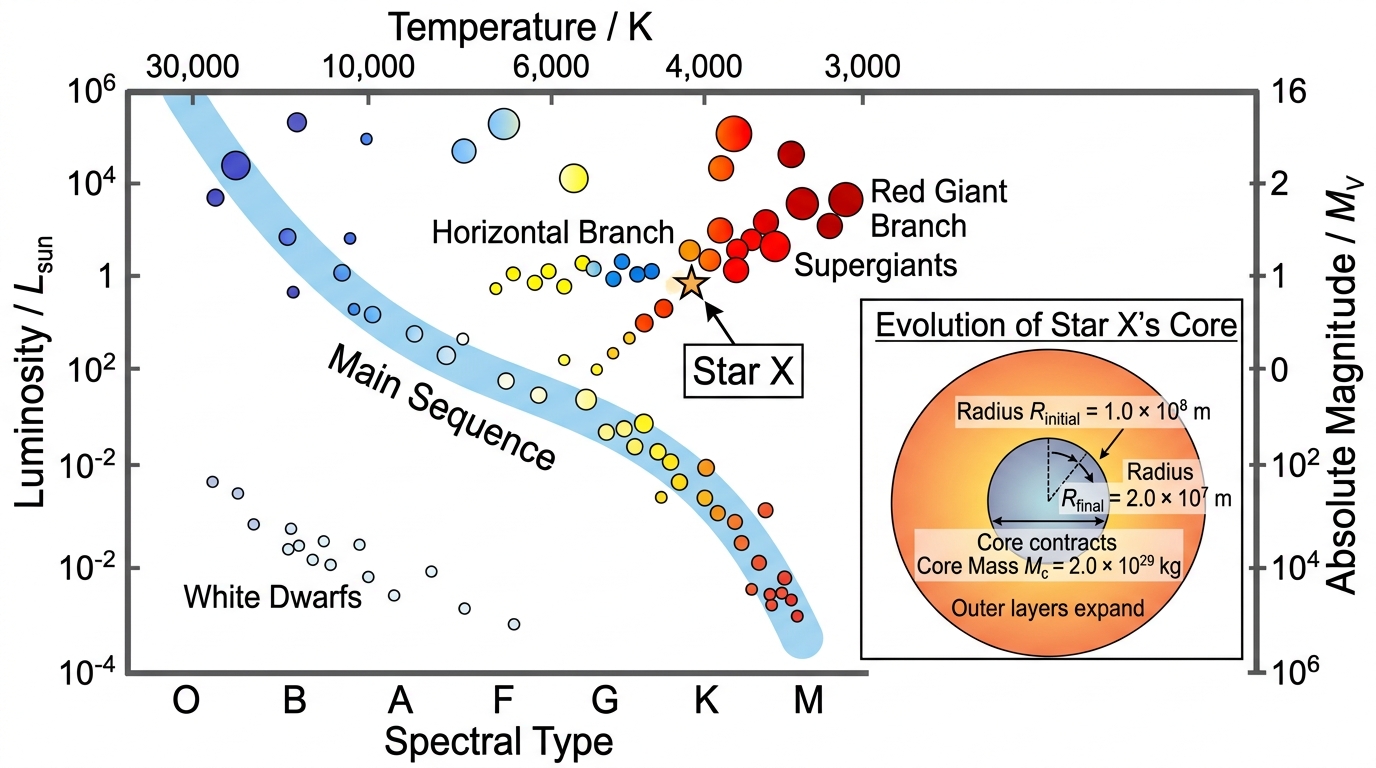
A Hertzsprung–Russell (H-R) for a star cluster shows a clear main sequence, a red giant branch, and a horizontal branch. One star, designated Star X, has left the main sequence and is now a red giant.
(a)
State the event that causes a star to leave the main sequence. [1 mark]
(b)
Explain the changes in the core of Star X that cause it to become a red giant. [2 marks]
(c)
The core of Star X contracts while the outer layers expand. The core has mass and its radius decreases from to .
The gravitational potential energy of a uniform sphere is:
where .
Calculate the change in gravitational potential energy of the core. [3 marks]
Solutions
3ChallengeSAQ-LNuclear fusion and energy production in stars7 marksPaper 2~11 min
Data
-
-
- Mass of proton
- Mass of helium-4 nucleus
- Mass of positron
-
- Coulomb barrier for two protons
- CNO reaction rate
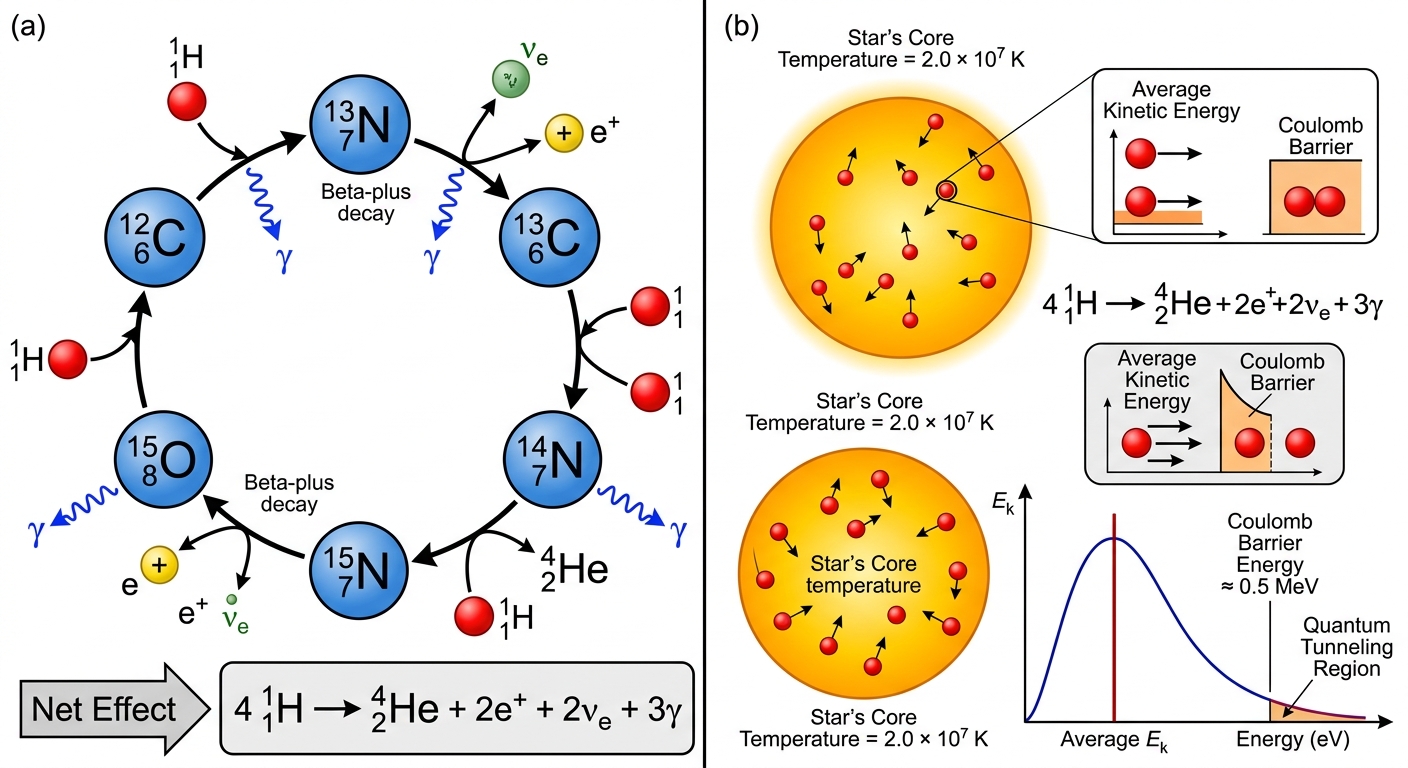
A star with mass burns hydrogen its core via the CNO cycle, in which carbon-12 acts a catalyst:
The net reaction is:
The star's core temperature is . The average kinetic energy of a proton at this temperature is .
(a)
Calculate the average kinetic energy of a proton in the star's core in eV. [2 marks]
(b)
Calculate the energy released, in MeV, in the net CNO cycle reaction. [3 marks]
(c)
Explain why fusion can occur even though the average proton kinetic energy found in (a) is far below the Coulomb barrier. [1 mark]
(d)
The core temperature increases to . Determine the factor by which the CNO energy production rate changes. [1 mark]
Solutions
That's every free question here — 3 of 86.
+83 more questions, plus Mock Papers & Worksheets, are waiting in Premium.