You're viewing 2 free preview questions for Physics SL — subscribe to unlock 74 more, plus the Full Question Bank, Mock Papers & Worksheets.Upgrade
Radioactive Decay · Paper 2 — Free Physics SL Practice Questions
1MasterySAQ-SHalf-life and decay constant5 marksPaper 2~8 min

Data
A sample of cobalt-60, used in radiotherapy machines, has a decay constant of .
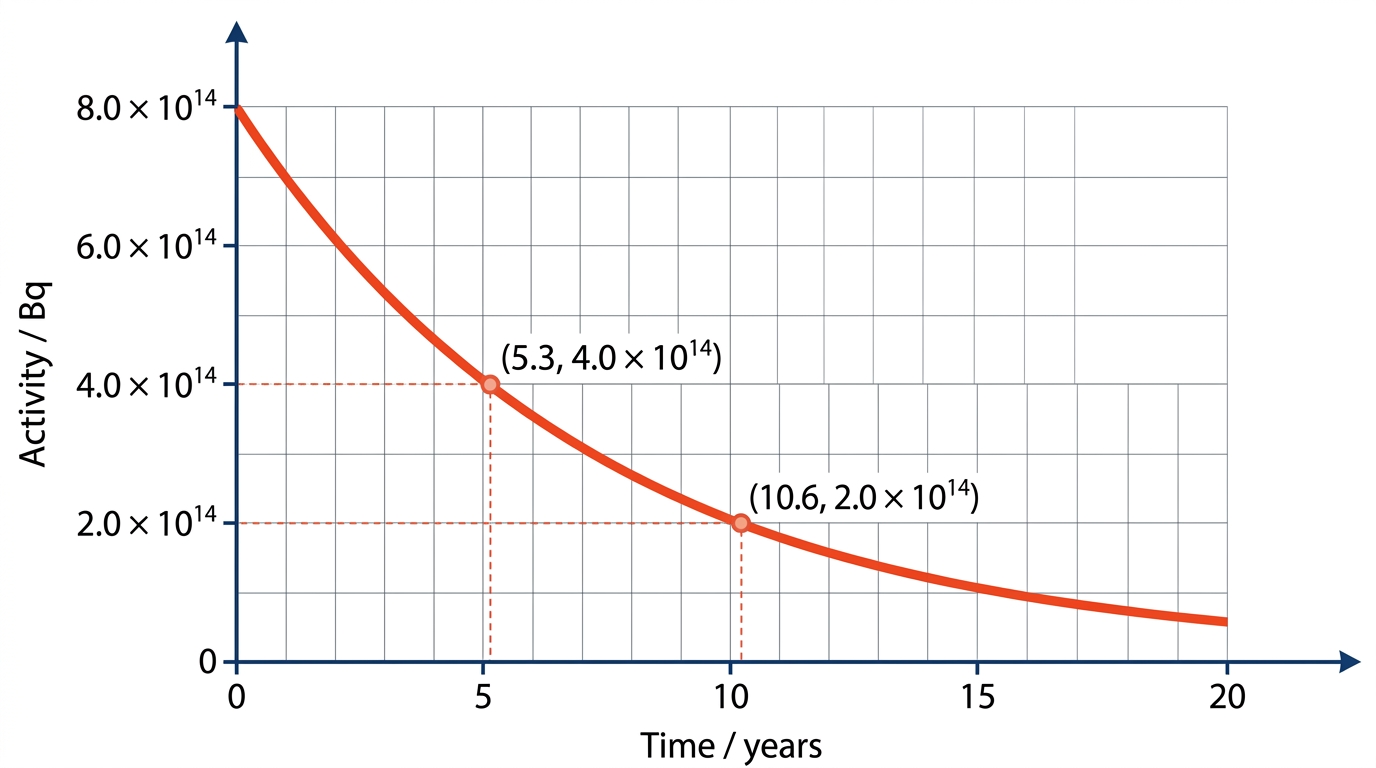
The graph shows the activity of the sample over time. The curve starts at ; at the activity is ; at the activity is .
(a)
Calculate the half-life of cobalt-60 in years using the decay constant. [2 marks]
(b)
Determine the initial number of cobalt-60 nuclei in the sample. [2 marks]
(c)
A medical physicist states that after three half-lives the sample is no longer suitable for radiotherapy because its activity has fallen below . Evaluate this statement. [1 mark]

Solutions
2ChallengeSAQ-LRadioactive decay and applications6 marksPaper 2~9 min
Data
- Initial activity of the sample:
- Atomic mass of fluorine-18:
- Atomic mass of oxygen-18:
- Mass of a positron:
- Speed of light:
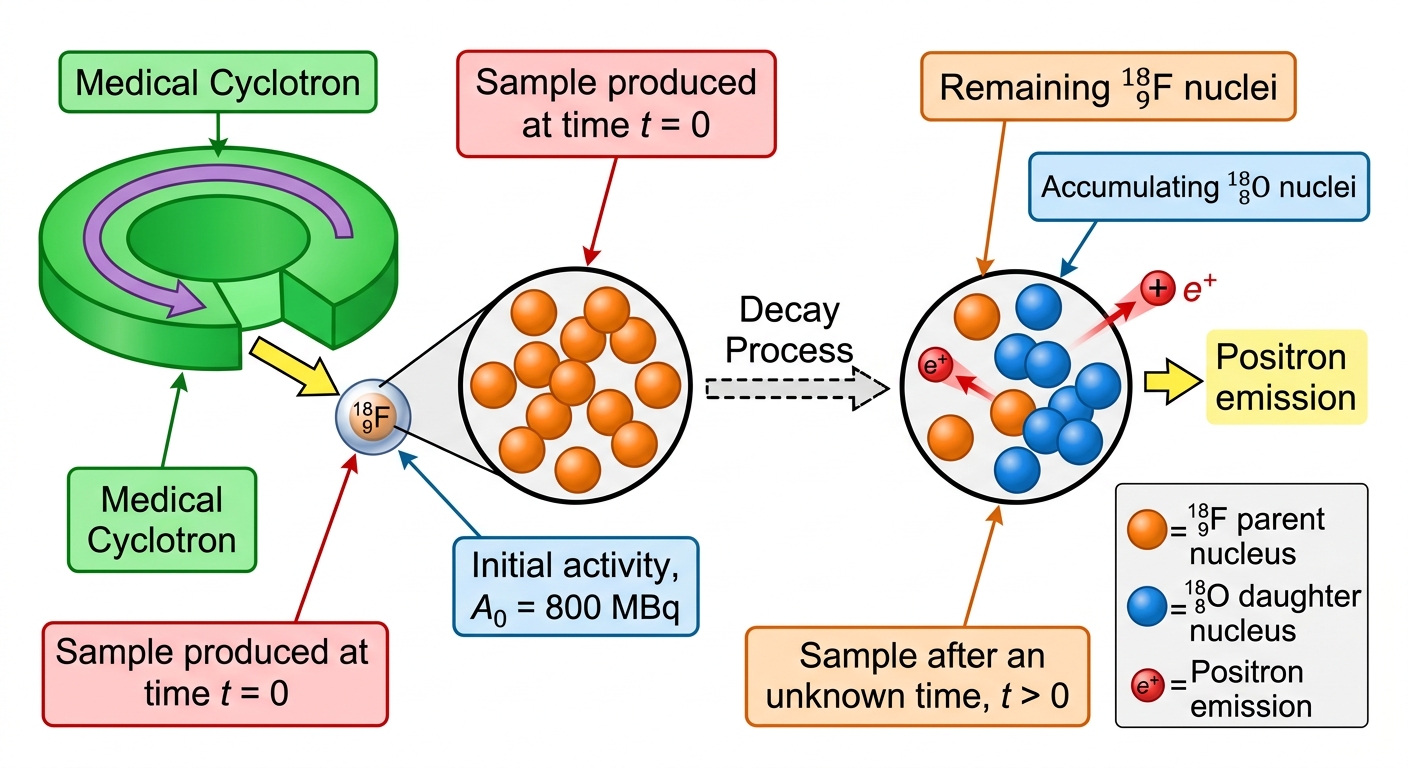
A medical cyclotron produces a pure sample of the radioisotope fluorine-18 () for use in PET scans. Fluorine-18 decays via positron emission to oxygen-18 () with a half-life of 110 minutes.
(a)
(i) Calculate the decay constant of fluorine-18. [1]
(ii) Determine the number of fluorine-18 atoms in the sample at the instant is produced. [2 marks]
(ii) Determine the number of fluorine-18 atoms in the sample at the instant is produced. [2 marks]
(b)
(i) Explain why the energy released per decay cannot be calculated from the difference in atomic masses of fluorine-18 and oxygen-18 alone. [2]
(ii) Calculate the energy, in MeV, released in a single fluorine-18 decay. [2 marks]
(ii) Calculate the energy, in MeV, released in a single fluorine-18 decay. [2 marks]
(c)
Determine the time, in hours, after production at which the activity of the sample falls to . [2 marks]
Solutions
That's every free question here — 2 of 76.
+74 more questions, plus Mock Papers & Worksheets, are waiting in Premium.