Structure of the Atom · Paper 2 — Free Physics SL Practice Questions
Free questions
Open in full, with answers, mark scheme and examiner insights.
Geiger–Marsden–Rutherford experiment and the nuclear model
The diagram shows an electron in a hydrogen atom falling from the level () to the level (), emitting a photon. (, , )
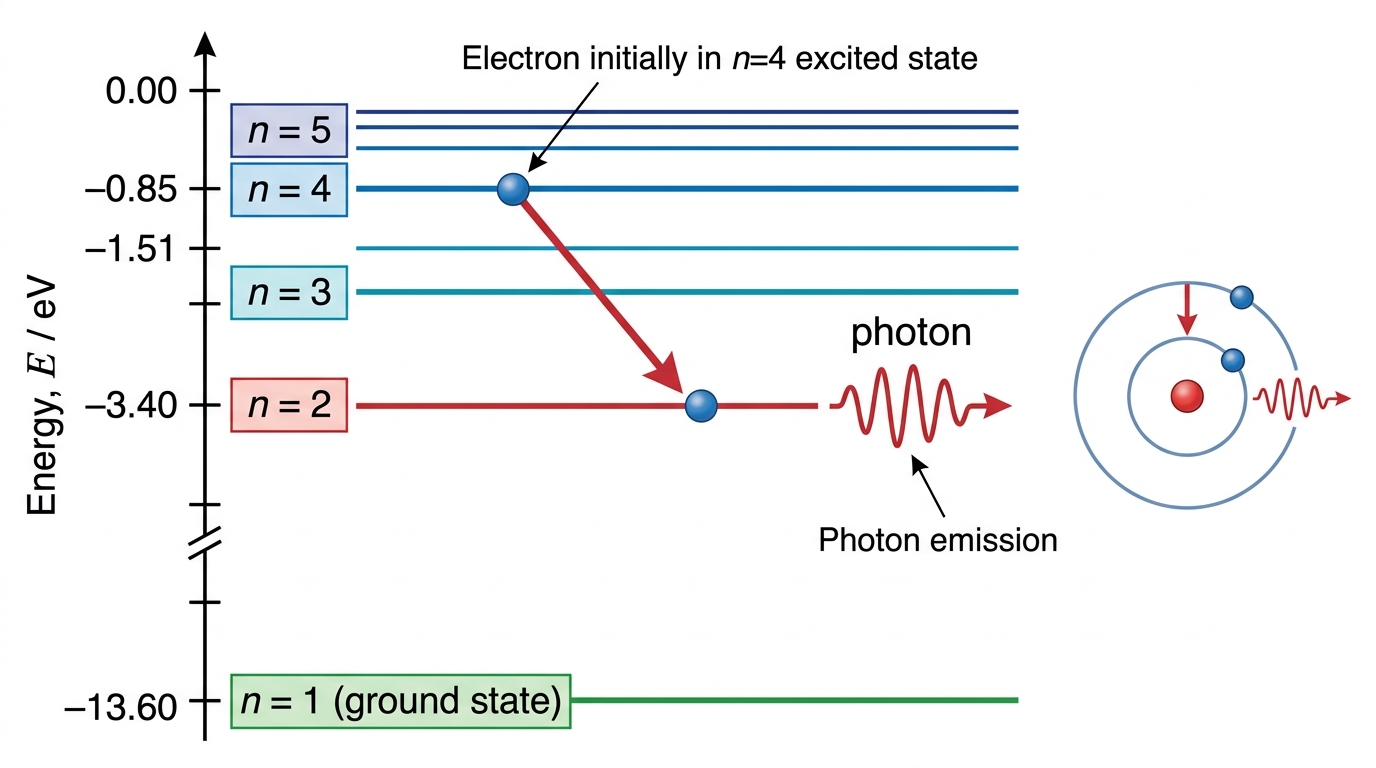
Determine the photon energy in eV.
Calculate the wavelength of the photon.
State the region of the electromagnetic spectrum in which this photon lies.
State the photon energy needed for the reverse transition, from to .
revisionprep.com
Summary Answer
Not available for this question.
Model Answer
Not available for this question.
Marking Scheme
Not available for this question.
Examiner Insights
Not available for this question.
Nuclear notation, nucleons and isotopes
The diagram shows the mass spectrum of gallium, with peaks for gallium-69 and gallium-71. Gallium has proton number 31. (, )
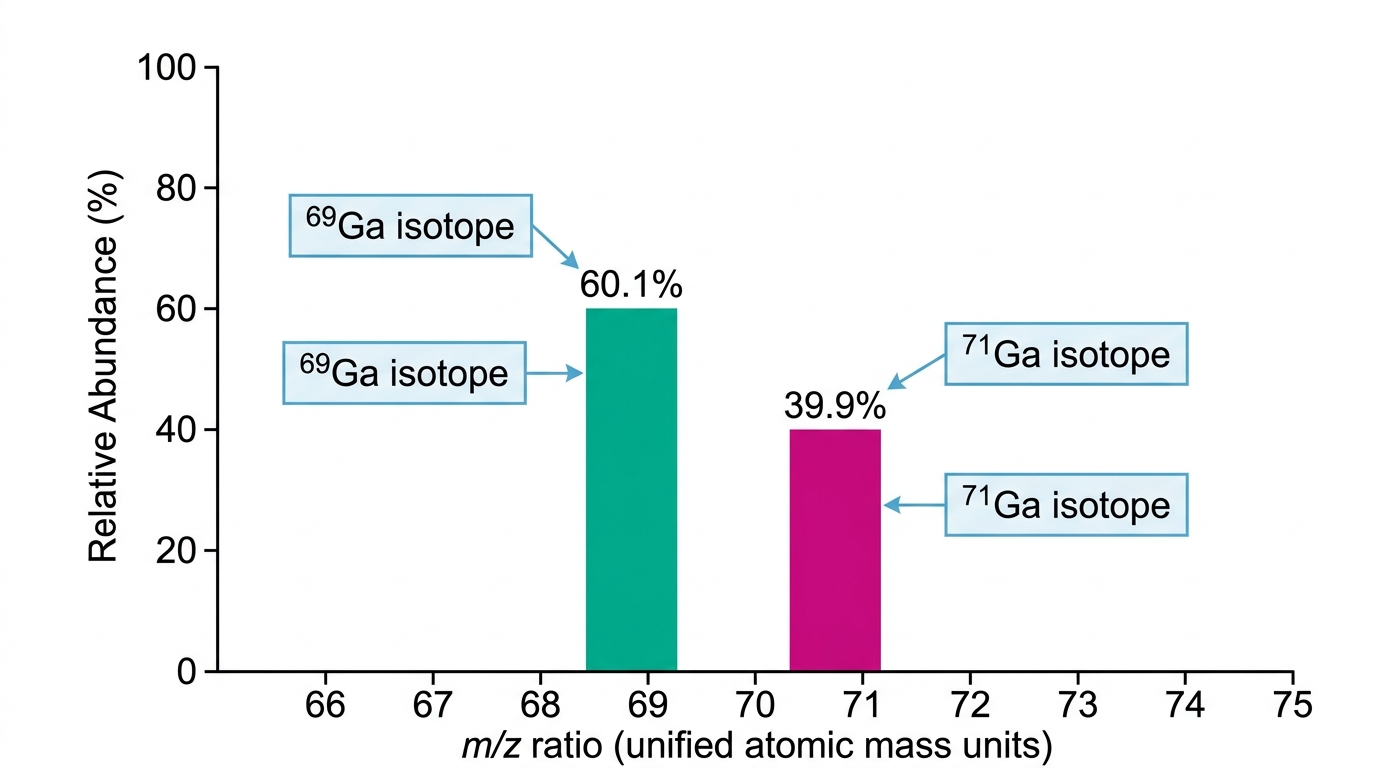
State what is meant by isotopes.
State the difference in nuclear composition between gallium-69 and gallium-71.
Determine the charge on a gallium-71 nucleus.
The mass of a gallium-71 atom is . Determine this mass in kilograms.
revisionprep.com
Summary Answer
Not available for this question.
Model Answer
Not available for this question.
Marking Scheme
Not available for this question.
Examiner Insights
Not available for this question.
Geiger–Marsden–Rutherford experiment and the nuclear model
The diagram shows hydrogen atoms emitting light of wavelength as electrons fall to the level , at . The energy levels of hydrogen are (), (), (), () and (). (, , )
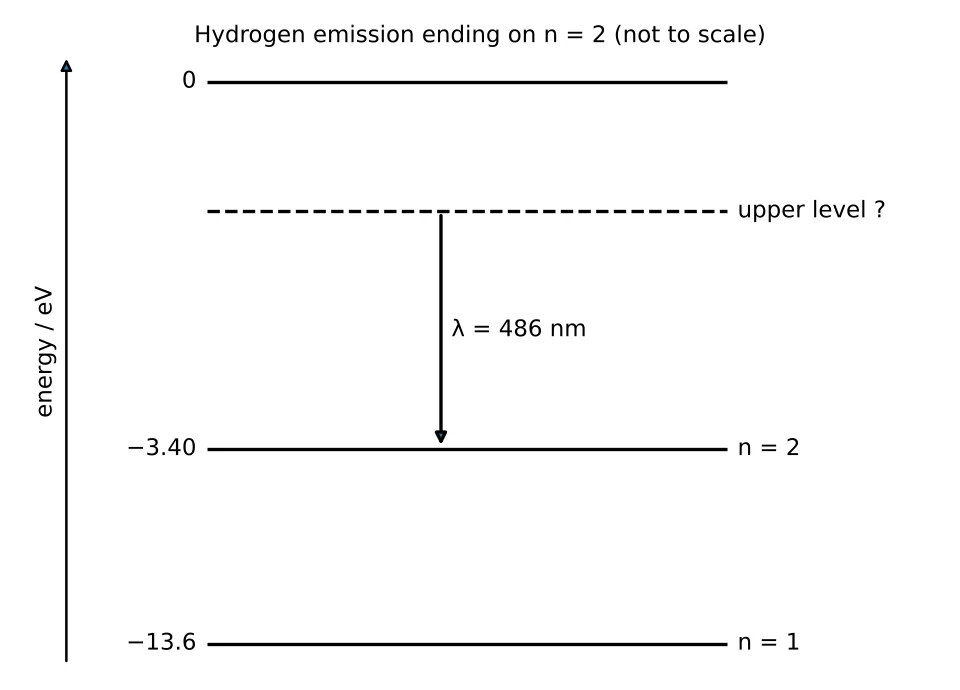
Show that the energy of a photon of wavelength is about .
Determine the energy of the level from which the electron falls.
Hence identify this level.
Outline why light of this wavelength is emitted only when the gas has been excited.
Calculate the frequency of a photon of wavelength .
An electron in the level then falls to the ground state. Calculate the wavelength of the photon emitted and state the region of the electromagnetic spectrum in which it lies.
revisionprep.com
Summary Answer
Not available for this question.
Model Answer
Not available for this question.
Marking Scheme
Not available for this question.
Examiner Insights
Not available for this question.
Geiger–Marsden–Rutherford experiment and the nuclear model
Before 1911 the atom was described by the Thomson model: positive charge spread evenly through the atom, with electrons embedded in it. The Geiger–Marsden experiment led to the nuclear model.
Describe the predictions of the Thomson model for alpha particles fired at a thin gold foil.
Outline the observations that contradicted these predictions.
Explain how the nuclear model accounts for the observations.
At each detector angle the alpha particles were counted for the same time. Suggest why the counts at large angles were repeated several times.
revisionprep.com
Summary Answer
Not available for this question.
Model Answer
Not available for this question.
Marking Scheme
Not available for this question.
Examiner Insights
Not available for this question.
Geiger–Marsden–Rutherford experiment and the nuclear model
In the Geiger–Marsden experiment, alpha particles of mass moved at about . The mass of an electron is .
Determine the ratio of the mass of an alpha particle to the mass of an electron.
Determine the momentum of an alpha particle.
Explain why collisions with electrons could not deflect alpha particles through large angles.
Hence explain why the large-angle deflections showed that the nucleus has a mass much larger than that of the alpha particle.
Calculate the kinetic energy, in MeV, of one of these alpha particles. ()
revisionprep.com
Summary Answer
Not available for this question.
Model Answer
Not available for this question.
Marking Scheme
Not available for this question.
Examiner Insights
Not available for this question.
Nuclear notation, nucleons and isotopes
The diagram shows a time-of-flight mass spectrometer. Gallium-69 and gallium-71 ions, each with charge , are accelerated through the same potential difference, so they gain the same kinetic energy, and then drift along the same tube to a detector.
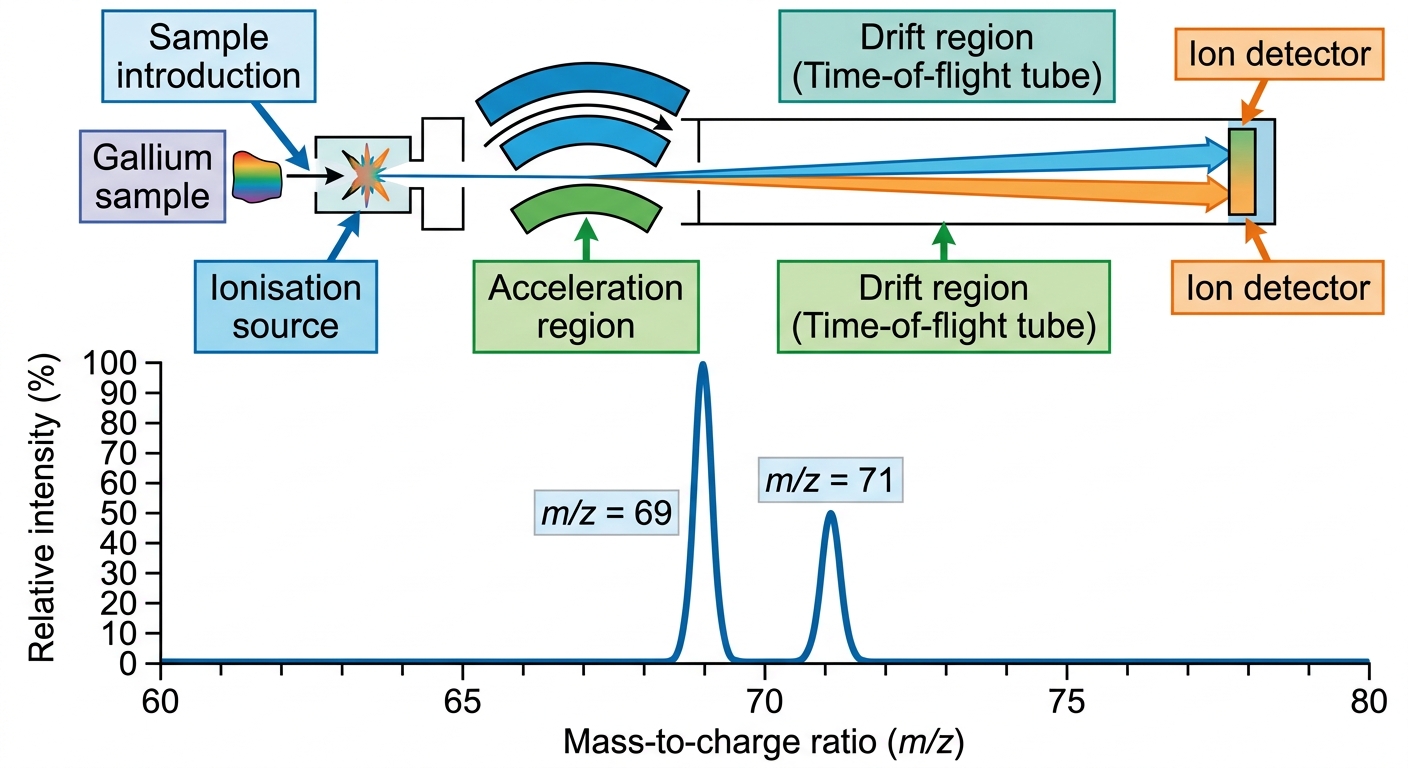
State the difference in nuclear composition between the two isotopes.
Explain why the gallium-69 ions reach the detector first.
Determine the ratio , taking the ion masses to be in the ratio .
Each ion gains of kinetic energy. The mass of a gallium-69 ion is . Calculate the speed of a gallium-69 ion in the drift tube.
The drift tube is long. Determine the difference between the times taken by the two isotopes to cross it.
revisionprep.com
Summary Answer
Not available for this question.
Model Answer
Not available for this question.
Marking Scheme
Not available for this question.
Examiner Insights
Not available for this question.
That's every free question here — 6 of 98.
+92 more questions, plus Mock Papers & Worksheets, are waiting in Premium.