Work, Energy, and Power · Paper 2 — Free Physics SL Practice Questions
Free questions
Open in full, with answers, mark scheme and examiner insights.
Work done by a force and the work–energy principle
The diagram shows a car of mass that brakes on a horizontal road, decelerating uniformly from to rest over .
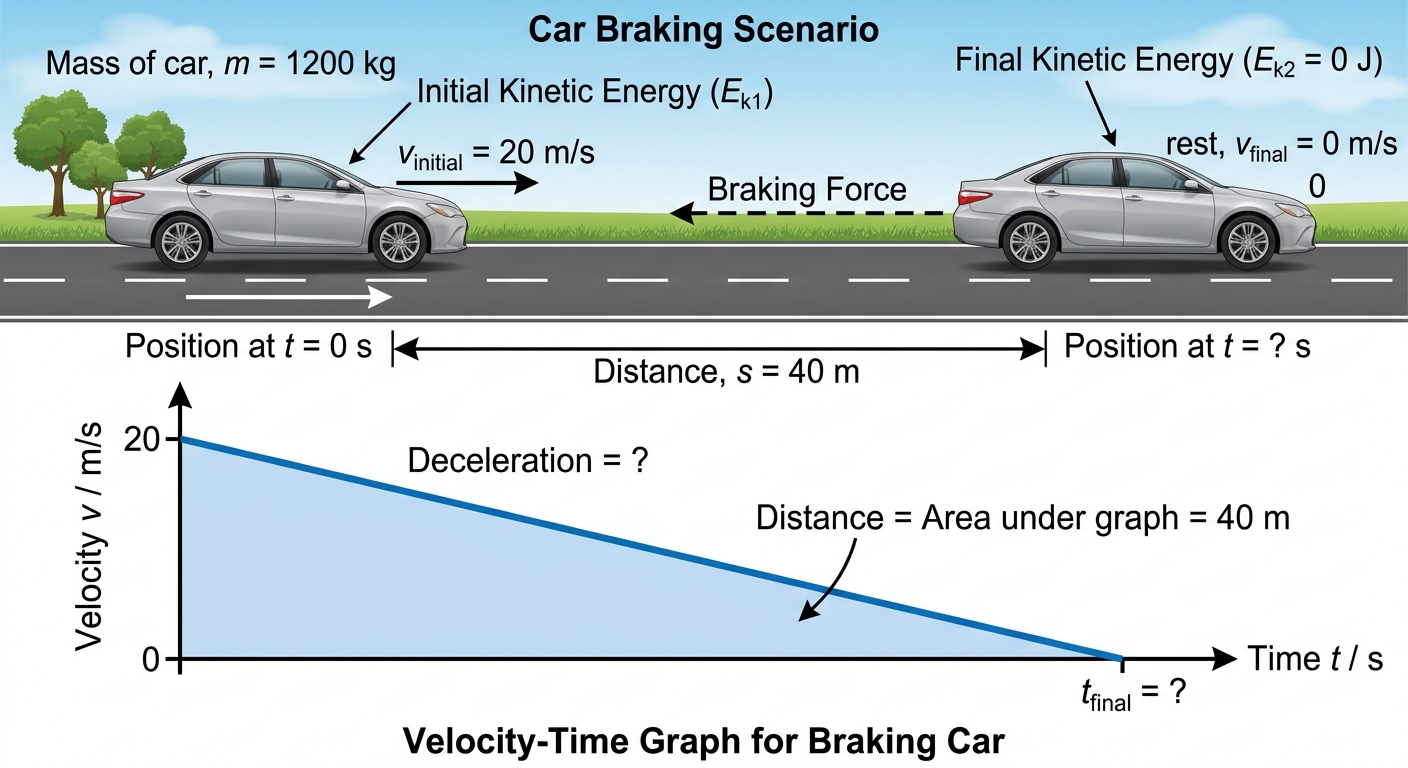
State why the work done by the braking force is negative.
Calculate the work done by the braking force.
Determine the magnitude of the braking force.
revisionprep.com
Summary Answer
Not available for this question.
Model Answer
Not available for this question.
Marking Scheme
Not available for this question.
Examiner Insights
Not available for this question.
Power and efficiency
The diagram shows a solar panel of area that receives solar radiation of intensity . The panel converts 18% of the incident energy into electrical energy, which charges a battery. The charging process has an efficiency of 90%.
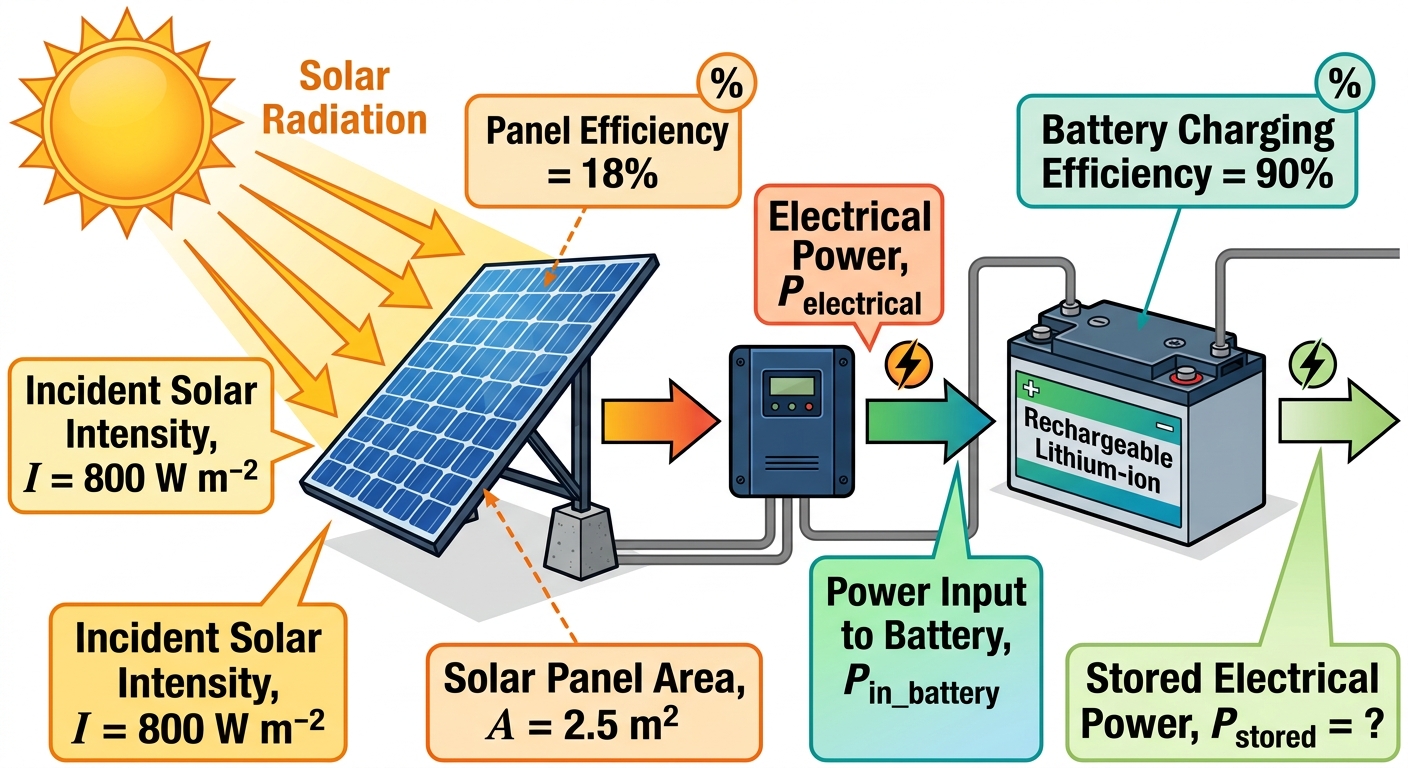
State what is meant by the efficiency of an energy transfer device.
Calculate the electrical power output of the panel.
Determine the rate at which energy is stored in the battery.
revisionprep.com
Summary Answer
Not available for this question.
Model Answer
Not available for this question.
Marking Scheme
Not available for this question.
Examiner Insights
Not available for this question.
Kinetic, gravitational potential and elastic potential energy
The diagram shows a ball of mass dropped from rest above the top of a vertical spring. The ball compresses the spring by a maximum of before it stops momentarily. Air resistance is negligible. Take .
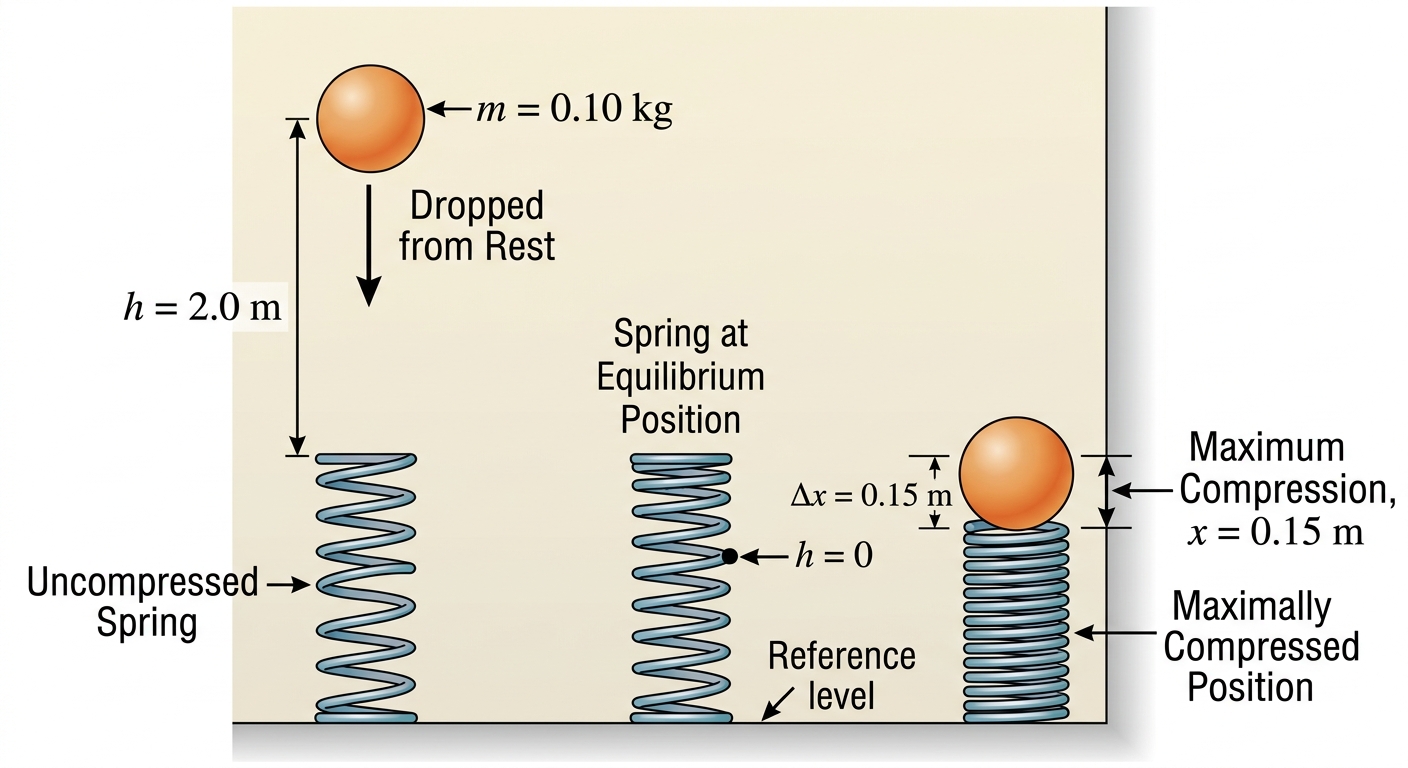
Describe the energy changes from the release of the ball until the spring is at maximum compression.
Calculate the spring constant of the spring.
revisionprep.com
Summary Answer
Not available for this question.
Model Answer
Not available for this question.
Marking Scheme
Not available for this question.
Examiner Insights
Not available for this question.
Energy density of fuels
A combined-cycle power station delivers an electrical output of with an overall efficiency of . It burns natural gas that has an energy density of at atmospheric pressure.
Determine the rate at which chemical energy is supplied to the station.
Calculate the rate at which energy is wasted.
Calculate the volume of gas burned each second.
Calculate the volume of gas burned in one day.
A storage reservoir holds of gas at atmospheric pressure. Determine how many days it would supply the station.
State one reason why natural gas is stored at high pressure or as a liquid.
revisionprep.com
Summary Answer
Not available for this question.
Model Answer
Not available for this question.
Marking Scheme
Not available for this question.
Examiner Insights
Not available for this question.
Kinetic, gravitational potential and elastic potential energy
A ball of mass is dropped from rest from a tall building. The graph shows how its kinetic energy varies with the distance it has fallen. Air resistance acts on the ball. Take .
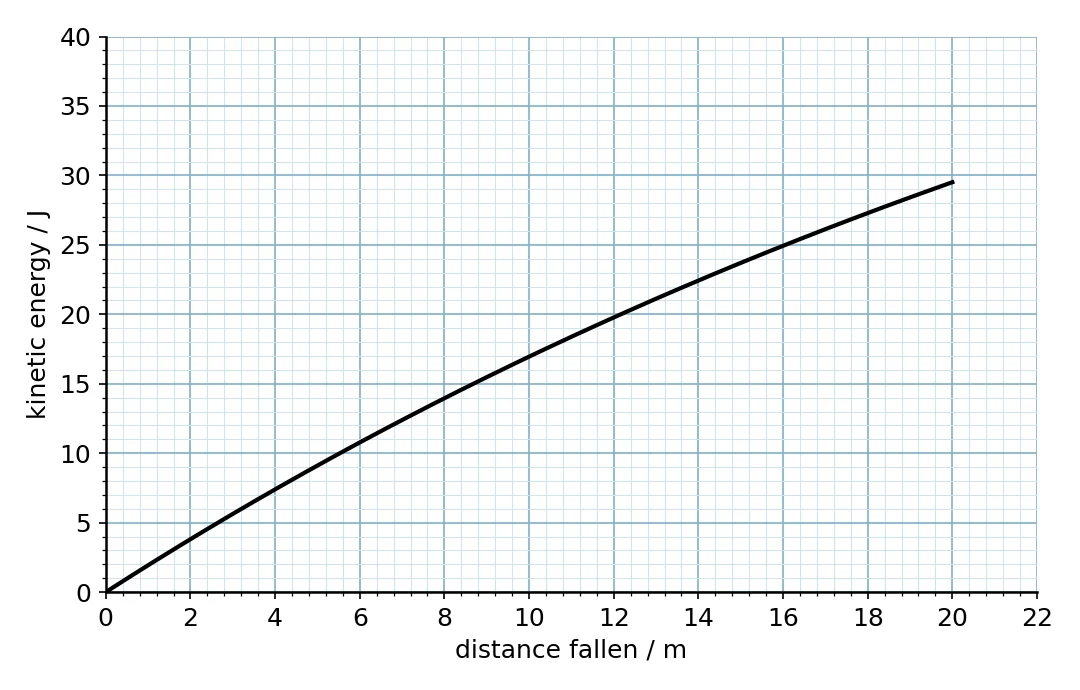
Calculate the kinetic energy the ball would have after falling if there were no air resistance.
Determine the work done against air resistance during the first of the fall.
Explain why the gradient of the graph decreases as the ball falls.
Use the gradient of the graph at a distance fallen of to estimate the air resistance on the ball at that point.
revisionprep.com
Summary Answer
Not available for this question.
Model Answer
Not available for this question.
Marking Scheme
Not available for this question.
Examiner Insights
Not available for this question.
Conservation of energy and Sankey diagrams
The diagram shows a pendulum bob of mass on a light string of length , released from rest with the string at to the vertical. Take .
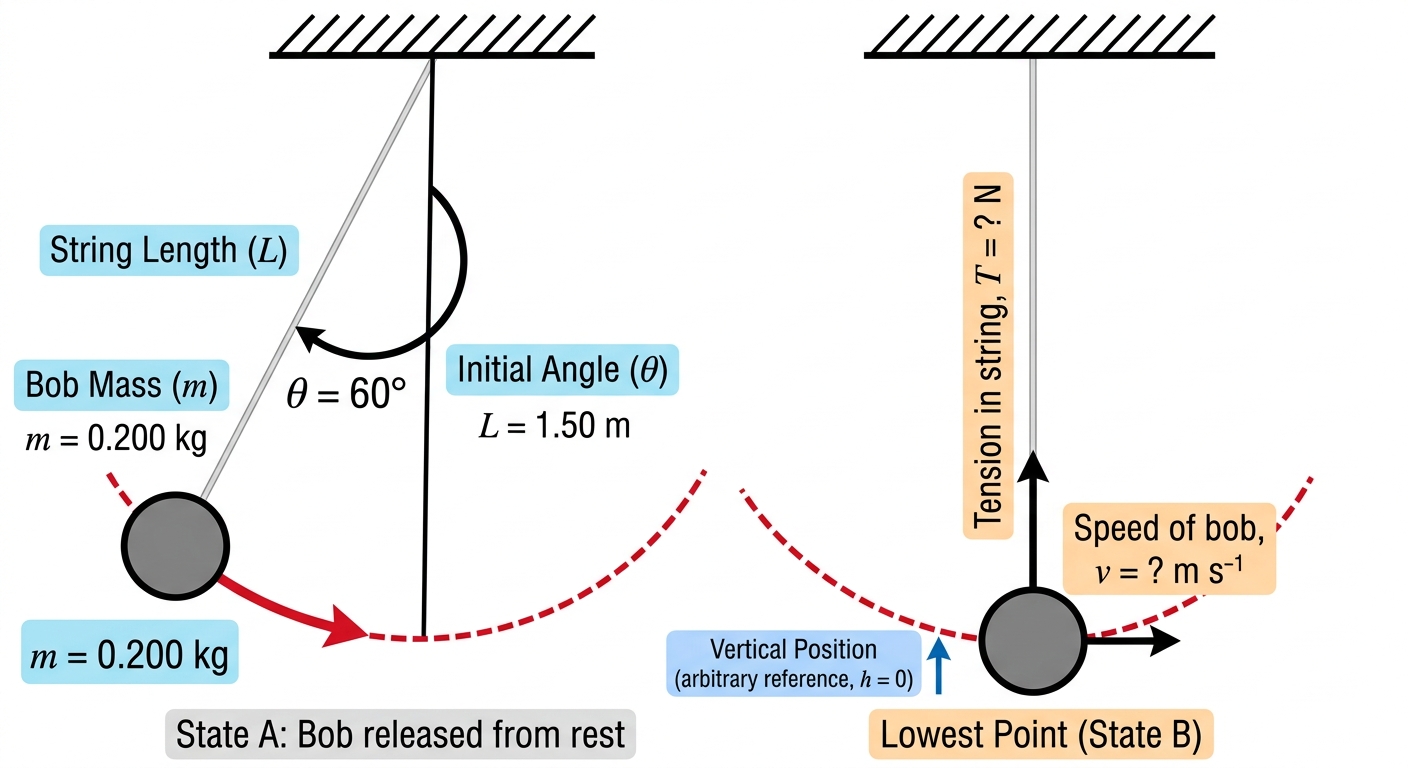
Determine the speed of the bob at the lowest point.
Determine the tension in the string at the lowest point.
The bob is given an extra push at the lowest point so that it moves in a complete vertical circle. Determine the minimum speed at the top of the circle for the string to stay taut.
Explain why the bob could pass over the top at a lower speed if the string were replaced by a light rigid rod.
revisionprep.com
Summary Answer
Not available for this question.
Model Answer
Not available for this question.
Marking Scheme
Not available for this question.
Examiner Insights
Not available for this question.
That's every free question here — 6 of 199.
+193 more questions, plus Mock Papers & Worksheets, are waiting in Premium.