Greenhouse Effect · Paper 1 — Free Physics SL Practice Questions
Free questions
Open in full, with answers, mark scheme and examiner insights.
Solar constant, albedo, emissivity and Earth's energy balance
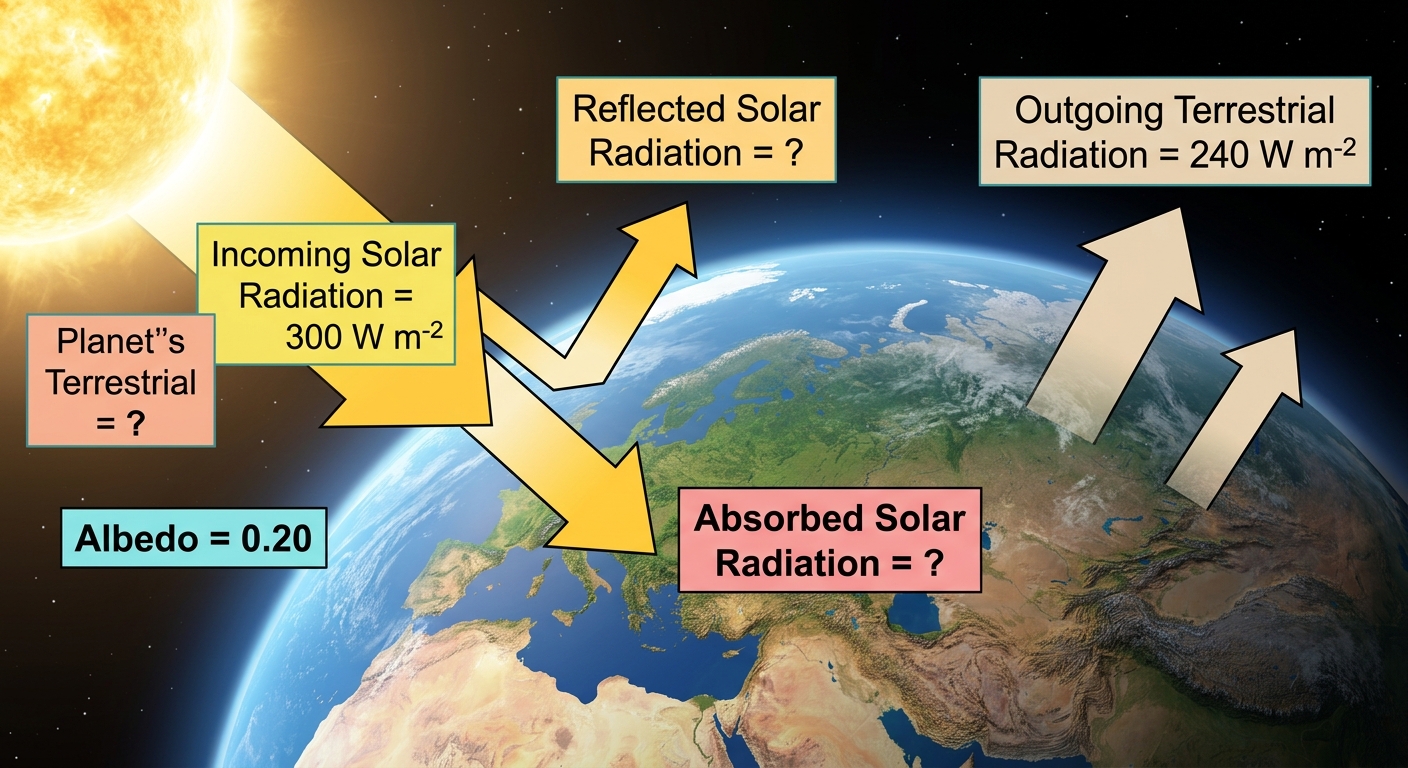
A planet receives incoming solar radiation of and has an albedo of . The planet emits outgoing terrestrial radiation of . Which statement correctly describes the planet's energy balance?
revisionprep.com
Summary Answer
Not available for this question.
Model Answer
Not available for this question.
Marking Scheme
Not available for this question.
Examiner Insights
Not available for this question.
Greenhouse gases: molecular absorption and re-emission of infrared
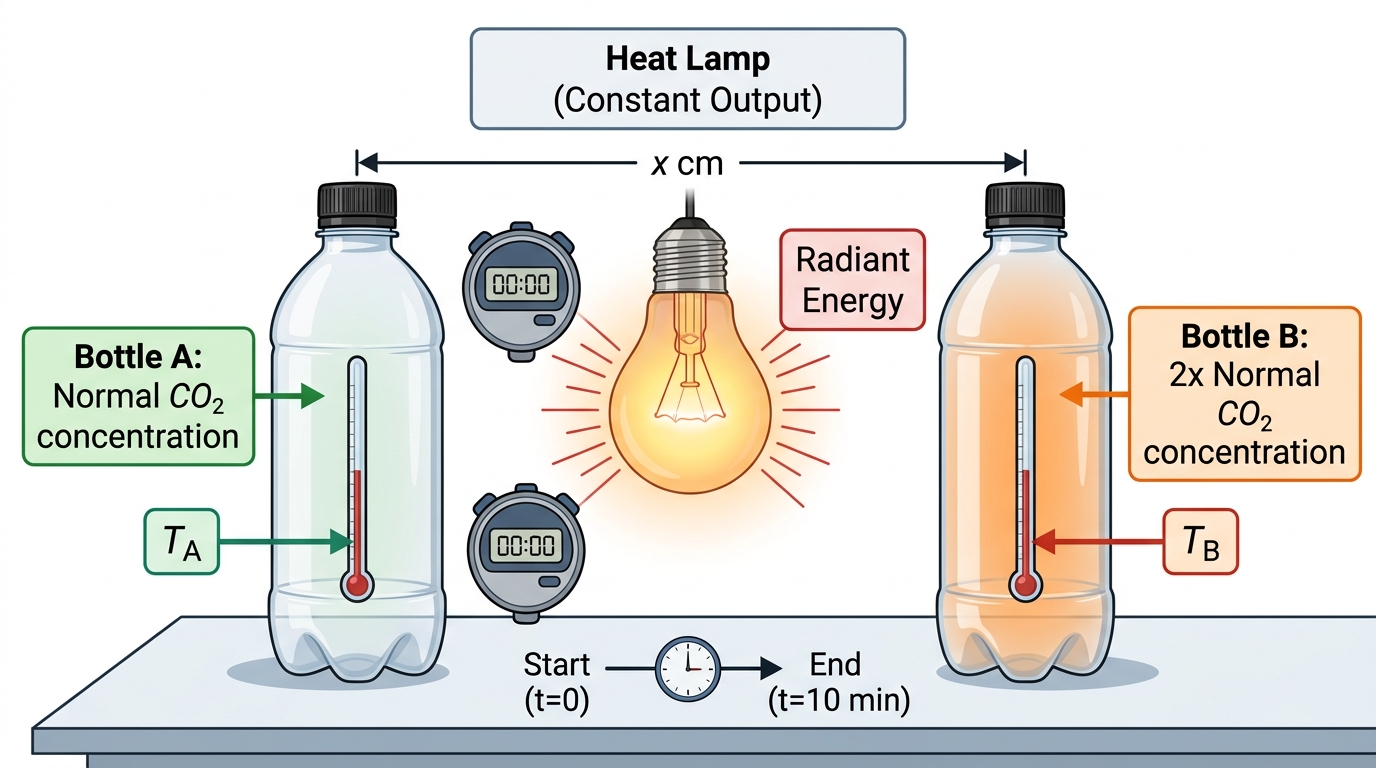
A student investigates the greenhouse effect using two identical sealed transparent bottles placed equal distances from a heat lamp. Bottle A contains air at normal concentration; Bottle B contains air at twice the normal concentration. Both bottles are exposed to the lamp for 10 minutes. The lamp emits both visible light and infrared radiation. Which statement best describes the expected temperature change in each bottle?
revisionprep.com
Summary Answer
Not available for this question.
Model Answer
Not available for this question.
Marking Scheme
Not available for this question.
Examiner Insights
Not available for this question.
Solar constant, albedo, emissivity and Earth's energy balance
A weather station in a northern forest clearing measures the solar intensity incident on the ground and the intensity reflected from it, at noon on clear days. Table 1 shows the data. The uncertainty in each intensity reading is .
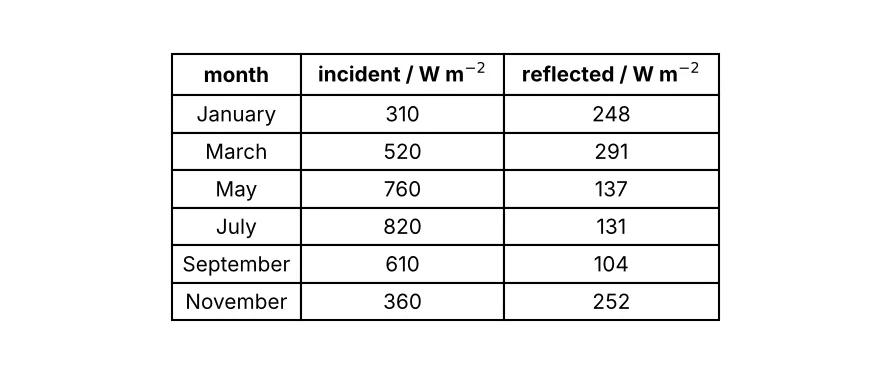
Determine the albedo of the ground in May.
Determine the absolute uncertainty in the albedo calculated in (a).
Explain the variation in albedo shown by the data over the year.
A warmer climate shortens the snow season at this site. Explain why this is an example of positive feedback.
revisionprep.com
Summary Answer
Not available for this question.
Model Answer
Not available for this question.
Marking Scheme
Not available for this question.
Examiner Insights
Not available for this question.
Greenhouse gases: molecular absorption and re-emission of infrared
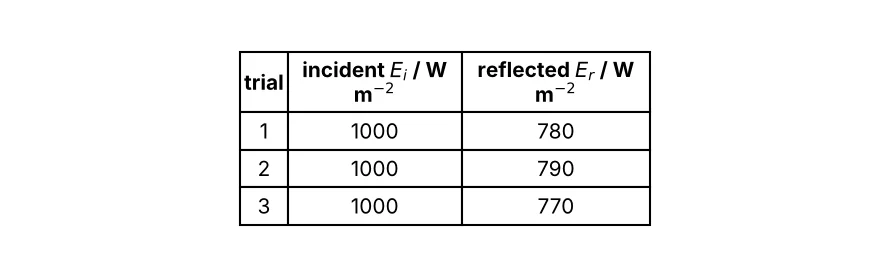
A student measures the albedo of a patch of fresh snow with a pyranometer, which measures the intensity of the radiation incident on, and reflected from, the surface. Table 1 shows three trials. Each reading is uncertain by .
Define albedo.
Determine the mean albedo and the absolute uncertainty in it, using half the range.
Determine the intensity absorbed by the snow when the incident intensity is .
Suggest why the sensor should be held level at a fixed height for each trial, and one further way of improving the reliability of the measurement.
revisionprep.com
Summary Answer
Not available for this question.
Model Answer
Not available for this question.
Marking Scheme
Not available for this question.
Examiner Insights
Not available for this question.
Solar constant, albedo, emissivity and Earth's energy balance
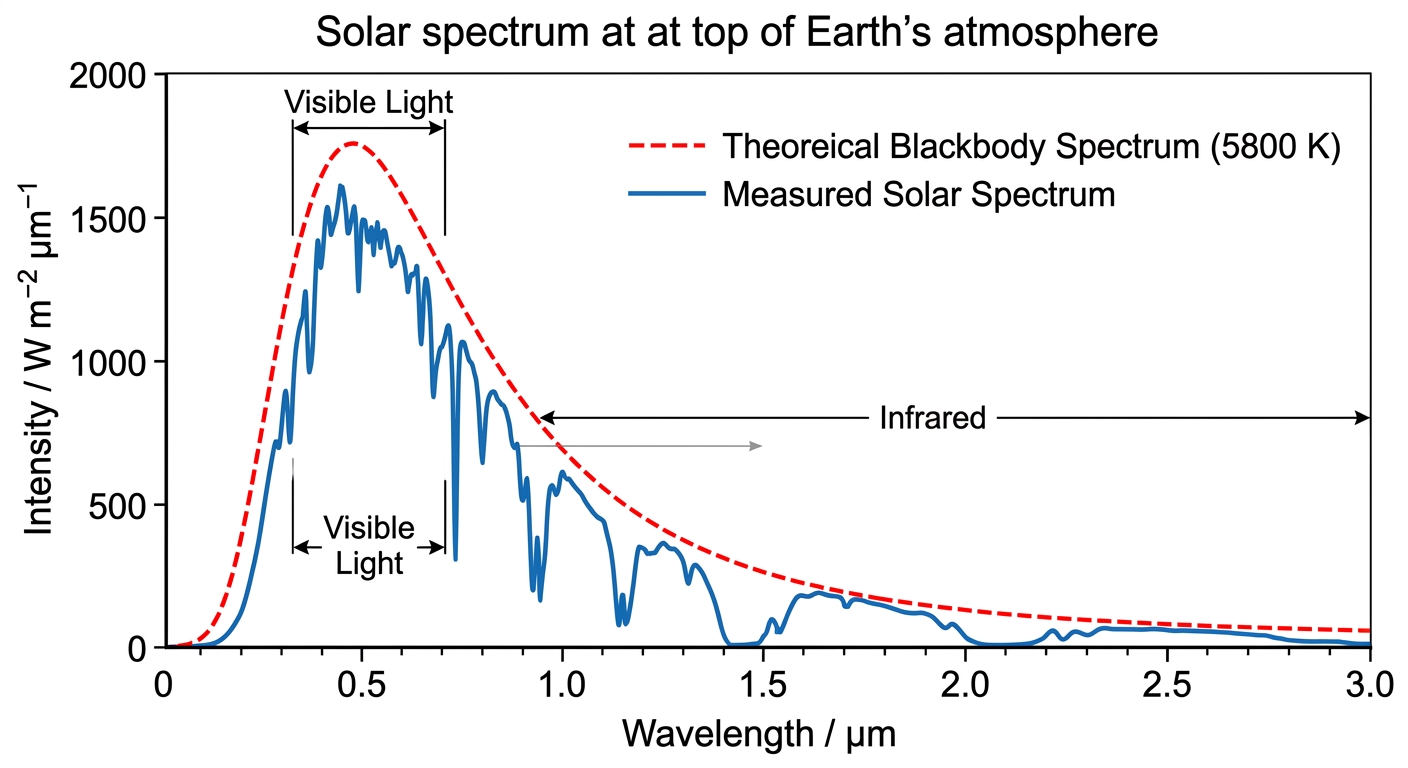
The graph was given the title 'Solar spectrum at top of Earth's atmosphere'. The measured curve was in fact recorded at the Earth's surface. Which feature of the measured curve shows this?
revisionprep.com
Summary Answer
Not available for this question.
Model Answer
Not available for this question.
Marking Scheme
Not available for this question.
Examiner Insights
Not available for this question.
Greenhouse gases: molecular absorption and re-emission of infrared
Two identical clear bottles, one filled with air and one with carbon dioxide, are placed the same distance from a lamp. A temperature sensor in each bottle records the temperature for 12 minutes. Figure 1 shows the results; each temperature is uncertain by .
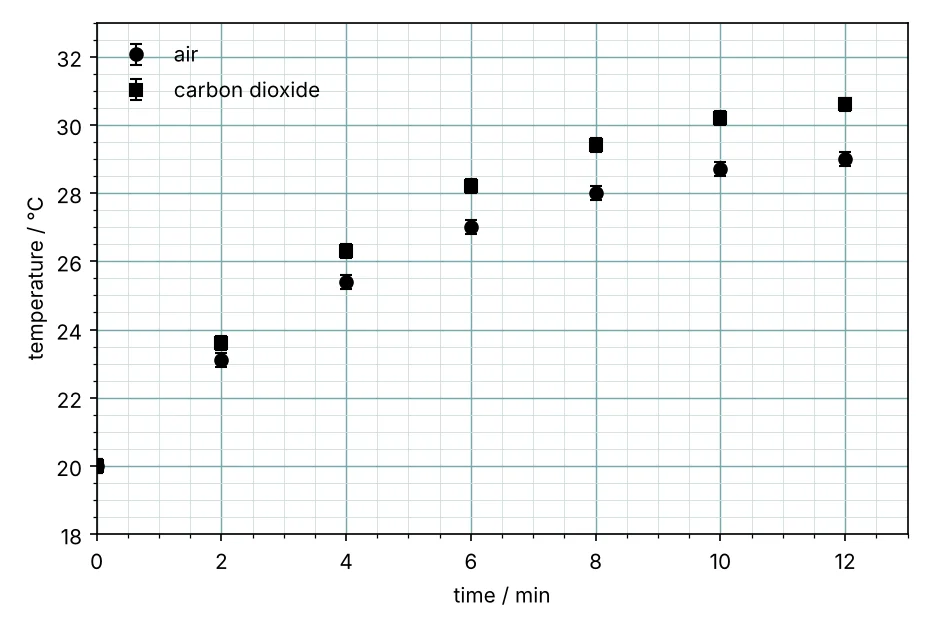
Determine the initial rate of temperature rise in each bottle.
Determine the difference between the final temperatures and its percentage uncertainty.
State whether the data support the claim that carbon dioxide causes the greater warming, justifying your answer with reference to the uncertainty.
Explain, in terms of the radiation involved, why the gas with the larger temperature rise is the better absorber.
Suggest two variables that must be controlled in this experiment.
revisionprep.com
Summary Answer
Not available for this question.
Model Answer
Not available for this question.
Marking Scheme
Not available for this question.
Examiner Insights
Not available for this question.
That's every free question here — 6 of 139.
+133 more questions, plus Mock Papers & Worksheets, are waiting in Premium.