Thermal Energy Transfers · Paper 1 — Free Physics SL Practice Questions
Free questions
Open in full, with answers, mark scheme and examiner insights.
Molecular model of matter, density, temperature and internal energy
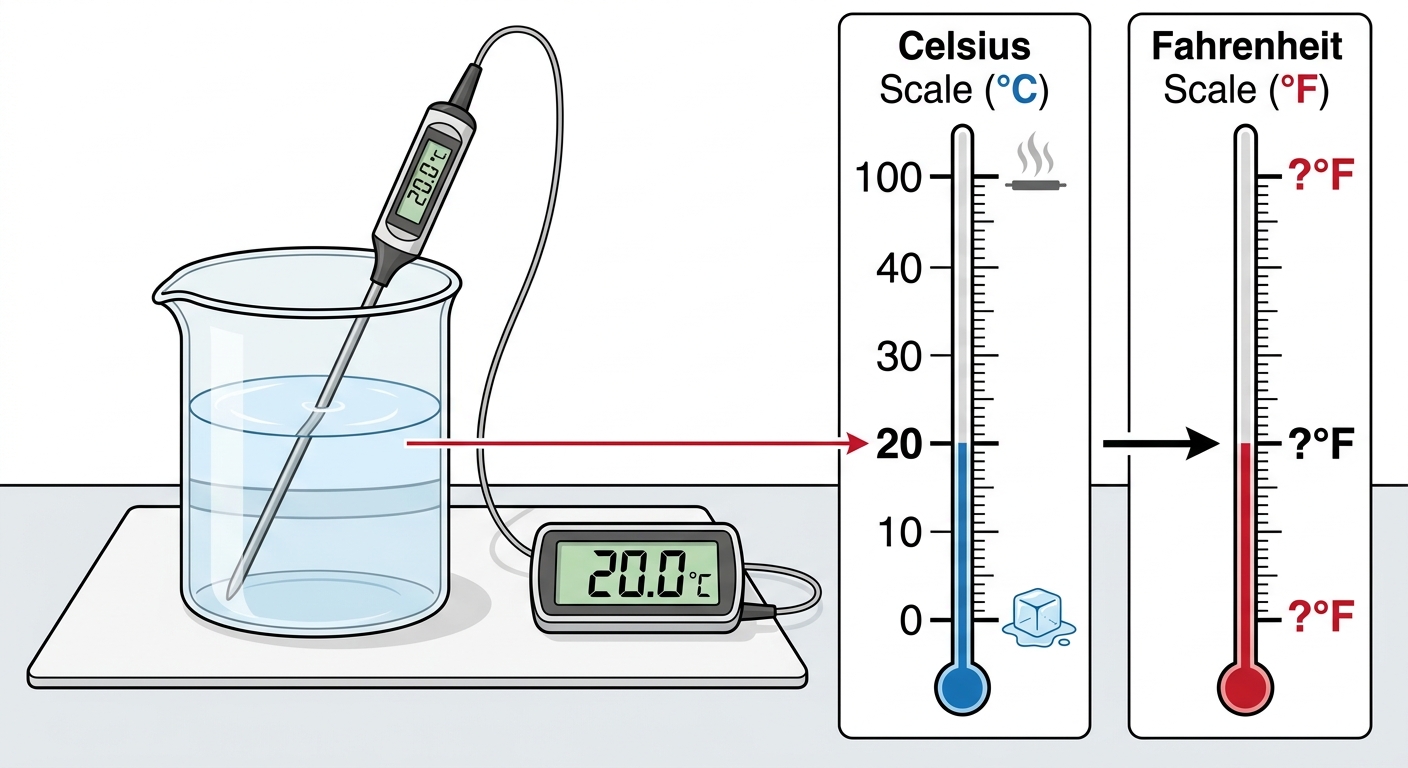
The digital thermometer shows the water temperature. The water is then heated to . The Fahrenheit scale is related to the Celsius scale by . What is the temperature rise on the Fahrenheit scale?
revisionprep.com
Summary Answer
Not available for this question.
Model Answer
Not available for this question.
Marking Scheme
Not available for this question.
Examiner Insights
Not available for this question.
Specific heat capacity and specific latent heat
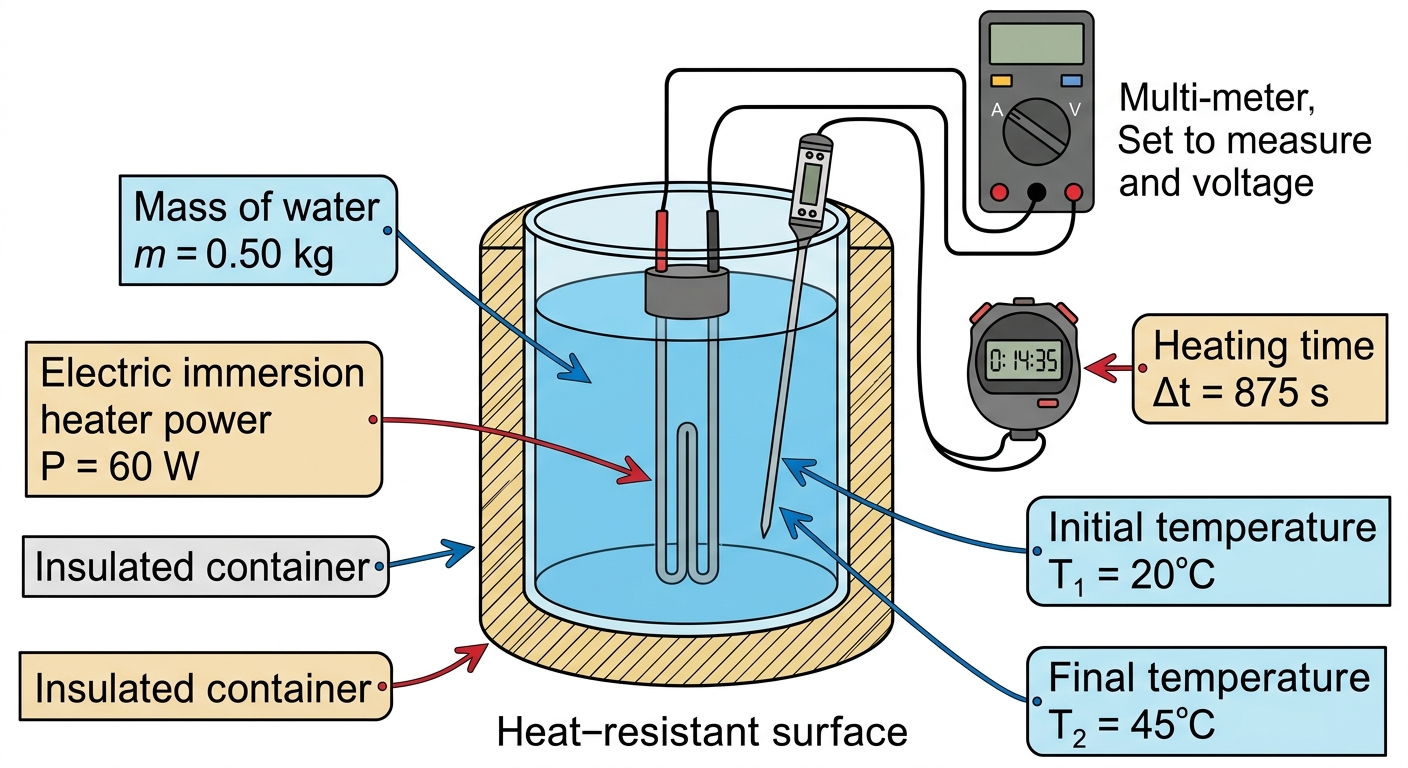
An electric immersion heater rated at heats of water in a well-insulated container. The water temperature rises from to in . What is the specific heat capacity of water determined from this experiment?
revisionprep.com
Summary Answer
Not available for this question.
Model Answer
Not available for this question.
Marking Scheme
Not available for this question.
Examiner Insights
Not available for this question.
Molecular model of matter, density, temperature and internal energy
A student traps a fixed volume of air in a flask and measures its pressure at six temperatures. The results are shown in the table and plotted on the graph, with a line of best fit.
/ C: 0, 20, 40, 60, 80, 100 / kPa: 100.2, 107.1, 114.9, 122.1, 129.3, 136.8
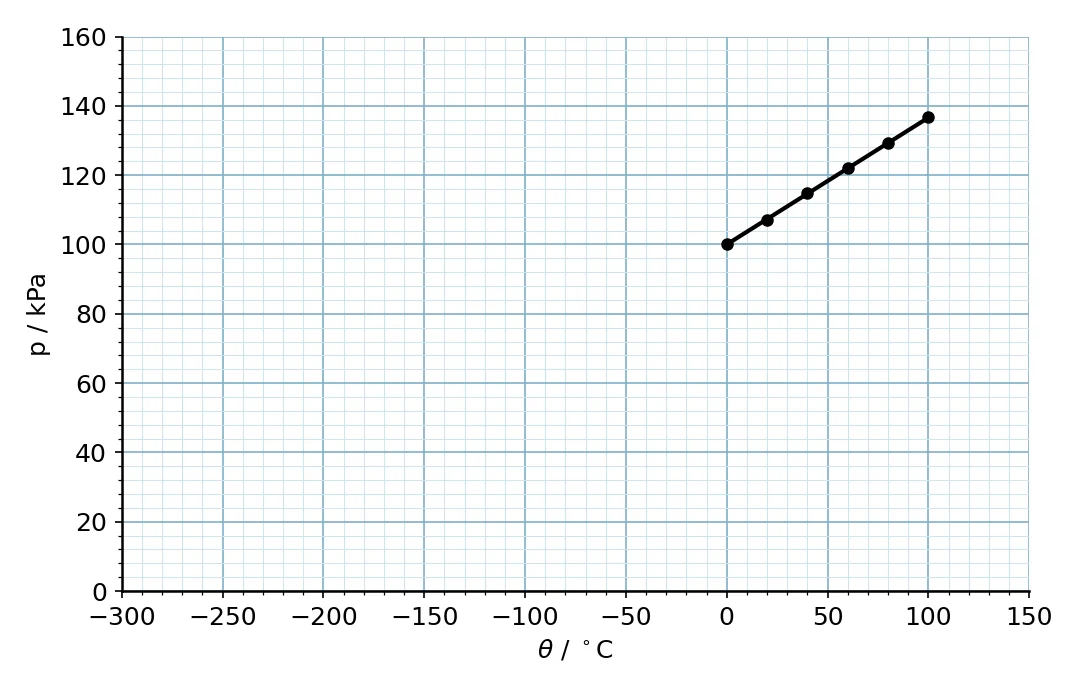
Determine the gradient of the line of best fit, including its unit.
Hence determine the temperature, in C, at which the pressure of the air would be zero.
Explain, in terms of the motion of the particles, why the temperature found in (b) is the lowest temperature possible.
Calculate the average translational kinetic energy of an air particle at .
revisionprep.com
Summary Answer
Not available for this question.
Model Answer
Not available for this question.
Marking Scheme
Not available for this question.
Examiner Insights
Not available for this question.
Specific heat capacity and specific latent heat
A student heats an aluminium block of mass 0.400 kg with an electric heater of power 60.0 W. The block is wrapped in felt and a thermometer in a hole in the block is read every 100 s. The error bars show the uncertainty in each temperature.
Figure 1 shows the data. The line of best fit is drawn.
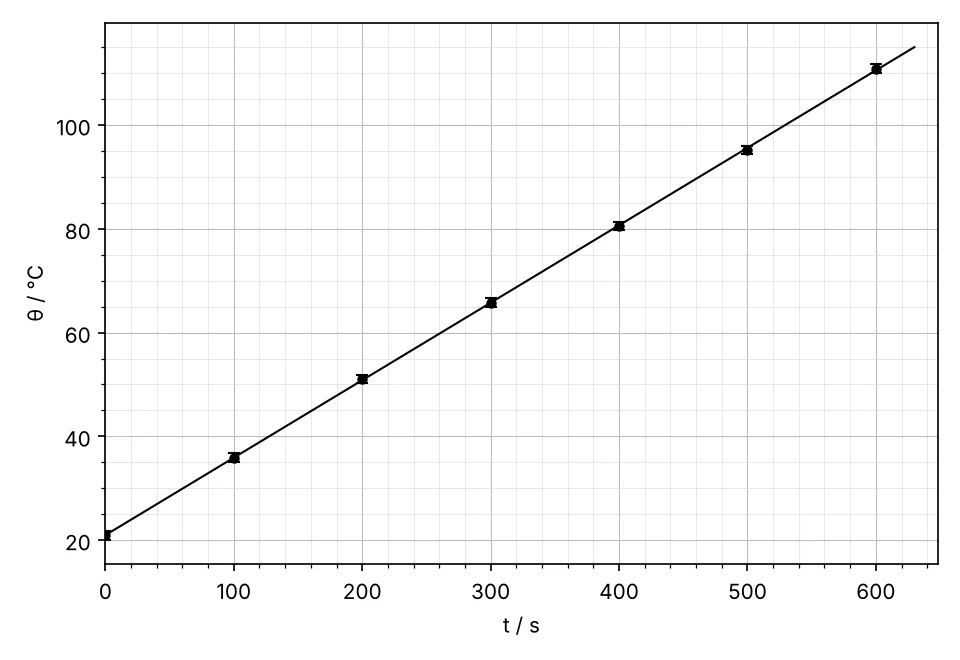
Calculate the percentage uncertainty in the temperature at t = 300 s.
Determine the gradient of the line of best fit, with its absolute uncertainty. State your answer with its unit.
A value of c calculated from the gradient with P = 60.0 W is larger than the accepted 900 J kg⁻¹ K⁻¹. Suggest one reason, with an explanation.
revisionprep.com
Summary Answer
Not available for this question.
Model Answer
Not available for this question.
Marking Scheme
Not available for this question.
Examiner Insights
Not available for this question.
Molecular model of matter, density, temperature and internal energy
A student pours a mass m_h of hot water into 0.200 kg of cold water at 20.0 °C in a polystyrene cup and records the final temperature θ_f. The fraction f = m_h / (m_h + 0.200 kg) is calculated for each trial. The hot water is at the same temperature in every trial.
Figure 1 shows the data. The line of best fit is drawn.
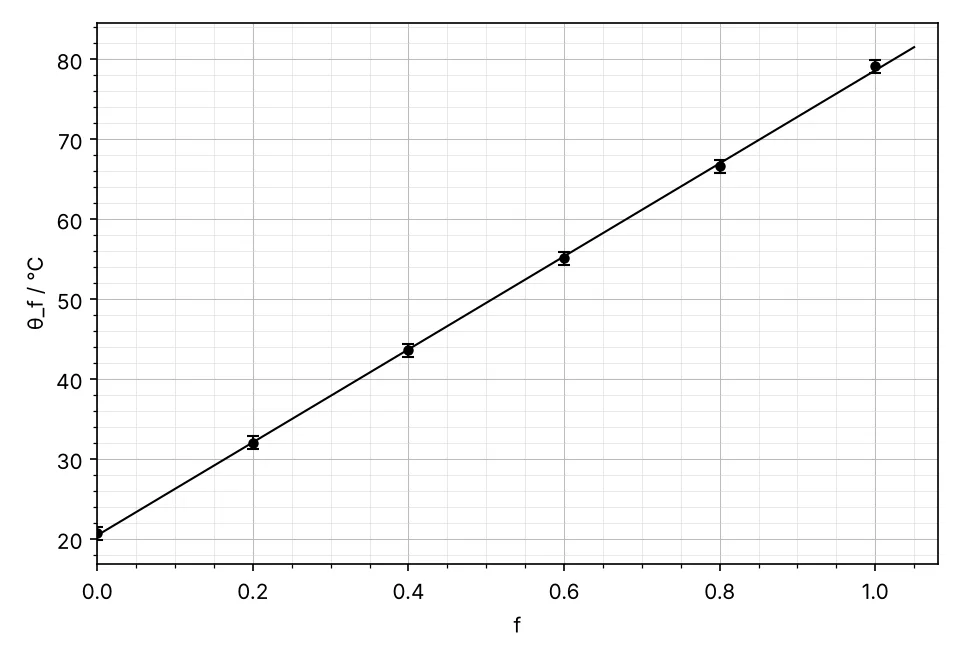
Calculate the percentage uncertainty in θ_f when f = 0.600.
Determine the gradient of the line of best fit, with its absolute uncertainty. State your answer with its unit.
Use the gradient to determine the temperature of the hot water, in °C, assuming the cold water was at 20.0 °C, with its absolute uncertainty.
The gradient implies a hot-water temperature lower than the thermometer reading of 60.0 °C. Suggest a reason, with an explanation.
revisionprep.com
Summary Answer
Not available for this question.
Model Answer
Not available for this question.
Marking Scheme
Not available for this question.
Examiner Insights
Not available for this question.
Specific heat capacity and specific latent heat
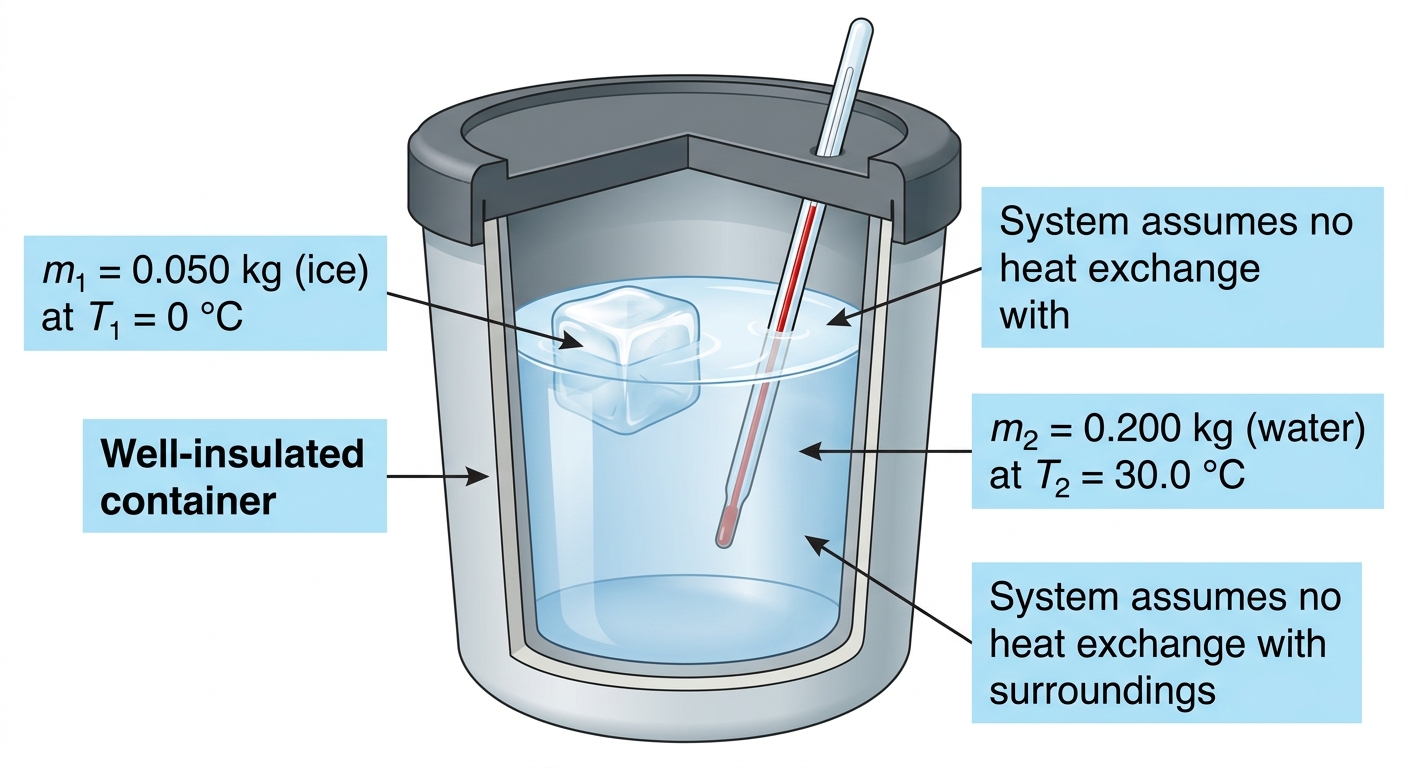
The shows an ice cube at placed in water in a well-insulated container. The specific latent heat of fusion of ice is and the specific heat capacity of water is . What is the greatest mass of ice at that this water could melt completely?
revisionprep.com
Summary Answer
Not available for this question.
Model Answer
Not available for this question.
Marking Scheme
Not available for this question.
Examiner Insights
Not available for this question.
That's every free question here — 6 of 273.
+267 more questions, plus Mock Papers & Worksheets, are waiting in Premium.