Gas Laws · Paper 2 — Free Physics SL Practice Questions
Free questions
Open in full, with answers, mark scheme and examiner insights.
Pressure, the mole, Avogadro constant and the empirical gas laws
A sealed syringe contains a fixed mass of ideal gas at and . The plunger is pushed in slowly to and the temperature stays constant.
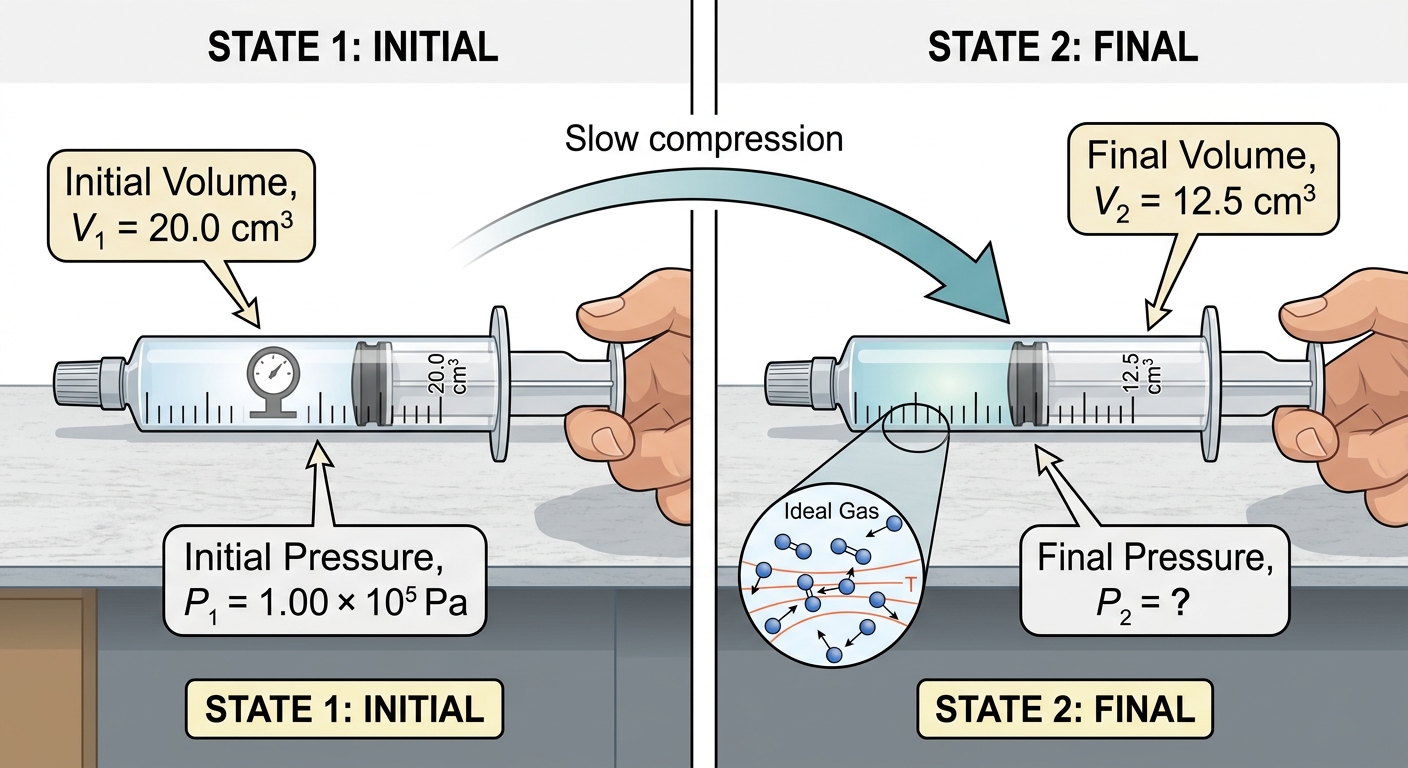
State Boyle's law.
State the two conditions needed for Boyle's law to apply.
Calculate the new pressure of the gas.
revisionprep.com
Summary Answer
Not available for this question.
Model Answer
Not available for this question.
Marking Scheme
Not available for this question.
Examiner Insights
Not available for this question.
Ideal gas equation (PV = nRT = NkBT)
A bicycle tyre has a volume of and contains air at a pressure of and a temperature of . During a long ride the air warms to . The volume of the tyre does not change.
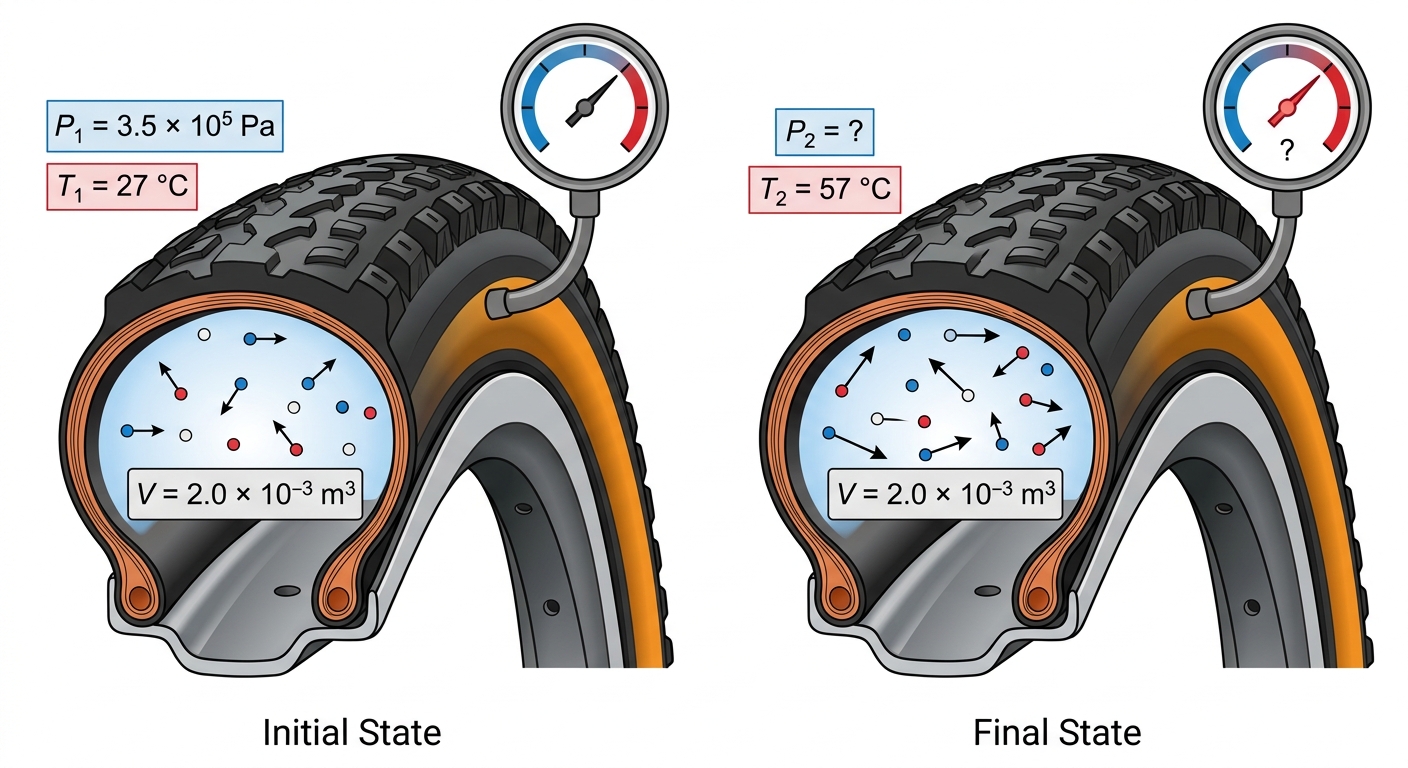
State the relationship between pressure and absolute temperature for a fixed mass of ideal gas at constant volume.
Explain, in terms of molecular motion, why the pressure rises when the temperature rises.
Calculate the final pressure in the tyre.
revisionprep.com
Summary Answer
Not available for this question.
Model Answer
Not available for this question.
Marking Scheme
Not available for this question.
Examiner Insights
Not available for this question.
Ideal gas equation (PV = nRT = NkBT)
A student investigates the relationship between pressure and volume for a fixed mass of an ideal gas at a constant temperature of . The gas is contained in a syringe connected to a pressure sensor. The initial volume of the gas is and the initial pressure is .
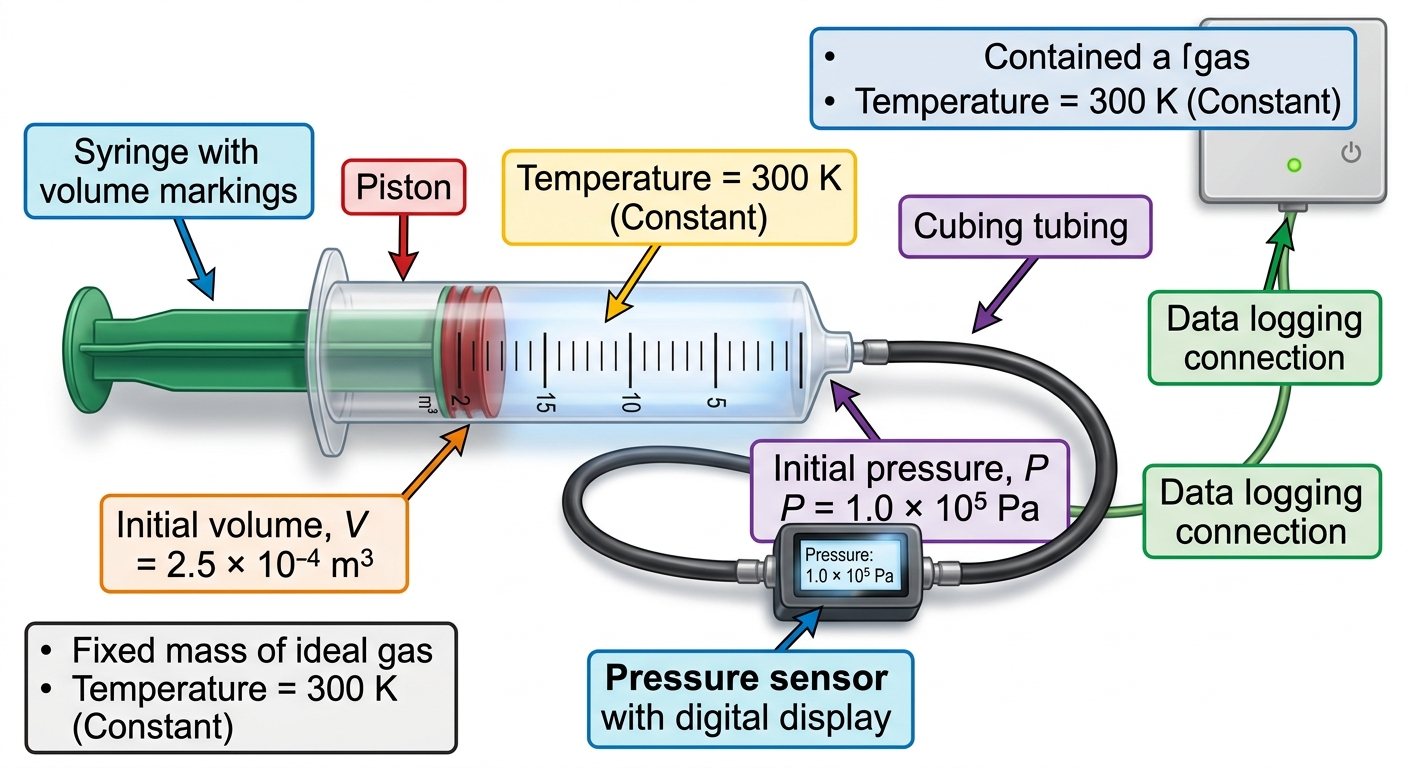
State what is meant by an ideal gas.
Calculate the number of moles of gas in the syringe.
The student slowly pushes the piston inward until the volume is . In practice, the temperature of the gas rises slightly above during compression. Deduce whether the actual final pressure will be greater than, equal to, or less than the value predicted assuming compression at constant temperature, and justify your answer.
revisionprep.com
Summary Answer
Not available for this question.
Model Answer
Not available for this question.
Marking Scheme
Not available for this question.
Examiner Insights
Not available for this question.
Real gases and deviations from ideal behaviour
A sample of gas is contained in a rigid cylinder of volume at a temperature of . The cylinder contains of gas. A pressure gauge reads .
The universal gas constant is .
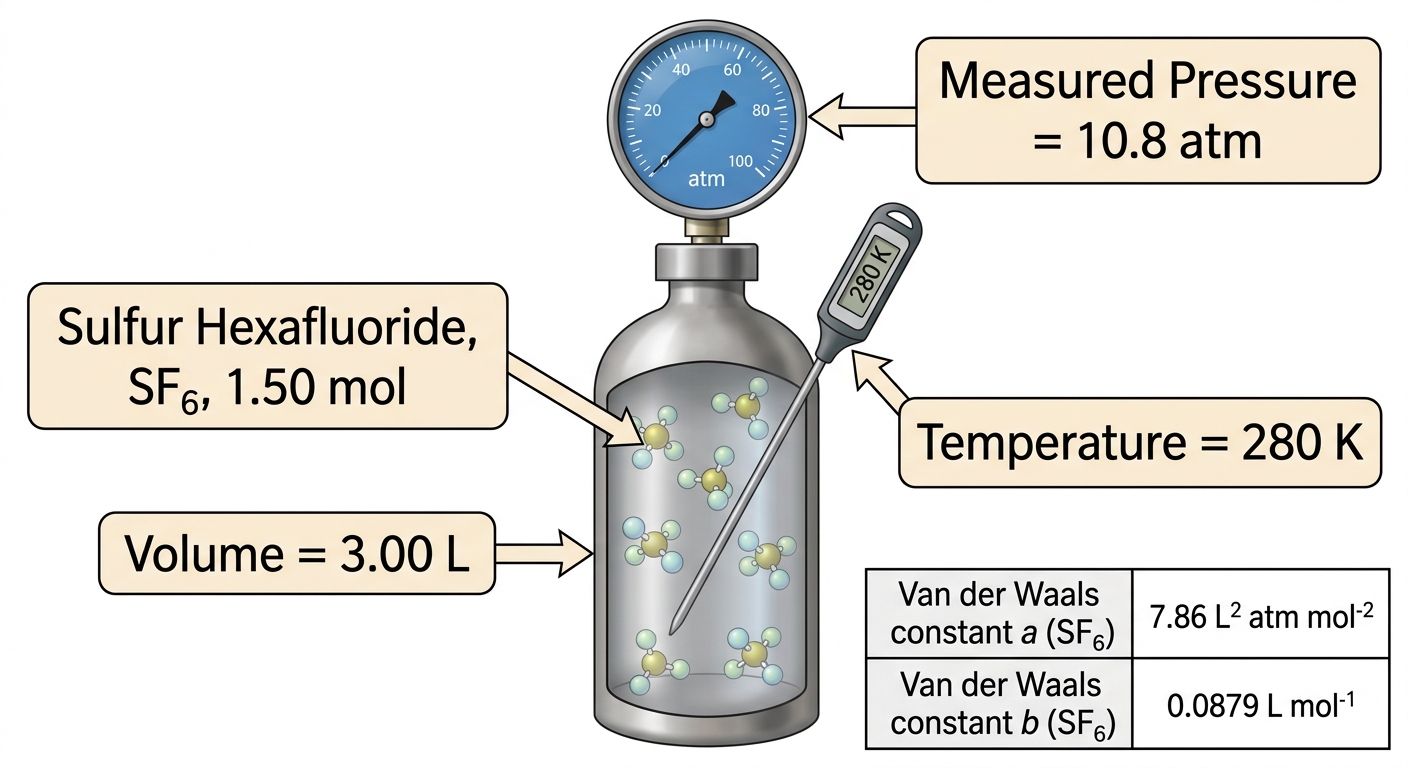
Calculate the pressure predicted by the ideal gas law for this sample.
The measured pressure is lower than the ideal gas prediction. Explain, with reference to the assumptions of the ideal gas model, why a real gas at these conditions produces a lower pressure than predicted.
Determine the percentage difference between the ideal gas pressure and the measured pressure, and hence evaluate whether the ideal gas model is appropriate for under these conditions.
revisionprep.com
Summary Answer
Not available for this question.
Model Answer
Not available for this question.
Marking Scheme
Not available for this question.
Examiner Insights
Not available for this question.
Pressure, the mole, Avogadro constant and the empirical gas laws
Data
A 0.200 m³ tank contains argon gas at 300 K and Pa. A second tank of volume 0.100 m³ contains argon at 350 K and Pa. The two tanks are connected by a tube of negligible volume and the system reaches thermal equilibrium at 320 K.
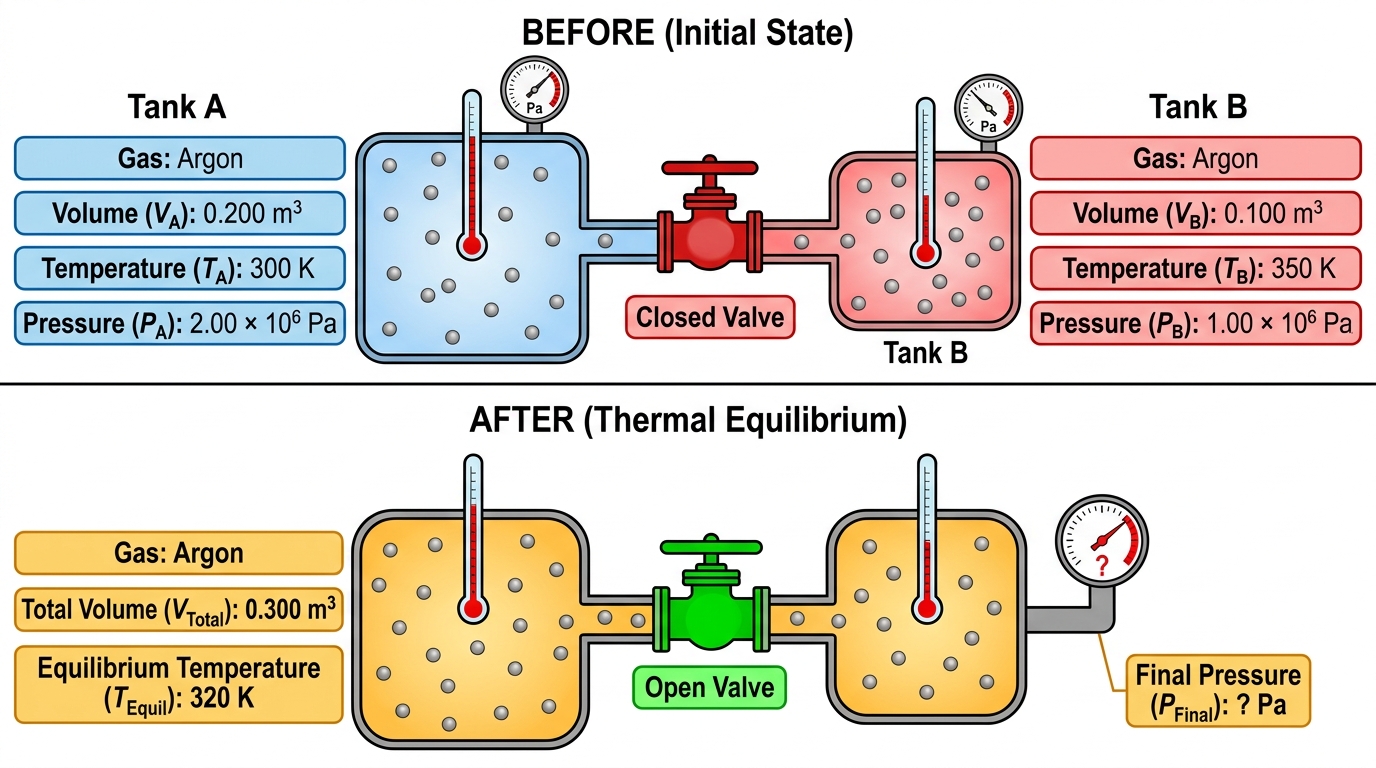
Determine the final pressure of the argon in the connected system.
The connecting tube has a non-negligible internal volume of . Determine the new final pressure and state whether it is higher or lower than your answer to (a).
Evaluate whether treating argon as an ideal gas is a reasonable assumption at the pressures found in (a). Justify your answer with reference to the conditions under which real gases deviate from ideal behaviour. [2]
(e) Calculate the mass of argon in the connected system. The molar mass of argon is .
revisionprep.com
Summary Answer
Not available for this question.
Model Answer
Not available for this question.
Marking Scheme
Not available for this question.
Examiner Insights
Not available for this question.
Kinetic model of an ideal gas: pressure, mean kinetic energy and internal energy
A nitrogen molecule of mass moves at between two opposite walls of a cubical box of side . It moves at right angles to the walls and every collision is elastic. Ignore collisions with other molecules.
Calculate the change in momentum of the molecule when it hits a wall.
Show that the molecule hits the same wall 2500 times every second.
Determine the mean force that this molecule exerts on the wall.
The box contains such molecules, moving in random directions with the same speed. Assume one third of them move along each axis. Determine the pressure on the wall, and verify that it agrees with .
Calculate the temperature of the gas in the box.
Explain why the assumption in (d) that one third of the molecules move along each axis gives the correct pressure even though real molecules move in all directions.
revisionprep.com
Summary Answer
Not available for this question.
Model Answer
Not available for this question.
Marking Scheme
Not available for this question.
Examiner Insights
Not available for this question.
That's every free question here — 6 of 101.
+95 more questions, plus Mock Papers & Worksheets, are waiting in Premium.