Greenhouse Effect · Paper 2 — Free Physics SL Practice Questions
Free questions
Open in full, with answers, mark scheme and examiner insights.
Solar constant, albedo, emissivity and Earth's energy balance
The graph below shows the intensity of solar radiation at different wavelengths measured at the top of the atmosphere and at Earth's surface.
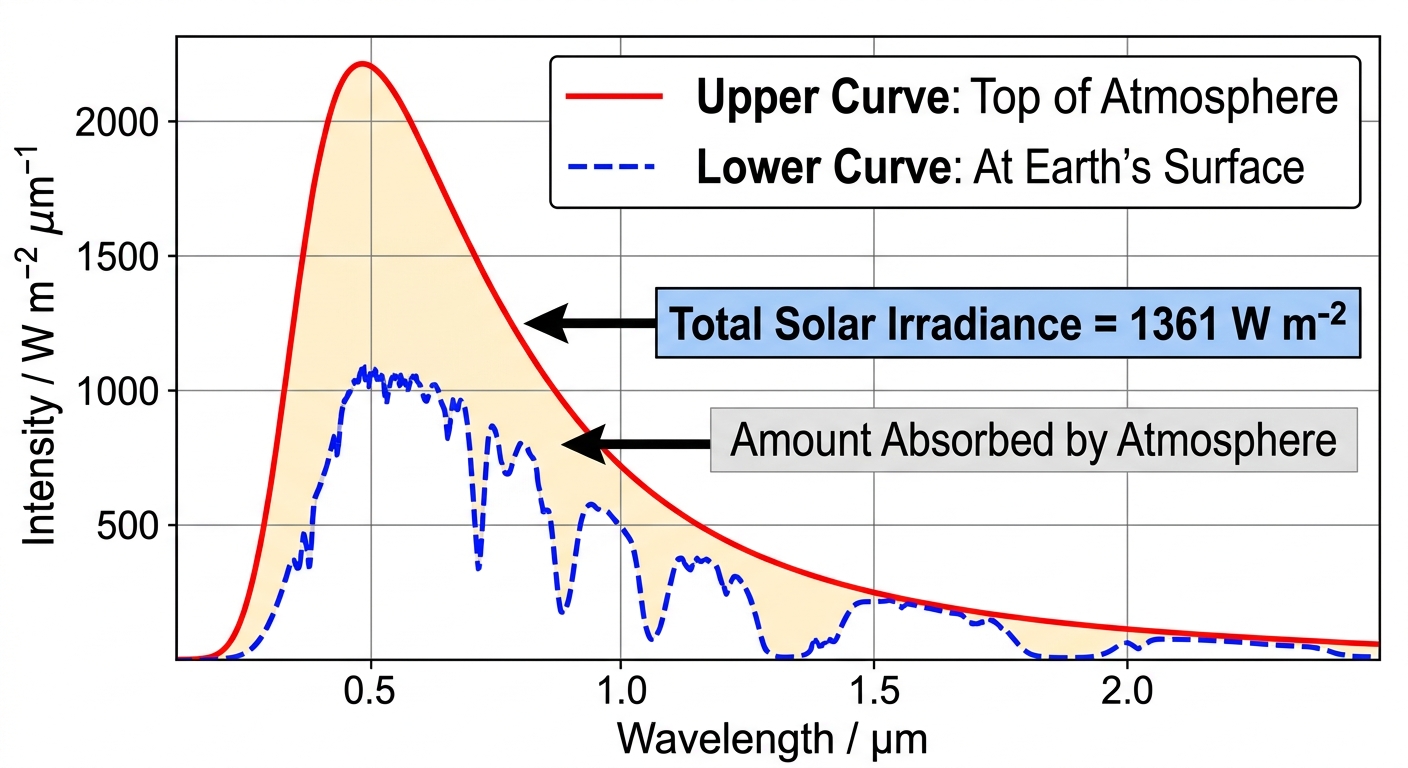
State one difference between the two curves shown in the graph.
Identify one wavelength region where the surface curve shows a pronounced dip relative to the top-of-atmosphere curve, and state the atmospheric gas responsible for absorption in that region.
The total solar irradiance at the top of the atmosphere is . Of this, 23% is absorbed by the atmosphere and 48% reaches Earth's surface. Calculate the average power per square metre absorbed by the atmosphere.
Determine the average power per square metre that reaches Earth's surface.
revisionprep.com
Summary Answer
Not available for this question.
Model Answer
Not available for this question.
Marking Scheme
Not available for this question.
Examiner Insights
Not available for this question.
Greenhouse gases: molecular absorption and re-emission of infrared
Greenhouse gases in the atmosphere absorb some of the radiation emitted by the surface of the Earth.
State two greenhouse gases.
State the region of the electromagnetic spectrum in which the Earth's surface mainly emits radiation.
revisionprep.com
Summary Answer
Not available for this question.
Model Answer
Not available for this question.
Marking Scheme
Not available for this question.
Examiner Insights
Not available for this question.
Solar constant, albedo, emissivity and Earth's energy balance
A student draws the diagram to summarise the Earth's mean energy budget, in arbitrary units.
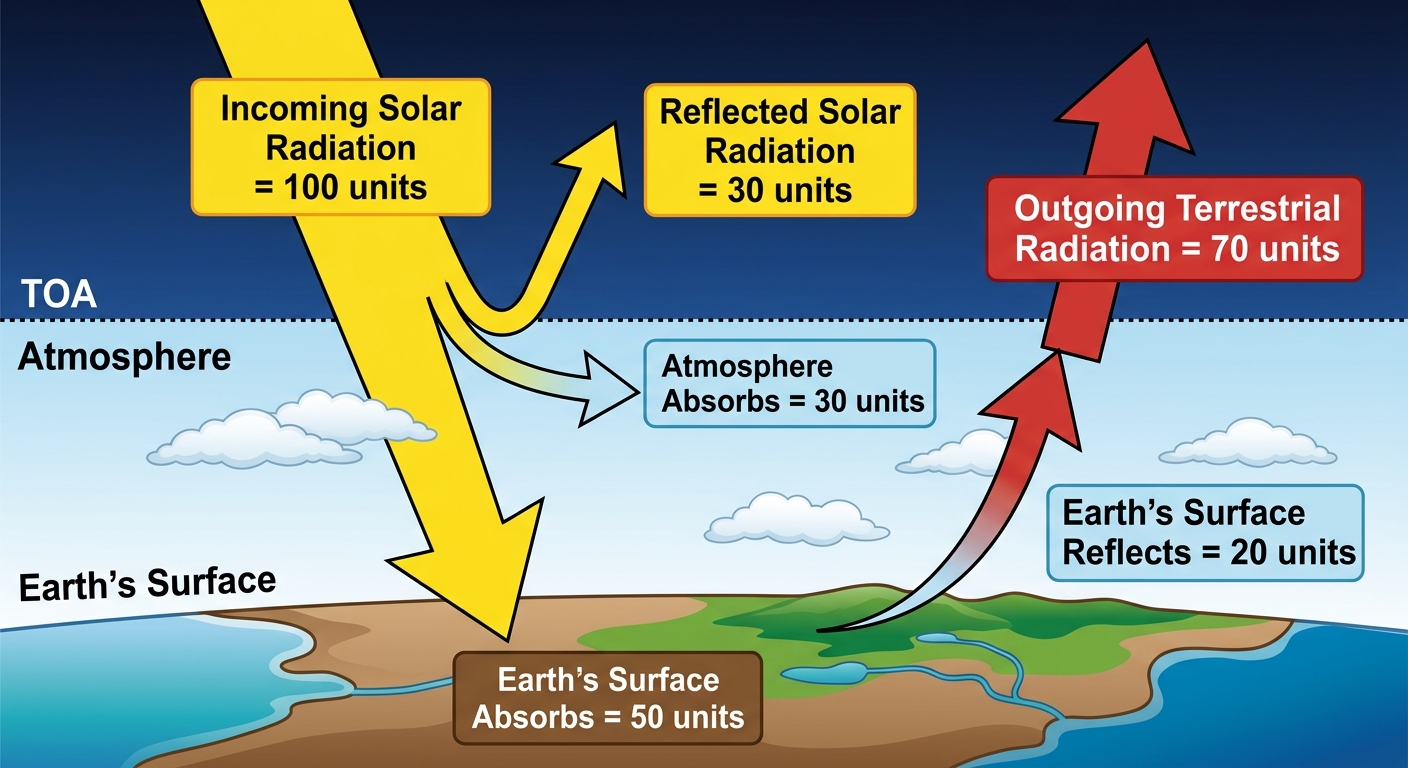
State the albedo of the Earth implied by the diagram.
Show that the values for solar radiation on the diagram are inconsistent with conservation of energy.
The values for reflected solar radiation and outgoing terrestrial radiation are correct. Determine the total solar radiation absorbed by the surface and atmosphere together, and deduce whether the Earth is in energy balance.
revisionprep.com
Summary Answer
Not available for this question.
Model Answer
Not available for this question.
Marking Scheme
Not available for this question.
Examiner Insights
Not available for this question.
Greenhouse gases: molecular absorption and re-emission of infrared
The graph below shows the relative contribution of different greenhouse gases to the enhanced greenhouse effect from human activities. The gases shown are carbon dioxide (), methane (), nitrous oxide (), and fluorinated gases (F-gases).
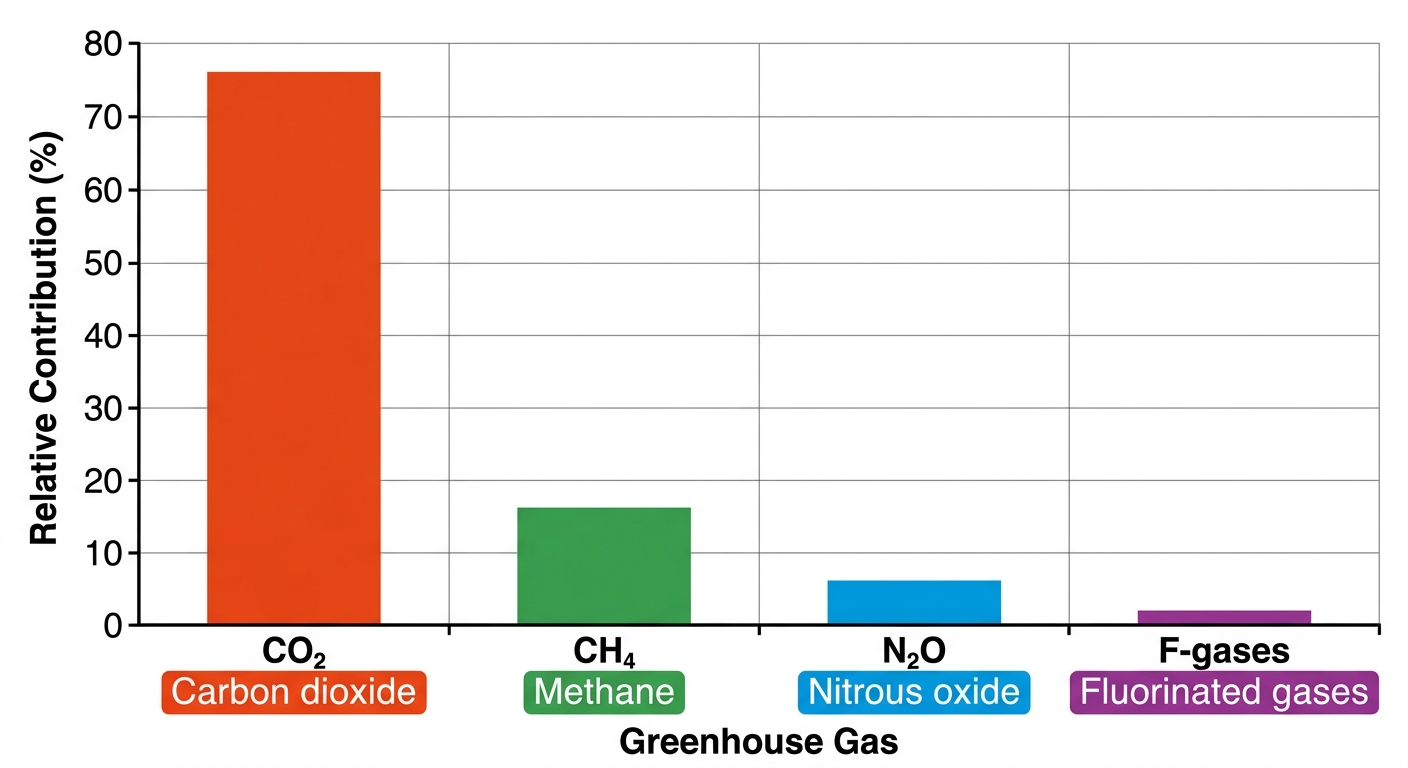
State two properties of greenhouse gases that enable them to contribute to the enhanced greenhouse effect.
The total radiative forcing from all greenhouse gases combined is . Calculate the radiative forcing due to methane alone.
Deduce whether the radiative forcing due to alone exceeds .
revisionprep.com
Summary Answer
Not available for this question.
Model Answer
Not available for this question.
Marking Scheme
Not available for this question.
Examiner Insights
Not available for this question.
Solar constant, albedo, emissivity and Earth's energy balance
A simplified model of Earth's energy balance treats the atmosphere as a single layer that is transparent to solar radiation but absorbs all terrestrial infrared radiation. The surface emits as a blackbody at temperature , and the atmosphere emits equally upward and downward as a blackbody at temperature .
The incoming absorbed solar radiation at the surface is .
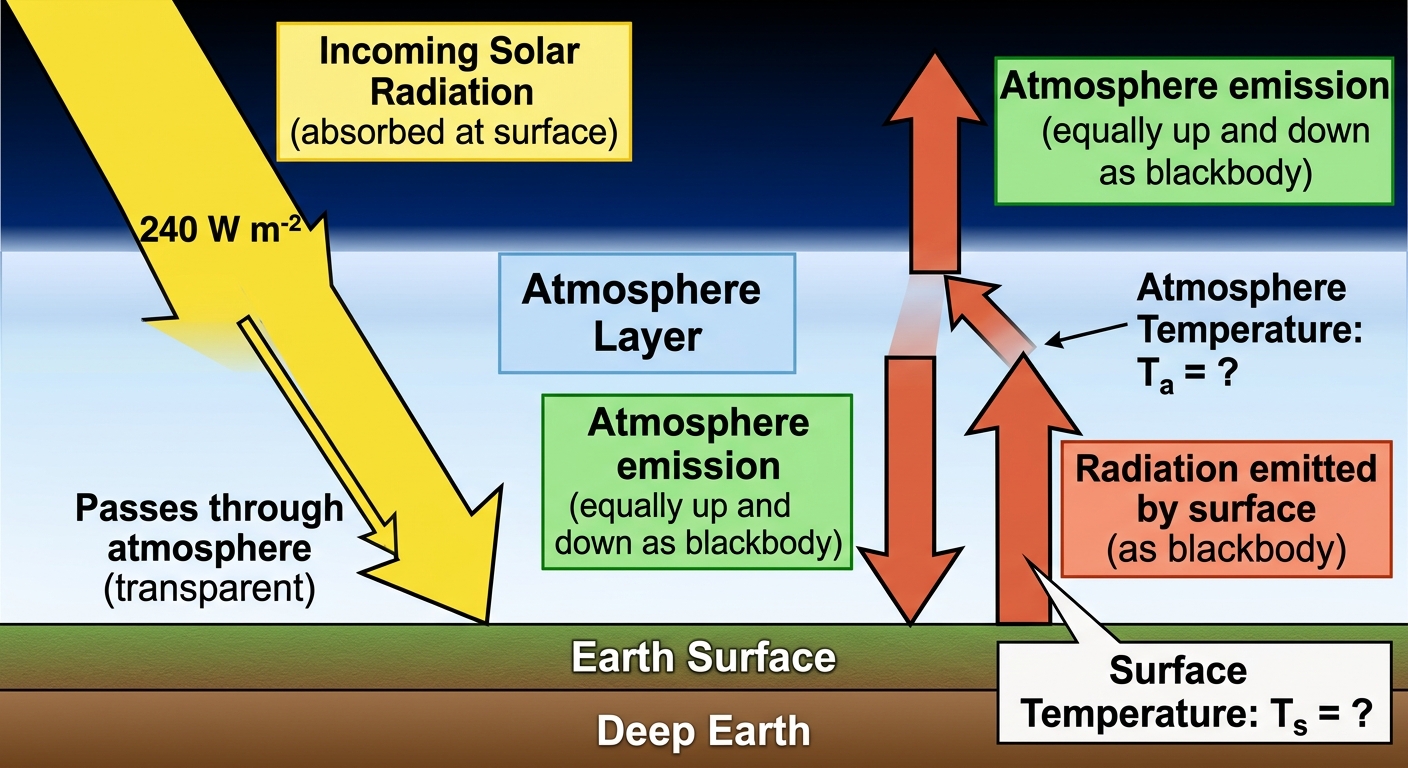
Write an equation for the energy balance of the Earth's surface in terms of , , and .
Determine and .
Explain why this model predicts a higher surface temperature than a model with no atmosphere.
Evaluate one limitation of this single-layer atmospheric model.
revisionprep.com
Summary Answer
Not available for this question.
Model Answer
Not available for this question.
Marking Scheme
Not available for this question.
Examiner Insights
Not available for this question.
Enhanced greenhouse effect and energy balance models
Five climate models are run with the same assumed increase in greenhouse gas concentrations. Table 1 shows the temperature rise by the year 2100 predicted by each model (hypothetical data).
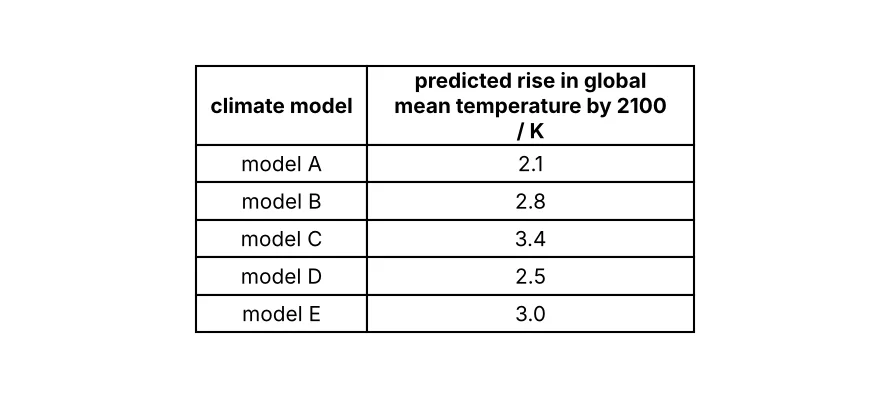
Determine the mean predicted rise and its absolute uncertainty, taken as half the range of the predictions.
Determine the percentage uncertainty in the mean predicted rise.
Outline two reasons why the models predict different rises even though the greenhouse gas concentrations are the same.
Discuss how the spread of the predictions affects the decisions that governments can take about the climate.
revisionprep.com
Summary Answer
Not available for this question.
Model Answer
Not available for this question.
Marking Scheme
Not available for this question.
Examiner Insights
Not available for this question.
That's every free question here — 6 of 151.
+145 more questions, plus Mock Papers & Worksheets, are waiting in Premium.