Standing Waves and Resonance · Paper 1 — Free Physics SL Practice Questions
Free questions
Open in full, with answers, mark scheme and examiner insights.
Standing waves: nodes, antinodes and harmonics on strings and in pipes
A student measures the fundamental frequency f of one guitar string as it is pressed at different frets, which changes its vibrating length L. The tension does not change. Table 1 shows the results.
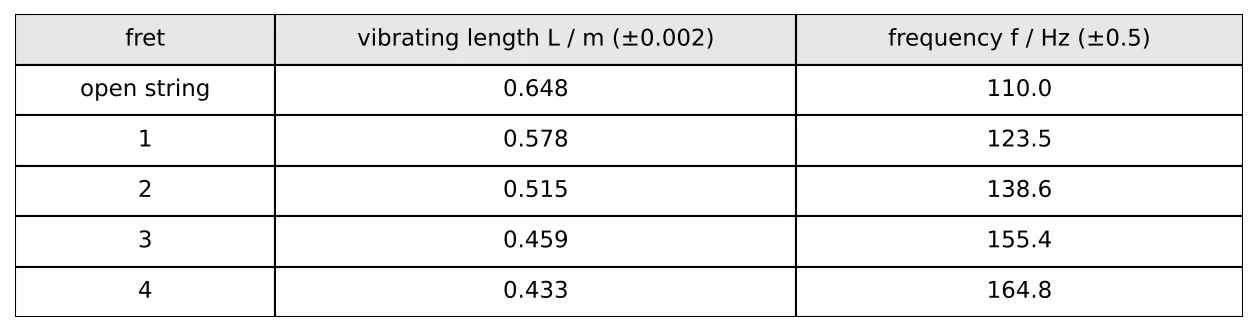
State the relationship between f and L that is expected if the wave speed is constant.
Calculate the product fL for the open string and for fret 4.
Hence calculate the speed of waves on the string.
Calculate the percentage uncertainty in the open-string length.
revisionprep.com
Summary Answer
Not available for this question.
Model Answer
Not available for this question.
Marking Scheme
Not available for this question.
Examiner Insights
Not available for this question.
Resonance, natural frequency and damping
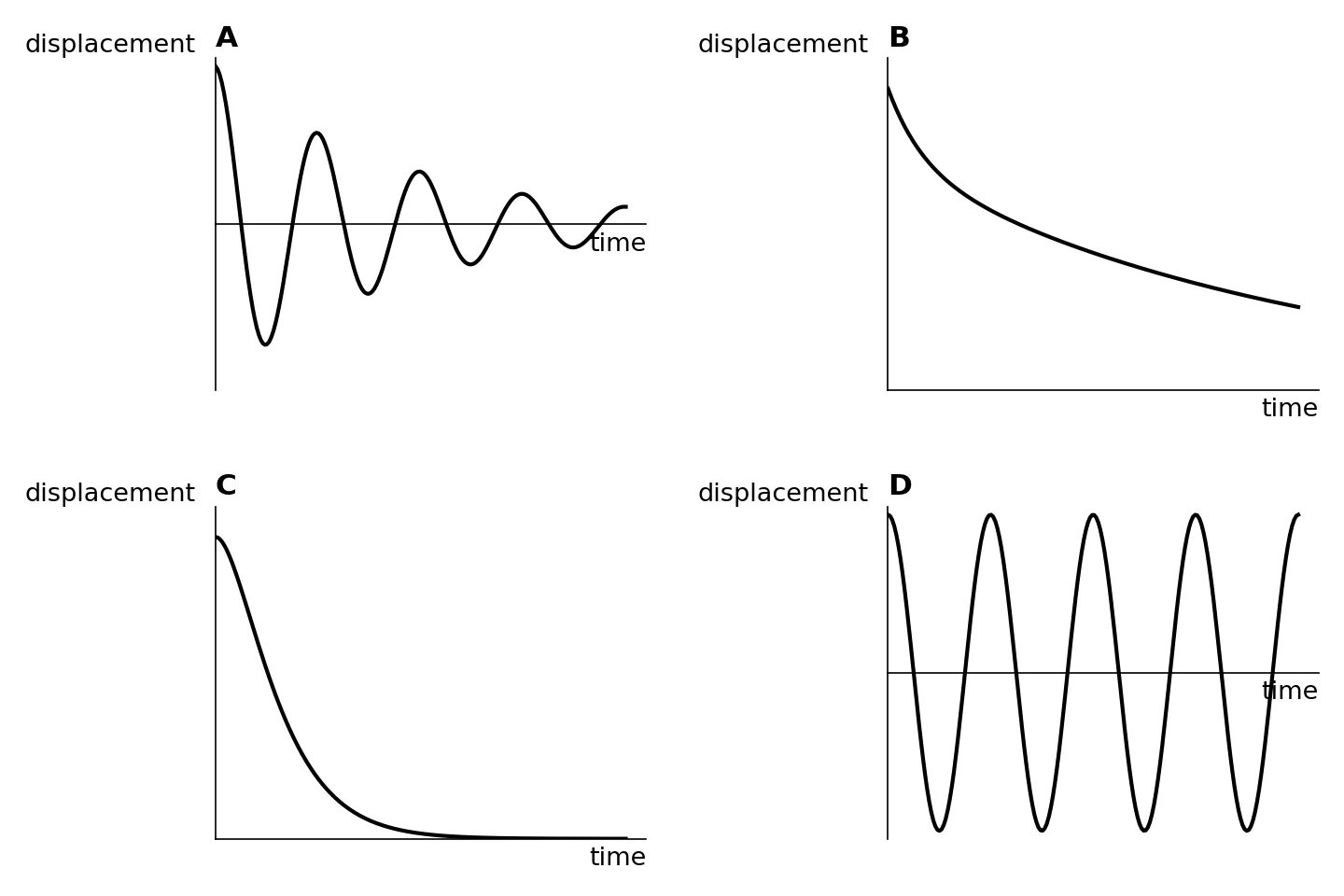
Each graph shows how the displacement of an oscillating system varies with time after it is released. Which graph shows critical damping?
revisionprep.com
Summary Answer
Not available for this question.
Model Answer
Not available for this question.
Marking Scheme
Not available for this question.
Examiner Insights
Not available for this question.
Standing waves: nodes, antinodes and harmonics on strings and in pipes
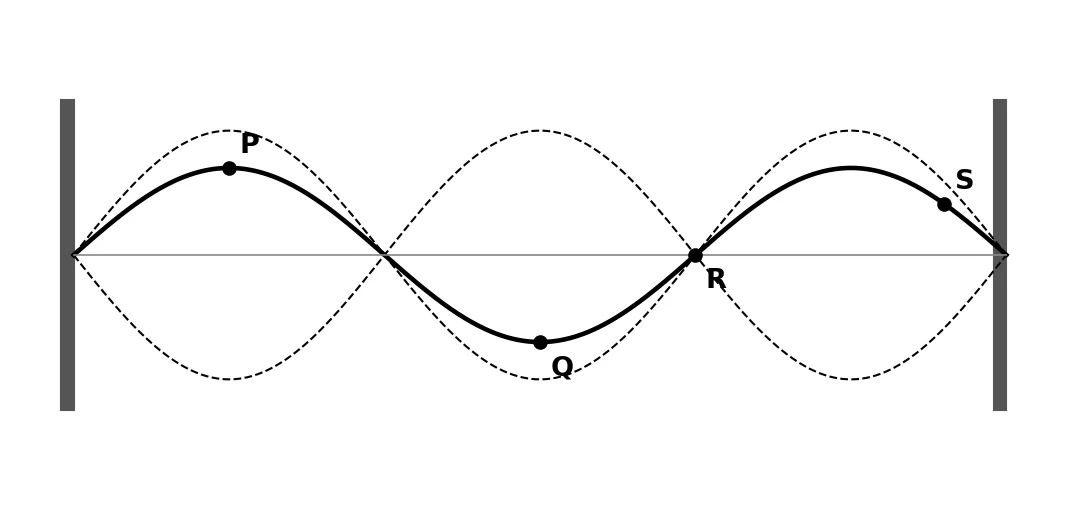
The shows a string fixed at both ends vibrating in its third harmonic. The solid line shows the string at one instant and the dashed lines show the envelope. Which point or points oscillate in phase with P?
revisionprep.com
Summary Answer
Not available for this question.
Model Answer
Not available for this question.
Marking Scheme
Not available for this question.
Examiner Insights
Not available for this question.
Resonance, natural frequency and damping
A string of vibrating length 1.20 m is driven by a vibrator connected to a signal generator. A student slowly increases the frequency and records the frequency f at which a standing wave with n loops appears, for n = 1 to 5. Figure 1 shows the results; each frequency is uncertain by ±2.0 Hz.
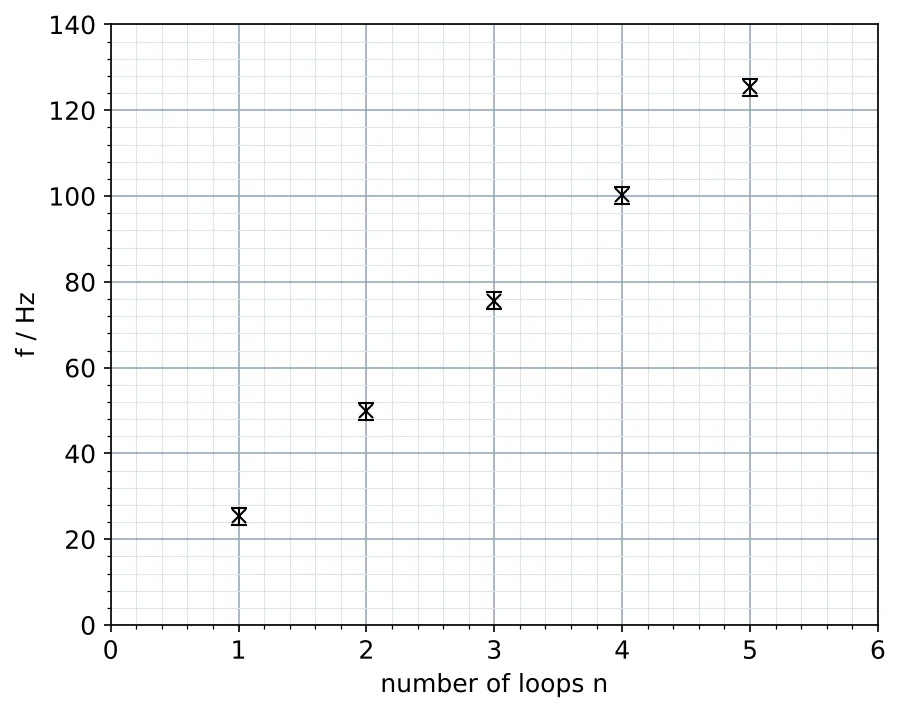
Determine the gradient of the line of best fit for the data in Figure 1.
Hence determine the speed of the waves on the string.
Explain why the gradient gives a more reliable value of the fundamental frequency than the reading for n = 1 alone.
revisionprep.com
Summary Answer
Not available for this question.
Model Answer
Not available for this question.
Marking Scheme
Not available for this question.
Examiner Insights
Not available for this question.
Standing waves: nodes, antinodes and harmonics on strings and in pipes
A string is driven at a fixed frequency of 50.0 Hz by a vibrator at one end. A movable bridge sets the vibrating length L. The student moves the bridge and records the lengths at which standing waves with n = 1 to 5 loops form. Figure 1 shows L against n, with error bars of ±0.010 m.
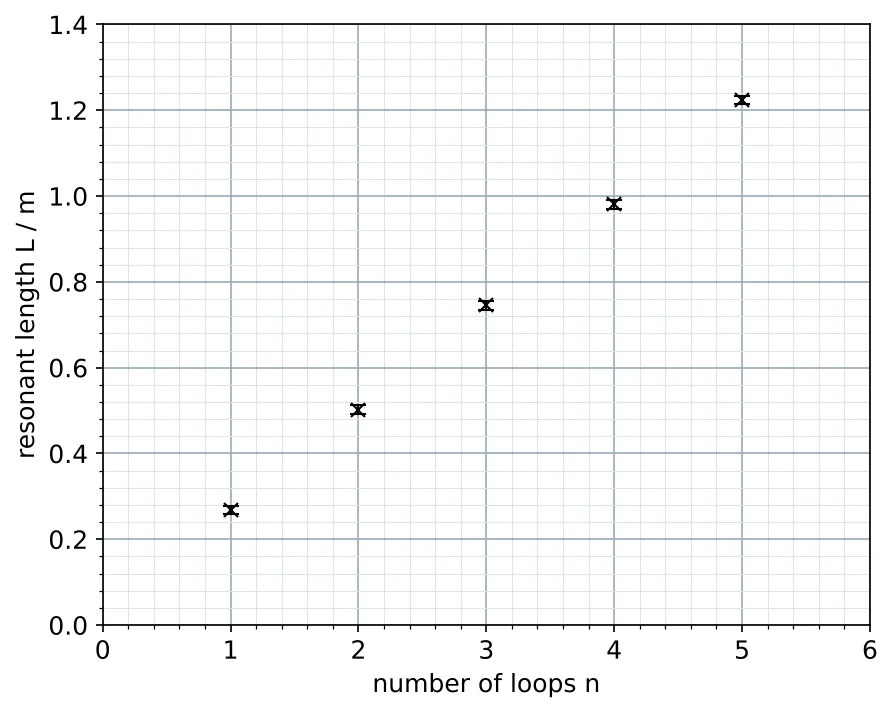
Explain why L is expected to be proportional to n.
Determine the gradient of the line of best fit.
Determine the speed of the waves on the string.
The line of best fit does not pass through the origin. Determine its intercept and suggest a cause.
Explain why this effect does not change the value of the wave speed found in (c).
revisionprep.com
Summary Answer
Not available for this question.
Model Answer
Not available for this question.
Marking Scheme
Not available for this question.
Examiner Insights
Not available for this question.
Resonance, natural frequency and damping
A string of fixed length is driven at one end and shows a standing wave with 3 antinodes. The tension is unchanged and the driving frequency is increased to of its original value. How many antinodes does the new standing wave have?
revisionprep.com
Summary Answer
Not available for this question.
Model Answer
Not available for this question.
Marking Scheme
Not available for this question.
Examiner Insights
Not available for this question.
That's every free question here — 6 of 41.
+35 more questions, plus Mock Papers & Worksheets, are waiting in Premium.