Doppler Effect · Paper 2 — Free Physics SL Practice Questions
Free questions
Open in full, with answers, mark scheme and examiner insights.
Doppler effect for sound and light; Δf/f = Δλ/λ ≈ v/c
The diagram shows a police officer using a radar gun to measure the speed of a car. The gun emits microwaves of frequency . The microwaves reflect from the car, and the gun measures the frequency shift of the reflected waves. For a car moving directly towards the gun at speed , where is much less than , .
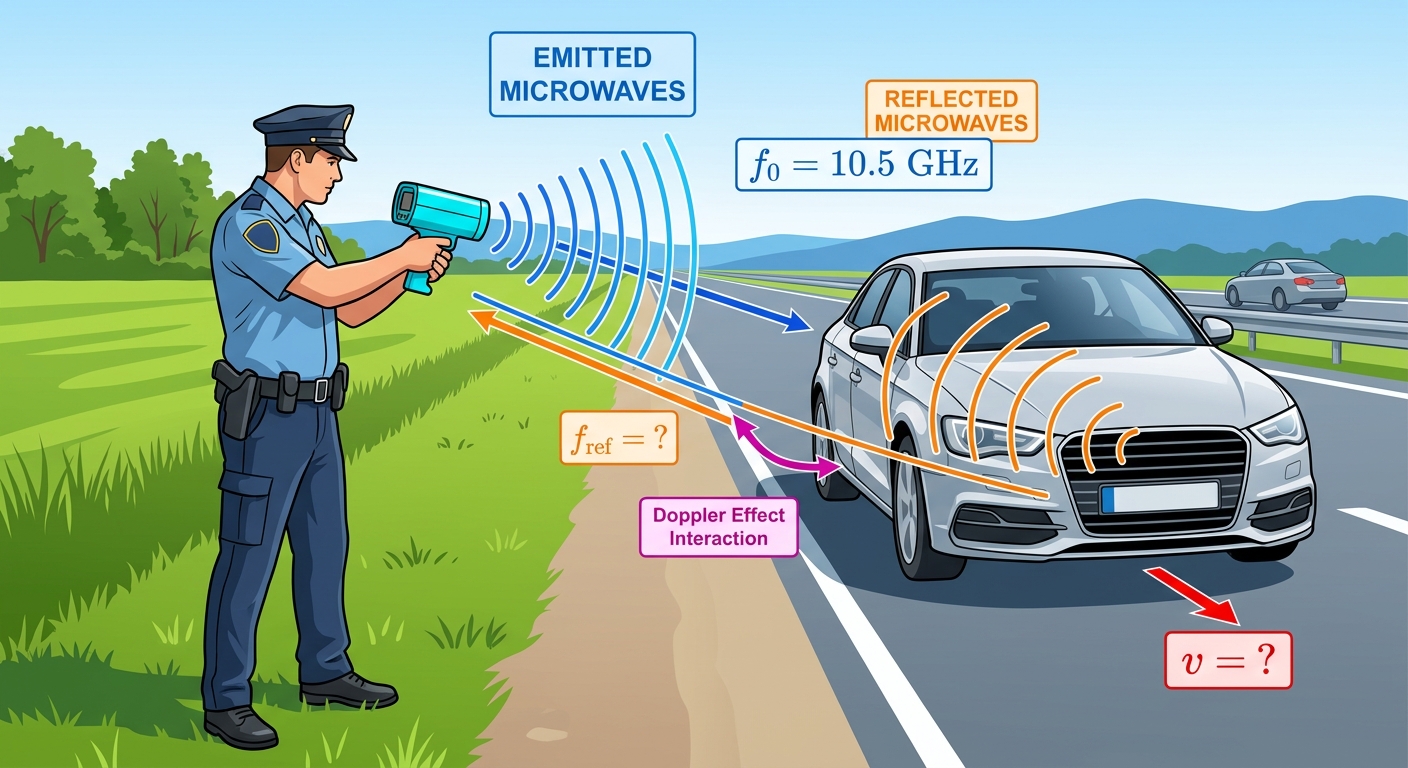
Explain why the reflected microwaves have a higher frequency than the emitted microwaves.
The frequency shift detected is . Calculate the speed of the car.
The speed limit on this road is . Determine whether the car is exceeding the speed limit.
revisionprep.com
Summary Answer
Not available for this question.
Model Answer
Not available for this question.
Marking Scheme
Not available for this question.
Examiner Insights
Not available for this question.
Doppler effect for sound and light; Δf/f = Δλ/λ ≈ v/c
The diagram shows a star moving directly away from Earth at a speed of . A hydrogen line in its spectrum has a rest wavelength of .
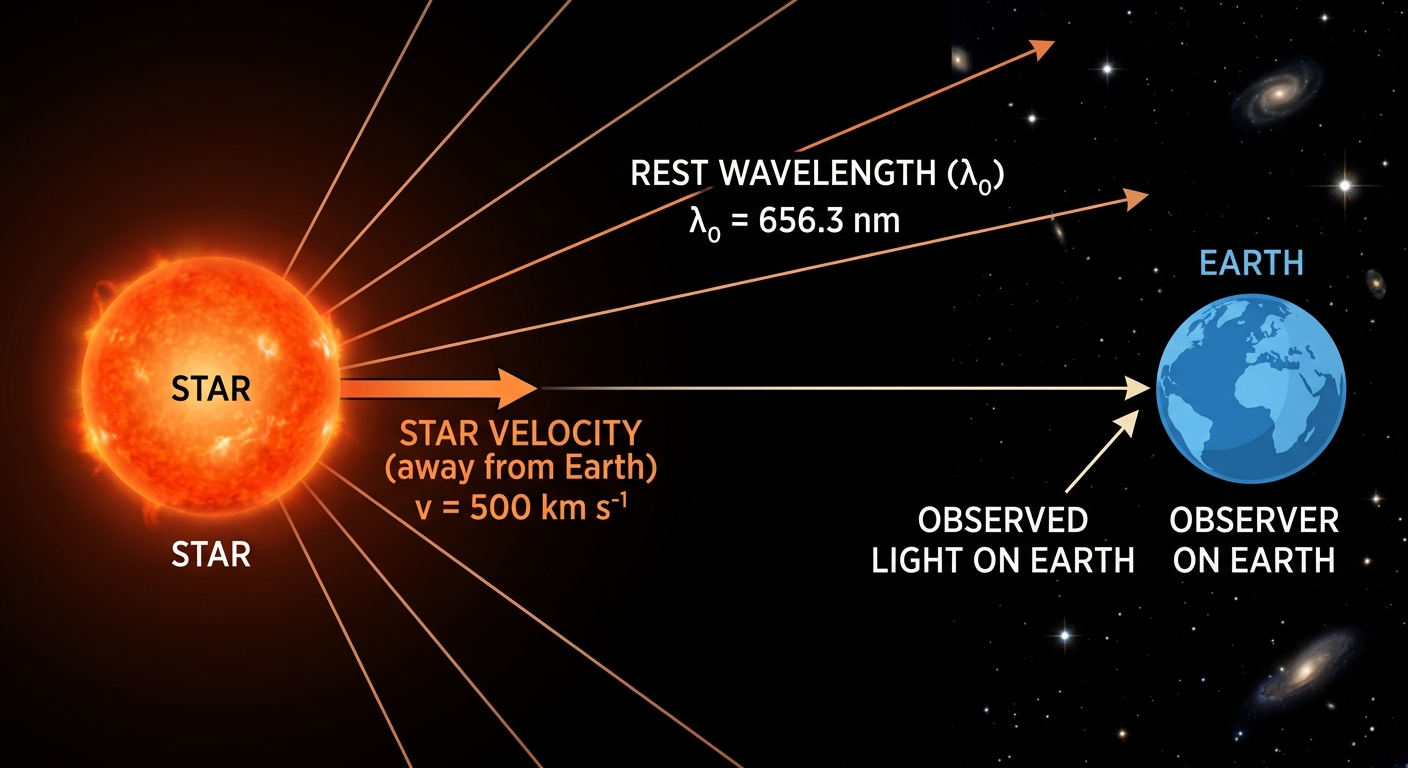
Describe the change in the observed wavelength of this line.
Outline why this change is called a redshift.
Calculate the observed wavelength of the line.
revisionprep.com
Summary Answer
Not available for this question.
Model Answer
Not available for this question.
Marking Scheme
Not available for this question.
Examiner Insights
Not available for this question.
Doppler effect for sound and light; Δf/f = Δλ/λ ≈ v/c
The diagram shows an ambulance with a siren of frequency 700 Hz driving at constant speed along a straight road past a stationary observer standing at the roadside.
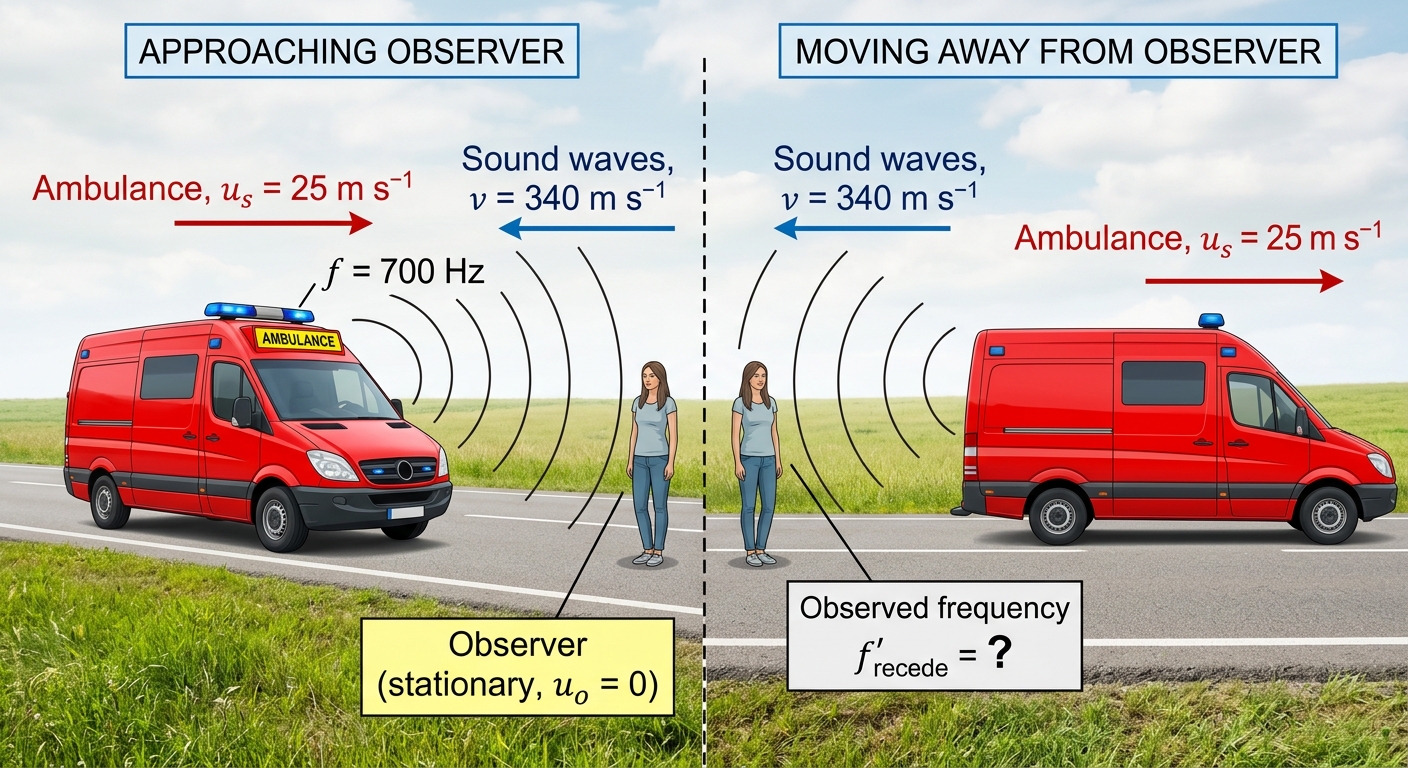
Explain, with reference to wavefronts, why the observer hears a frequency higher than 700 Hz as the ambulance approaches.
State why the speed of the sound reaching the observer is not changed by the motion of the ambulance.
Sketch a graph showing how the frequency heard by the observer varies with time as the ambulance approaches, passes and moves away. Mark 700 Hz on the frequency axis.
revisionprep.com
Summary Answer
Not available for this question.
Model Answer
Not available for this question.
Marking Scheme
Not available for this question.
Examiner Insights
Not available for this question.
Doppler effect for sound and light; Δf/f = Δλ/λ ≈ v/c
The diagram shows a bat flying towards a stationary insect and emitting ultrasound pulses of frequency 40 kHz. The speed of sound in air is .
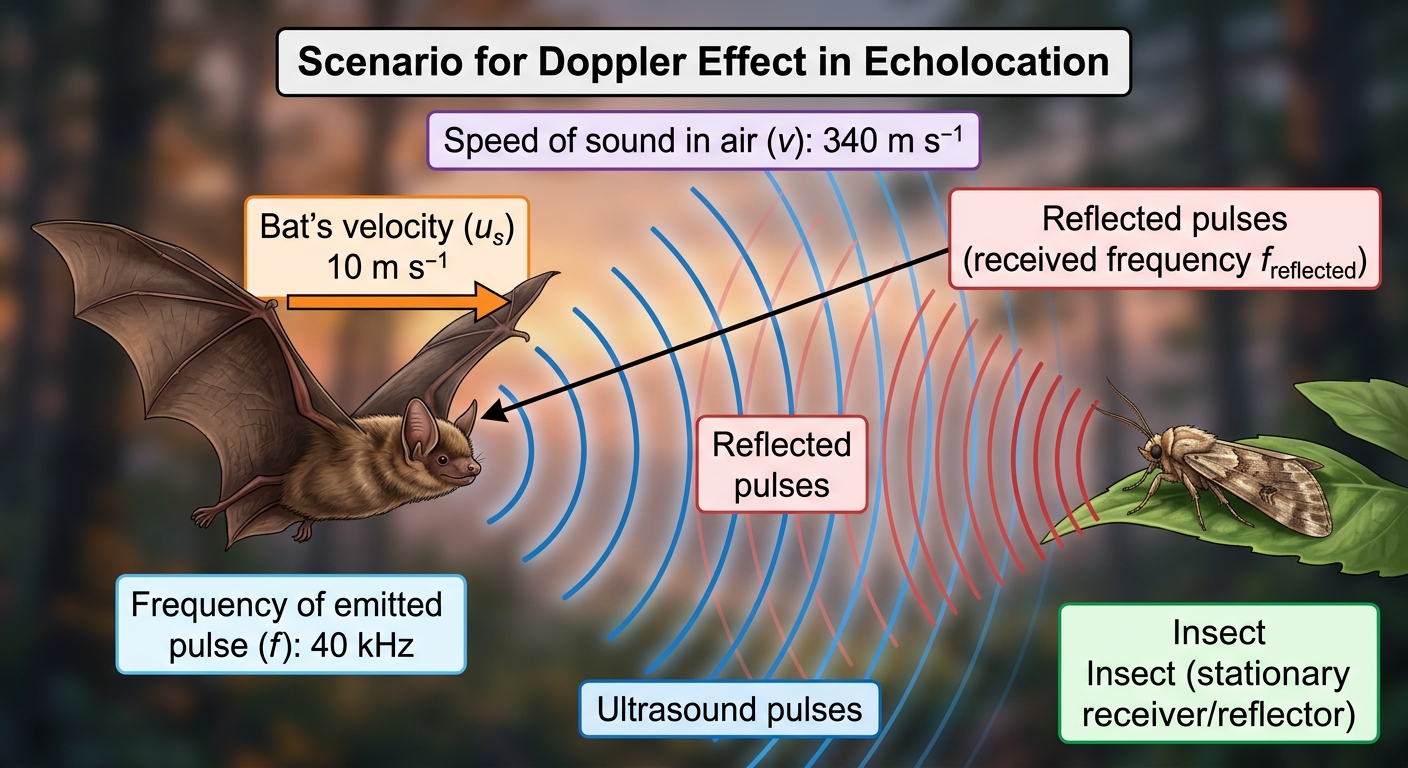
State two pieces of information the bat can gain from the reflected pulses.
When the insect is 1.7 m from the bat, calculate the time between a pulse being emitted and its echo returning. Ignore the bat's motion during this time.
Explain why the frequency of the echo received by the bat is higher than 40 kHz.
revisionprep.com
Summary Answer
Not available for this question.
Model Answer
Not available for this question.
Marking Scheme
Not available for this question.
Examiner Insights
Not available for this question.
Doppler effect for sound and light; Δf/f = Δλ/λ ≈ v/c
The diagram shows a train moving at towards a tunnel and sounding a horn of frequency 400 Hz. A person stands at the tunnel entrance. The speed of sound is .
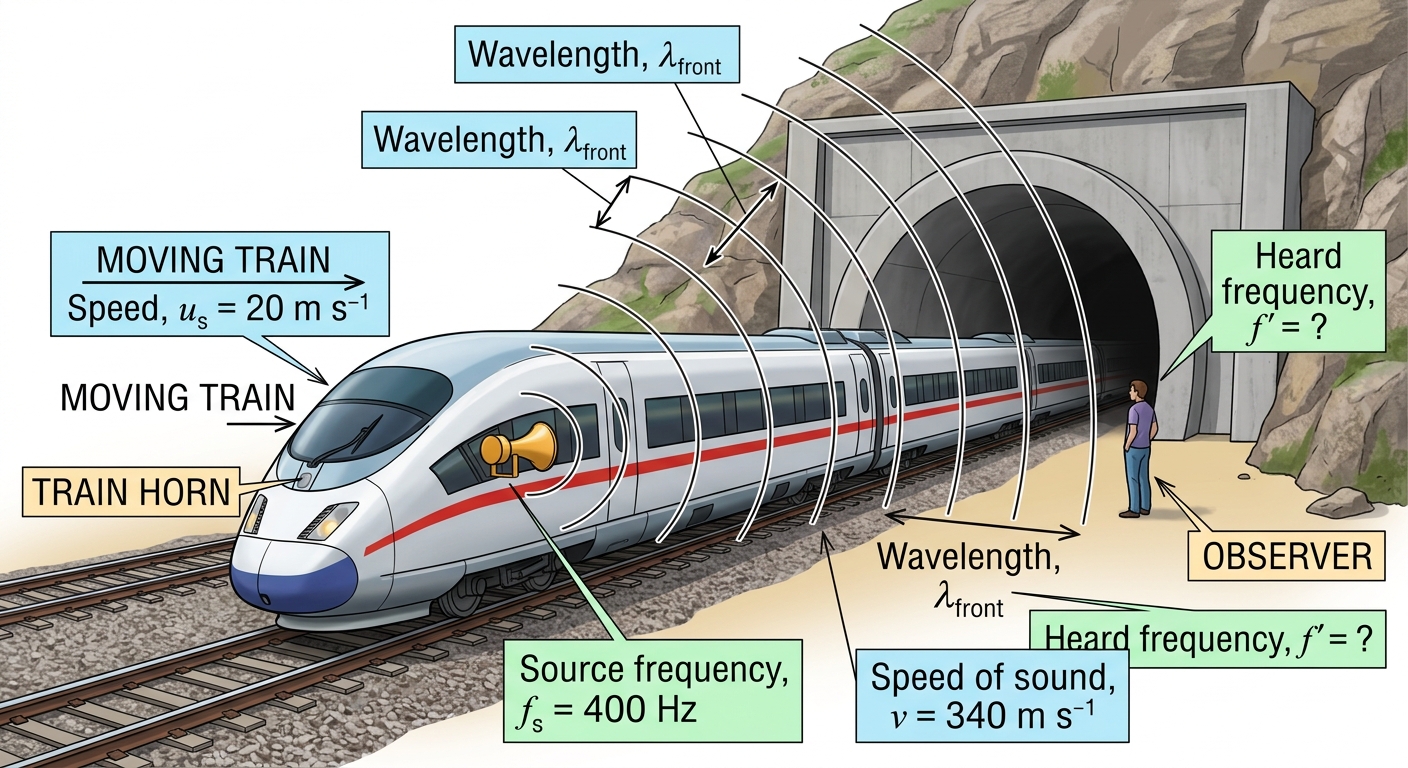
Calculate the wavelength of the sound the horn would produce if the train were stationary.
Compare the wavelength of the sound in front of the moving train with the wavelength behind it. Give a reason.
Describe and explain what the person hears as the train enters the tunnel and then the last carriage passes.
State the frequency heard by the train driver.
revisionprep.com
Summary Answer
Not available for this question.
Model Answer
Not available for this question.
Marking Scheme
Not available for this question.
Examiner Insights
Not available for this question.
Doppler effect for sound and light; Δf/f = Δλ/λ ≈ v/c
A star is orbited by a large planet. Star and planet orbit their common centre of mass, so the star moves in a small circle. Seen edge-on from Earth, a sodium absorption line in the star's spectrum, of rest wavelength 589.00 nm, varies regularly between 588.99988 nm and 589.00012 nm with a period of 4.2 days.
Explain why the wavelength of the line varies periodically.
Calculate the maximum speed of the star along the line of sight.
Calculate the radius of the star's orbit, assuming it is circular.
Earth orbits the Sun at about . Estimate the largest shift of this line caused by Earth's motion, and explain why astronomers must correct for it.
Suggest why this method detects massive planets close to their stars most easily, and why it fails when the planet's orbit is seen face-on.
revisionprep.com
Summary Answer
Not available for this question.
Model Answer
Not available for this question.
Marking Scheme
Not available for this question.
Examiner Insights
Not available for this question.
That's every free question here — 6 of 37.
+31 more questions, plus Mock Papers & Worksheets, are waiting in Premium.