Simple Harmonic Motion · Paper 2 — Free Physics SL Practice Questions
Free questions
Open in full, with answers, mark scheme and examiner insights.
Conditions for SHM, a = −ω²x, period and frequency
A pendulum bob oscillates with simple harmonic motion of amplitude 0.040 m and period 1.2 s. The diagram shows the bob at displacement m.
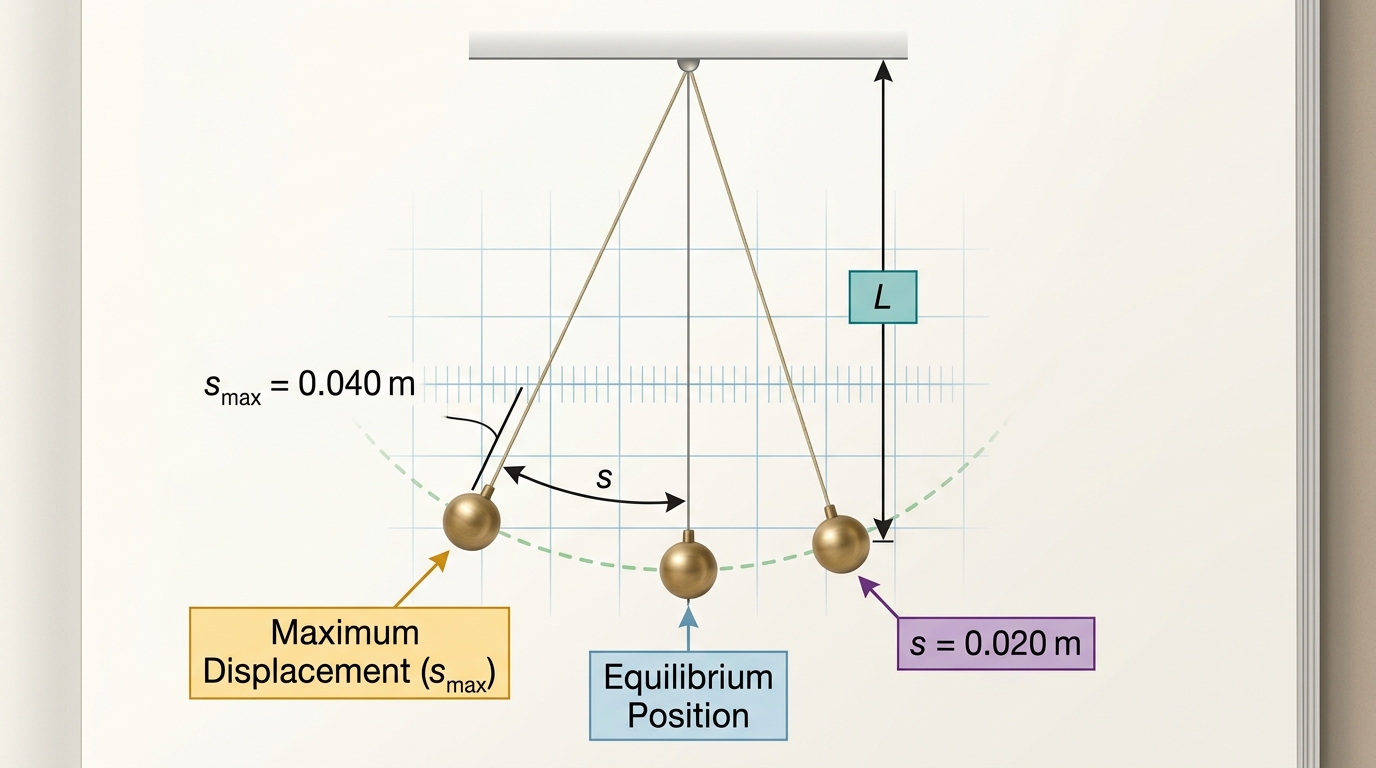
State the direction of the acceleration of the bob at the position shown.
Calculate the magnitude of the acceleration of the bob at the position shown.
Determine the length of the pendulum.
The bob moves from the equilibrium position to maximum displacement. Describe how the restoring force and the kinetic energy of the bob change.
revisionprep.com
Summary Answer
Not available for this question.
Model Answer
Not available for this question.
Marking Scheme
Not available for this question.
Examiner Insights
Not available for this question.
Mass–spring systems and the simple pendulum
Two identical pendulum bobs are suspended from strings of lengths and respectively. Both pendulums are released from rest at a small initial angle.
The period of a simple pendulum is given by .
State how the period of a simple pendulum depends on the mass of the bob.
State the condition on amplitude required for the pendulum to undergo simple harmonic motion, and state how the period depends on amplitude under this condition.
Calculate the ratio of the period of the longer pendulum to that of the shorter pendulum.
The longer pendulum is taken to a planet where the gravitational field strength is four times that on Earth. Determine the string length required on this planet so that its period equals on Earth.
revisionprep.com
Summary Answer
Not available for this question.
Model Answer
Not available for this question.
Marking Scheme
Not available for this question.
Examiner Insights
Not available for this question.
Conditions for SHM, a = −ω²x, period and frequency
A diver stands on the end of a diving board. The end of the board and the diver oscillate vertically with simple harmonic motion. The graph shows how the vertical displacement of the end of the board varies with time .
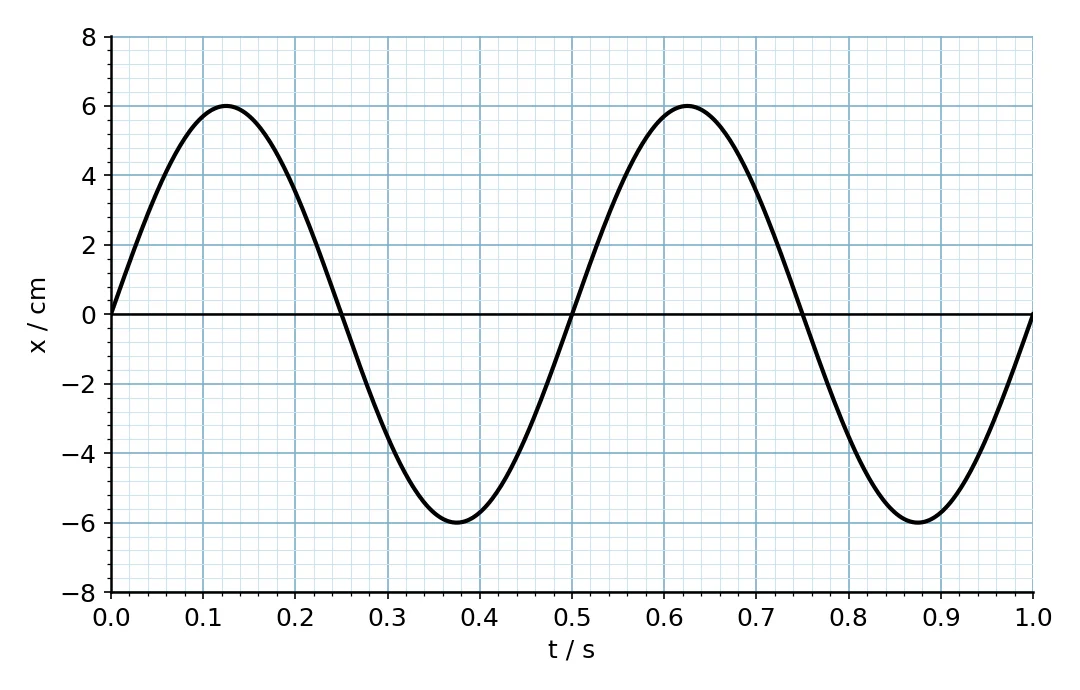
Use the graph to determine the amplitude and the frequency of the oscillation.
Calculate the maximum acceleration of the end of the board.
At the highest point of the motion the board accelerates downwards. Explain why the diver stays in contact with the board at this point only if the maximum acceleration is less than .
The frequency stays the same but the amplitude is increased. Determine the smallest amplitude at which the diver would lose contact with the board.
The diver has a mass of . Determine the largest and the smallest normal force that the board exerts on the diver during the oscillation in (b).
A student says that a diver of smaller mass is more likely to lose contact with the board when it vibrates with this amplitude and frequency. Evaluate the student's statement.
revisionprep.com
Summary Answer
Not available for this question.
Model Answer
Not available for this question.
Marking Scheme
Not available for this question.
Examiner Insights
Not available for this question.
Mass–spring systems and the simple pendulum
Data
A spring-mass system consists of a 0.200 kg mass attached to a horizontal spring with spring constant . The mass is displaced from equilibrium and released from rest.
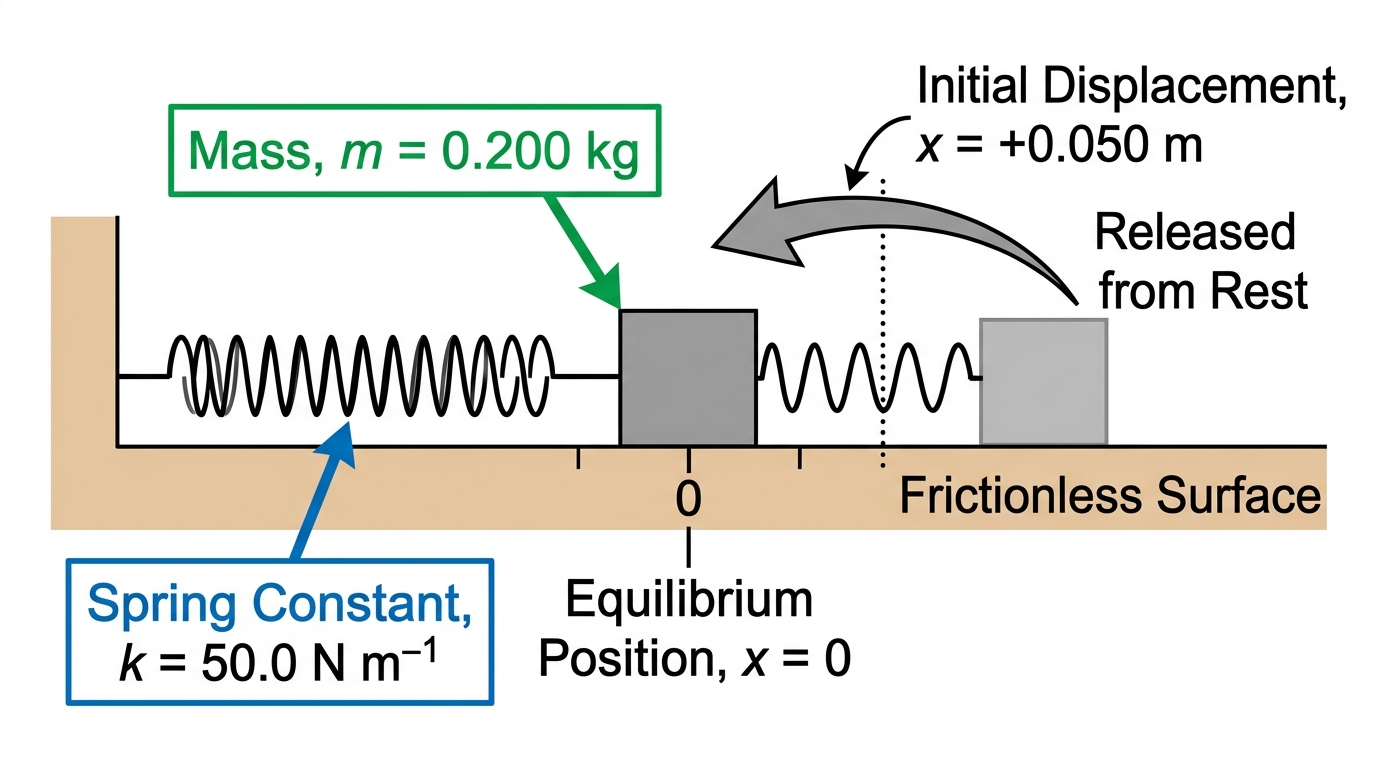
State the form of energy stored in the spring at maximum displacement and explain why the kinetic energy of the mass is zero at this point.
Calculate the maximum speed of the mass during its oscillation.
The amplitude is increased to while the spring constant and mass remain unchanged. Deduce the effect of this change on the maximum speed and on the period of oscillation.
revisionprep.com
Summary Answer
Not available for this question.
Model Answer
Not available for this question.
Marking Scheme
Not available for this question.
Examiner Insights
Not available for this question.
Conditions for SHM, a = −ω²x, period and frequency
The cone of a loudspeaker vibrates with simple harmonic motion of frequency 1.2 kHz and amplitude 0.50 mm. The mass of the cone is kg.
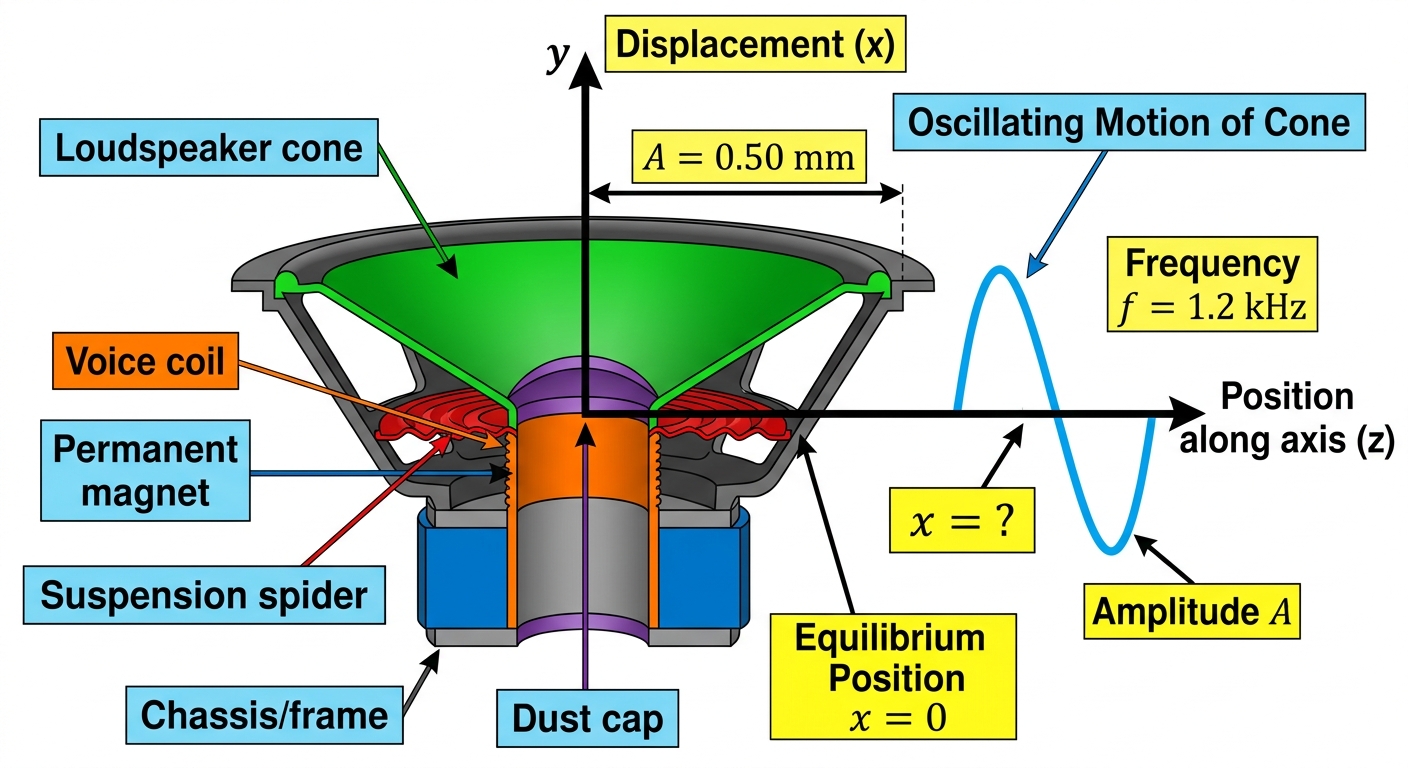
Calculate the maximum acceleration of the cone.
Determine the maximum resultant force on the cone.
The frequency is doubled to 2.4 kHz with the same amplitude. Determine the new maximum resultant force.
The suspension of the cone can provide a force of at most 400 N. Evaluate whether the cone can vibrate at 2.4 kHz with an amplitude of 0.50 mm, and determine the largest amplitude possible at this frequency.
State the acceleration of the cone at the instant it passes through the equilibrium position and explain, with reference to the resultant force, why its speed is a maximum there.
Calculate the time taken for the cone to move from maximum displacement to the equilibrium position at a frequency of .
revisionprep.com
Summary Answer
Not available for this question.
Model Answer
Not available for this question.
Marking Scheme
Not available for this question.
Examiner Insights
Not available for this question.
Energy changes during SHM (qualitative and graphical)
A pendulum of length 0.80 m has a bob of mass 0.25 kg. A 0.25 kg mass is attached to a horizontal spring of spring constant on a frictionless surface. Both are released from rest with a horizontal displacement of 5.0 cm.
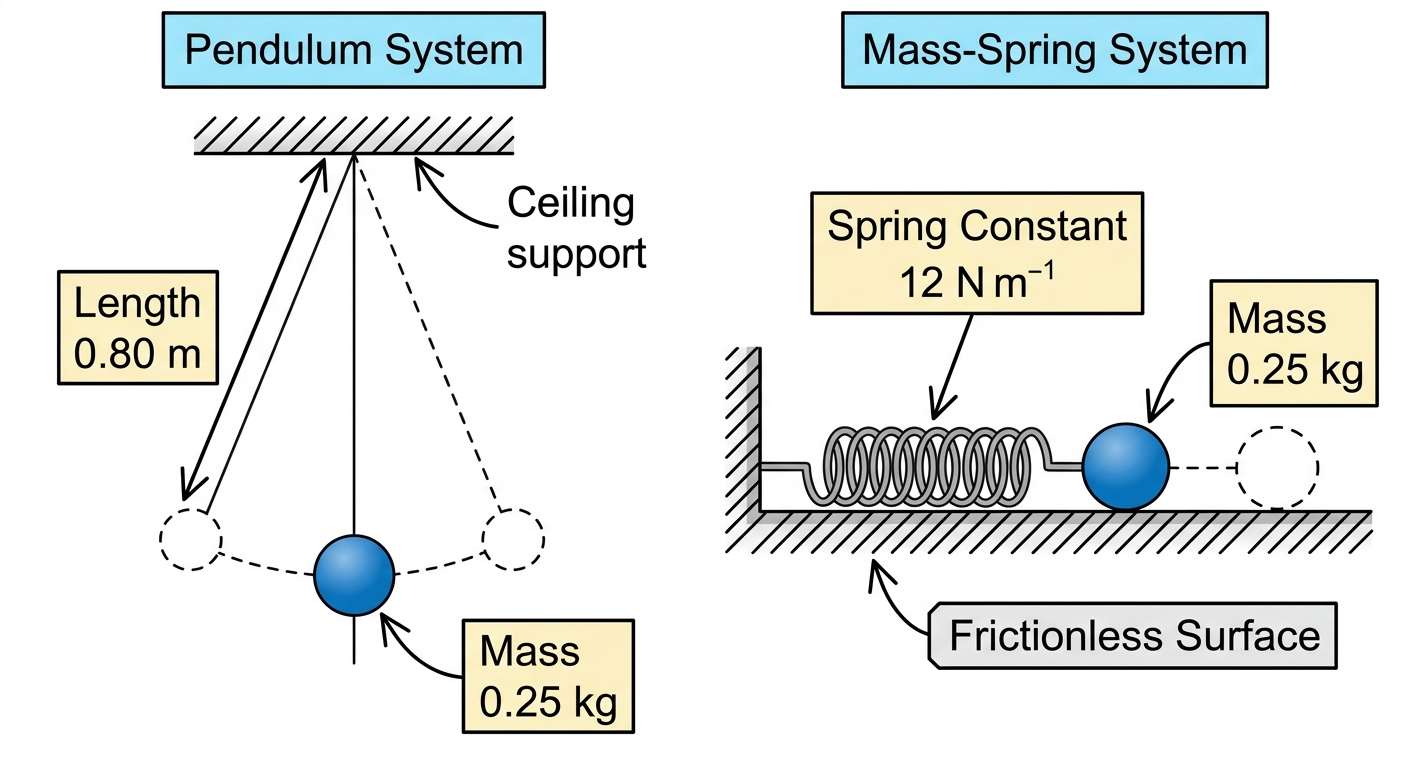
Determine the maximum speed of the mass on the spring.
Determine the maximum speed of the pendulum bob, using the height it falls.
Deduce which object reaches its equilibrium position first after release.
Determine the mass that would have to replace the 0.25 kg mass on the spring for the two periods to be equal.
A student suggests that the period of the pendulum would be shorter if the bob had twice the mass, because a heavier bob falls faster. Evaluate this suggestion.
The mass on the spring is doubled to . Calculate the factor by which its period changes.
revisionprep.com
Summary Answer
Not available for this question.
Model Answer
Not available for this question.
Marking Scheme
Not available for this question.
Examiner Insights
Not available for this question.
That's every free question here — 6 of 122.
+116 more questions, plus Mock Papers & Worksheets, are waiting in Premium.