Standing Waves and Resonance · Paper 2 — Free Physics SL Practice Questions
Free questions
Open in full, with answers, mark scheme and examiner insights.
Standing waves: nodes, antinodes and harmonics on strings and in pipes
Figure 1 shows a rope driven by a vibration generator at 24 Hz. The other end passes over a pulley and is held taut by hanging masses. The distance between adjacent nodes is 0.35 m.
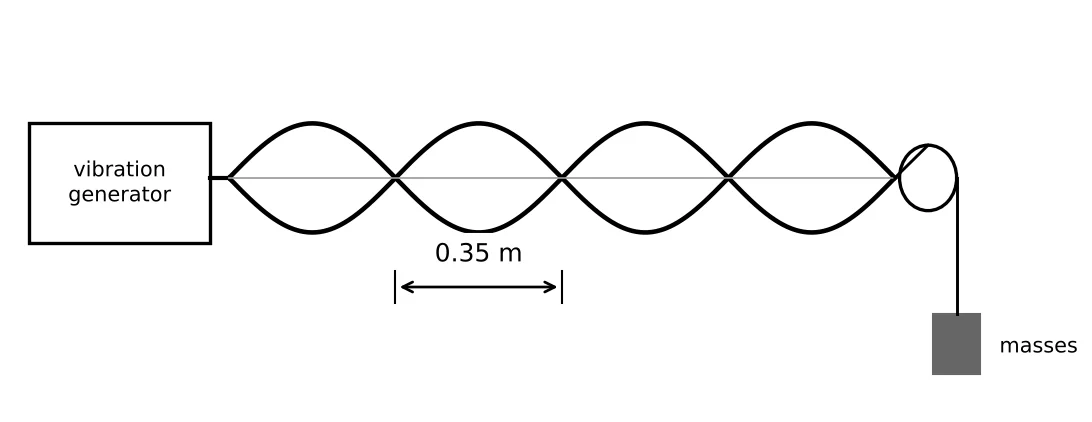
Describe how a node is formed on the rope.
Calculate the speed of the wave on the rope.
The frequency is increased to 48 Hz and the tension is unchanged. A new standing wave forms. Determine the new distance between adjacent nodes.
revisionprep.com
Summary Answer
Not available for this question.
Model Answer
Not available for this question.
Marking Scheme
Not available for this question.
Examiner Insights
Not available for this question.
Standing waves: nodes, antinodes and harmonics on strings and in pipes
Figure 1 shows a standing wave on a string of length 0.80 m that is fixed at both ends. The speed of transverse waves on the string is 240 m s⁻¹.
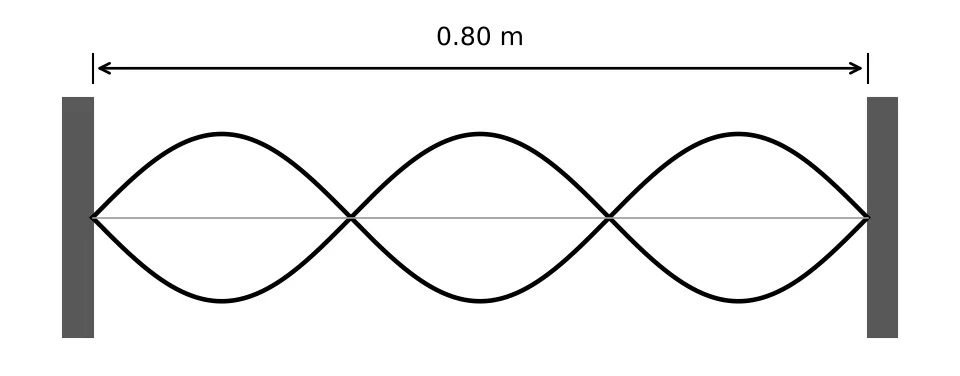
Outline how the standing wave forms on the string.
Calculate the frequency of the standing wave.
The tension is increased so that the wave speed becomes 480 m s⁻¹. The string is still driven at the frequency found in (b). Determine whether a standing wave can form.
revisionprep.com
Summary Answer
Not available for this question.
Model Answer
Not available for this question.
Marking Scheme
Not available for this question.
Examiner Insights
Not available for this question.
Standing waves: nodes, antinodes and harmonics on strings and in pipes
The diagram shows a microwave oven operating at a frequency of 2.45 GHz. With the turntable stopped, a standing wave forms inside the oven. The distance between adjacent antinodes is 6.1 cm.
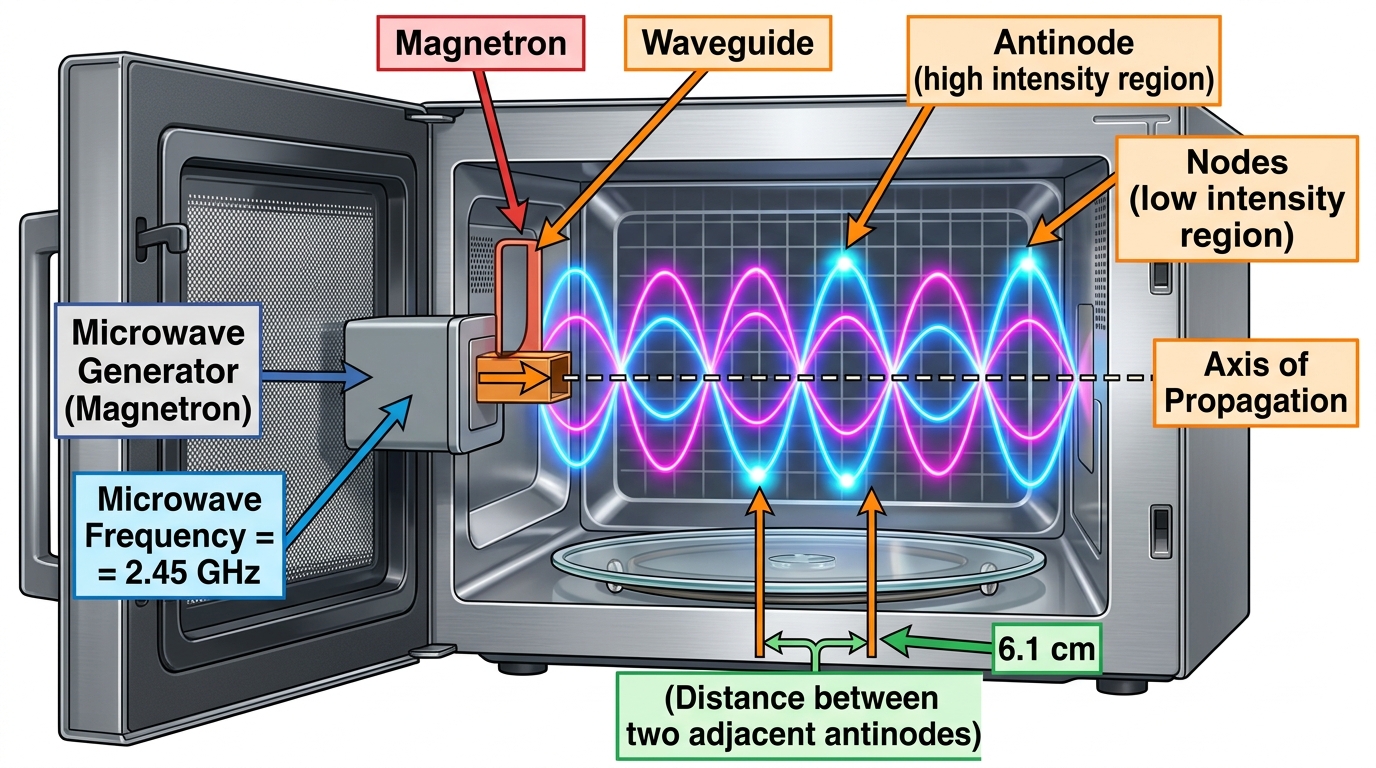
Explain why food heats unevenly when it does not move inside the oven.
Show that the speed of the microwaves is about m s⁻¹.
A manufacturer claims that rotating the food on a turntable gives more even heating. Evaluate this claim using your understanding of standing waves.
revisionprep.com
Summary Answer
Not available for this question.
Model Answer
Not available for this question.
Marking Scheme
Not available for this question.
Examiner Insights
Not available for this question.
Resonance, natural frequency and damping
The diagram shows a tuning fork of frequency 440 Hz held above a measuring cylinder. Water is added until the first resonance is heard, with an air column 0.19 m long.
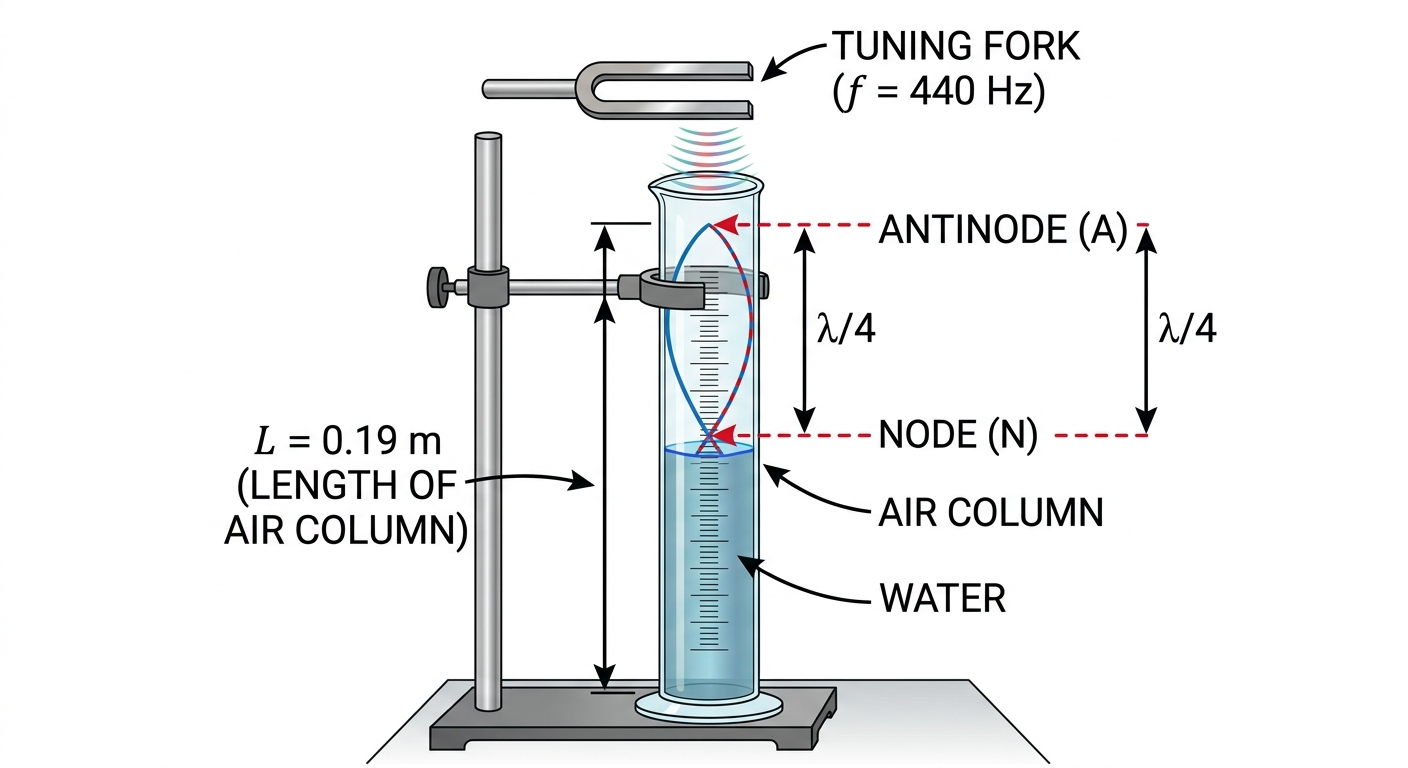
Explain why resonance occurs at this length of air column.
Calculate the speed of sound from these data, ignoring any end correction.
The accepted speed of sound is 340 m s⁻¹. Determine the end correction, and suggest one property of the tube that its size depends on.
revisionprep.com
Summary Answer
Not available for this question.
Model Answer
Not available for this question.
Marking Scheme
Not available for this question.
Examiner Insights
Not available for this question.
Standing waves: nodes, antinodes and harmonics on strings and in pipes
Figure 1 shows the optical cavity of a laser: two parallel mirrors a distance L = 0.300 m apart. Light reflects back and forth between the mirrors and forms a standing wave with a node at each mirror. The laser emits red light of wavelength 633 nm. The speed of light is m s⁻¹.
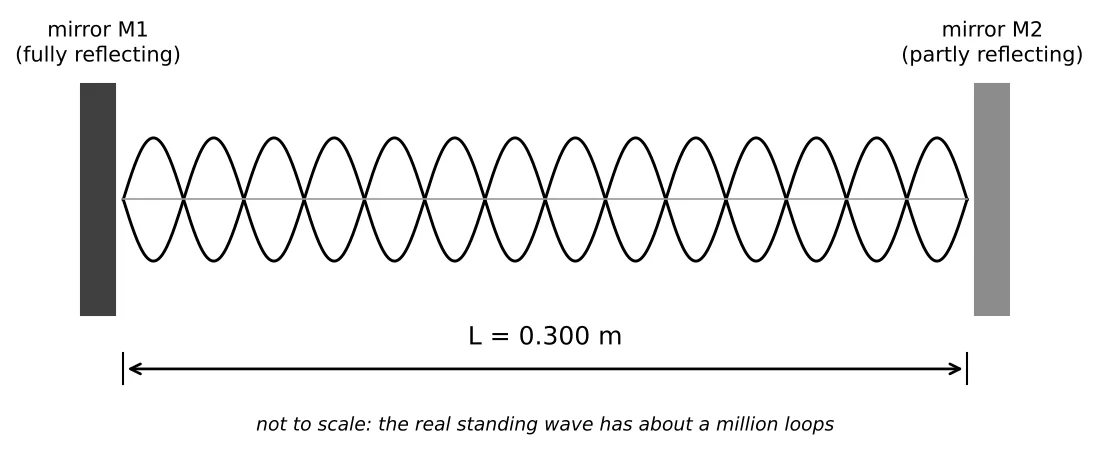
State the condition that the wavelength must meet for a standing wave to form in the cavity.
Calculate the frequency of the light.
Determine the number of half-wavelengths that fit in the cavity.
Show that adjacent standing waves allowed in the cavity differ in frequency by Hz.
The laser material can amplify light only over a frequency range of 1.5 GHz. Determine how many of the allowed standing waves fit within this range.
As the laser warms up, the mirror separation increases by m. Discuss the effect on the standing wave and on the frequencies of the light emitted.
revisionprep.com
Summary Answer
Not available for this question.
Model Answer
Not available for this question.
Marking Scheme
Not available for this question.
Examiner Insights
Not available for this question.
Resonance, natural frequency and damping
A tall office building sways when it is pushed by gusts of wind. Figure 1 shows how the amplitude of oscillation of the top floor varies with the driving frequency of the force, without and with a large damper installed near the top of the building.
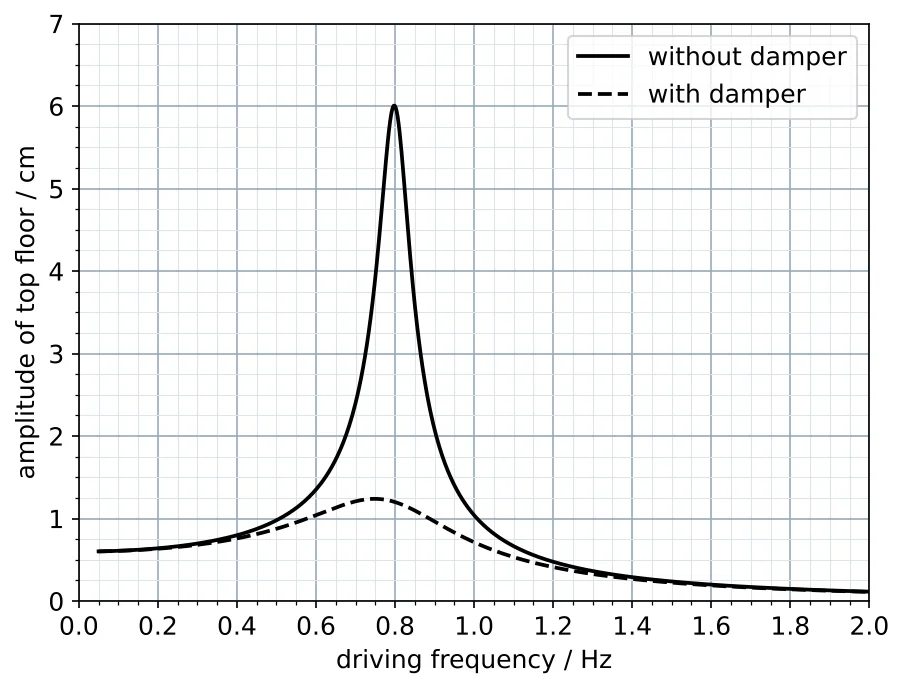
State the natural frequency of the building.
Calculate the period of the building's natural oscillation.
Explain why gusts that arrive regularly every 1.25 s are a particular danger to the building.
Determine, using Figure 1, the factor by which the damper reduces the largest amplitude.
Describe two other changes that the damper makes to the curve.
Explain why the two curves almost coincide at very low driving frequencies.
An engineer suggests that the building should be critically damped. Evaluate this suggestion.
revisionprep.com
Summary Answer
Not available for this question.
Model Answer
Not available for this question.
Marking Scheme
Not available for this question.
Examiner Insights
Not available for this question.
That's every free question here — 6 of 37.
+31 more questions, plus Mock Papers & Worksheets, are waiting in Premium.