You're viewing 2 free preview questions for Physics SL — subscribe to unlock 85 more, plus the Full Question Bank, Mock Papers & Worksheets.Upgrade
Wave Model · Paper 2 — Free Physics SL Practice Questions
1FoundationSAQ-LWave equations4 marksPaper 2~6 min

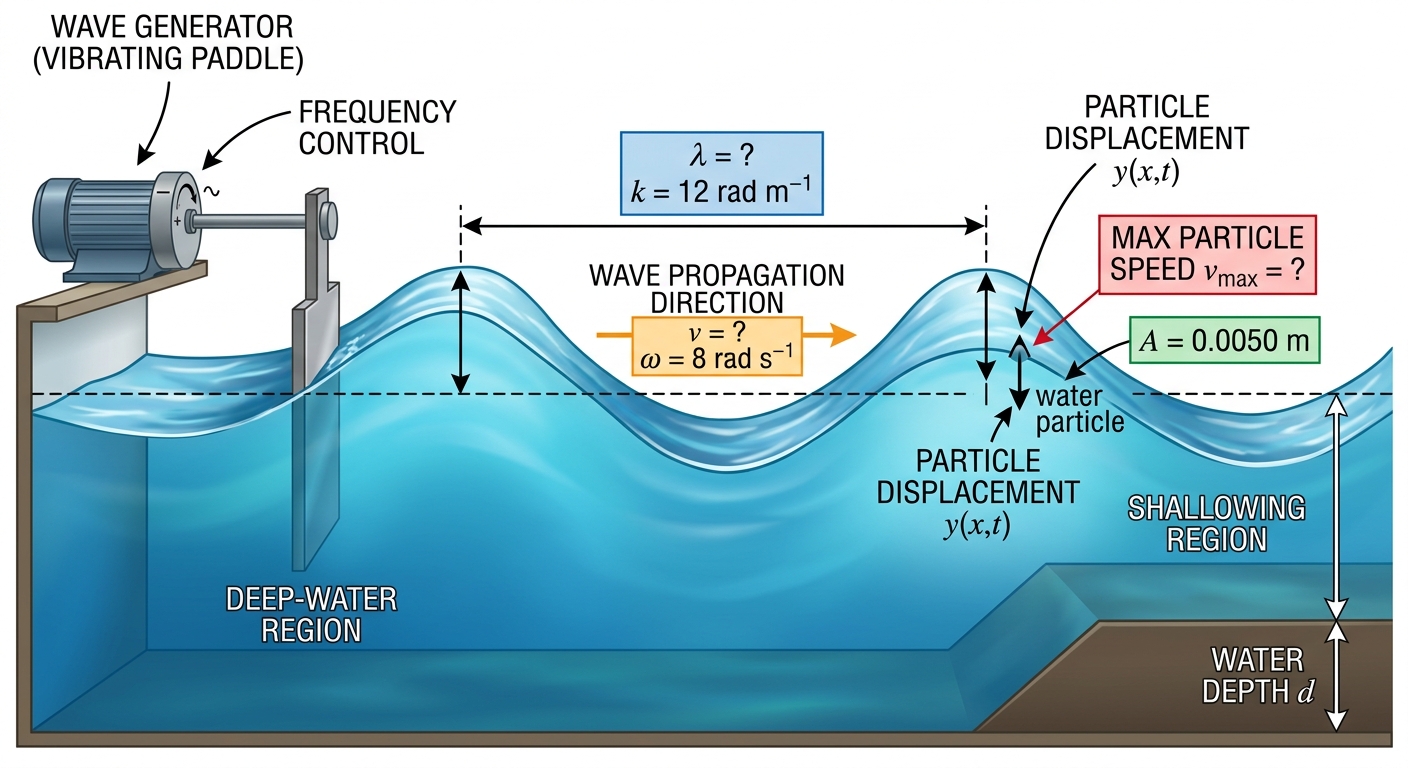
A wave is generated in a ripple tank. The displacement of the water surface is given by
where is in metres, is in seconds, and the amplitude is in metres.
For deep-water waves, the wave speed is given by , where .
(a)
(i) Determine the wavelength and frequency of the wave. [2]
(ii) Determine the wave speed. [1]
(iii) Determine the maximum speed of a water particle in the medium. [1 mark]
(ii) Determine the wave speed. [1]
(iii) Determine the maximum speed of a water particle in the medium. [1 mark]
(b)
Calculate the theoretical deep-water wave speed for this wavelength. Hence evaluate whether this wave behaves as a deep-water wave. [2 marks]
(c)
The wave generator frequency is doubled while the water depth remains unchanged. The new wavelength is .
Using the deep-water formula, calculate the theoretical deep-water speed for the new wavelength. Evaluate whether doubling the frequency makes the wave more or less consistent with deep-water behaviour, justifying your answer by comparing both wave speeds with their respective deep-water predictions. [1 mark]

Solutions
2MasterySAQ-STypes of waves: Transverse and longitudinal4 marksPaper 2~6 min
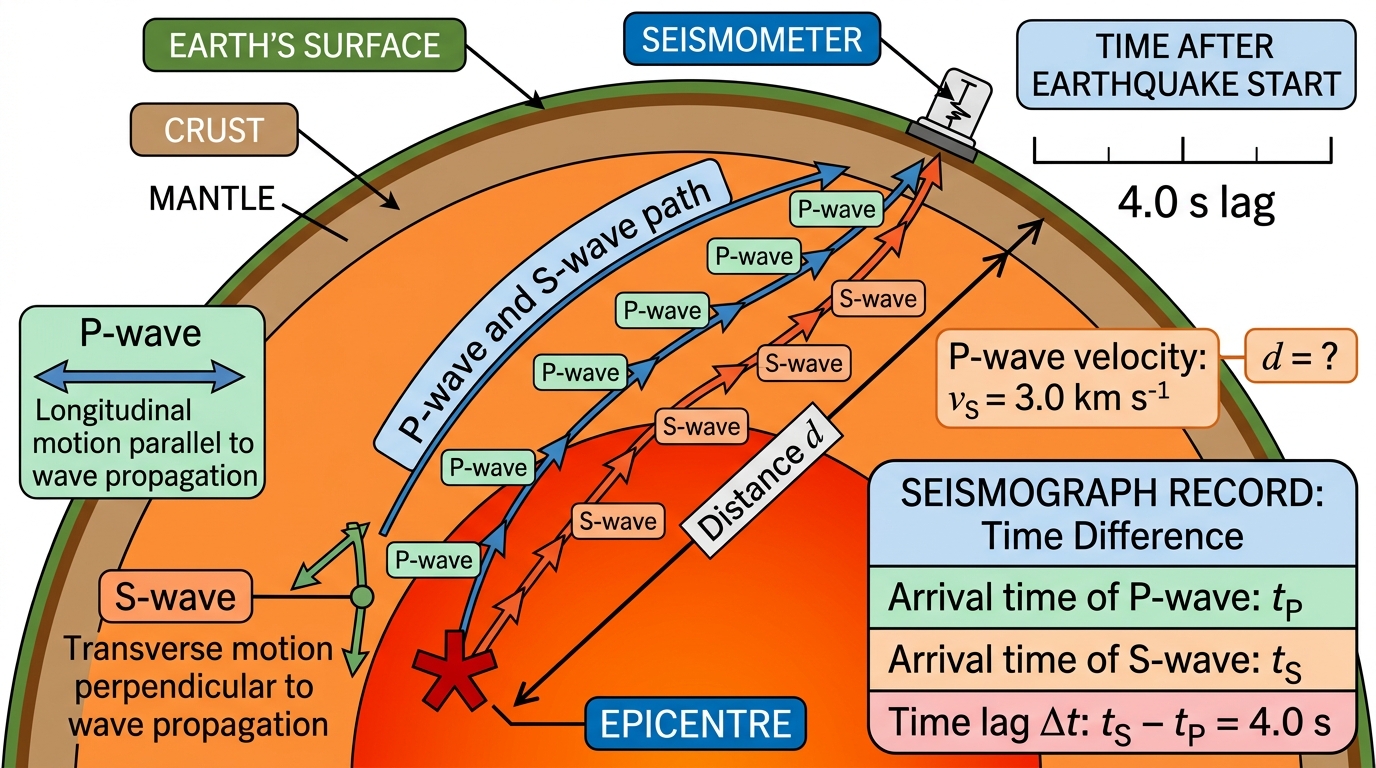
An earthquake generates P-waves and S-waves simultaneously at the epicentre. P-waves travel through the Earth's interior at . S-waves travel at . A seismometer detects the P-wave arrival 4.0 s before the S-wave arrival.
(a)
State the difference in the direction of particle oscillation between P-waves and S-waves. [1 mark]
(b)
S-waves cannot travel through the liquid outer core of the Earth.
(i) State the physical property that liquids lack which prevents S-wave propagation. [1]
(ii) Explain, using your answer to (b)(i), why S-waves cannot propagate through the liquid outer core. [1 mark]
(ii) Explain, using your answer to (b)(i), why S-waves cannot propagate through the liquid outer core. [1 mark]
(c)
Determine the distance from the earthquake epicentre to the seismometer. [2 marks]
Solutions
That's every free question here — 2 of 87.
+85 more questions, plus Mock Papers & Worksheets, are waiting in Premium.