You're viewing free preview questions — 6 questions previewing here — subscribe to unlock 50 more, plus the Full Question Bank, Mock Papers & Worksheets.Upgrade
Back

Factors Multiples LCM and HCF — Free MYP1 Mathematics Practice Questions

Free questions

Open in full, with answers, mark scheme and examiner insights.

Question 1Criterion A · Band 1-4 · Easy · 3 marksrevisionprep.com

Finding Factors of a Number

A factor of a number divides into it exactly.
(a)
List all the factors of 12 and all the factors of 13. [2]Criterion A (i), A (ii) · Level 1-2
(b)
Explain why 13 has only two factors. [1]Criterion A (iii) · Level 3-4

revisionprep.com

Summary Answer

Not available for this question.

Model Answer

Not available for this question.

Marking Scheme

Not available for this question.

Examiner Insights

Not available for this question.

Question 2Criterion A · Band 1-4 · Easy · 4 marksrevisionprep.com

Prime Factorization Using Factor Trees
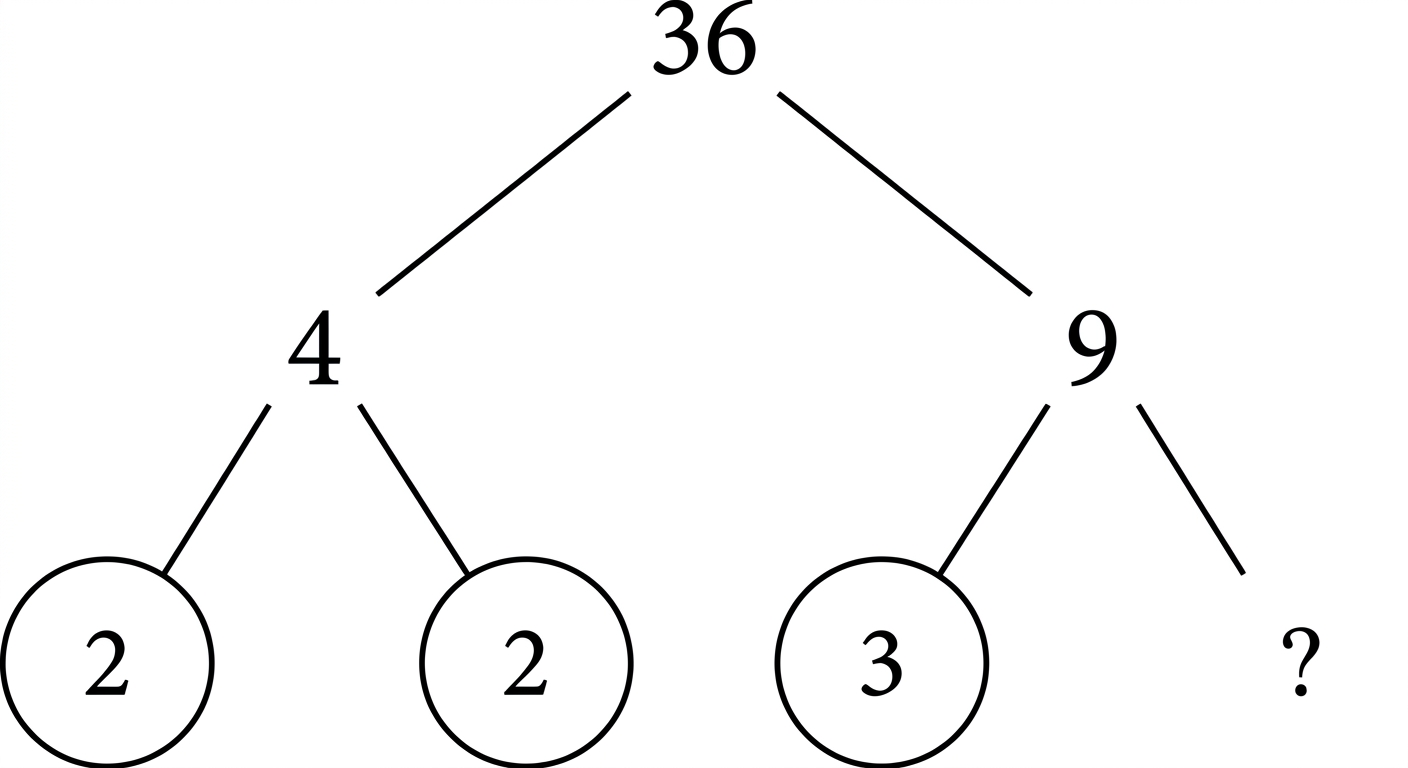
The factor tree for 36 is shown. One prime factor is missing.
Question diagram
(a)
Write down the missing prime factor. [1]Criterion A (i) · Level 1-2
(b)
Write 36 as a product of primes in index form. [1]Criterion A (ii) · Level 1-2
(c)
Draw a different factor tree for 36, starting with 6×66 \times 6, and explain what you notice about the final primes. [2]Criterion A (iii) · Level 3-4

revisionprep.com

Summary Answer

Not available for this question.

Model Answer

Not available for this question.

Marking Scheme

Not available for this question.

Examiner Insights

Not available for this question.

Question 3Criterion C · Band 1-6 · Medium · 5 marksrevisionprep.com

Finding Factors of a Number

The proper factors of a number are all its factors except the number itself. A number is perfect if its proper factors add up to the number, abundant if they add up to more, and deficient if they add up to less.
(a)
Classify 6, 12 and 15, showing the sums. [2]Criterion C (i), C (ii) · Level 1-2
(b)
Show that 28 is perfect. [1]Criterion C (iii) · Level 3-4
(c)
Ella says, 'Every even number is abundant.' Use a counterexample to show she is wrong, and explain how one example is enough. [2]Criterion C (iv) · Level 5-6

revisionprep.com

Summary Answer

Not available for this question.

Model Answer

Not available for this question.

Marking Scheme

Not available for this question.

Examiner Insights

Not available for this question.

Question 4Criterion D · Band 1-6 · Medium · 6 marksrevisionprep.com

Lowest Common Multiple LCM

A baker packs cookies in bags of 12 (type A) or bags of 18 (type B), as in the picture.
Question diagram
(a)
Find the smallest batch of cookies that can be packed exactly in either type of bag. [2]Criterion D (i), D (ii) · Level 1-2
(b)
Write down how many bags of each type that batch fills. [1]Criterion D (iii) · Level 3-4
(c)
The baker has 100 cookies and wants a number she can pack in either type. Find the most she can use, and how many are left for the staff. [2]Criterion D (iii), D (iv) · Level 3-4
(d)
Suggest one reason the baker might prefer bags of 12. [1]Criterion D (v) · Level 5-6

revisionprep.com

Summary Answer

Not available for this question.

Model Answer

Not available for this question.

Marking Scheme

Not available for this question.

Examiner Insights

Not available for this question.

Question 5Criterion B · Band 1-8 · Challenge · 5 marksrevisionprep.com

Finding Multiples of a Number

Conjecture: 'When you add two multiples of 3, the answer is always a multiple of 3.'
(a)
Test the conjecture with three pairs of multiples of 3. [1]Criterion B (i) · Level 1-2
(b)
Explain why the conjecture is always true, writing the multiples as 3a3a and 3b3b. [2]Criterion B (iii) · Level 7-8
(c)
Test whether the sum of two odd multiples of 3 is always a multiple of 6, using three examples, and state your conclusion. [2]Criterion B (ii) · Level 5-6

revisionprep.com

Summary Answer

Not available for this question.

Model Answer

Not available for this question.

Marking Scheme

Not available for this question.

Examiner Insights

Not available for this question.

Question 6Criterion B · Band 1-8 · Challenge · 7 marksrevisionprep.com

Highest Common Factor HCF or GCD

This question looks at the HCF of two numbers that differ by 2.
(a)
Find the HCF of (10, 12), (15, 17), (14, 16) and (21, 23). [2]Criterion B (i) · Level 1-2
(b)
Describe the pattern, linking it to whether the numbers are odd or even. [2]Criterion B (ii) · Level 3-4
(c)
Predict the HCF of (36, 38) and (35, 37) and verify. [1]Criterion B (iii) · Level 5-6
(d)
Explain why the HCF of two numbers that differ by 2 can only be 1 or 2. [2]Criterion B (iii) · Level 7-8

revisionprep.com

Summary Answer

Not available for this question.

Model Answer

Not available for this question.

Marking Scheme

Not available for this question.

Examiner Insights

Not available for this question.

That's every free question here — 6 of 56.

+50 more questions, plus Mock Papers & Worksheets, are waiting in Premium.

Upgrade