You're viewing free preview questions — 6 questions previewing here — subscribe to unlock 50 more, plus the Full Question Bank, Mock Papers & Worksheets.Upgrade
Back

Number Patterns and Sequences — Free MYP1 Mathematics Practice Questions

Free questions

Open in full, with answers, mark scheme and examiner insights.

Question 1Criterion A · Band 1-4 · Easy · 3 marksrevisionprep.com

Creating Patterns Using Rules

A pattern starts at 50 and subtracts 6 each time.
(a)
List the first four terms. [1]Criterion A (i) · Level 1-2
(b)
Find the first negative term and its position. [2]Criterion A (ii), A (iii) · Level 3-4

revisionprep.com

Summary Answer

Not available for this question.

Model Answer

Not available for this question.

Marking Scheme

Not available for this question.

Examiner Insights

Not available for this question.

Question 2Criterion A · Band 1-4 · Easy · 3 marksrevisionprep.com

Generating Terms from Position-to-Term Rule

A sequence follows the rule term == position ×3\times 3.
(a)
Write down whether this is a position-to-term or a term-to-term rule, and the 5th term. [1]Criterion A (i) · Level 1-2
(b)
Find the position of the term 60, and explain the advantage of a position-to-term rule. [2]Criterion A (ii), A (iii) · Level 3-4

revisionprep.com

Summary Answer

Not available for this question.

Model Answer

Not available for this question.

Marking Scheme

Not available for this question.

Examiner Insights

Not available for this question.

Question 3Criterion D · Band 1-6 · Medium · 4 marksrevisionprep.com

Identifying Patterns in Number Series

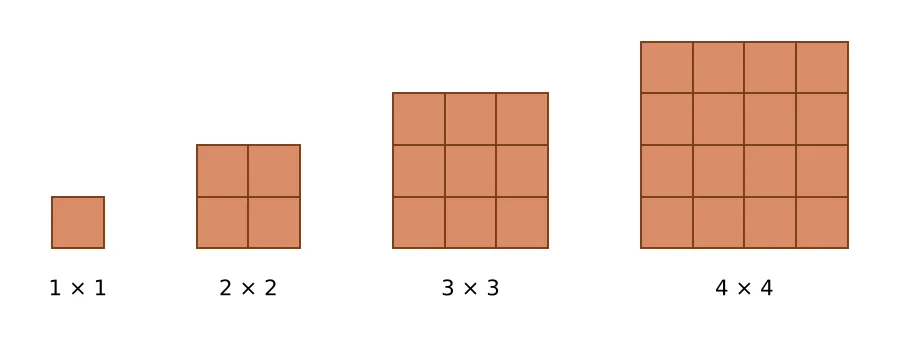
The picture shows square patios made of tiles: 1,4,9,16,…1, 4, 9, 16, \ldots A 4×44 \times 4 patio needs 16 tiles.
Question diagram
(a)
Find the tiles for a 6×66 \times 6 patio, and how many more than for 5×55 \times 5. [1]Criterion D (i) · Level 1-2
(b)
Tiles come in boxes of 10. Find the boxes needed for the 6×66 \times 6 patio if 10% extra is ordered for breakages. [2]Criterion D (ii), D (iii) · Level 3-4
(c)
Explain why the pattern alone may not give the number of tiles to order. [1]Criterion D (v) · Level 5-6

revisionprep.com

Summary Answer

Not available for this question.

Model Answer

Not available for this question.

Marking Scheme

Not available for this question.

Examiner Insights

Not available for this question.

Question 4Criterion C · Band 1-6 · Medium · 6 marksrevisionprep.com

Describing Patterns Using Words and Symbols

A plant is 12 cm tall and grows 3 cm every week. Three students describe its height hh after ww weeks.
Ali: 'Add 3 each week, starting from 12.'
Bea: h=3w+12h = 3w + 12.
Cal: h=12w+3h = 12w + 3.
(a)
Find the height after 1, 2 and 5 weeks. [1]Criterion C (i) · Level 1-2
(b)
Test Bea's and Cal's rules with w=2w = 2, and say which is correct. [2]Criterion C (ii) · Level 3-4
(c)
Explain the difference between Ali's description and Bea's rule, and when each is more useful. [2]Criterion C (iv) · Level 5-6
(d)
Explain what Cal mixed up. [1]Criterion C (iv) · Level 5-6

revisionprep.com

Summary Answer

Not available for this question.

Model Answer

Not available for this question.

Marking Scheme

Not available for this question.

Examiner Insights

Not available for this question.

Question 5Criterion B · Band 1-8 · Challenge · 6 marksrevisionprep.com

Identifying Patterns in Number Series

Sequence A: 3,7,11,15,…3, 7, 11, 15, \ldots Sequence B: 50,46,42,38,…50, 46, 42, 38, \ldots
(a)
Write down the next three terms of each sequence. [1]Criterion B (i) · Level 1-2
(b)
Describe each pattern, and describe what happens to the gap between A and B at each position. [2]Criterion B (ii) · Level 3-4
(c)
Predict the first position where A's term is larger than B's, and verify. [2]Criterion B (ii), B (iii) · Level 5-6
(d)
Explain why A and B never have the same value at the same position. [1]Criterion B (iii) · Level 7-8

revisionprep.com

Summary Answer

Not available for this question.

Model Answer

Not available for this question.

Marking Scheme

Not available for this question.

Examiner Insights

Not available for this question.

Question 6Criterion B · Band 1-8 · Challenge · 6 marksrevisionprep.com

Finding the Next Term in a Sequence

Each term of a sequence is the sum of the two terms before it: 1,1,2,3,5,…1, 1, 2, 3, 5, \ldots
(a)
Write down the next four terms. [1]Criterion B (i) · Level 1-2
(b)
Write 'odd' or 'even' for each of the first nine terms, and describe the pattern. [2]Criterion B (ii) · Level 3-4
(c)
Predict whether the 30th and the 31st terms are odd or even. [2]Criterion B (ii), B (iii) · Level 5-6
(d)
Explain why the odd/even pattern must keep repeating. [1]Criterion B (iii) · Level 7-8

revisionprep.com

Summary Answer

Not available for this question.

Model Answer

Not available for this question.

Marking Scheme

Not available for this question.

Examiner Insights

Not available for this question.

That's every free question here — 6 of 56.

+50 more questions, plus Mock Papers & Worksheets, are waiting in Premium.

Upgrade