Plant and Animal Cell Differences — Free MYP1 Sciences Practice Questions
Free questions
Open in full, with answers, mark scheme and examiner insights.
Organelles Unique to Plant Cells Chloroplasts Cell Wall
revisionprep.com
Summary Answer
Not available for this question.
Model Answer
Not available for this question.
Marking Scheme
Not available for this question.
Examiner Insights
Not available for this question.
Functions Related to Structure in Both Cells
Cytoplasm is found in both plant and animal cells.
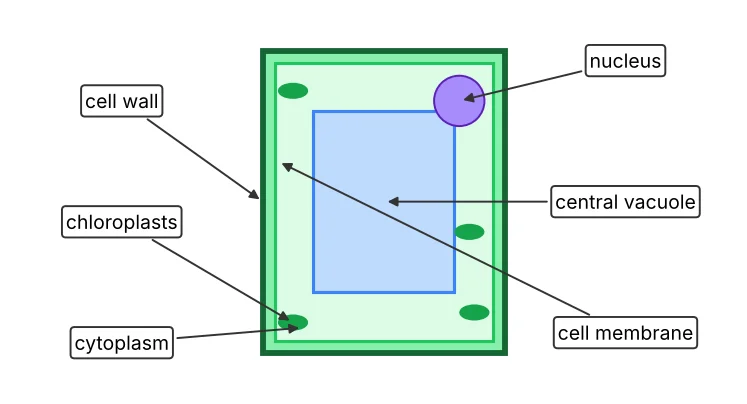
revisionprep.com
Summary Answer
Not available for this question.
Model Answer
Not available for this question.
Marking Scheme
Not available for this question.
Examiner Insights
Not available for this question.
Organelles Unique to Plant Cells Chloroplasts Cell Wall
| Distance (cm) | 10 | 20 | 30 | 40 |
|---|---|---|---|---|
| Bubbles per minute | 40 | 20 | 10 | 5 |
(e) Suggest one problem with counting bubbles. [1]Criterion C (iv) · Level 3-4
revisionprep.com
Summary Answer
Not available for this question.
Model Answer
Not available for this question.
Marking Scheme
Not available for this question.
Examiner Insights
Not available for this question.
Comparing Diagrams of Plant vs Animal Cells
| Top layer cells | 40 | 38 | 42 | 44 | 36 |
|---|---|---|---|---|---|
| Bottom layer cells | 12 | 15 | 10 | 13 | 10 |
(e) Suggest why counting only five cells in each layer may not give a reliable result. [1]Criterion C (iv) · Level 3-4
revisionprep.com
Summary Answer
Not available for this question.
Model Answer
Not available for this question.
Marking Scheme
Not available for this question.
Examiner Insights
Not available for this question.
Importance of Differences for Life Processes
Uncovered part: blue-black
Covered part: orange-brown
(e) Write a conclusion and explain it using what happens in chloroplasts. [2]Criterion B (iii) · Level 3-4
revisionprep.com
Summary Answer
Not available for this question.
Model Answer
Not available for this question.
Marking Scheme
Not available for this question.
Examiner Insights
Not available for this question.
Vacuole Differences and Functions
| Salt (%) | 0 | 2 | 5 | 10 |
|---|---|---|---|---|
| Change in mass (g) | +0.5 | 0.0 | −0.4 | −0.8 |
(e) Explain why limp lettuce gets crisp again in cold water but goes floppy if salted for a long time. Use Sami's results to predict the change in mass of a chip in 15% salt. [3]Criterion B (ii) · Level 3-4
revisionprep.com
Summary Answer
Not available for this question.
Model Answer
Not available for this question.
Marking Scheme
Not available for this question.
Examiner Insights
Not available for this question.
That's every free question here — 6 of 64.
+58 more questions, plus Mock Papers & Worksheets, are waiting in Premium.