You're viewing free preview questions — 6 questions previewing here — subscribe to unlock 52 more, plus the Full Question Bank, Mock Papers & Worksheets.Upgrade
Back

Unicellular vs Multicellular Organisms — Free MYP1 Sciences Practice Questions

Free questions

Open in full, with answers, mark scheme and examiner insights.

Question 1Criterion A · Band 1-4 · Easy · 2 marksrevisionprep.com

Definition and Characteristics of Unicellular Organisms
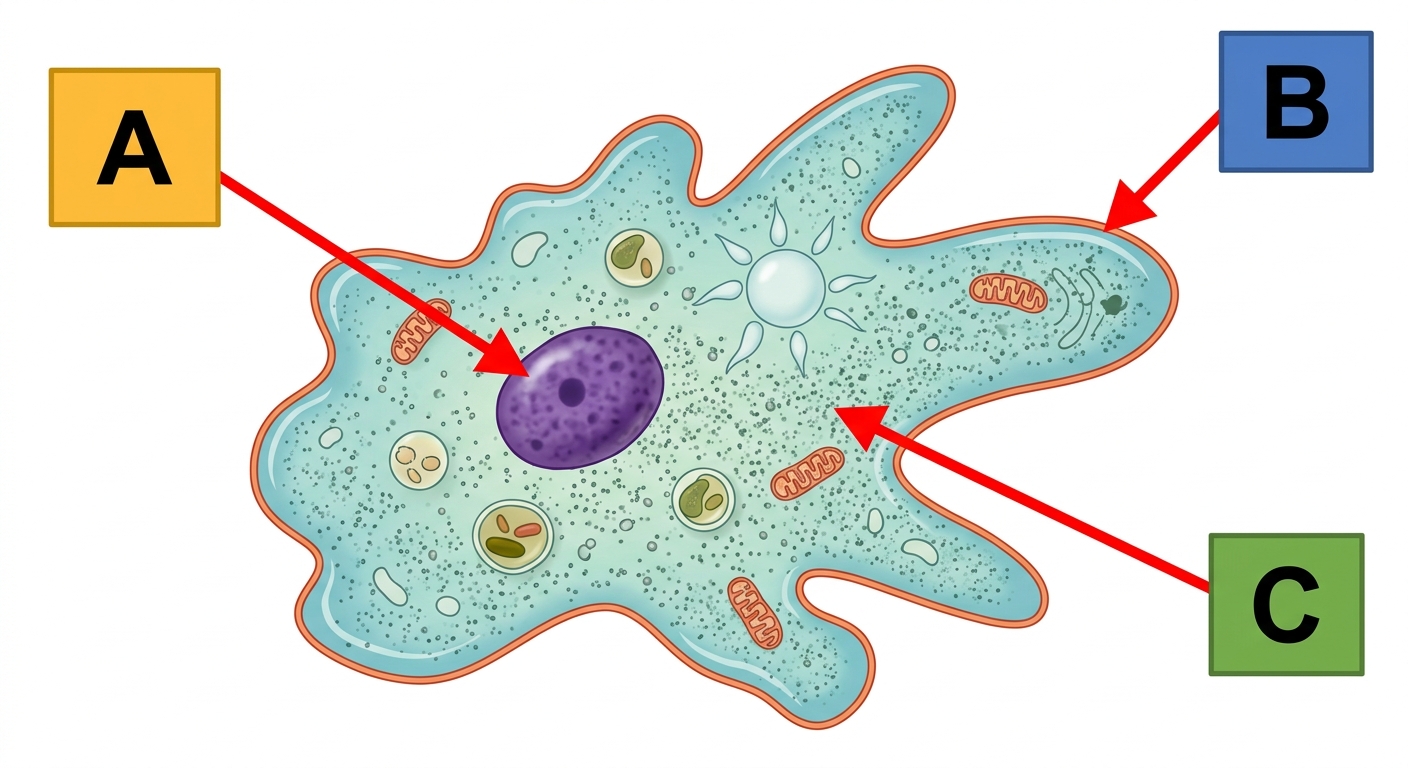
The diagram shows an amoeba with three parts labelled A, B and C.
Question diagram
(a)
Name part A, the large dark structure in the middle. [1]Criterion A (i) · Level 1-2
(b)
Describe what part B, the outer edge, does. [1]Criterion A (ii) · Level 3-4

revisionprep.com

Summary Answer

Not available for this question.

Model Answer

Not available for this question.

Marking Scheme

Not available for this question.

Examiner Insights

Not available for this question.

Question 2Criterion A · Band 1-4 · Easy · 2 marksrevisionprep.com

Comparing with Multicellular Organisms

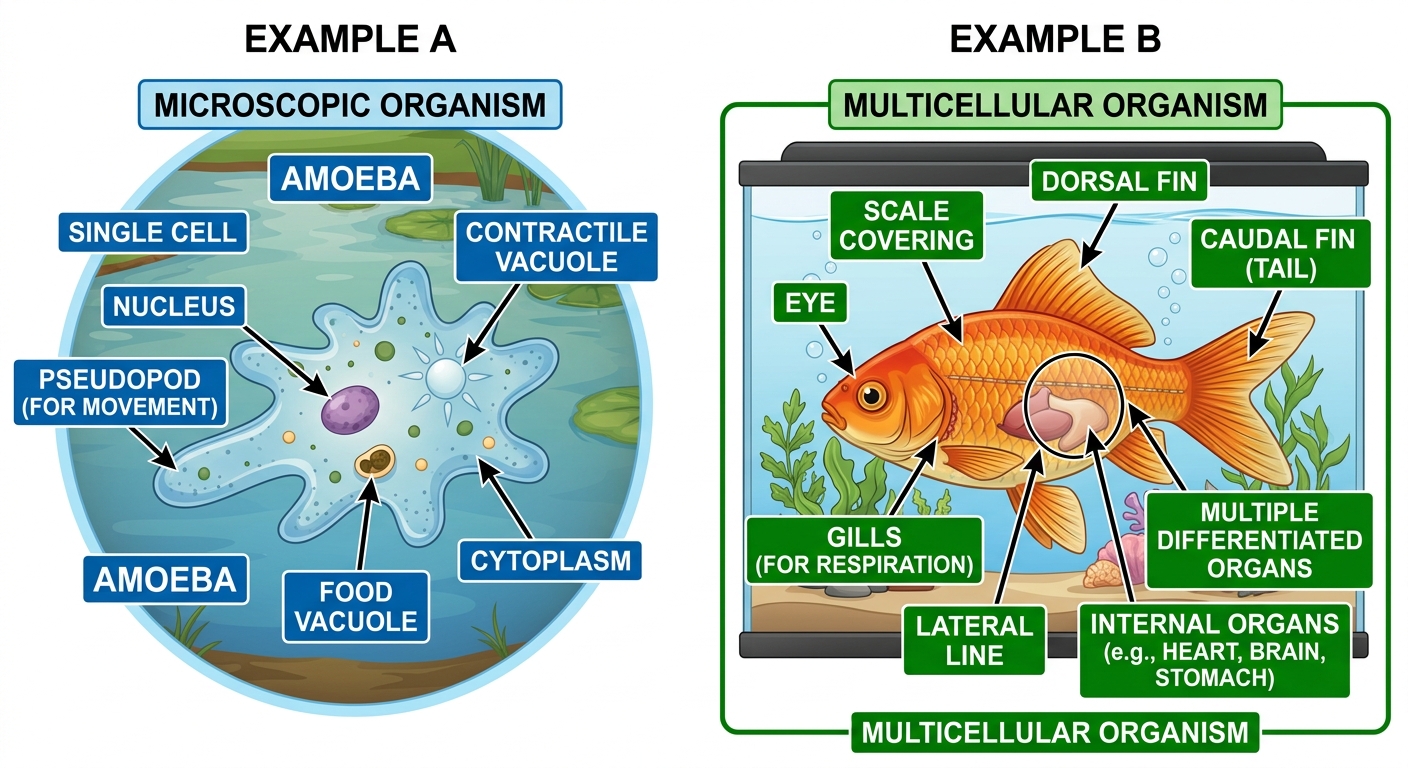
The picture shows Example A (the amoeba) and Example B (the goldfish).

Organism A: an amoeba, one cell, seen only with a microscope.
Organism B: a goldfish, with eyes, fins, a heart and a brain.
Question diagram
(a)
Identify the multicellular organism. [1]Criterion A (i) · Level 1-2
(b)
Describe what the goldfish has that the amoeba does not. [1]Criterion A (ii) · Level 3-4

revisionprep.com

Summary Answer

Not available for this question.

Model Answer

Not available for this question.

Marking Scheme

Not available for this question.

Examiner Insights

Not available for this question.

Question 3Criterion C · Band 1-6 · Medium · 6 marksrevisionprep.com

Examples of Bacteria Amoeba and Paramecium

Hana adds a handful of dry hay to a jar of pond water and counts paramecium in one drop each day.
Day 0: 2
Day 2: 10
Day 4: 45
Day 6: 80
Day 8: 85
Day 10: 60
(a)
Plot a line graph of the data with labelled axes. [2]Criterion C (ii) · Level 1-2
(b)
Describe the pattern up to day 6. [1]Criterion C (iii) · Level 3-4
(c)
Calculate the increase from day 2 to day 6. [1]Criterion C (iii) · Level 3-4
(d)
Suggest why the numbers grew so fast at first. [1]

(e) Suggest why the number fell after day 8. [1]
Criterion C (iv) · Level 5-6

revisionprep.com

Summary Answer

Not available for this question.

Model Answer

Not available for this question.

Marking Scheme

Not available for this question.

Examiner Insights

Not available for this question.

Question 4Criterion B · Band 1-6 · Medium · 6 marksrevisionprep.com

Functions Performed by One Cell

Euglena are single cells that swim towards light. Ali wants to find out which colour of light they move to most. He has a dish of Euglena, a lamp, red, green and blue see-through filters, a dropper and a microscope.
(a)
Write a hypothesis. [1]Criterion B (i) · Level 1-2
(b)
Identify the independent and the dependent variable. [2]Criterion B (i) · Level 3-4
(c)
State two things he must keep the same. [1]Criterion B (iii) · Level 3-4
(d)
Describe how he could count the Euglena fairly. [1]

(e) Explain which life process this investigation tests. [1]
Criterion B (iii) · Level 3-4

revisionprep.com

Summary Answer

Not available for this question.

Model Answer

Not available for this question.

Marking Scheme

Not available for this question.

Examiner Insights

Not available for this question.

Question 5Criterion C · Band 1-6 · Medium · 6 marksrevisionprep.com

Advantages and Limitations of Unicellularity

A pond dries up in a heatwave. A scientist counts living amoebae in a drop of mud each day.
Day 0: 100
Day 1: 60
Day 2: 25
Day 3: 10
Day 4: 10
Day 5: 10
(a)
Describe the pattern. [1]Criterion C (iii) · Level 1-2
(b)
Plot a line graph with labelled axes. [2]Criterion C (ii) · Level 3-4
(c)
Calculate the percentage that died by day 3. [1]Criterion C (iii) · Level 3-4
(d)
Explain why a single cell is easily killed by drying. [1]

(e) Suggest how the last 10 survive. [1]
Criterion C (iv) · Level 5-6

revisionprep.com

Summary Answer

Not available for this question.

Model Answer

Not available for this question.

Marking Scheme

Not available for this question.

Examiner Insights

Not available for this question.

Question 6Criterion B · Band 1-8 · Challenge · 7 marksrevisionprep.com

Definition and Characteristics of Unicellular Organisms

Yeast is a unicellular fungus. Ravi puts the same amount of yeast and sugar water into three bottles with a balloon on top. He keeps them at 10 °C, 25 °C and 40 °C and measures the width of each balloon after 30 minutes.
10 °C: 2 cm
25 °C: 6 cm
40 °C: 11 cm
(a)
Write a hypothesis. [1]Criterion B (i) · Level 1-2
(b)
Identify the independent and the dependent variable. [2]Criterion B (i) · Level 3-4
(c)
State two things he kept the same. [1]Criterion B (iii) · Level 3-4
(d)
Describe the conclusion. [1]

(e) Explain how this shows yeast is alive even though it is just one cell, and predict what would happen at 80 °C, with a reason. [2]
Criterion B (ii) · Level 3-4

revisionprep.com

Summary Answer

Not available for this question.

Model Answer

Not available for this question.

Marking Scheme

Not available for this question.

Examiner Insights

Not available for this question.

That's every free question here — 6 of 58.

+52 more questions, plus Mock Papers & Worksheets, are waiting in Premium.

Upgrade