You're viewing free preview questions — 6 questions previewing here — subscribe to unlock 54 more, plus the Full Question Bank, Mock Papers & Worksheets.Upgrade
Back

Rocks and the Rock Cycle — Free MYP1 Sciences Practice Questions

Free questions

Open in full, with answers, mark scheme and examiner insights.

Question 1Criterion D · Band 1-4 · Easy · 2 marksrevisionprep.com

Types of Rocks Igneous Sedimentary Metamorphic

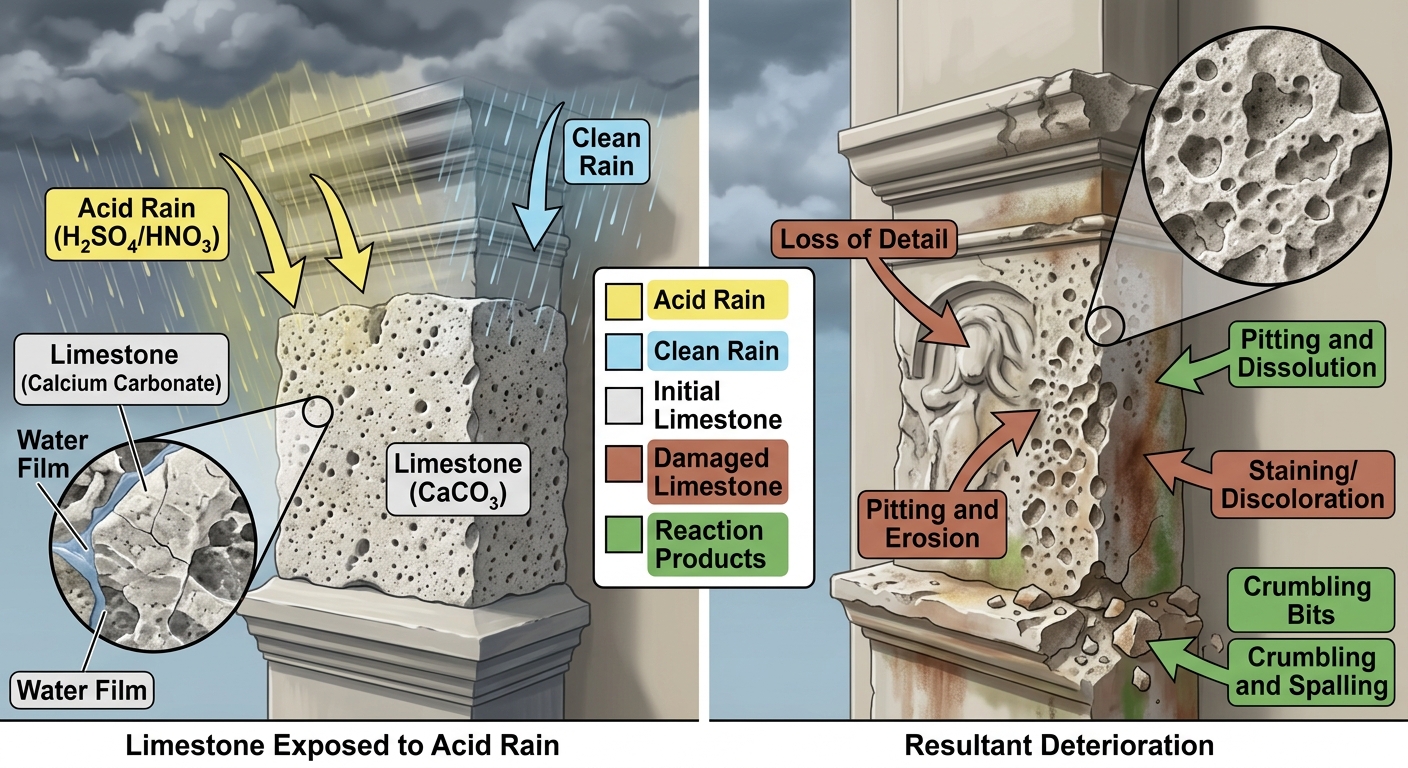
The picture shows limestone being worn away by acid rain.

Acid rain can damage buildings made from limestone.
Question diagram
(a)
State what acid rain does to limestone. [1]Criterion D (i) · Level 1-2
(b)
Describe one problem this causes for old statues. [1]Criterion D (ii) · Level 3-4

revisionprep.com

Summary Answer

Not available for this question.

Model Answer

Not available for this question.

Marking Scheme

Not available for this question.

Examiner Insights

Not available for this question.

Question 2Criterion A · Band 1-4 · Easy · 2 marksrevisionprep.com

Uses of Rocks and Minerals in Everyday Life

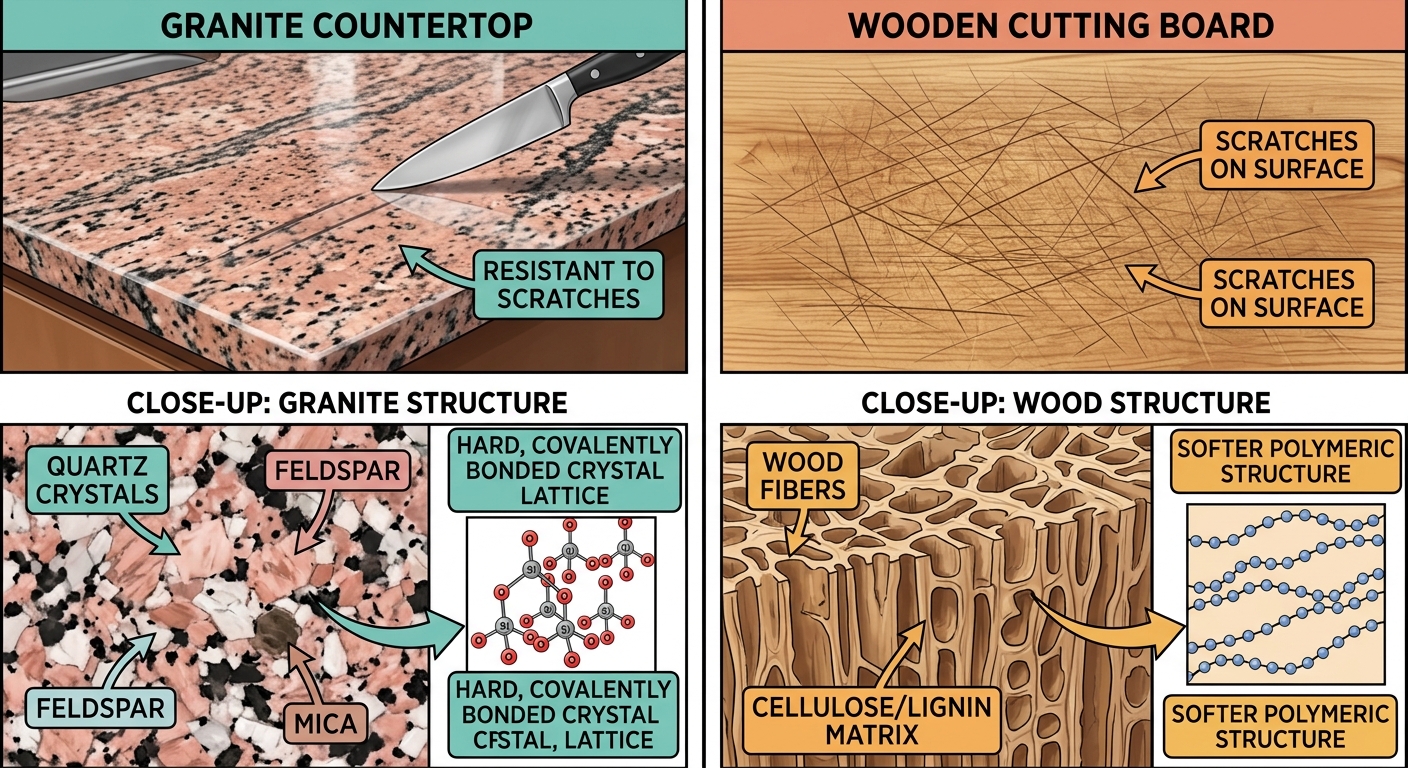
The picture compares the granite worktop and the wooden board. You do not need its close-up labels.

A kitchen worktop is made of granite, which contains quartz crystals. A wooden chopping board next to it has scratches.
Question diagram
(a)
Name the property that describes how well a material resists scratching. [1]Criterion A (i) · Level 1-2
(b)
Explain why the granite does not scratch easily but the wood does. [1]Criterion A (iii) · Level 3-4

revisionprep.com

Summary Answer

Not available for this question.

Model Answer

Not available for this question.

Marking Scheme

Not available for this question.

Examiner Insights

Not available for this question.

Question 3Criterion C · Band 1-6 · Medium · 6 marksrevisionprep.com

How Each Type of Rock Forms

Jo shakes a jar of water with gravel, sand, silt and clay, then times how long each layer takes to settle.
Gravel: 2 s
Sand: 10 s
Silt: 300 s
Clay: about 1 day
(a)
Draw a bar chart of settling time for gravel, sand and silt, with labelled axes. [2]Criterion C (ii) · Level 3-4
(b)
Describe the link between particle size and settling time. [1]Criterion C (iii) · Level 1-2
(c)
Predict the order of layers in the jar from bottom to top. [1]Criterion C (iii) · Level 3-4
(d)
Explain how this helps explain layers in sedimentary rock. [1]

(e) Explain why the lowest layers in a cliff of sedimentary rock are usually the oldest. [1]
Criterion C (iv) · Level 3-4

revisionprep.com

Summary Answer

Not available for this question.

Model Answer

Not available for this question.

Marking Scheme

Not available for this question.

Examiner Insights

Not available for this question.

Question 4Criterion B · Band 1-6 · Medium · 7 marksrevisionprep.com

The Rock Cycle Diagram

Water expands when it freezes. Mei tests whether this can break rock. She soaks four plaster blocks in water and puts them in a freezer overnight, then lets them thaw. She does this again and again and weighs the blocks. Four dry blocks are treated the same way.
Freeze-thaw cycles051015
Wet blocks, mean mass (g)100989591
Dry blocks, mean mass (g)100100100100
(a)
Write a hypothesis for her test. [1]Criterion B (i) · Level 1-2
(b)
Identify the independent and the dependent variable. [2]Criterion B (i) · Level 1-2
(c)
Explain why she also tested dry blocks. [1]Criterion B (iii) · Level 3-4
(d)
Calculate the mass lost by the wet blocks after 15 cycles. [1]

(e) Explain how this models weathering of rocks in mountains, and how it fits into the rock cycle. [2]
Criterion B (ii) · Level 3-4

revisionprep.com

Summary Answer

Not available for this question.

Model Answer

Not available for this question.

Marking Scheme

Not available for this question.

Examiner Insights

Not available for this question.

Question 5Criterion C · Band 1-6 · Medium · 6 marksrevisionprep.com

Physical and Chemical Properties of Rocks

Ben puts 20 g chips of limestone and granite into vinegar (a weak acid) and weighs them every two days after drying.
Day0246
Limestone (g)20.019.218.517.7
Granite (g)20.020.020.020.0
(a)
Draw a line graph of both rocks on the same axes, with a key. [2]Criterion C (ii) · Level 3-4
(b)
Calculate the mass lost by limestone in 6 days. [1]Criterion C (iii) · Level 1-2
(c)
Describe the trend for limestone. [1]Criterion C (iii) · Level 3-4
(d)
Explain the difference between the two rocks using the idea of chemical properties. [1]

(e) Suggest why this test uses vinegar instead of collecting real acid rain, and one problem this causes. [1]
Criterion C (iv) · Level 3-4

revisionprep.com

Summary Answer

Not available for this question.

Model Answer

Not available for this question.

Marking Scheme

Not available for this question.

Examiner Insights

Not available for this question.

Question 6Criterion B · Band 1-8 · Challenge · 8 marksrevisionprep.com

Types of Rocks Igneous Sedimentary Metamorphic

Ravi melts a substance called salol and lets drops of it cool on glass slides at different temperatures. He measures the size of the crystals that form.
Slide temperature (°C)52040
Crystal size (mm)0.21.03.0
(a)
Write a hypothesis for his test. [1]Criterion B (i) · Level 1-2
(b)
Identify the independent and the dependent variable. [2]Criterion B (i) · Level 1-2
(c)
State two things he must keep the same. [1]Criterion B (iii) · Level 3-4
(d)
Describe one safety rule for this test. [1]

(e) Explain how this model helps explain the difference between granite and basalt, and give one way the model is not like real rocks. [3]
Criterion B (iii) · Level 3-4

revisionprep.com

Summary Answer

Not available for this question.

Model Answer

Not available for this question.

Marking Scheme

Not available for this question.

Examiner Insights

Not available for this question.

That's every free question here — 6 of 60.

+54 more questions, plus Mock Papers & Worksheets, are waiting in Premium.

Upgrade