You're viewing free preview questions — 4 questions previewing here — subscribe to unlock 51 more, plus the Full Question Bank, Mock Papers & Worksheets.Upgrade
Seasons and the Earth Tilt — Free MYP1 Sciences Practice Questions

1QuestionClimatic Differences Due to Earth MovementConcept Practice
2 marks~3 minCriterion A
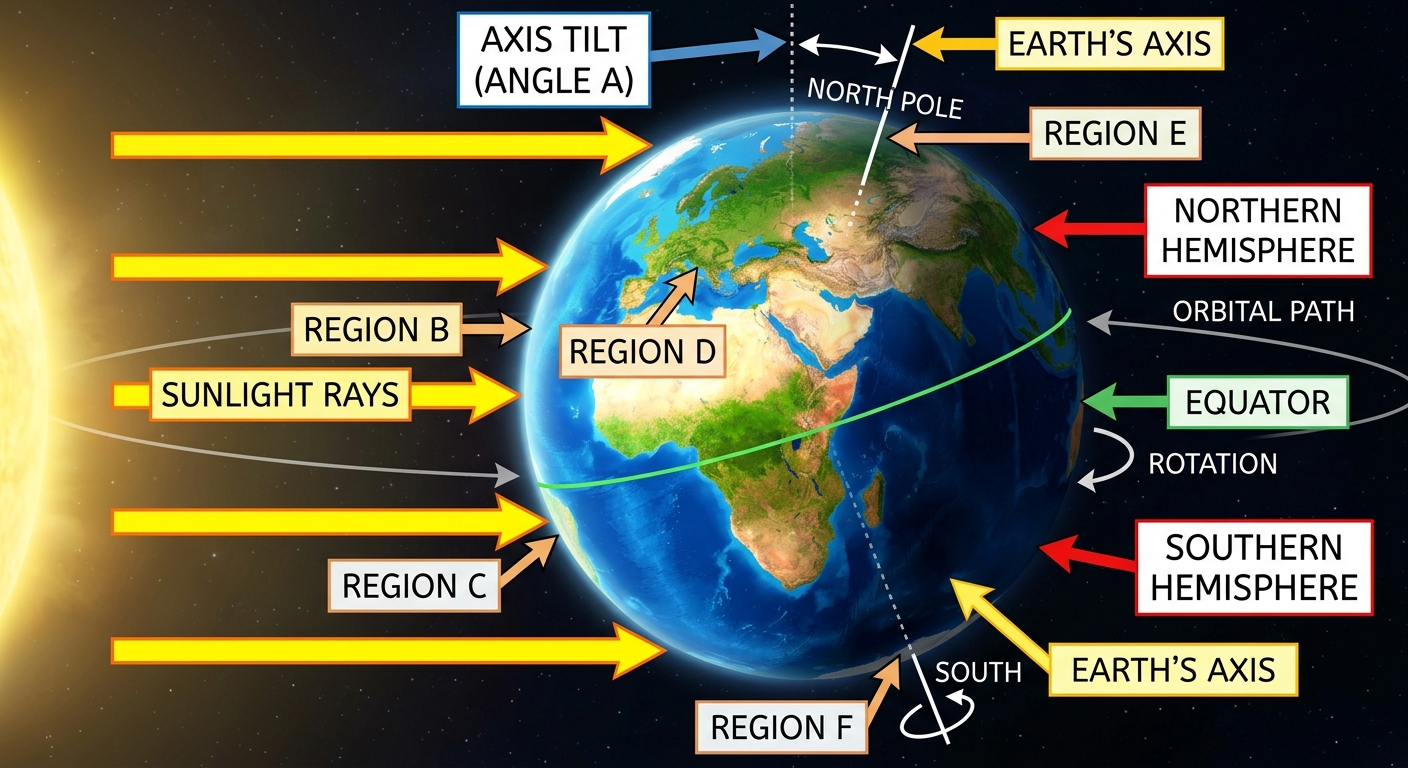
The diagram shows Earth with its axis tilted at from the vertical. Sunlight rays strike the Northern and Southern Hemispheres at different angles. Label A marks the tilt angle. Label B marks a region on Earth's surface.
a
Identify the feature shown by Label A. [1]
b
Describe why the region marked by Label B receives the strongest sunlight. [1]

Solutions
2QuestionEffect of Tilt and Orbit on Day LengthAssessment Practice
4 marks~6 minCriterion C
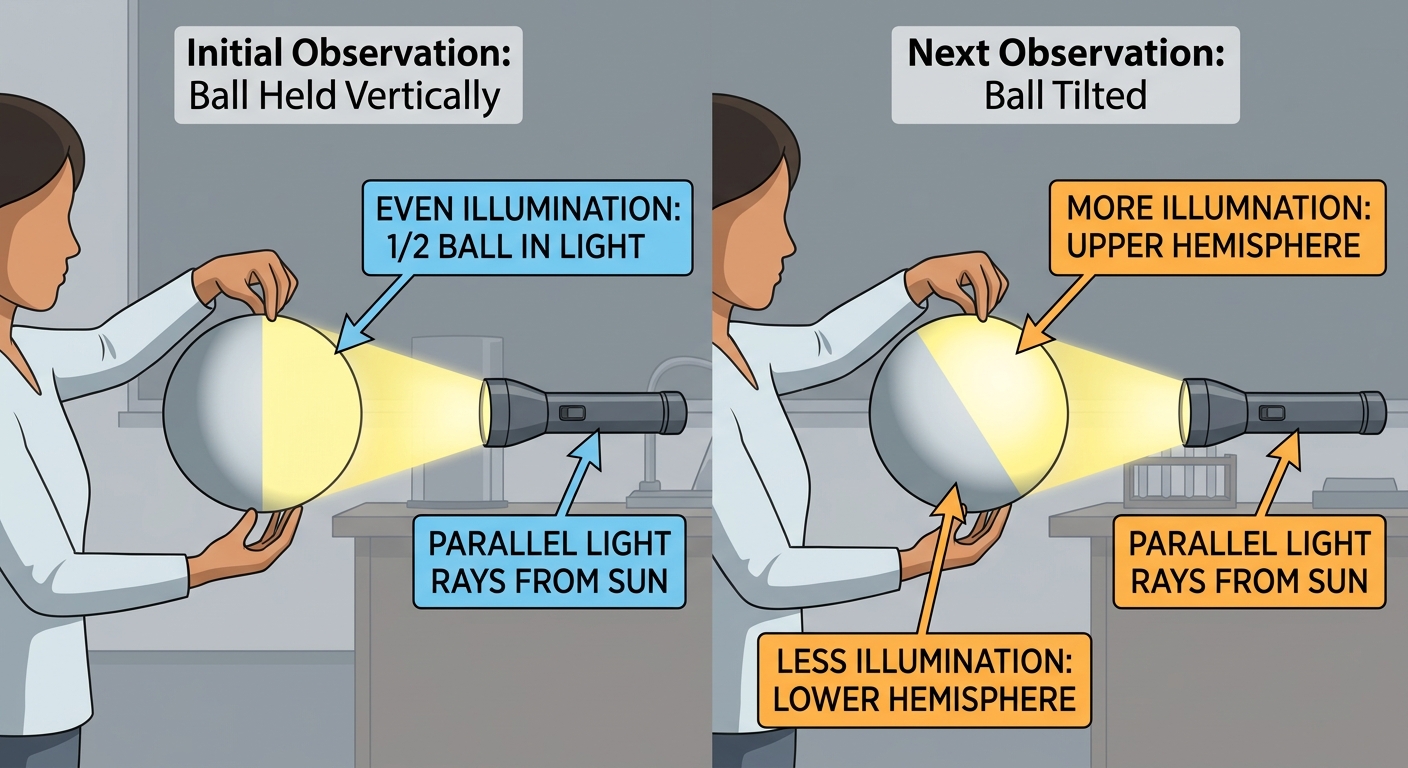
A teacher shines a torch on a ball held straight up. The light spreads evenly over the top and bottom halves. The teacher then tilts the ball and shines the torch again.
a
Identify which half of the tilted ball receives more light from the torch. [1]
b
Describe what would happen to day length all year round if Earth had no tilt. [1]
c
Sam says: "Day length changes between summer and winter only because Earth moves around the Sun, not because of Earth's tilt." Using the torch and ball experiment, explain whether Sam is correct or incorrect. [2]
Solutions
3QuestionEffect of Tilt and Orbit on Day LengthConcept Practice
2 marks~3 minCriterion D
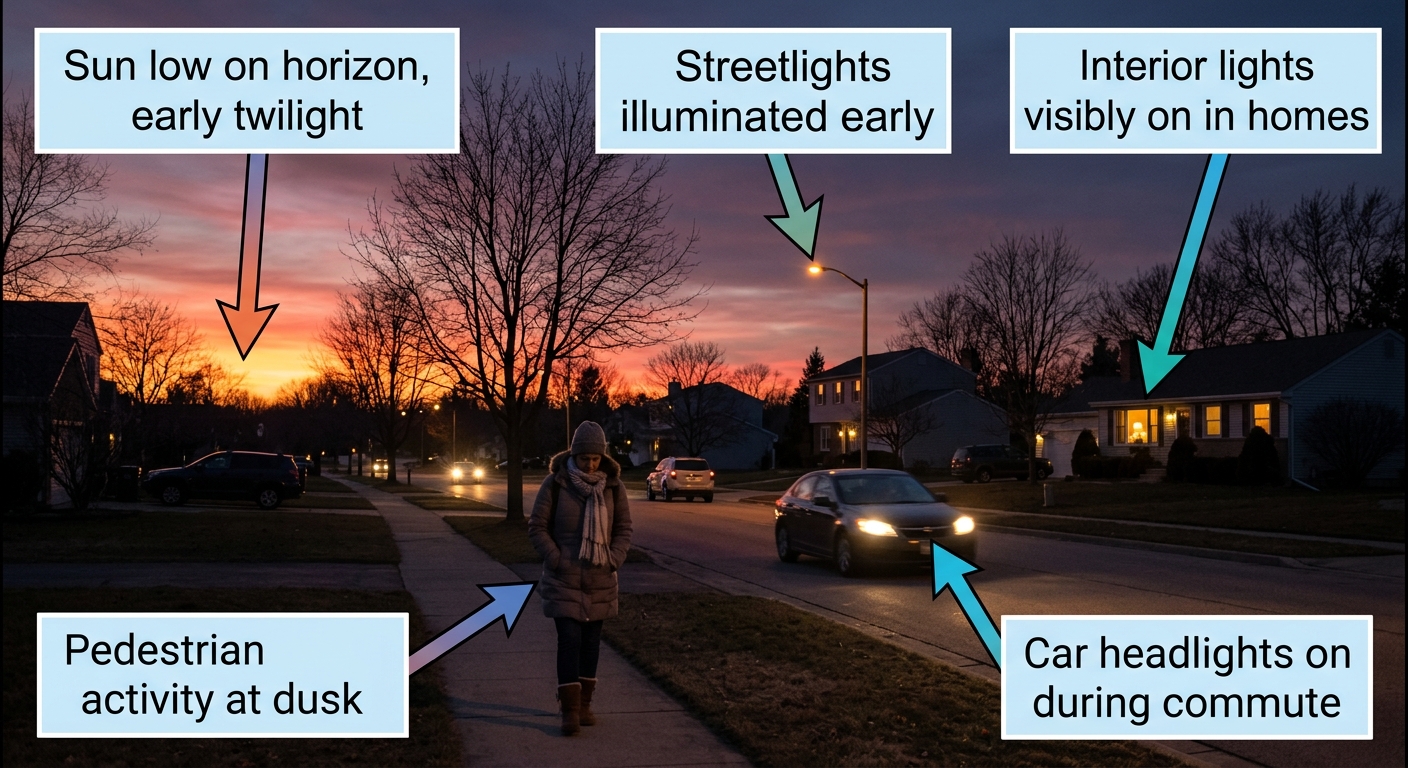
In winter, the Sun sets earlier and daylight hours are shorter.
Describe one way this change in daylight affects what a person does during a typical day. [2]
Describe one way this change in daylight affects what a person does during a typical day. [2]
Solutions
4QuestionClimatic Differences Due to Earth MovementConcept Practice
5 marks~8 minCriterion B
Three cities were measured for temperature.
| City A (on the equator) | summer | winter |
|---|---|---|
| City B (a little north) | summer | winter |
| City C (much further north) | summer | winter |
a
Identify which city has the smallest difference between its summer and winter temperatures. [1]
b
Describe what happens to winter temperatures as a city gets further from the equator. [2]
c
City D is located between City B and City C in distance from the equator. State a likely winter temperature for City D and describe how the data above supports your answer. [2]
Solutions
That's every free question here — 4 of 55.
+51 more questions, plus Mock Papers & Worksheets, are waiting in Premium.