You're viewing free preview questions — 6 questions previewing here — subscribe to unlock 53 more, plus the Full Question Bank, Mock Papers & Worksheets.Upgrade
Back

Food Chains and Webs — Free MYP1 Sciences Practice Questions

Free questions

Open in full, with answers, mark scheme and examiner insights.

Question 1Criterion D · Band 1-4 · Easy · 4 marksrevisionprep.com

Producers Consumers and Decomposers

The picture shows the school's compost bin.

A school sets up a compost bin to turn food scraps into fertiliser for its garden.
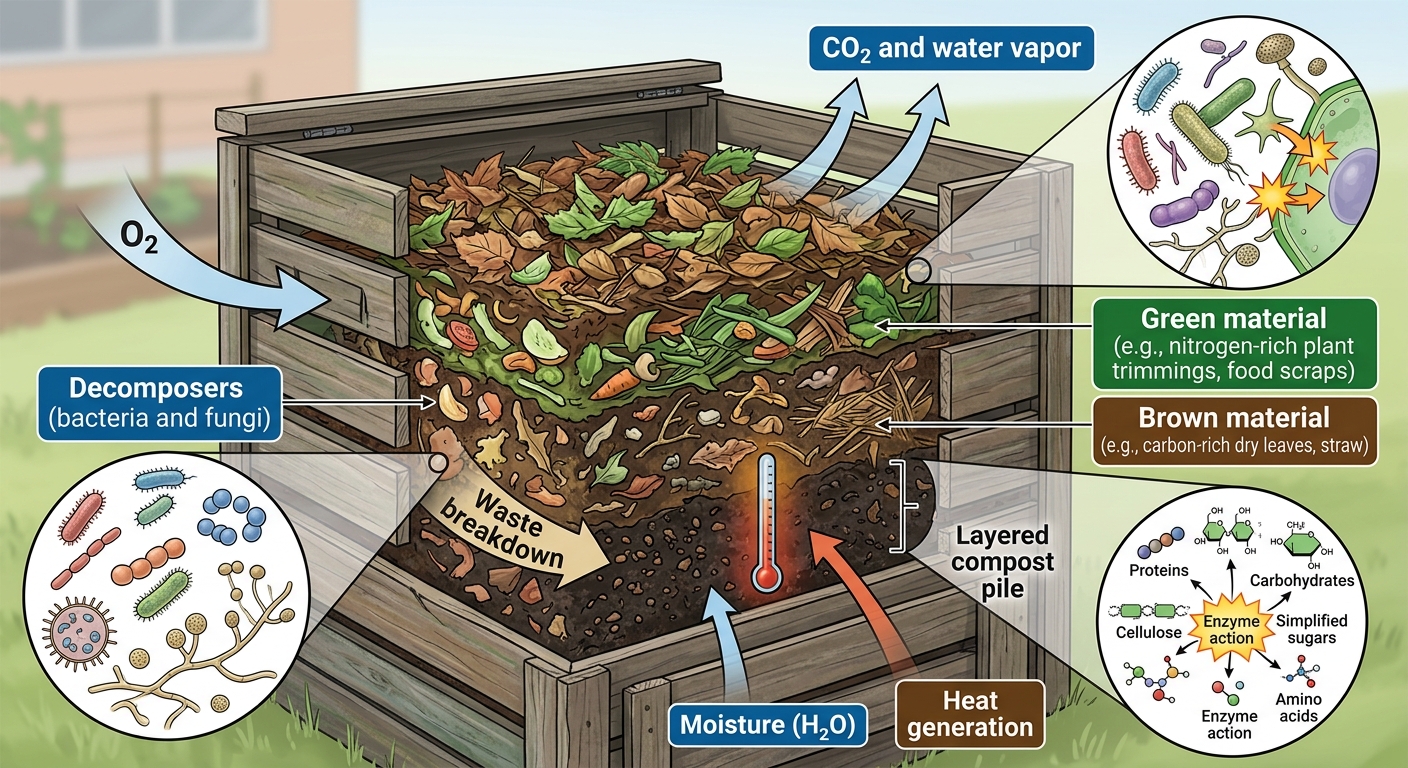
Question diagram
(a)
The picture shows the decomposers (bacteria and fungi). Name two things shown in the picture that they need to work well. [1]Criterion D (i) · Level 1-2
(b)
Describe what the decomposers do to the food scraps. [1]Criterion D (ii) · Level 3-4
(c)
Give one benefit and one limitation of composting instead of throwing scraps away. [2]Criterion D (iii) · Level 3-4

revisionprep.com

Summary Answer

Not available for this question.

Model Answer

Not available for this question.

Marking Scheme

Not available for this question.

Examiner Insights

Not available for this question.

Question 2Criterion A · Band 1-2 · Easy · 2 marksrevisionprep.com

Constructing and Interpreting Food Chains
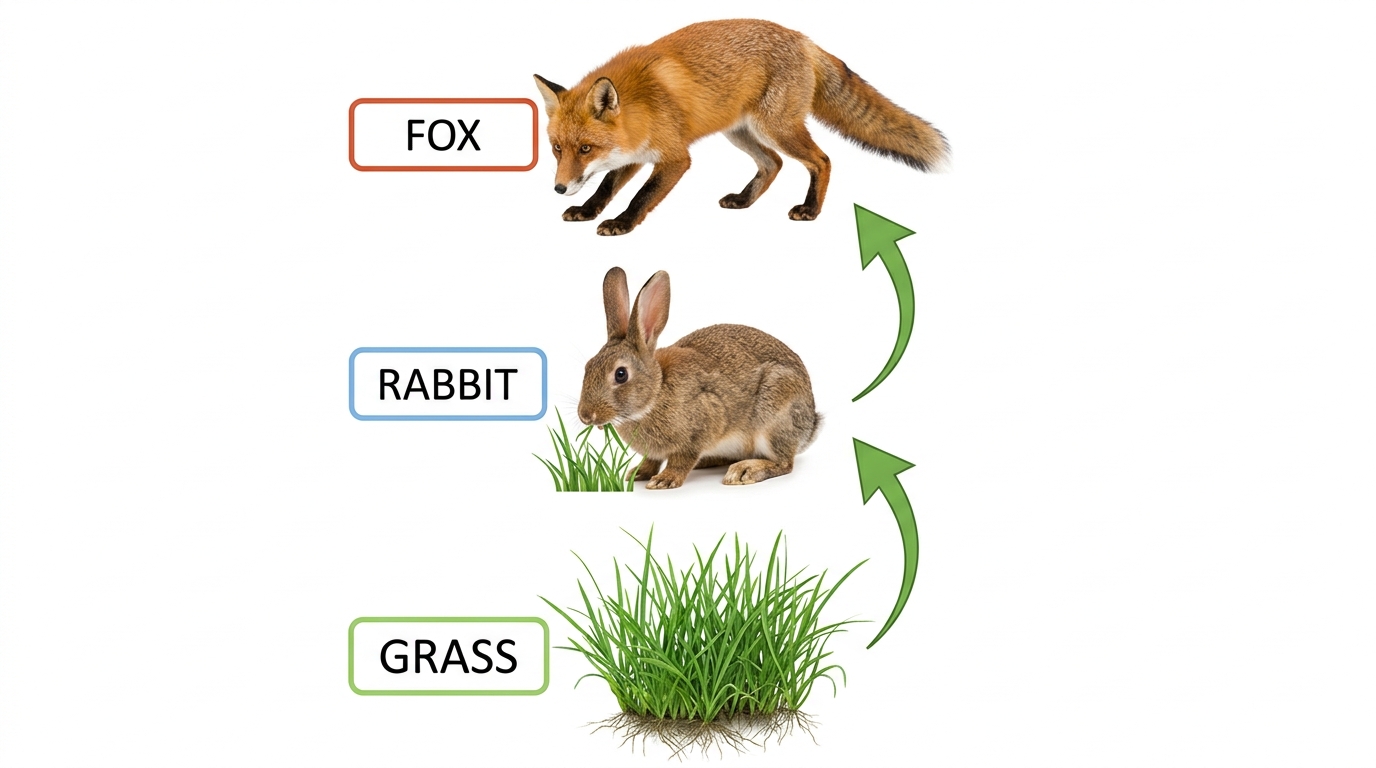
The picture shows a food chain: grass → rabbit → fox.
Question diagram
(a)
Name the role of the rabbit. [1]Criterion A (i) · Level 1-2
(b)
State what the arrows show. [1]Criterion A (i) · Level 1-2

revisionprep.com

Summary Answer

Not available for this question.

Model Answer

Not available for this question.

Marking Scheme

Not available for this question.

Examiner Insights

Not available for this question.

Question 3Criterion C · Band 1-6 · Medium · 6 marksrevisionprep.com

Constructing and Interpreting Food Chains

A rock pool contains: seaweed, limpets (eat seaweed), crabs (eat limpets and dead fish), starfish (eat limpets and mussels), mussels (filter tiny plankton from the water), plankton (tiny plants), and seagulls (eat crabs, mussels and bread from tourists).
(a)
Draw a food web for the rock pool. Leave out the bread and the dead fish. [3]Criterion C (ii) · Level 3-4
(b)
Name the two producers. [1]Criterion C (ii) · Level 1-2
(c)
Identify one animal that is eaten by two different animals. [1]Criterion C (iv) · Level 3-4
(d)
Explain why a food web shows real feeding better than a single food chain. [1]Criterion C (iv) · Level 5-6

revisionprep.com

Summary Answer

Not available for this question.

Model Answer

Not available for this question.

Marking Scheme

Not available for this question.

Examiner Insights

Not available for this question.

Question 4Criterion B · Band 3-6 · Medium · 7 marksrevisionprep.com

Energy Flow Through Food Webs

Mealworms are young beetles that eat bran. Ruby wants to find out how much of the food mealworms eat becomes new body mass. She has 20 mealworms, bran, a balance and a small tub with air holes.
(a)
Outline how she can measure the mass of bran eaten and the mass gained by the mealworms in one week. [3]Criterion B (iii) · Level 5-6
(b)
Predict whether the mass gained will be more or less than the bran eaten. Give a reason. [2]Criterion B (ii) · Level 3-4
(c)
Suggest one way to make her results more reliable. [1]Criterion B (iii) · Level 3-4
(d)
State how she should care for the mealworms. [1]Criterion B (iii) · Level 3-4

revisionprep.com

Summary Answer

Not available for this question.

Model Answer

Not available for this question.

Marking Scheme

Not available for this question.

Examiner Insights

Not available for this question.

Question 5Criterion C · Band 1-6 · Medium · 4 marksrevisionprep.com

Trophic Levels and Energy Transfer Introductory

In a grassland, the grass stores 1000 kJ, rabbits store 100 kJ and foxes store 4 kJ.
A scientist says about 10% of energy passes to the next level.
(a)
Calculate the percentage passed from grass to rabbits. [1]Criterion C (iii) · Level 1-2
(b)
Calculate the percentage passed from rabbits to foxes. [1]Criterion C (iii) · Level 3-4
(c)
Discuss whether the data support the scientist's claim. [2]Criterion C (iv) · Level 5-6

revisionprep.com

Summary Answer

Not available for this question.

Model Answer

Not available for this question.

Marking Scheme

Not available for this question.

Examiner Insights

Not available for this question.

Question 6Criterion C · Band 1-8 · Challenge · 5 marksrevisionprep.com

Impact of Removing an Organism from a Food Web

A food chain: grass → rabbits → foxes. In week 3 all foxes are removed.
Week123456
Grass (plants)500500500450350200
Rabbits200200200300450600
Foxes202020000
(a)
Identify the top predator. [1]Criterion C (iii) · Level 1-2
(b)
Describe what happened to the rabbits after week 3, using numbers. [1]Criterion C (iii) · Level 3-4
(c)
A classmate says removing the foxes only changed the rabbits. Discuss this claim, and predict what will happen to the rabbits after week 6 if no foxes return, with a reason. [3]Criterion C (iv) · Level 7-8

revisionprep.com

Summary Answer

Not available for this question.

Model Answer

Not available for this question.

Marking Scheme

Not available for this question.

Examiner Insights

Not available for this question.

That's every free question here — 6 of 59.

+53 more questions, plus Mock Papers & Worksheets, are waiting in Premium.

Upgrade