You're viewing free preview questions — 6 questions previewing here — subscribe to unlock 14 more, plus the Full Question Bank, Mock Papers & Worksheets.Upgrade
Back

Series and Parallel Circuits — Free MYP1 Sciences Practice Questions

Free questions

Open in full, with answers, mark scheme and examiner insights.

Question 1Criterion A · Band 3-4 · Easy · 3 marksrevisionprep.com

Difference Between Series and Parallel Circuits

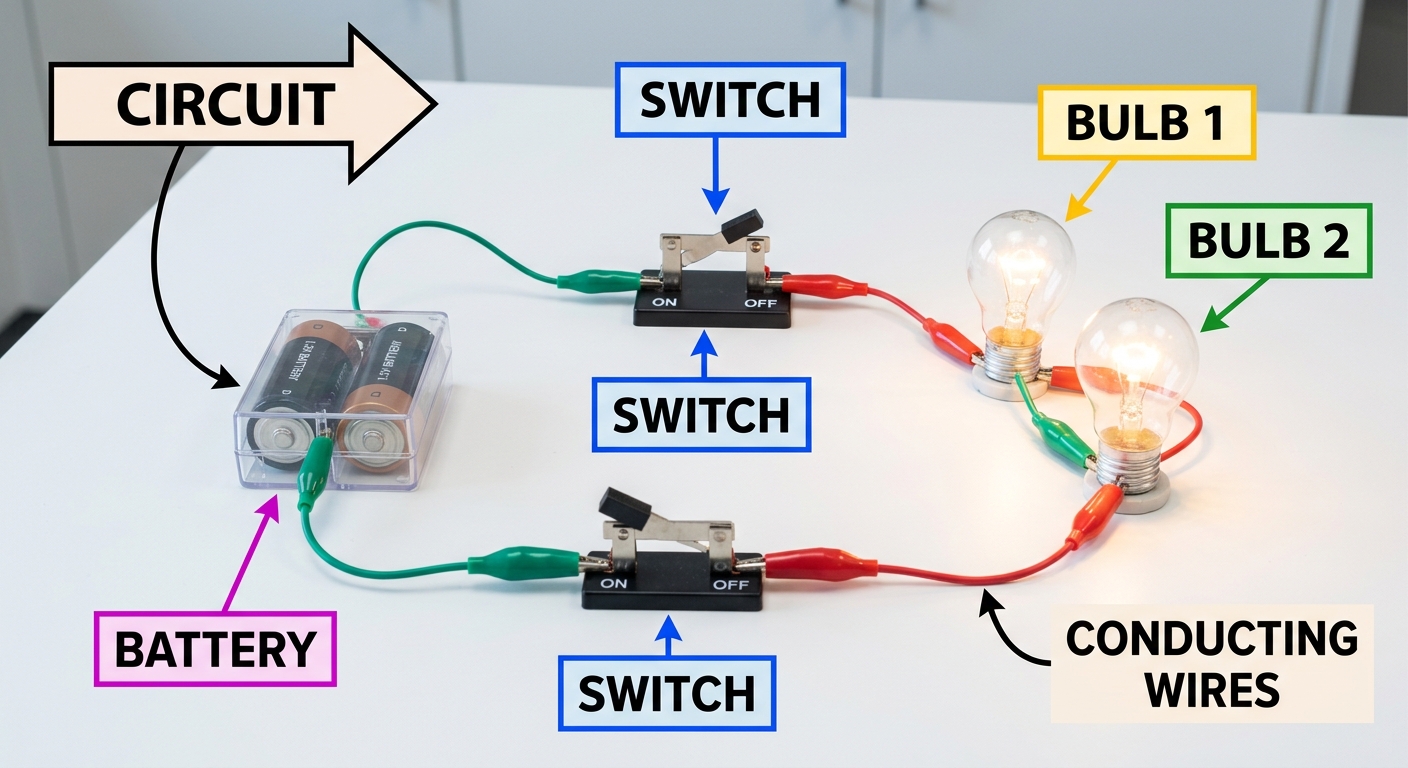
The picture shows a series and a parallel circuit drawn as pictures.

Circuit diagrams use symbols instead of pictures.
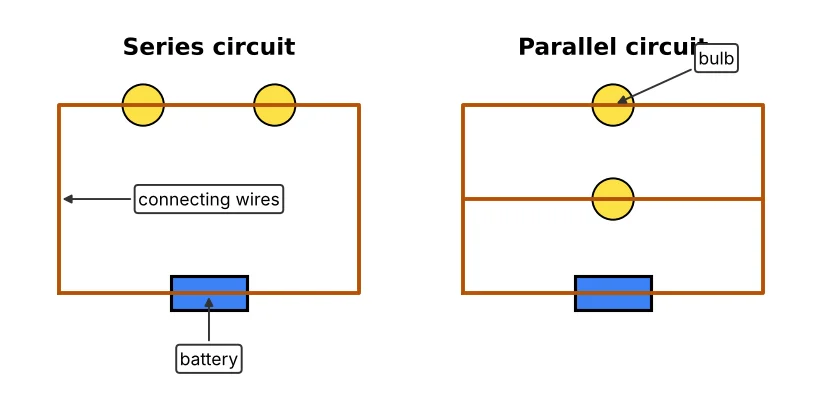
Question diagram
(a)
Draw a circuit diagram of a series circuit with one cell, one switch and two bulbs. [2]Criterion A (i) · Level 3-4
(b)
Describe how you would change your drawing to put the two bulbs in parallel. [1]Criterion A (ii) · Level 3-4

revisionprep.com

Summary Answer

Not available for this question.

Model Answer

Not available for this question.

Marking Scheme

Not available for this question.

Examiner Insights

Not available for this question.

Question 2Criterion B · Band 1-4 · Easy · 4 marksrevisionprep.com

Difference Between Series and Parallel Circuits

A student tests identical bulbs with a 6 V battery and scores brightness from 1 (very dim) to 5 (very bright).
Bulbs123
Series521
Parallel555
(a)
Describe what happens to brightness as bulbs are added in series. [1]Criterion B (ii) · Level 1-2
(b)
Predict the brightness of each bulb with 4 bulbs in each circuit. [1]Criterion B (ii) · Level 3-4
(c)
Explain the difference between the circuits. [2]Criterion B (ii) · Level 3-4

revisionprep.com

Summary Answer

Not available for this question.

Model Answer

Not available for this question.

Marking Scheme

Not available for this question.

Examiner Insights

Not available for this question.

Question 3Criterion C · Band 1-6 · Medium · 6 marksrevisionprep.com

Difference Between Series and Parallel Circuits

Omar adds identical bulbs one at a time to a series circuit and to a parallel circuit. He measures the current from the battery.
Bulbs1234
Series (A)0.300.150.100.08
Parallel (A)0.300.600.901.20
(a)
Draw a line graph with both sets of results on the same axes, with a key. [2]Criterion C (ii) · Level 3-4
(b)
Describe the pattern for the parallel circuit. [1]Criterion C (iii) · Level 1-2
(c)
Predict the parallel current with 5 bulbs. [1]Criterion C (iii) · Level 3-4
(d)
Explain why adding bulbs makes the series current smaller. [1]

(e) Explain why plugging too many devices into one socket can be dangerous, using the parallel results. [1]
Criterion C (iv) · Level 3-4

revisionprep.com

Summary Answer

Not available for this question.

Model Answer

Not available for this question.

Marking Scheme

Not available for this question.

Examiner Insights

Not available for this question.

Question 4Criterion C · Band 1-6 · Medium · 6 marksrevisionprep.com

Real-Life Applications Home and School Circuits

A family checks the current on each parallel branch at home with an energy monitor.
Lights: 1.0 A
Fridge: 1.5 A
TV: 0.5 A
Kettle: 9.0 A
(a)
Calculate the total current when all four are on. [1]Criterion C (iii) · Level 1-2
(b)
Draw a bar chart of the four currents, with labelled axes. [2]Criterion C (ii) · Level 3-4
(c)
Identify the device that takes the most current. [1]Criterion C (iii) · Level 1-2
(d)
The circuit breaker switches off above 10 A. Explain what happens if a second kettle is switched on as well. [1]

(e) Suggest one reason the kettle is often given its own circuit. [1]
Criterion C (iv) · Level 3-4

revisionprep.com

Summary Answer

Not available for this question.

Model Answer

Not available for this question.

Marking Scheme

Not available for this question.

Examiner Insights

Not available for this question.

Question 5Criterion B · Band 1-6 · Medium · 7 marksrevisionprep.com

Real-Life Applications Home and School Circuits

Ana builds a parallel circuit with two bulbs, P and Q. Each bulb has its own switch on its branch. She tries every switch setting.
Switch 1 on, Switch 2 onP litQ lit
Switch 1 on, Switch 2 offP litQ off
Switch 1 off, Switch 2 onP offQ lit
Switch 1 off, Switch 2 offP offQ off
Question diagram
(a)
The picture shows Ana's first attempt, with both bulbs and both switches in one loop. Predict what happens to both bulbs when either switch is turned off. [1]Criterion B (i) · Level 1-2
(b)
Identify which switch controls bulb Q. [1]Criterion B (ii) · Level 1-2
(c)
Explain why turning off Switch 1 does not turn off bulb Q. [1]Criterion B (ii) · Level 3-4
(d)
Describe where Ana should add a third switch to turn off both bulbs at once. [1]

(e) Describe a safety rule Ana must follow while testing. [1]

(f) Explain how this circuit is like the light switches in a school. [2]
Criterion B (iii) · Level 3-4

revisionprep.com

Summary Answer

Not available for this question.

Model Answer

Not available for this question.

Marking Scheme

Not available for this question.

Examiner Insights

Not available for this question.

Question 6Criterion B · Band 1-8 · Challenge · 8 marksrevisionprep.com

Difference Between Series and Parallel Circuits

Hana wants to know whether a battery lasts longer with two bulbs in series or two bulbs in parallel. She uses two new identical batteries and four identical bulbs. She times how long each circuit stays lit.
Series: 10 hours (bulbs dim)
Parallel: 4 hours (bulbs bright)
(a)
Write a hypothesis for her test. [1]Criterion B (i) · Level 1-2
(b)
Identify the independent and the dependent variable. [2]Criterion B (i) · Level 1-2
(c)
State two things she must keep the same. [1]Criterion B (iii) · Level 3-4
(d)
Explain why the parallel circuit runs out sooner. [1]

(e) Suggest which circuit is better for a torch that must last a long camping trip, give one problem with your choice, and suggest how a torch designer could reduce that problem. [3]
Criterion B (ii) · Level 3-4

revisionprep.com

Summary Answer

Not available for this question.

Model Answer

Not available for this question.

Marking Scheme

Not available for this question.

Examiner Insights

Not available for this question.

That's every free question here — 6 of 20.

+14 more questions, plus Mock Papers & Worksheets, are waiting in Premium.

Upgrade