You're viewing free preview questions — 6 questions previewing here — subscribe to unlock 57 more, plus the Full Question Bank, Mock Papers & Worksheets.Upgrade
Back

Static and Current Electricity — Free MYP1 Sciences Practice Questions

Free questions

Open in full, with answers, mark scheme and examiner insights.

Question 1Criterion A · Band 1-4 · Easy · 2 marksrevisionprep.com

Definition of Static Electricity

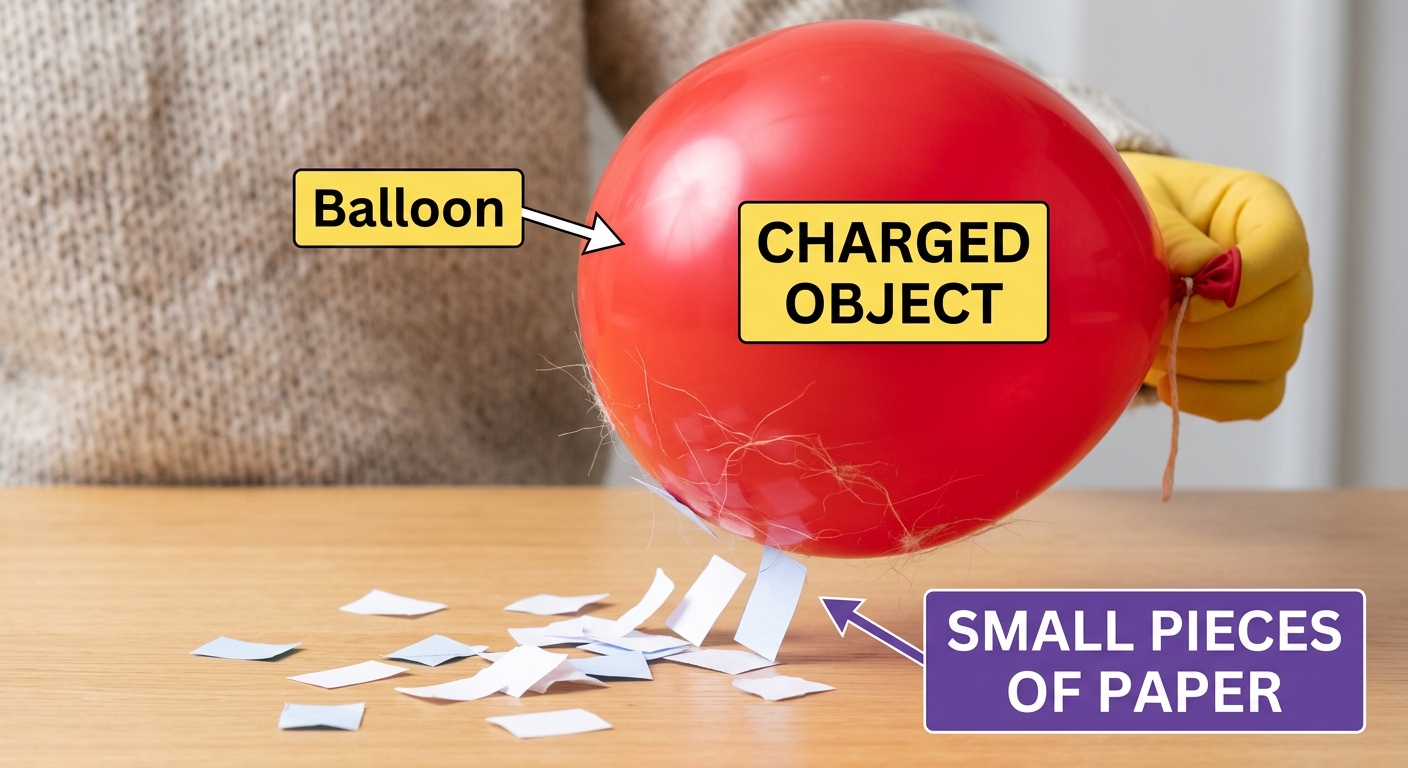
The picture shows the rubbed balloon picking up paper.

A balloon rubbed on a wool jumper picks up small pieces of paper.
Question diagram
(a)
State the type of electricity on the balloon. [1]Criterion A (i) · Level 1-2
(b)
Explain why the paper is pulled towards the balloon. [1]Criterion A (iii) · Level 3-4

revisionprep.com

Summary Answer

Not available for this question.

Model Answer

Not available for this question.

Marking Scheme

Not available for this question.

Examiner Insights

Not available for this question.

Question 2Criterion A · Band 1-4 · Easy · 2 marksrevisionprep.com

Charging by Friction Conduction and Induction

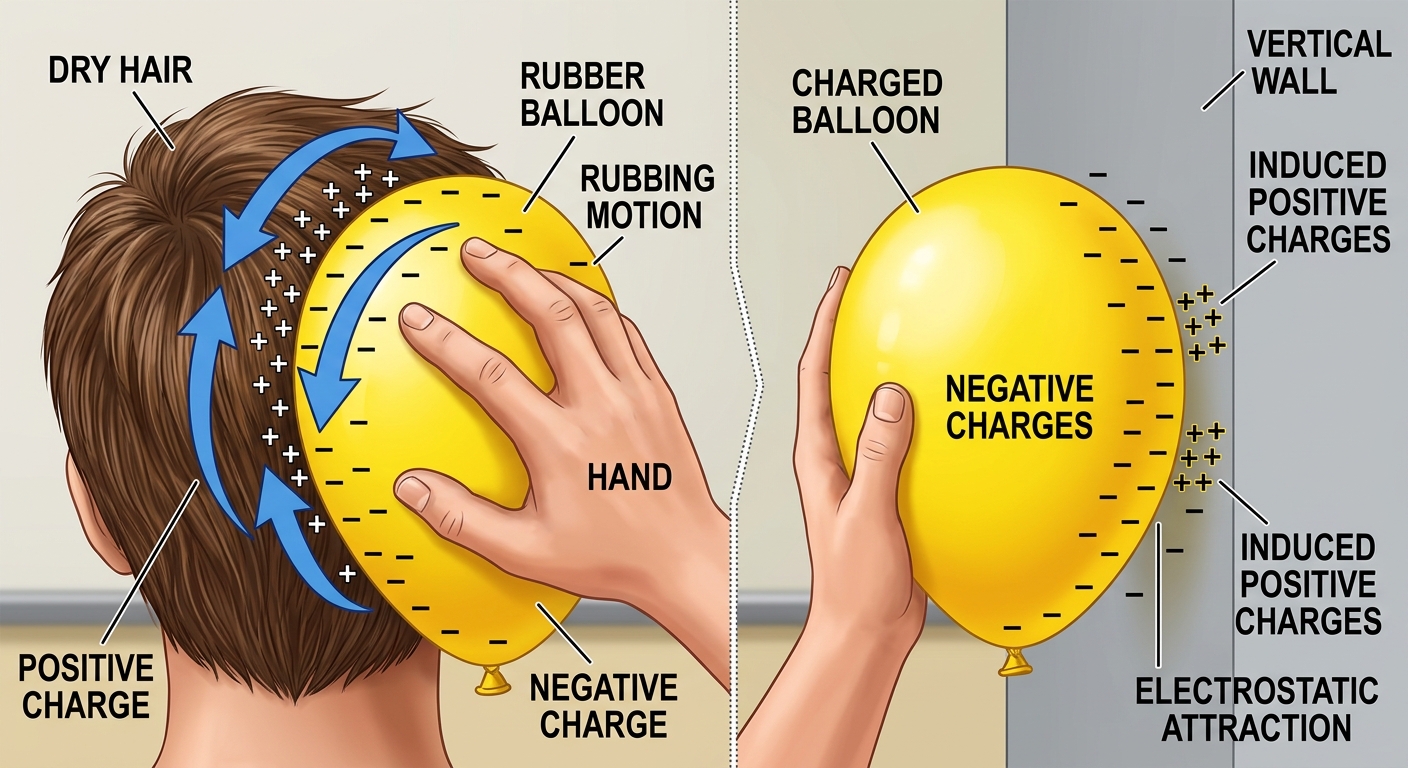
The picture shows the balloon being rubbed on hair and then held on a wall.

A balloon rubbed on hair sticks to a wall, then falls off later.
Question diagram
(a)
Name the charge on the balloon. [1]Criterion A (i) · Level 1-2
(b)
Explain why it eventually falls off. [1]Criterion A (iii) · Level 3-4

revisionprep.com

Summary Answer

Not available for this question.

Model Answer

Not available for this question.

Marking Scheme

Not available for this question.

Examiner Insights

Not available for this question.

Question 3Criterion B · Band 1-6 · Medium · 6 marksrevisionprep.com

Attraction and Repulsion of Charges

Lina notices static shocks happen more in winter. She thinks damp air stops charge building up. She plans to rub a balloon on wool 10 times and count paper pieces it picks up, in a dry classroom and in a steamy bathroom.
Dry room182022
Steamy bathroom453
(a)
Write a hypothesis. [1]Criterion B (i) · Level 1-2
(b)
Identify the independent and the dependent variable. [2]Criterion B (i) · Level 3-4
(c)
State two things she must keep the same. [1]Criterion B (iii) · Level 3-4
(d)
Calculate the mean for the dry room. [1]

(e) Explain the results. [1]
Criterion B (ii) · Level 3-4

revisionprep.com

Summary Answer

Not available for this question.

Model Answer

Not available for this question.

Marking Scheme

Not available for this question.

Examiner Insights

Not available for this question.

Question 4Criterion B · Band 1-6 · Medium · 6 marksrevisionprep.com

Definition and Flow of Electric Current

Sam wants to find out how the number of cells affects a bulb. He has 4 cells, a bulb, wires and an ammeter.
1 cell: 0.10 A
2 cells: 0.19 A
3 cells: 0.27 A
4 cells: 0.34 A
(a)
Write a hypothesis. [1]Criterion B (i) · Level 1-2
(b)
Identify the independent and the dependent variable. [2]Criterion B (i) · Level 3-4
(c)
State two things he must keep the same. [1]Criterion B (iii) · Level 3-4
(d)
Describe the pattern. [1]

(e) Explain why using an ammeter is better than judging brightness by eye. [1]
Criterion B (ii) · Level 3-4

revisionprep.com

Summary Answer

Not available for this question.

Model Answer

Not available for this question.

Marking Scheme

Not available for this question.

Examiner Insights

Not available for this question.

Question 5Criterion C · Band 1-6 · Medium · 6 marksrevisionprep.com

Comparing Static and Current Electricity

A balloon is rubbed on hair and stuck to a wall. A student measures how far it can lift a small piece of tissue at different times after rubbing.
0 min: 10 cm
2 min: 7 cm
4 min: 5 cm
6 min: 3 cm
10 min: 1 cm
A torch bulb, by contrast, stays equally bright for 10 minutes.
(a)
Describe the pattern for the balloon. [1]Criterion C (iii) · Level 1-2
(b)
Plot a line graph of the balloon data with labelled axes. [2]Criterion C (ii) · Level 3-4
(c)
Calculate the drop in the first 4 minutes. [1]Criterion C (iii) · Level 3-4
(d)
Explain why the balloon's effect fades but the torch's does not. [2]Criterion C (iv) · Level 5-6

revisionprep.com

Summary Answer

Not available for this question.

Model Answer

Not available for this question.

Marking Scheme

Not available for this question.

Examiner Insights

Not available for this question.

Question 6Criterion C · Band 1-8 · Challenge · 7 marksrevisionprep.com

Charging by Friction Conduction and Induction

Ava rubs a plastic ruler with three cloths and counts the paper clips it lifts.
Rubs5101520
Wool25811
Silk1357
Cotton0123
(a)
Plot a line graph with a separate line for each cloth, and a key. [2]Criterion C (ii) · Level 1-2
(b)
Identify the best cloth. [1]Criterion C (iii) · Level 3-4
(c)
Describe what happens to the number of clips as rubs increase. [1]Criterion C (iii) · Level 3-4
(d)
Predict the number for wool at 25 rubs. [1]

(e) Explain why more rubs give a bigger effect, and use the wool results to predict the paper clips lifted after 25 rubs. [2]
Criterion C (iii) · Level 5-6

revisionprep.com

Summary Answer

Not available for this question.

Model Answer

Not available for this question.

Marking Scheme

Not available for this question.

Examiner Insights

Not available for this question.

That's every free question here — 6 of 63.

+57 more questions, plus Mock Papers & Worksheets, are waiting in Premium.

Upgrade