You're viewing free preview questions — 6 questions previewing here — subscribe to unlock 41 more, plus the Full Question Bank, Mock Papers & Worksheets.Upgrade
Back

Respiratory and Circulatory Systems — Free MYP1 Sciences Practice Questions

Free questions

Open in full, with answers, mark scheme and examiner insights.

Question 1Criterion A · Band 1-4 · Easy · 2 marksrevisionprep.com

Structure and Function of the Respiratory System

The picture shows the breathing system.

Air passes through these parts on the way to the lungs: nose, windpipe (trachea), bronchi, bronchioles, alveoli.
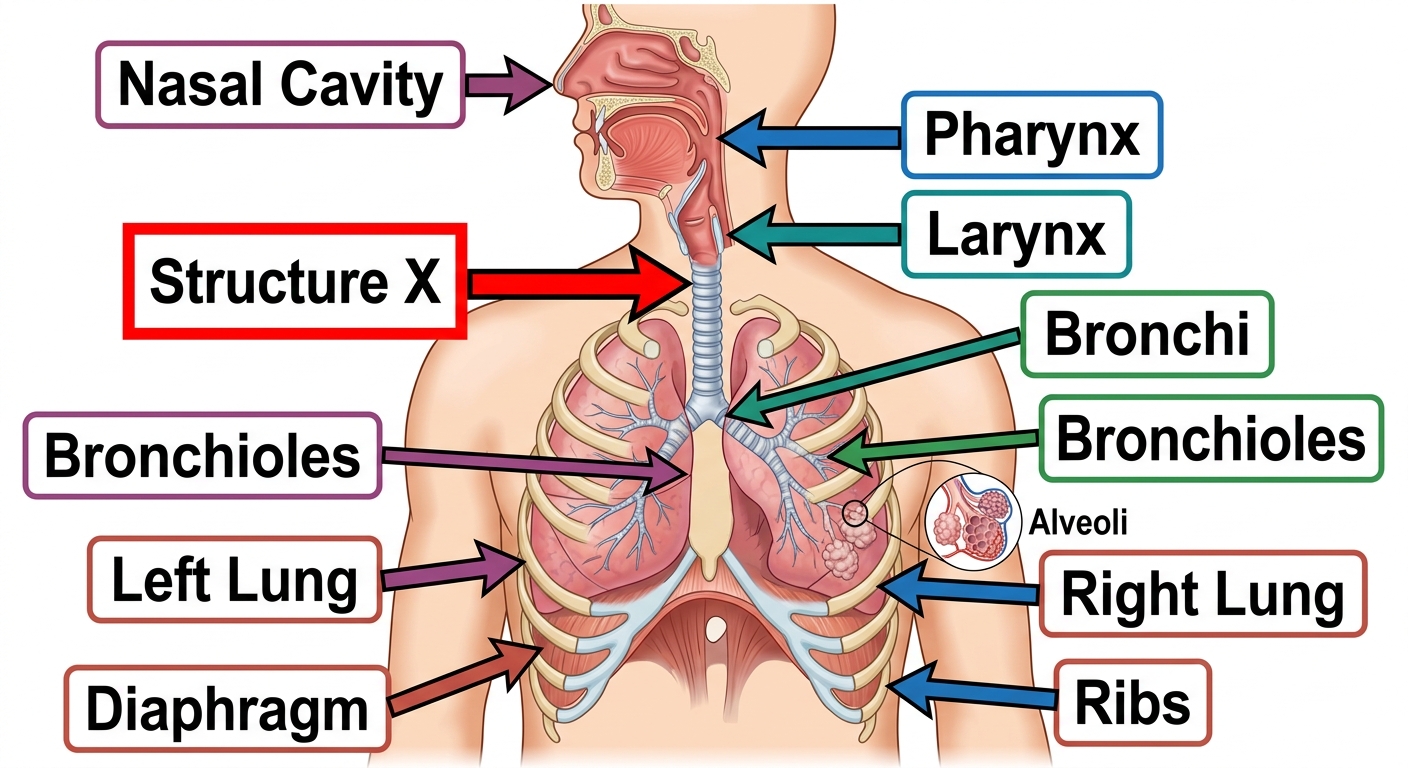
Question diagram
(a)
Name Structure X in the picture. [1]Criterion A (i) · Level 1-2
(b)
Describe one job of the nose. [1]Criterion A (ii) · Level 3-4

revisionprep.com

Summary Answer

Not available for this question.

Model Answer

Not available for this question.

Marking Scheme

Not available for this question.

Examiner Insights

Not available for this question.

Question 2Criterion A · Band 1-4 · Easy · 2 marksrevisionprep.com

Link Between Respiration and Circulation

When you breathe out, a waste gas leaves your body.
(a)
Name the waste gas. [1]Criterion A (i) · Level 1-2
(b)
State where in the body this gas is made. [1]Criterion A (i) · Level 3-4

revisionprep.com

Summary Answer

Not available for this question.

Model Answer

Not available for this question.

Marking Scheme

Not available for this question.

Examiner Insights

Not available for this question.

Question 3Criterion C · Band 1-6 · Medium · 6 marksrevisionprep.com

Gas Exchange in the Alveoli

Some smokers get a lung disease that breaks down the walls of the alveoli. Doctors measured lung surface area and the percentage of oxygen in the blood of four patients.
Lung surface area (m²)70605040
Blood oxygen (%)98969389
(a)
Draw a line graph of blood oxygen against surface area, with labelled axes. [2]Criterion C (ii) · Level 3-4
(b)
Describe the pattern. [1]Criterion C (iii) · Level 1-2
(c)
Calculate the drop in blood oxygen from 70 m² to 40 m². [1]Criterion C (iii) · Level 3-4
(d)
Explain the pattern using the idea of gas exchange. [1]

(e) Suggest why the patient with 40 m² feels tired and out of breath when climbing stairs. [1]
Criterion C (iv) · Level 3-4

revisionprep.com

Summary Answer

Not available for this question.

Model Answer

Not available for this question.

Marking Scheme

Not available for this question.

Examiner Insights

Not available for this question.

Question 4Criterion B · Band 1-6 · Medium · 7 marksrevisionprep.com

Structure and Function of the Heart

Priya thinks fitter people's hearts return to normal faster after exercise. She asks four classmates to do 2 minutes of step-ups and measures their pulse every minute until it is back to resting.
Classmate (exercise each week)Ali (1 hour)Bea (3 hours)Cai (5 hours)Dee (7 hours)
Recovery time (minutes)8643
(a)
Write a hypothesis for her test. [1]Criterion B (i) · Level 1-2
(b)
Identify the independent and the dependent variable. [2]Criterion B (i) · Level 1-2
(c)
State two things she must keep the same. [1]Criterion B (iii) · Level 3-4
(d)
Describe one safety rule for this test. [1]

(e) Explain why testing only four people is a weakness, and suggest an improvement. [2]
Criterion B (iii) · Level 3-4

revisionprep.com

Summary Answer

Not available for this question.

Model Answer

Not available for this question.

Marking Scheme

Not available for this question.

Examiner Insights

Not available for this question.

Question 5Criterion C · Band 1-6 · Medium · 6 marksrevisionprep.com

Blood Vessels Arteries Veins Capillaries

The pressure of blood in different vessels (mmHg):
Large artery: 100
Small artery: 60
Capillary: 25
Vein: 10
(a)
Draw a bar chart of the data with labelled axes. [2]Criterion C (ii) · Level 3-4
(b)
Describe the pattern as blood moves away from the heart. [1]Criterion C (iii) · Level 1-2
(c)
Calculate how many times higher the pressure is in a large artery than in a vein. [1]Criterion C (iii) · Level 3-4
(d)
Explain how the data explains why arteries have thick walls. [1]

(e) Explain how the data explains why veins have valves. [1]
Criterion C (iv) · Level 3-4

revisionprep.com

Summary Answer

Not available for this question.

Model Answer

Not available for this question.

Marking Scheme

Not available for this question.

Examiner Insights

Not available for this question.

Question 6Criterion B · Band 1-8 · Challenge · 8 marksrevisionprep.com

Gas Exchange in the Alveoli

Limewater turns cloudy when carbon dioxide bubbles through it. Ben wants to compare the carbon dioxide in the air we breathe in and out. He bubbles room air through one tube of limewater with a pump, and breathes out through a straw into another tube. He times how long each takes to turn cloudy.
Room air: still clear after 5 minutes
Breathed-out air: cloudy after 20 seconds
(a)
Write a hypothesis for his test. [1]Criterion B (i) · Level 1-2
(b)
Identify the independent and the dependent variable. [2]Criterion B (i) · Level 1-2
(c)
State two things he must keep the same. [1]Criterion B (iii) · Level 3-4
(d)
Describe one safety rule for breathing through a straw into limewater. [1]

(e) Explain the results using gas exchange, and suggest one way to make the comparison between the two tubes fairer. [3]
Criterion B (iii) · Level 3-4

revisionprep.com

Summary Answer

Not available for this question.

Model Answer

Not available for this question.

Marking Scheme

Not available for this question.

Examiner Insights

Not available for this question.

That's every free question here — 6 of 47.

+41 more questions, plus Mock Papers & Worksheets, are waiting in Premium.

Upgrade