You're viewing free preview questions — 4 questions previewing here — subscribe to unlock 81 more, plus the Full Question Bank, Mock Papers & Worksheets.Upgrade
Operations with Fractions — Free MYP2 Mathematics Practice Questions

1QuestionAdding and Subtracting FractionsConcept Practice
3 marks~5 minCriterion A
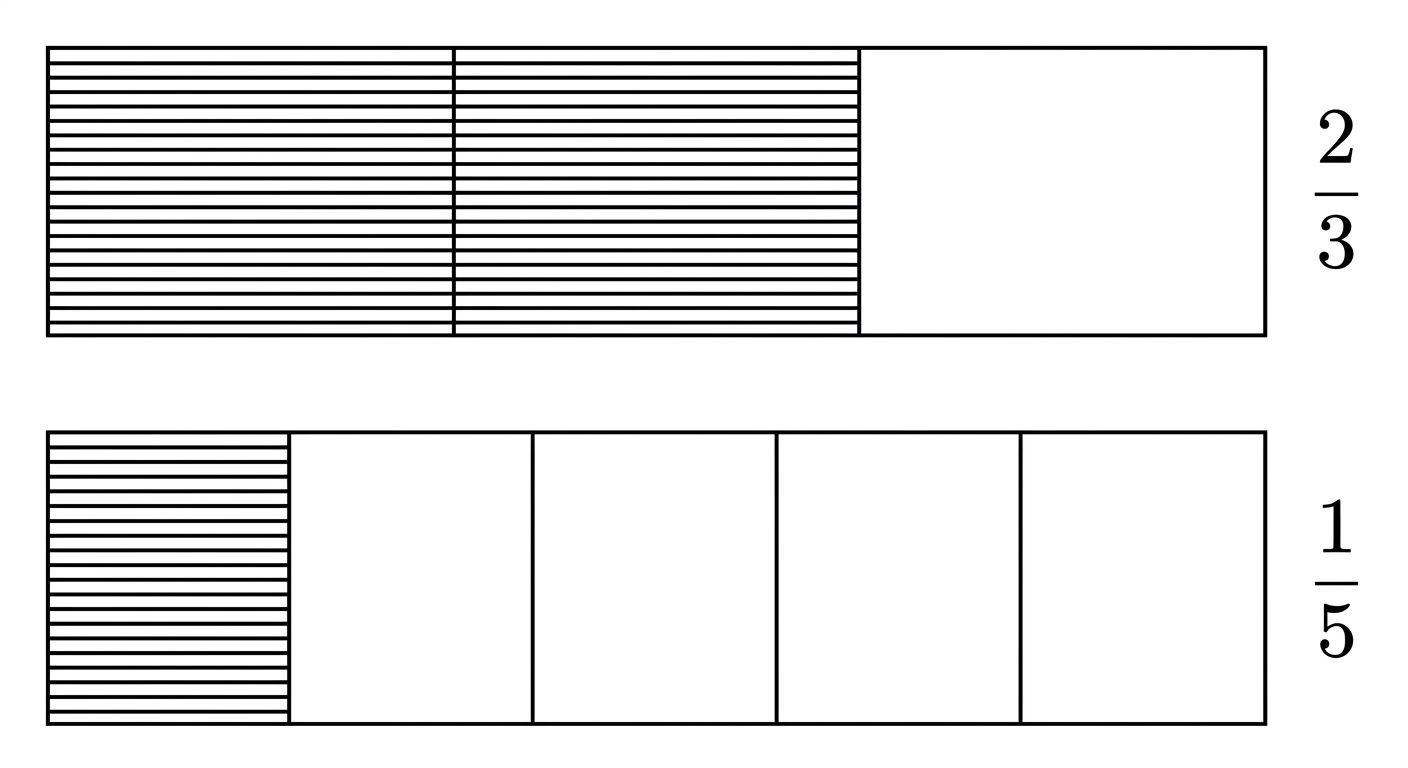
Two bar models are shown. The first bar is divided into 3 equal parts with 2 parts shaded, representing . The second bar is divided into 5 equal parts with 1 part shaded, representing .
a
Identify the least common multiple (LCM) of 3 and 5. [1]
b
Calculate the total shaded fraction. Show your working. [1]
c
Explain why cannot be simplified further. [1]

Solutions
2QuestionAdding and Subtracting FractionsAssessment Practice
6 marks~9 minCriterion D
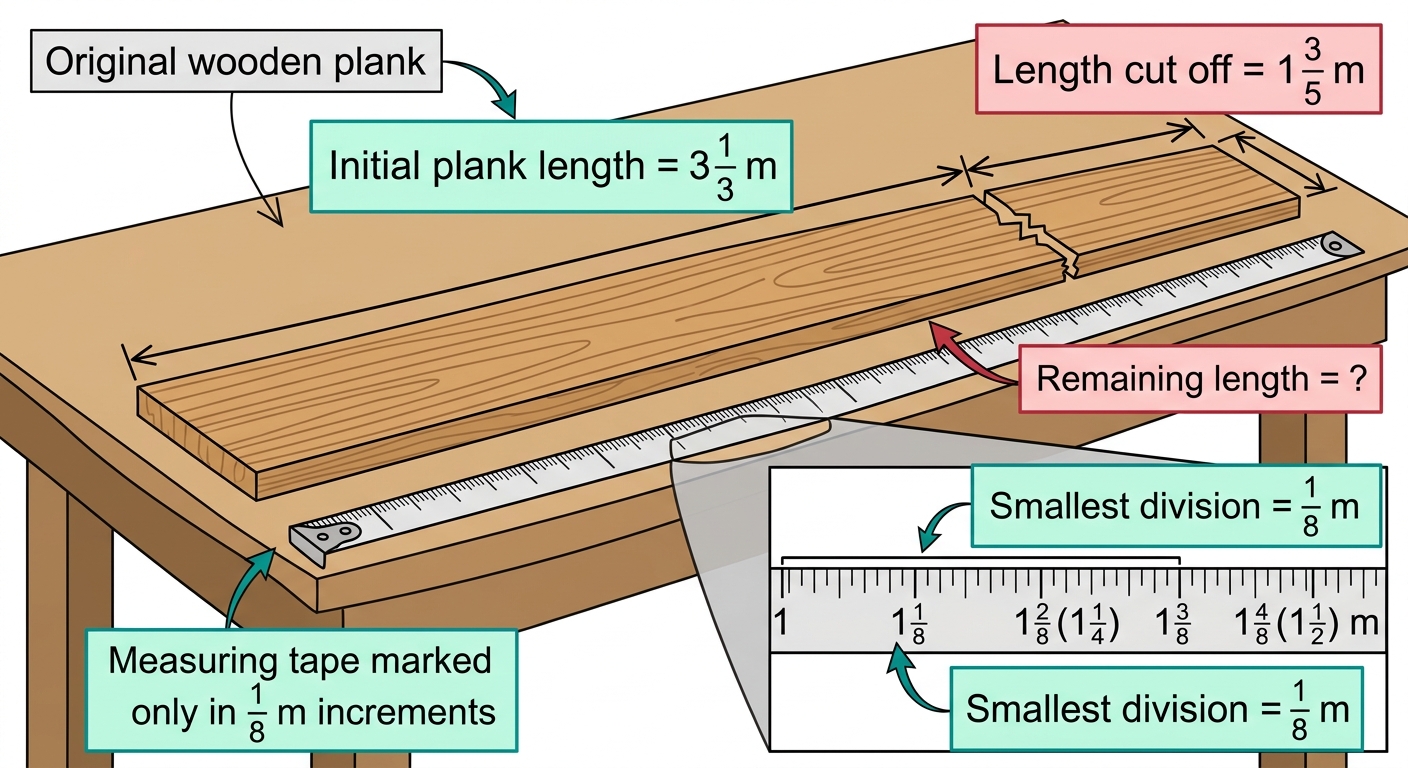
A student cuts a piece of length m from a wooden plank of length m. Their measuring tape is marked only in eighths of a metre.
a
Calculate the remaining length of the plank using the exact measurements. [2]
b
Calculate the remaining length after first rounding each measurement to the nearest m. Show your rounding clearly. [2]
c
Compare the two remaining lengths from parts (a) and (b). State one limitation of using a measuring tape marked only in eighths of a metre for this task. [2]
Solutions
3QuestionEquivalent FractionsConcept Practice
4 marks~6 minCriterion B
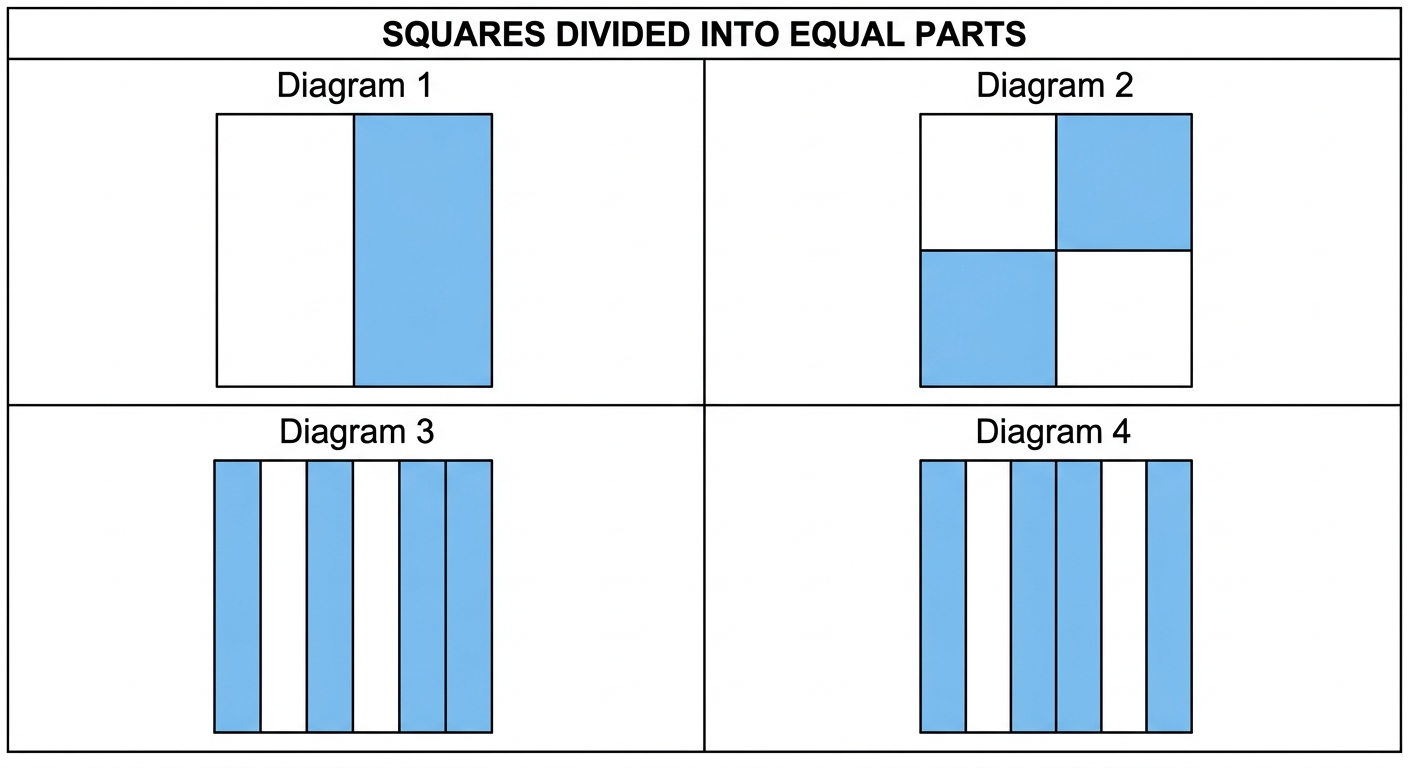
Each square below is divided into equal parts. The shaded region shows a fraction of the whole square.
| Diagram 1 | 2 equal parts | 1 shaded. |
|---|---|---|
| Diagram 2 | 4 equal parts | 2 shaded. |
| Diagram 3 | 6 equal parts | 3 shaded. |
| Diagram 4 | 8 equal parts | 4 shaded. |
a
Identify the fraction of each square that is shaded. [2]
b
Explain why all four fractions represent the same value, and state the general rule that connects them. [2]
Solutions
4QuestionAdding and Subtracting FractionsAssessment Practice
8 marks~12 minCriterion C
Alice and Ben each calculate .
Alice uses denominator 12:
Ben uses denominator 24:
Alice uses denominator 12:
Ben uses denominator 24:
a
Identify one equivalent fraction used by either student and explain why it equals the original fraction. [2]
b
Calculate whether Ben's answer equals Alice's answer . Show your working. [2]
c
Compare the two methods. Explain which is more efficient and why, giving at least two reasons. [4]
Solutions
That's every free question here — 4 of 85.
+81 more questions, plus Mock Papers & Worksheets, are waiting in Premium.