You're viewing free preview questions — 6 questions previewing here — subscribe to unlock 76 more, plus the Full Question Bank, Mock Papers & Worksheets.Upgrade
Back

Structure and Function of Cells — Free MYP2 Sciences Practice Questions

Free questions

Open in full, with answers, mark scheme and examiner insights.

Question 1Criterion A · Easy · 2 marksrevisionprep.com

Basic Structure of Plant and Animal Cells
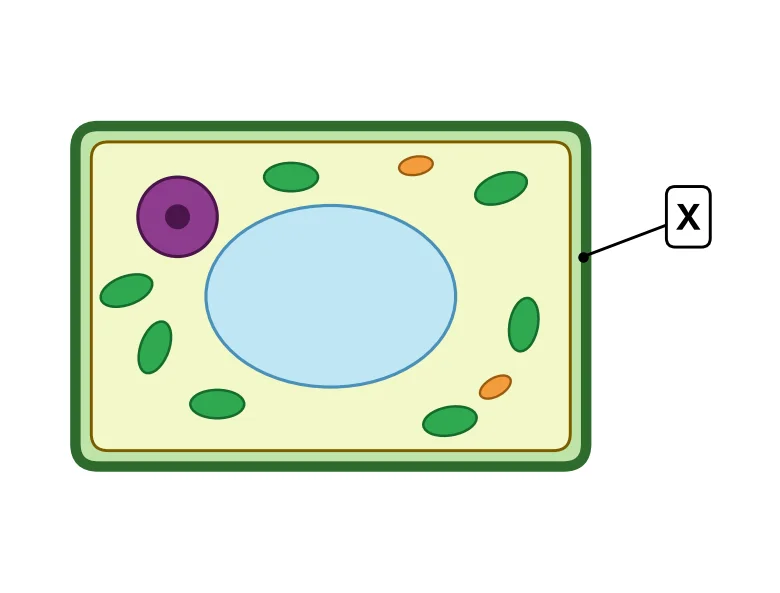
The diagram shows a plant cell. One part is labelled XX.
Question diagram
(a)
Name part XX. [1]
(b)
Describe one job of part XX. [1]

revisionprep.com

Summary Answer

Not available for this question.

Model Answer

Not available for this question.

Marking Scheme

Not available for this question.

Examiner Insights

Not available for this question.

Question 2Criterion A · Easy · 4 marksrevisionprep.com

Comparing Prokaryotic and Eukaryotic Cells Introductory
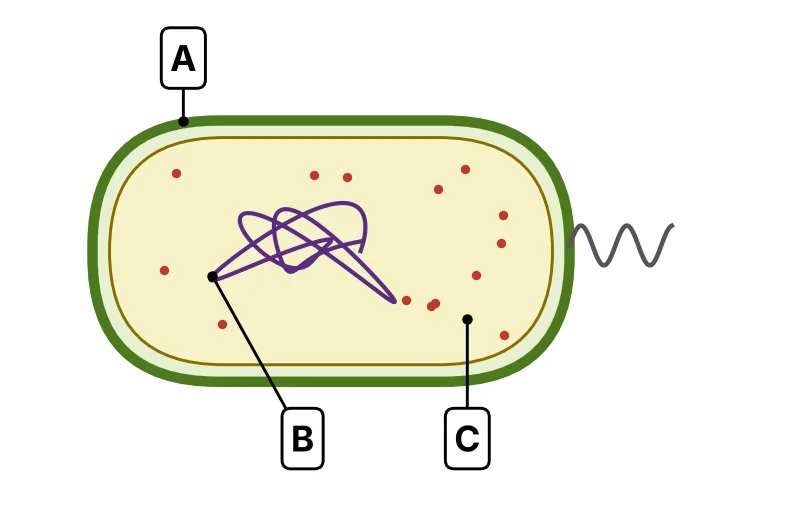
The diagram shows a bacterium. Three parts are labelled AA, BB and CC.
Question diagram
(a)
Name parts AA, BB and CC. [3]
(b)
Explain how the position of the DNA in this cell is different from a plant or animal cell. [1]

revisionprep.com

Summary Answer

Not available for this question.

Model Answer

Not available for this question.

Marking Scheme

Not available for this question.

Examiner Insights

Not available for this question.

Question 3Criterion A · Medium · 5 marksrevisionprep.com

Functions of Cell Organelles Nucleus Cytoplasm etc

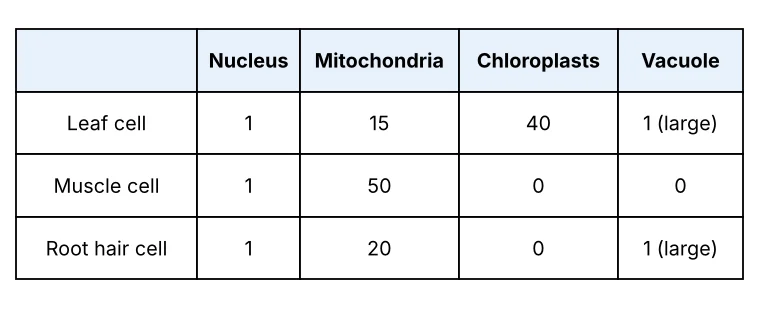
The table shows the relative number of four parts in three types of cell. A bigger number means more of that part.

Leaf cell: nucleus 11, mitochondria 1515, chloroplasts 4040, vacuole 11 (large).

Muscle cell: nucleus 11, mitochondria 5050, chloroplasts 00, vacuole 00.

Root hair cell: nucleus 11, mitochondria 2020, chloroplasts 00, vacuole 11 (large).
Question diagram
(a)
Name the part with the most copies in the leaf cell and the part with the most copies in the muscle cell. [2]
(b)
Explain why a muscle cell has many mitochondria. [1]
(c)
Explain why the root hair cell has mitochondria but no chloroplasts. [2]

revisionprep.com

Summary Answer

Not available for this question.

Model Answer

Not available for this question.

Marking Scheme

Not available for this question.

Examiner Insights

Not available for this question.

Question 4Criterion B · Medium · 3 marksrevisionprep.com

Understanding the Cell as the Basic Unit of Life
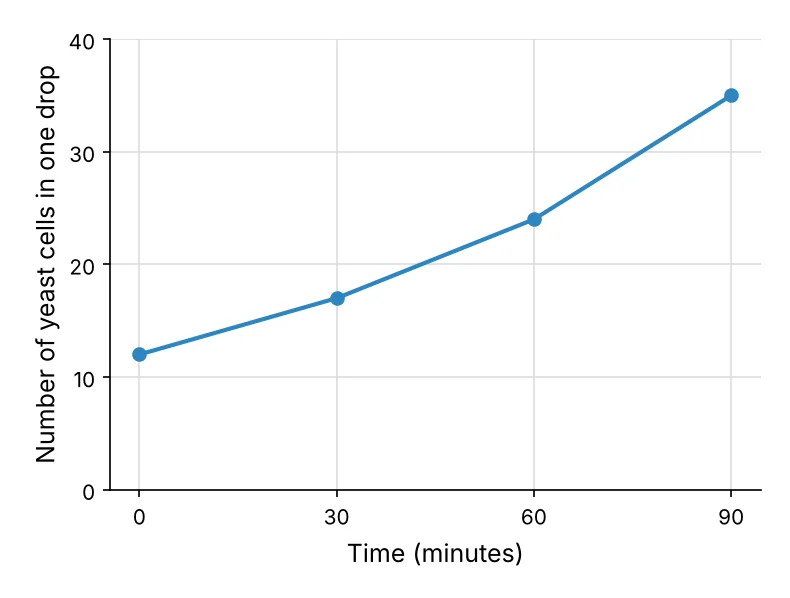
A student wants to test the idea that all cells come from other cells. She puts yeast cells in warm sugar water. Every 3030 minutes she counts the yeast cells in one drop of the water under a microscope. The graph shows her results.
Question diagram
(a)
Describe the trend in the graph. [1]
(b)
Explain how the results support the idea that cells come from other cells. [1]
(c)
State one variable she should keep the same each time she counts. [1]

revisionprep.com

Summary Answer

Not available for this question.

Model Answer

Not available for this question.

Marking Scheme

Not available for this question.

Examiner Insights

Not available for this question.

Question 5Criterion C + A · Challenge · 5 marksrevisionprep.com

Basic Structure of Plant and Animal Cells

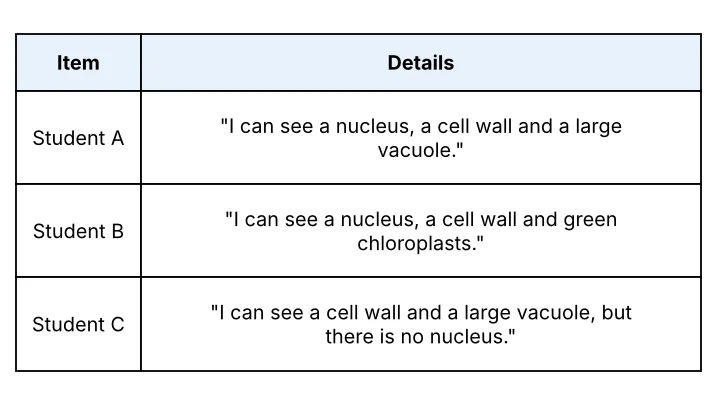
Three students looked at the same onion cell under a microscope. They wrote down what they saw.

Student A: "I can see a nucleus, a cell wall and a large vacuole."

Student B: "I can see a nucleus, a cell wall and green chloroplasts."

Student C: "I can see a cell wall and a large vacuole, but there is no nucleus."
Question diagram
(a)
Name two parts you would expect to see in a cell from the inside of an onion. [2]
(b)
Explain why Student B's observation is probably wrong. [2]
(c)
Decide which student, A or C, is more likely to be correct. Give a reason. [1]

revisionprep.com

Summary Answer

Not available for this question.

Model Answer

Not available for this question.

Marking Scheme

Not available for this question.

Examiner Insights

Not available for this question.

Question 6Criterion D + A · Challenge · 6 marksrevisionprep.com

Importance of Cell Membrane and Cytoplasm
After a big storm, sea water floods a farmer's field of crops. The soil becomes very salty. The crop plants wilt and some die. Osmosis is the movement of water through a cell membrane from a weaker solution to a stronger solution.
Question diagram
(a)
Explain why the plants wilt when the soil water is very salty. [2]
(b)
Describe one way the flood affects the farmer. [2]
(c)
Suggest one way the farmer could help the field to recover. [2]

revisionprep.com

Summary Answer

Not available for this question.

Model Answer

Not available for this question.

Marking Scheme

Not available for this question.

Examiner Insights

Not available for this question.

That's every free question here — 6 of 82.

+76 more questions, plus Mock Papers & Worksheets, are waiting in Premium.

Upgrade