You're viewing free preview questions — 6 questions previewing here — subscribe to unlock 71 more, plus the Full Question Bank, Mock Papers & Worksheets.Upgrade
Back

Phases of the Moon and Eclipses — Free MYP2 Sciences Practice Questions

Free questions

Open in full, with answers, mark scheme and examiner insights.

Question 1Criterion A · Easy · 2 marksrevisionprep.com

Lunar Phases and Their Cycle

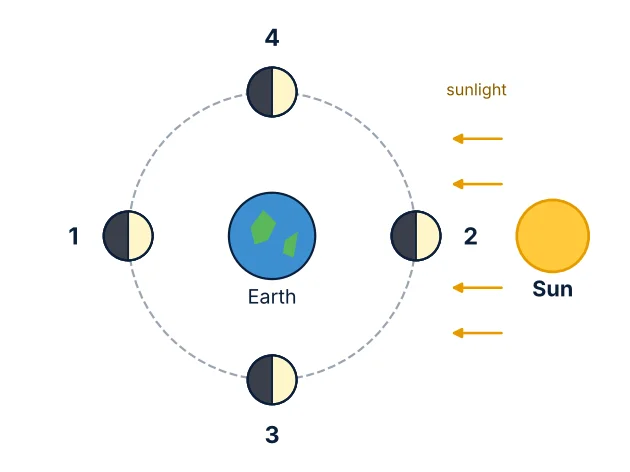
The diagram shows the Moon at four positions (1 to 4) as it travels round Earth. Sunlight comes from the right. The lit half of the Moon is shown in pale yellow.
Question diagram
(a)
Identify the number of the position where the Moon is between Earth and the Sun. [1]
(b)
Explain why the Moon cannot be seen from Earth at this position. [1]

revisionprep.com

Summary Answer

Not available for this question.

Model Answer

Not available for this question.

Marking Scheme

Not available for this question.

Examiner Insights

Not available for this question.

Question 2Criterion A · Easy · 2 marksrevisionprep.com

Viewing Moon Phases from Earth

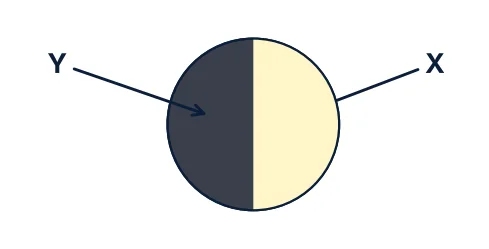
The diagram shows the Moon as seen from Earth. Two parts are marked, X and Y.
Question diagram
(a)
Identify what part Y is. [1]
(b)
Explain why part X looks bright. [1]

revisionprep.com

Summary Answer

Not available for this question.

Model Answer

Not available for this question.

Marking Scheme

Not available for this question.

Examiner Insights

Not available for this question.

Question 3Criterion A · Medium · 4 marksrevisionprep.com

Lunar Phases and Their Cycle

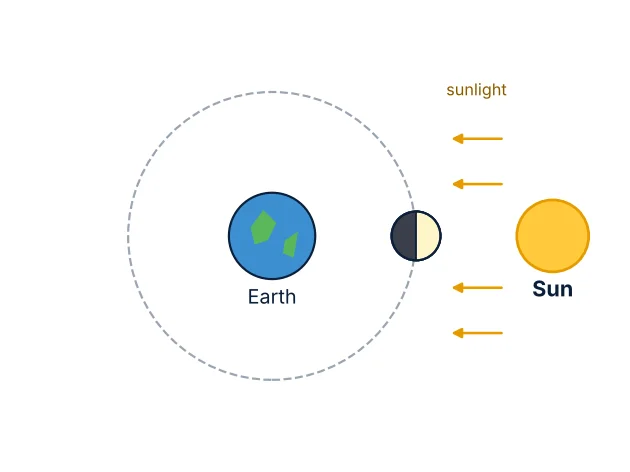
The diagram shows the Moon at one position in its orbit. Sunlight comes from the right. The Moon is on the same side of Earth as the Sun.
Question diagram
(a)
Identify the phase of the Moon seen from Earth at this position. [1]
(b)
Describe where the Sun, Earth and Moon are for this phase. [2]
(c)
A student says: 'At this phase the Moon rises at sunrise and sets at sunset.' State whether the student is correct and give a reason. [1]

revisionprep.com

Summary Answer

Not available for this question.

Model Answer

Not available for this question.

Marking Scheme

Not available for this question.

Examiner Insights

Not available for this question.

Question 4Criterion B + A · Medium · 6 marksrevisionprep.com

Why the Moon Changes Appearance

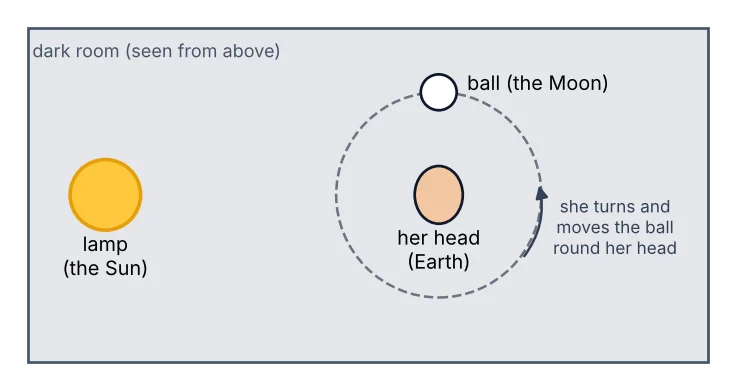
A student uses a lamp (the Sun), a ball (the Moon) and her own head (Earth) to model the Moon's phases in a dark room.
Question diagram
(a)
Predict what the lit part of the ball looks like when the ball is directly between her head and the lamp. [1]
(b)
Predict what she sees when the ball is on the opposite side of her head from the lamp, held a little above her head. [1]
(c)
A friend says: 'The phases happen because Earth's shadow covers part of the Moon.' Use the model to explain why this is not correct. [2]
(d)
State one way the model is different from the real Sun, Earth and Moon. [1]

(e) Predict what she sees when the ball is at a right angle to the lamp. [1]

revisionprep.com

Summary Answer

Not available for this question.

Model Answer

Not available for this question.

Marking Scheme

Not available for this question.

Examiner Insights

Not available for this question.

Question 5Criterion D · Medium · 6 marksrevisionprep.com

Tides and Moon Gravitational Effects Introductory
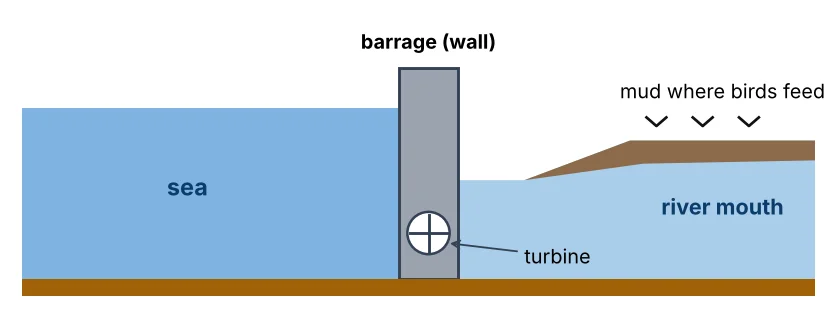
A company wants to build a tidal barrage across a river mouth. A barrage is a wall that uses the rising and falling tide to turn turbines and make electricity. Thousands of wading birds feed on the mud in the river mouth.
Question diagram
(a)
Identify one benefit of making electricity from the tides. [1]
(b)
Explain how the barrage could harm the river mouth. [2]
(c)
Evaluate whether the barrage should be built. Give a decision with reasons for and against. [3]

revisionprep.com

Summary Answer

Not available for this question.

Model Answer

Not available for this question.

Marking Scheme

Not available for this question.

Examiner Insights

Not available for this question.

Question 6Criterion C · Challenge · 5 marksrevisionprep.com

Solar and Lunar Eclipses

The diagram shows the Sun, Earth and Moon during a lunar eclipse. Some data about the eclipse are given.

Earth's diameter: 12 742 km

Moon's diameter: 3 474 km

Width of Earth's dark shadow where the Moon passes through it: about 9 200 km
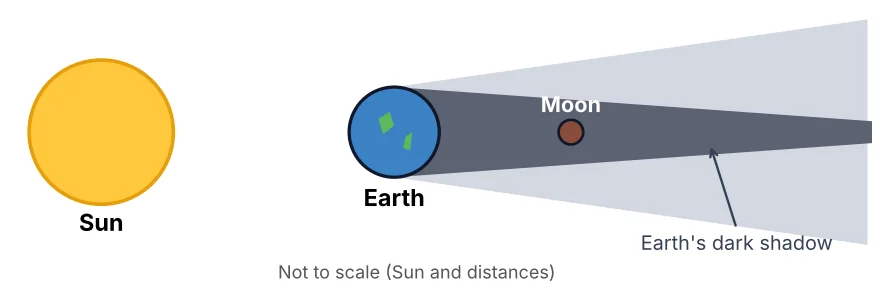
Question diagram
(a)
Calculate how many Moon widths fit across the dark shadow. Give your answer to one decimal place. [2]
(b)
Explain why the Moon can stay in the dark shadow for more than an hour. [1]
(c)
A student says: 'Earth's dark shadow is as wide as Earth, 12 742 km.' Evaluate this claim using the data. [2]

revisionprep.com

Summary Answer

Not available for this question.

Model Answer

Not available for this question.

Marking Scheme

Not available for this question.

Examiner Insights

Not available for this question.

That's every free question here — 6 of 77.

+71 more questions, plus Mock Papers & Worksheets, are waiting in Premium.

Upgrade