You're viewing free preview questions — 6 questions previewing here — subscribe to unlock 79 more, plus the Full Question Bank, Mock Papers & Worksheets.Upgrade
Back

Seasons and the Earth Tilt — Free MYP2 Sciences Practice Questions

Free questions

Open in full, with answers, mark scheme and examiner insights.

Question 1Criterion B · Easy · 2 marksrevisionprep.com

Effect of Tilt and Orbit on Day Length

A student records the hours of daylight in one city at 50°N on the first day of each season.

Season: Spring, Summer, Autumn, Winter

Daylight (hours): 12.0, 16.2, 12.0, 7.8
(a)
Identify the independent variable and the dependent variable in this investigation. [1]
(b)
Explain why the city must stay the same throughout the investigation. [1]

revisionprep.com

Summary Answer

Not available for this question.

Model Answer

Not available for this question.

Marking Scheme

Not available for this question.

Examiner Insights

Not available for this question.

Question 2Criterion A · Easy · 2 marksrevisionprep.com

Climatic Differences Due to Earth Movement
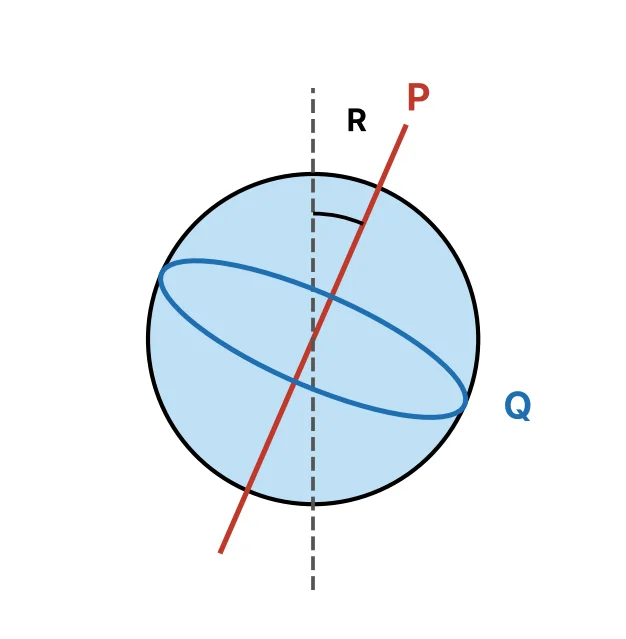
The diagram shows Earth. P is a red line through the North Pole and the South Pole. Q is a blue circle round the middle of Earth. The dashed line is at 90° to the flat surface of Earth's orbit. R is an arc between the dashed line and P.
Question diagram
(a)
Identify the letter that shows the equator. [1]
(b)
Identify the letter that shows the axial tilt, and state its value in degrees. [1]

revisionprep.com

Summary Answer

Not available for this question.

Model Answer

Not available for this question.

Marking Scheme

Not available for this question.

Examiner Insights

Not available for this question.

Question 3Criterion A · Medium · 6 marksrevisionprep.com

Earth Rotation and Revolution

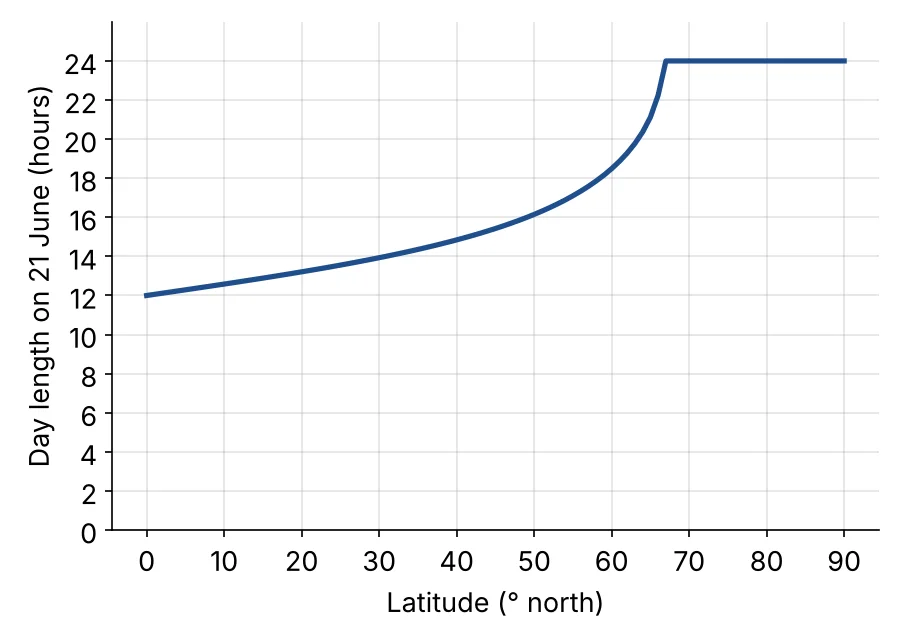
The graph shows how long the day is on 21 June at different latitudes in the Northern Hemisphere. Latitude is the distance north of the equator in degrees.
Question diagram
(a)
Describe the trend in day length as latitude increases from 0° to 90°. [2]
(b)
Explain why the equator has about the same day length all year. [2]
(c)
Predict the day length at 60°N on 21 June if Earth's axis was not tilted at all. Give a reason. [2]

revisionprep.com

Summary Answer

Not available for this question.

Model Answer

Not available for this question.

Marking Scheme

Not available for this question.

Examiner Insights

Not available for this question.

Question 4Criterion A · Medium · 6 marksrevisionprep.com

Solstices and Equinoxes

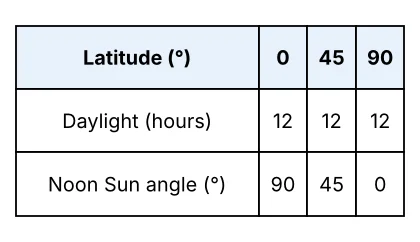
The table shows the hours of daylight and the noon Sun angle at three latitudes on the March equinox.

Latitude (°): 0, 45, 90

Daylight (hours): 12, 12, 12

Noon Sun angle (°): 90, 45, 0
Question diagram
(a)
Identify one pattern in the daylight hours and one pattern in the noon Sun angle. [2]
(b)
Explain why the equator gets more direct sunlight than the pole at an equinox. Use the Sun angles. [2]
(c)
You shine a torch at a globe. Compare the patch of light at the equator, where the torch points straight at the globe, with the patch near the pole, where the light skims the surface. What does this show? [2]

revisionprep.com

Summary Answer

Not available for this question.

Model Answer

Not available for this question.

Marking Scheme

Not available for this question.

Examiner Insights

Not available for this question.

Question 5Criterion D + C · Challenge · 10 marksrevisionprep.com

Earth Rotation and Revolution

A student says: 'It is hot in summer because Earth is closer to the Sun.' She finds this data.

Date: 3 January, 4 July

Distance from the Sun (million km): 147.1, 152.1

Season in the Northern Hemisphere: winter, summer
(a)
State the date on which Earth is closest to the Sun. [1]
(b)
Calculate the difference between the two distances, and write it as a percentage of the July distance. Show your working. [4]
(c)
Evaluate the student's claim. Use evidence from the data and give the real cause of the seasons. [5]

revisionprep.com

Summary Answer

Not available for this question.

Model Answer

Not available for this question.

Marking Scheme

Not available for this question.

Examiner Insights

Not available for this question.

Question 6Criterion C + A · Challenge · 6 marksrevisionprep.com

Why We Have Seasons

The table shows the noon Sun angle at 45°N on 21 June and 21 December. The first row is for the real Earth (tilt 23.5°). The second row is for an imaginary Earth with no tilt (0°).

Earth: Real Earth (23.5° tilt), Imaginary Earth (0° tilt)

Noon Sun angle on 21 June (°): 68.5, 45

Noon Sun angle on 21 December (°): 21.5, 45
(a)
Identify the pattern in the data. [1]
(b)
Calculate the difference in noon Sun angle between June and December on the real Earth. Show your working. Compare it with the difference on the imaginary Earth. [2]
(c)
Predict how the seasons at 45°N would be different on the imaginary Earth. Use the data to explain your prediction. [3]

revisionprep.com

Summary Answer

Not available for this question.

Model Answer

Not available for this question.

Marking Scheme

Not available for this question.

Examiner Insights

Not available for this question.

That's every free question here — 6 of 85.

+79 more questions, plus Mock Papers & Worksheets, are waiting in Premium.

Upgrade