You're viewing free preview questions — 6 questions previewing here — subscribe to unlock 83 more, plus the Full Question Bank, Mock Papers & Worksheets.Upgrade
Back

Structure of the Earth — Free MYP2 Sciences Practice Questions

Free questions

Open in full, with answers, mark scheme and examiner insights.

Question 1Criterion A · Easy · 2 marksrevisionprep.com

Properties and Composition of Each Layer
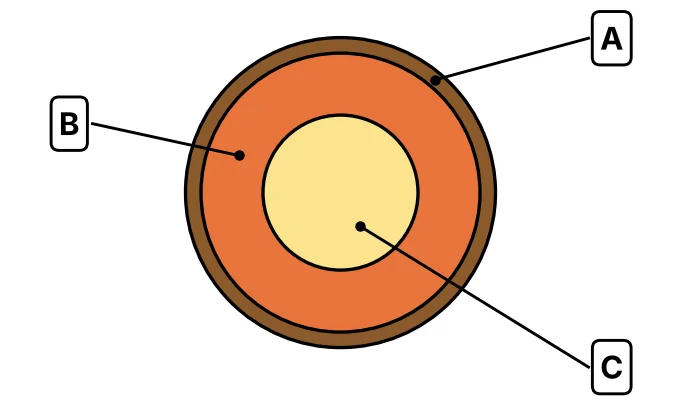
The diagram shows the inside of the Earth with three layers labelled A, B and C.
Question diagram
(a)
Identify the names of layers A, B and C. [1]
(b)
Layer C is at the centre. Describe one way that C is different from A. [1]

revisionprep.com

Summary Answer

Not available for this question.

Model Answer

Not available for this question.

Marking Scheme

Not available for this question.

Examiner Insights

Not available for this question.

Question 2Criterion A · Easy · 2 marksrevisionprep.com

How Earth Structure Affects Landforms

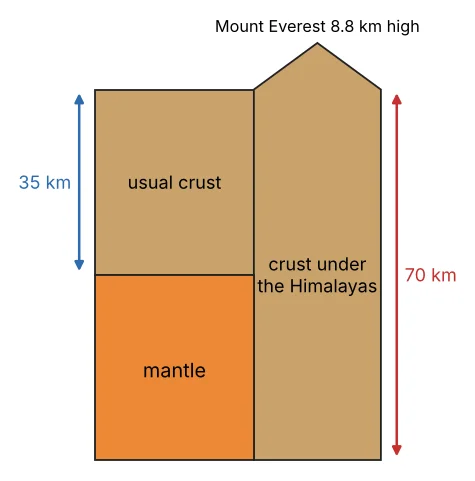
Mount Everest in the Himalayas is about 8.8 km high. The crust under the Himalayas is about 70 km thick, but the crust in most places on land is about 35 km thick.
Question diagram
(a)
Identify the layer of the Earth that mountains are part of. [1]
(b)
Calculate how much thicker the crust is under the Himalayas than the usual 35 km. [1]

revisionprep.com

Summary Answer

Not available for this question.

Model Answer

Not available for this question.

Marking Scheme

Not available for this question.

Examiner Insights

Not available for this question.

Question 3Criterion D + A · Medium · 6 marksrevisionprep.com

Layers of the Earth Crust Mantle Core

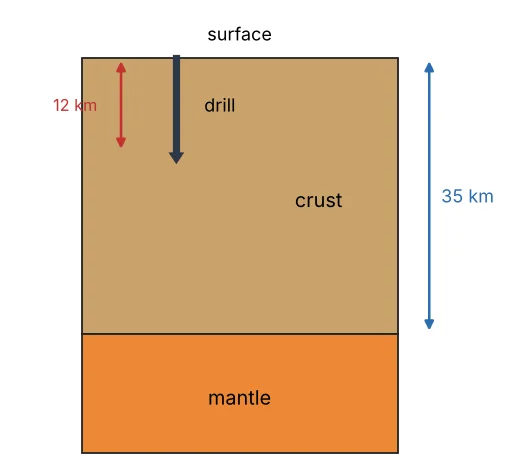
A mining company wants to drill into the Earth's mantle. The crust at the site is 35 km thick. The deepest drill reaches only 12 km. In this model the temperature goes up by 25 °C for every kilometre of depth.
Question diagram
(a)
Calculate the increase in temperature at a depth of 12 km and at a depth of 35 km. [2]
(b)
Calculate how much deeper the drill must go to reach the mantle. [1]
(c)
Discuss whether it is realistic for this company to reach the mantle. Give two reasons. [3]

revisionprep.com

Summary Answer

Not available for this question.

Model Answer

Not available for this question.

Marking Scheme

Not available for this question.

Examiner Insights

Not available for this question.

Question 4Criterion B + C · Medium · 5 marksrevisionprep.com

Volcanoes and Earthquakes Introductory

A team recorded the earthquakes near a volcano for one month.

Magnitude1.0 to 2.02.1 to 3.03.1 to 4.04.1 to 5.0
Number of earthquakes4025105
(a)
Identify the magnitude range with the most earthquakes. [1]
(b)
Calculate the percentage of earthquakes that had a magnitude below 3.1. [2]
(c)
Suggest one way the team could make their data more reliable. [1]
(d)
Write one question the team could investigate next. [1]

revisionprep.com

Summary Answer

Not available for this question.

Model Answer

Not available for this question.

Marking Scheme

Not available for this question.

Examiner Insights

Not available for this question.

Question 5Criterion A · Challenge · 6 marksrevisionprep.com

Layers of the Earth Crust Mantle Core

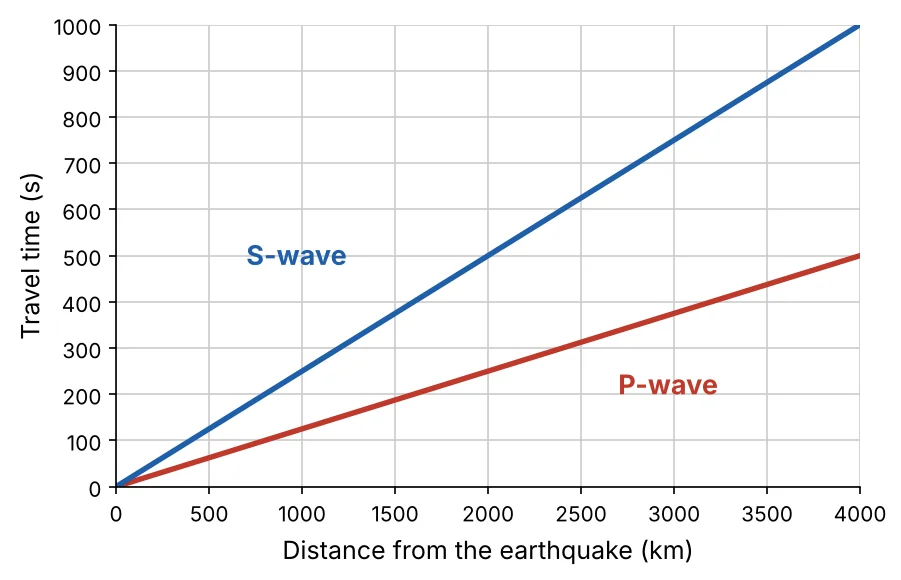
Earthquakes send out two kinds of waves, P-waves and S-waves. The graph shows how long each wave takes to reach places at different distances from an earthquake.
Question diagram
(a)
State how long the P-wave takes to travel 2 000 km. [1]
(b)
Calculate the speed of the P-wave. Use speed = distance divided by time. [2]
(c)
Calculate how much longer the S-wave takes than the P-wave to travel 2 000 km. The S-wave takes 500 s. [1]
(d)
Explain how the time gap between the two waves helps scientists to find how far away an earthquake is. [2]

revisionprep.com

Summary Answer

Not available for this question.

Model Answer

Not available for this question.

Marking Scheme

Not available for this question.

Examiner Insights

Not available for this question.

Question 6Criterion C + A · Challenge · 6 marksrevisionprep.com

Tectonic Plates and Plate Boundaries Introductory

Geologists recorded the features found at four places.

PlaceFeatures found
ADeep ocean trench, line of volcanoes, strong earthquakes
BUnderwater mountain chain, volcanoes, small earthquakes
CA long crack in the ground, strong earthquakes, no volcanoes
DHigh fold mountains, strong earthquakes, no volcanoes
(a)
Identify the type of plate boundary at B. [1]
(b)
Describe the pattern in where volcanoes are found. [1]
(c)
Explain which place is most likely to be a transform boundary, using the data. [2]
(d)
A student says 'earthquakes only happen where plates move apart'. Use the table to evaluate this claim. [2]

revisionprep.com

Summary Answer

Not available for this question.

Model Answer

Not available for this question.

Marking Scheme

Not available for this question.

Examiner Insights

Not available for this question.

That's every free question here — 6 of 89.

+83 more questions, plus Mock Papers & Worksheets, are waiting in Premium.

Upgrade