You're viewing free preview questions — 6 questions previewing here — subscribe to unlock 70 more, plus the Full Question Bank, Mock Papers & Worksheets.Upgrade
Back

The Solar System — Free MYP2 Sciences Practice Questions

Free questions

Open in full, with answers, mark scheme and examiner insights.

Question 1Criterion B · Easy · 3 marksrevisionprep.com

Planets Moons and Other Celestial Bodies

The table shows the distance from the Sun and the diameter of the four inner planets.

- Planet: Mercury, Venus, Earth, Mars
- Distance from Sun (million km): 57.9, 108.2, 149.6, 227.9
- Diameter (km): 4 879, 12 104, 12 756, 6 792
(a)
Identify the largest and the smallest of the four planets by diameter. [1]
(b)
Describe the relationship between distance from the Sun and diameter, using data from the table. [2]

revisionprep.com

Summary Answer

Not available for this question.

Model Answer

Not available for this question.

Marking Scheme

Not available for this question.

Examiner Insights

Not available for this question.

Question 2Criterion A · Easy · 2 marksrevisionprep.com

Structure and Order of the Solar System
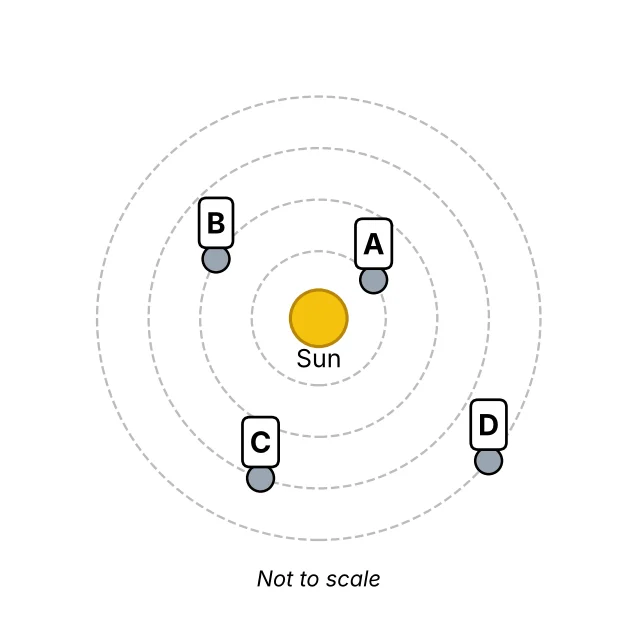
The diagram shows the four inner planets orbiting the Sun. The planets are labelled A, B, C and D in order moving away from the Sun.
Question diagram
(a)
Identify the name of planet C. [1]
(b)
State one reason why planet C is warmer than planet D. [1]

revisionprep.com

Summary Answer

Not available for this question.

Model Answer

Not available for this question.

Marking Scheme

Not available for this question.

Examiner Insights

Not available for this question.

Question 3Criterion A · Easy · 2 marksrevisionprep.com

Asteroids Comets and Meteoroids

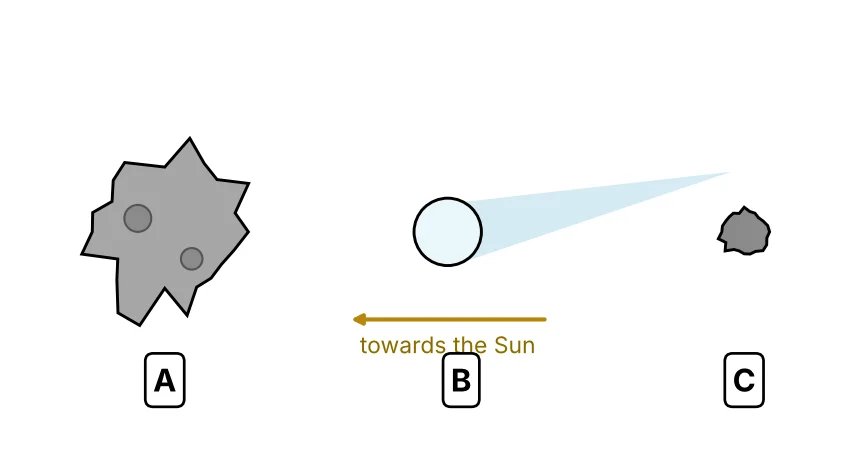
The diagram shows three objects in space, labelled A, B and C. The Sun is far away on the left side of the diagram.

Word bank: asteroid, comet, meteoroid
Question diagram
(a)
Match each of A, B and C with one word from the word bank. [1]
(b)
Explain which feature in the diagram shows that B is a comet. [1]

revisionprep.com

Summary Answer

Not available for this question.

Model Answer

Not available for this question.

Marking Scheme

Not available for this question.

Examiner Insights

Not available for this question.

Question 4Criterion D · Medium · 8 marksrevisionprep.com

Planets Moons and Other Celestial Bodies

In 2021 a country destroyed one of its old satellites with a missile. This made over 1 500 pieces of trackable space debris, which are broken bits of spacecraft. The debris moves at about 7 km/s in low Earth orbit (LEO), roughly 200 to 2 000 km above Earth.
(a)
Identify two risks that space debris in LEO causes for spacecraft. [2]
(b)
Explain why it is difficult to make a country clean up debris it creates. Include one weakness of the space treaties. [3]
(c)
Describe one international agreement that could reduce debris and compare one benefit with one challenge. [3]

revisionprep.com

Summary Answer

Not available for this question.

Model Answer

Not available for this question.

Marking Scheme

Not available for this question.

Examiner Insights

Not available for this question.

Question 5Criterion A · Medium · 4 marksrevisionprep.com

Historical Models of the Solar System

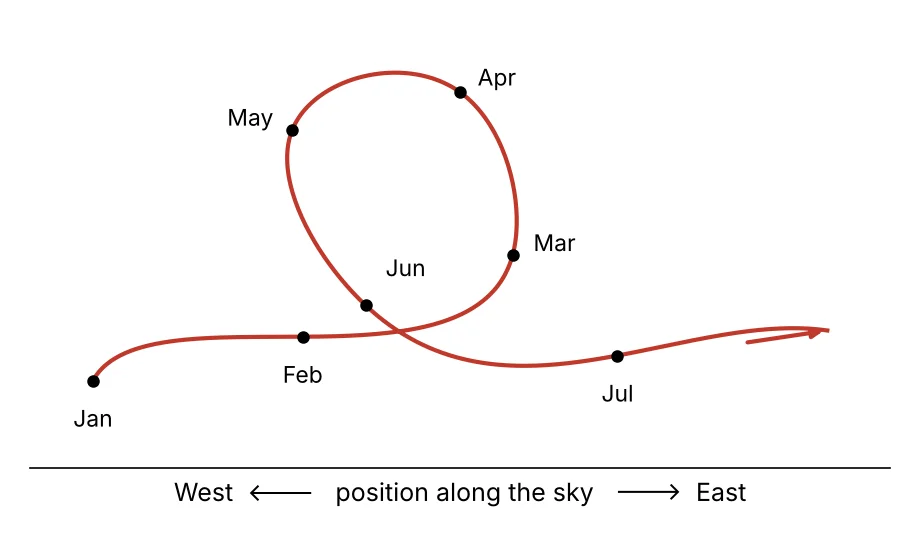
The diagram shows the path of Mars across the night sky over several months. Mars moves east, then loops back west for a while (this is called retrograde motion), then moves east again.
Question diagram
(a)
Identify which model, geocentric or heliocentric, explains retrograde motion most simply. [1]
(b)
Describe how that model explains the westward loop of Mars. [2]
(c)
The geocentric model used small extra circles, called epicycles, to explain the loop. Compare this with the explanation in (b). [1]

revisionprep.com

Summary Answer

Not available for this question.

Model Answer

Not available for this question.

Marking Scheme

Not available for this question.

Examiner Insights

Not available for this question.

Question 6Criterion C · Challenge · 6 marksrevisionprep.com

Movements of Planets Around the Sun

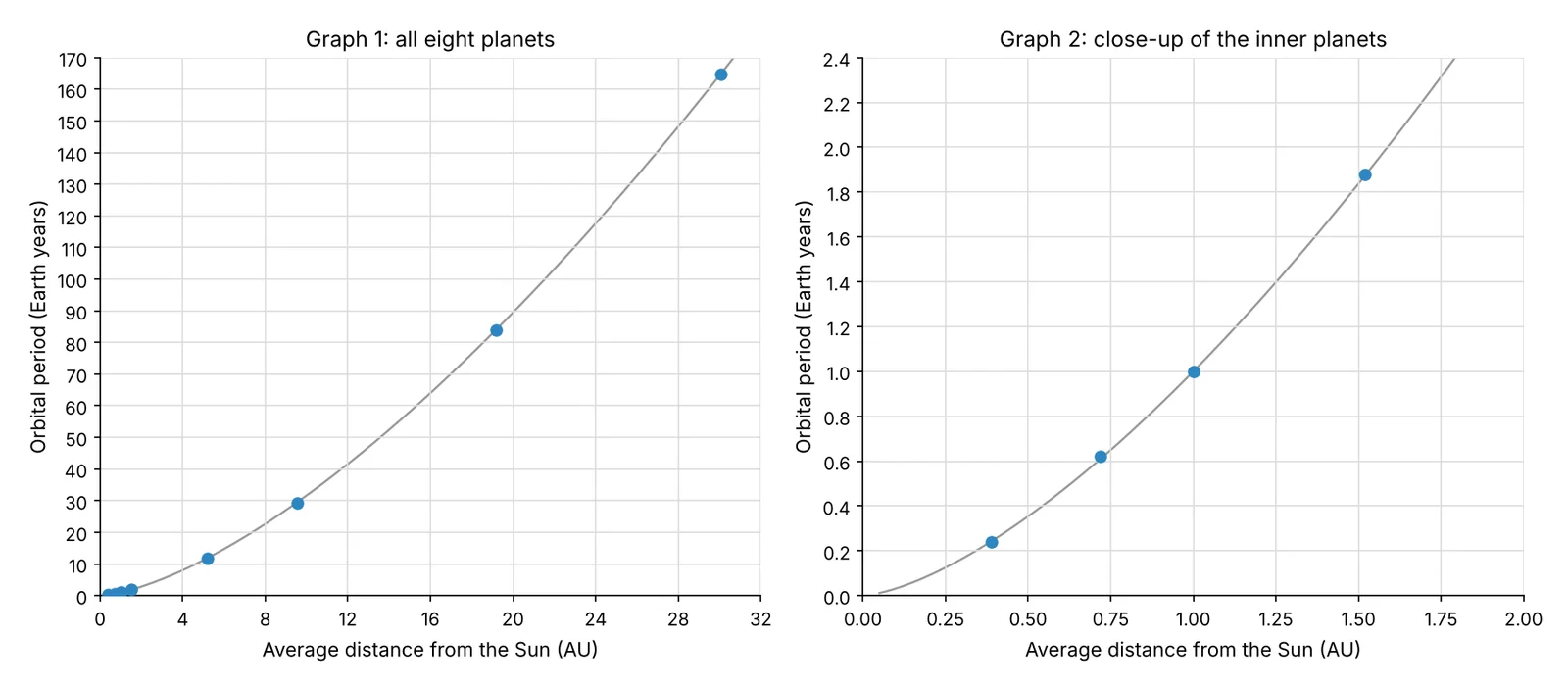
The graphs show the average distance from the Sun and the orbital period for the eight planets. Graph 1 shows all eight planets. Graph 2 is a close-up of the four inner planets.
Question diagram
(a)
Describe the shape of the curve in Graph 1 and the trend it shows. [2]
(b)
Estimate the orbital period of a planet 10 AU from the Sun using Graph 1. Describe your two reading steps. [2]
(c)
A planet orbits at 0.5 AU. Use Graph 2 to decide which is the better estimate for its period: 0.3 years or 0.6 years. Explain. [2]

revisionprep.com

Summary Answer

Not available for this question.

Model Answer

Not available for this question.

Marking Scheme

Not available for this question.

Examiner Insights

Not available for this question.

That's every free question here — 6 of 76.

+70 more questions, plus Mock Papers & Worksheets, are waiting in Premium.

Upgrade