You're viewing free preview questions — 4 questions previewing here — subscribe to unlock 61 more, plus the Full Question Bank, Mock Papers & Worksheets.Upgrade
Real-World Problem Solving Using Numbers — Free MYP3 Mathematics Practice Questions

1QuestionEstimating in Daily Life SituationsConcept Practice
2 marks~3 minCriterion A
A pencil is placed along a ruler. The left end of the pencil lines up with the 2 cm mark and the right end lines up with the 16.8 cm mark.
a
Calculate the length of the pencil in centimetres. [1]
b
Round your answer to the nearest whole number of centimetres. [1]

Solutions
2QuestionBanking Savings and TransactionsAssessment Practice
2 marks~3 minCriterion D
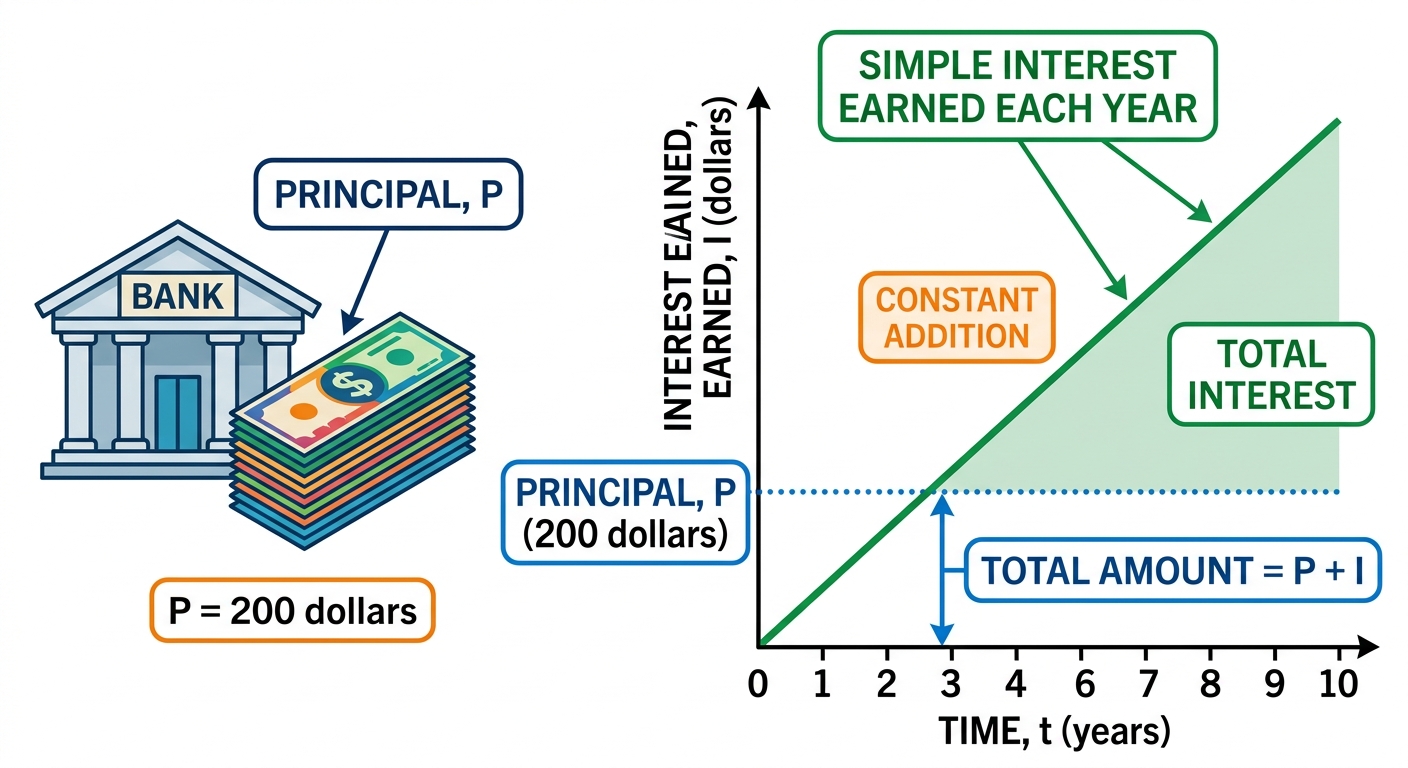
A student deposits 200 dollars in a bank account that earns simple interest at 3% per year, modelled by
where is the interest earned, is the principal, is the annual rate as a decimal, and is the time in years.
Explain one limitation of using simple interest to model the growth of this student's savings over 10 years. [2]
where is the interest earned, is the principal, is the annual rate as a decimal, and is the time in years.
Explain one limitation of using simple interest to model the growth of this student's savings over 10 years. [2]
Solutions
3QuestionMath in Cooking and RecipesConcept Practice
2 marks~3 minCriterion B
A basic cookie recipe uses 2 cups of flour to make 12 cookies.
| Number of cookies | 12 | 24 | 36 | 48 |
|---|---|---|---|---|
| Cups of flour | 2 | 4 | 6 | 8 |
a
Describe the relationship between the number of cookies and the cups of flour. [1]
b
Calculate the number of cups of flour needed to make 60 cookies. [1]
Solutions
4QuestionMath in Shopping and DiscountsAssessment Practice
8 marks~12 minCriterion C
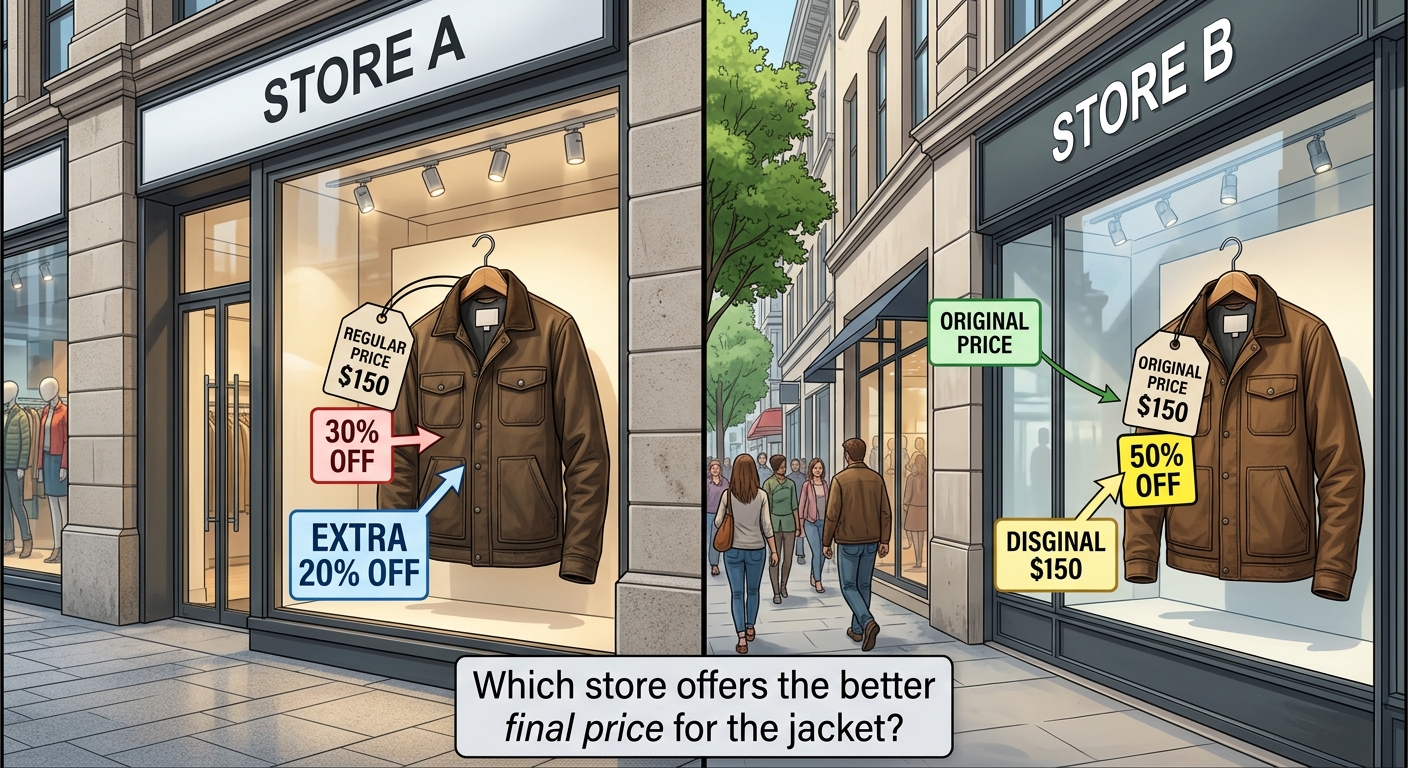
A jacket costs 150 dollars. Store A applies a 30% discount, then a further 20% off the reduced price. Store B applies a single 50% discount to the same jacket.
a
Calculate the final price of the jacket at Store A after both discounts are applied in sequence. [2]
b
Calculate the difference in final price between the two stores. [2]
c
A customer claims that shopping at Store A gives the same saving as Store B because . Analyse this claim. In your answer, show the effective percentage discount at Store A and explain why sequential discounts do not add in the way the customer expects. [4]
Solutions
That's every free question here — 4 of 65.
+61 more questions, plus Mock Papers & Worksheets, are waiting in Premium.