You're viewing free preview questions — 6 questions previewing here — subscribe to unlock 63 more, plus the Full Question Bank, Mock Papers & Worksheets.Upgrade
Back

Electromagnets and their applications — Free MYP3 Sciences Practice Questions

Free questions

Open in full, with answers, mark scheme and examiner insights.

Question 1Criterion A · Easy · 4 marksrevisionprep.com

Making an electromagnet

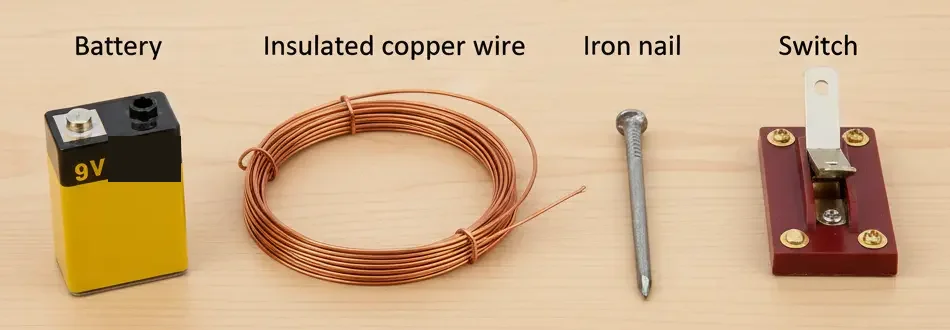
The photo shows the parts a student uses to make an electromagnet: a battery, insulated copper wire, an iron nail and a switch.
Question diagram
(a)
Describe, in the correct order, how she should build the electromagnet and make it work. Use the words circuit and current in your answer. [3]
(b)
Describe a test that shows the nail has become a magnet. [1]

revisionprep.com

Summary Answer

Not available for this question.

Model Answer

Not available for this question.

Marking Scheme

Not available for this question.

Examiner Insights

Not available for this question.

Question 2Criterion A · Easy · 3 marksrevisionprep.com

Comparing magnets and electromagnets

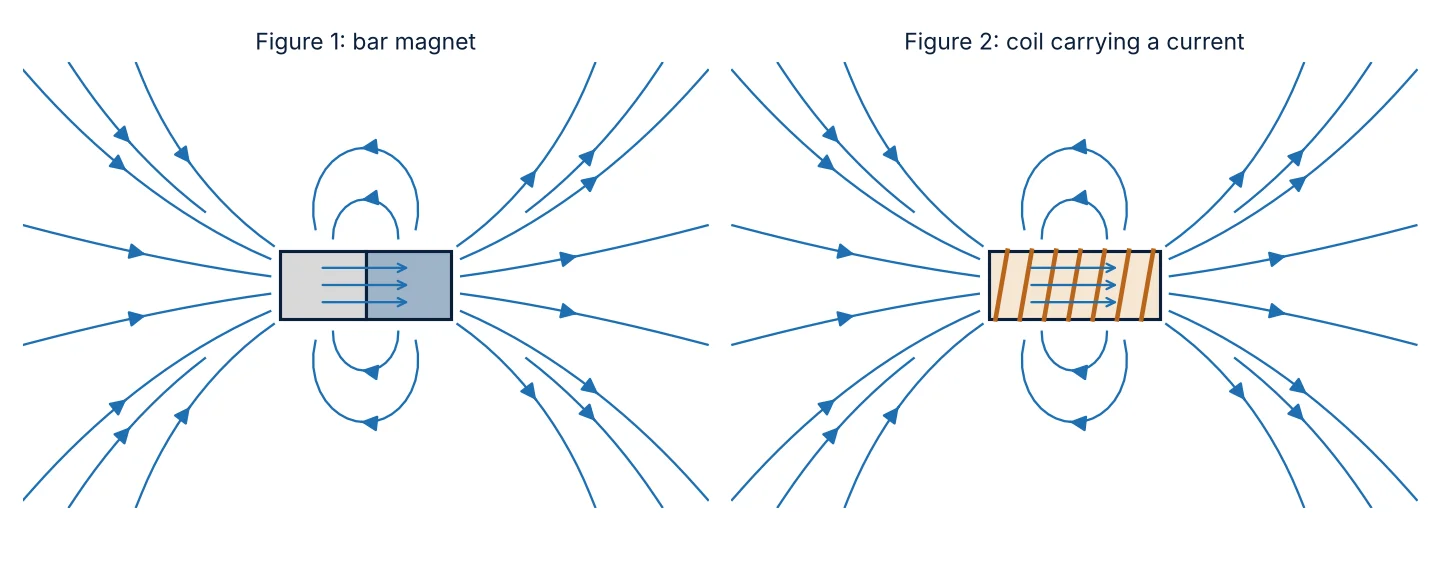
Figure 1 shows the magnetic field pattern of a bar magnet. Figure 2 shows the pattern of a coil of wire that carries a current.
Question diagram
(a)
Describe one similarity between the two field patterns. [1]
(b)
State how the student can reverse the poles of the coil. [1]
(c)
State one way to make the field of the coil stronger. [1]

revisionprep.com

Summary Answer

Not available for this question.

Model Answer

Not available for this question.

Marking Scheme

Not available for this question.

Examiner Insights

Not available for this question.

Question 3Criterion B + A · Medium · 3 marksrevisionprep.com

Making an electromagnet

A student winds bare (uninsulated) copper wire tightly around an iron nail. The turns of wire touch each other. She connects the ends to a cell. The nail picks up far fewer paper clips than she expected.
(a)
Explain why bare wire wound in touching turns makes a weak electromagnet. [2]
(b)
State how she should change the wire so that the electromagnet works properly. [1]

revisionprep.com

Summary Answer

Not available for this question.

Model Answer

Not available for this question.

Marking Scheme

Not available for this question.

Examiner Insights

Not available for this question.

Question 4Criterion C · Medium · 3 marksrevisionprep.com

Factors affecting electromagnet strength
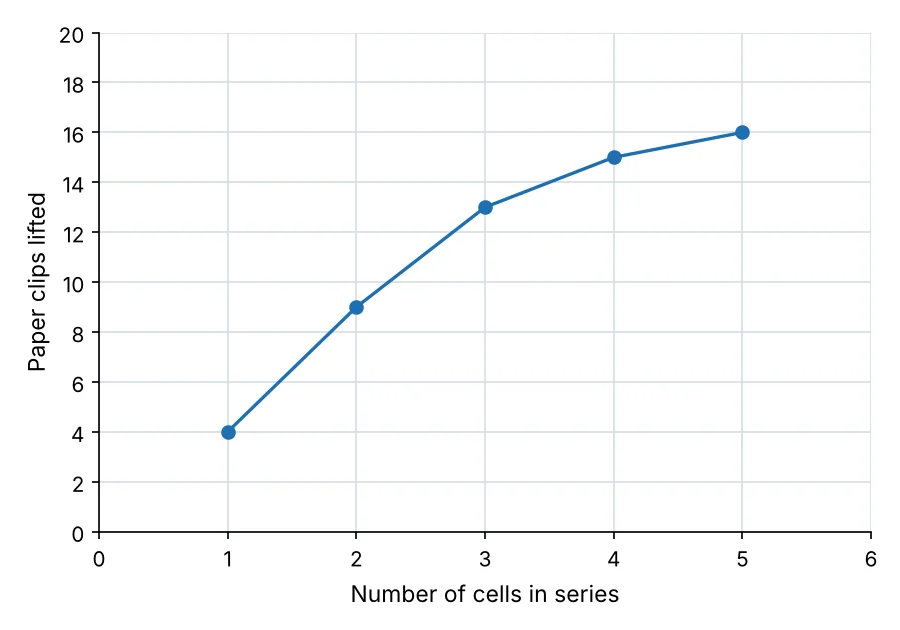
A student adds cells one at a time to a circuit with an electromagnet and counts the paper clips lifted. The graph shows her results. Number of cells: 1, 2, 3, 4, 5. Paper clips lifted: 4, 9, 13, 15, 16.
Question diagram
(a)
Use the graph to state the number of paper clips lifted with 3 cells. [1]
(b)
Describe how the gain in clips changes each time another cell is added. [1]
(c)
Suggest one reason why the extra cells give less and less extra strength. [1]

revisionprep.com

Summary Answer

Not available for this question.

Model Answer

Not available for this question.

Marking Scheme

Not available for this question.

Examiner Insights

Not available for this question.

Question 5Criterion D + A · Challenge · 6 marksrevisionprep.com

Uses of electromagnets in daily life

A maglev train floats about 10 mm above its track. It is held up and pushed along by electromagnets. Its wheels never touch the track. One maglev line carries passengers at up to 430 km/h. A fast conventional train runs at about 300 km/h. A new maglev track costs much more per kilometre than conventional track, and it cannot use existing track.
(a)
Explain why a maglev train has less friction than a train with wheels on rails. [2]
(b)
State one drawback of maglev trains. [1]
(c)
A politician says: 'Every country should replace its trains with maglev.' Evaluate this claim. [3]

revisionprep.com

Summary Answer

Not available for this question.

Model Answer

Not available for this question.

Marking Scheme

Not available for this question.

Examiner Insights

Not available for this question.

Question 6Criterion A + C · Challenge · 6 marksrevisionprep.com

Magnetic relays and electromagnetic devices

A relay circuit controls a motor. The relay coil works at 6 V and takes a current of 0.5 A. The relay contacts switch the motor circuit, which has its own supply of 12 V and a current of 2 A.
(a)
Describe how the relay allows a small current to switch a larger current. [2]
(b)
Calculate the power used by the coil and the power in the motor circuit. [2]
(c)
Use your answers to explain whether the relay acts as a power amplifier or as a switch. [2]

revisionprep.com

Summary Answer

Not available for this question.

Model Answer

Not available for this question.

Marking Scheme

Not available for this question.

Examiner Insights

Not available for this question.

That's every free question here — 6 of 69.

+63 more questions, plus Mock Papers & Worksheets, are waiting in Premium.

Upgrade