You're viewing free preview questions — 4 questions previewing here — subscribe to unlock 73 more, plus the Full Question Bank, Mock Papers & Worksheets.Upgrade
Series and Parallel Circuits — Free MYP3 Sciences Practice Questions

1QuestionAdvantages and Disadvantages of Each TypeConcept Practice
2 marks~3 minCriterion A
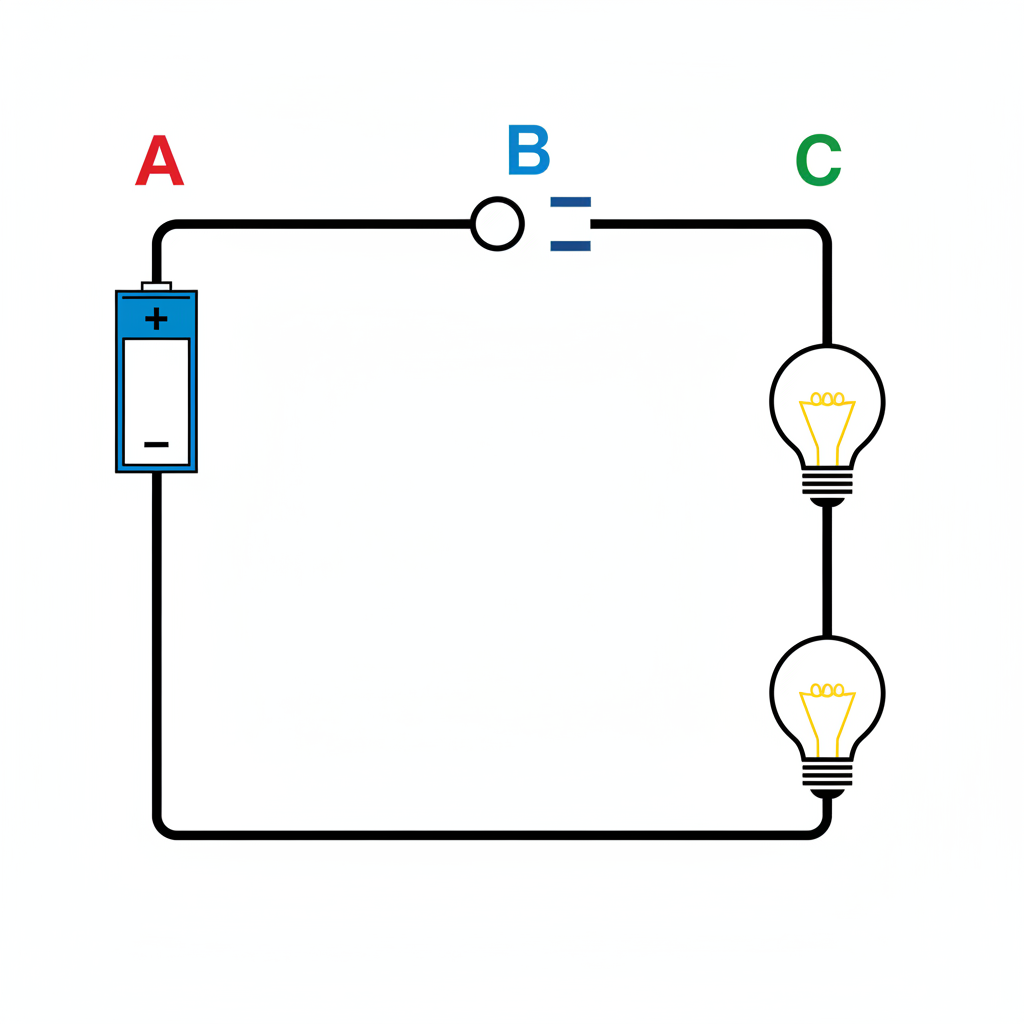
The diagram shows a series circuit containing a battery, a switch, and two bulbs. The components are labeled A, B, and C.
a
Identify the component that controls the flow of current. [1]
b
Explain how this component controls the flow of current in the circuit. [1]

Solutions
2QuestionAdvantages and Disadvantages of Each TypeAssessment Practice
5 marks~8 minCriterion D
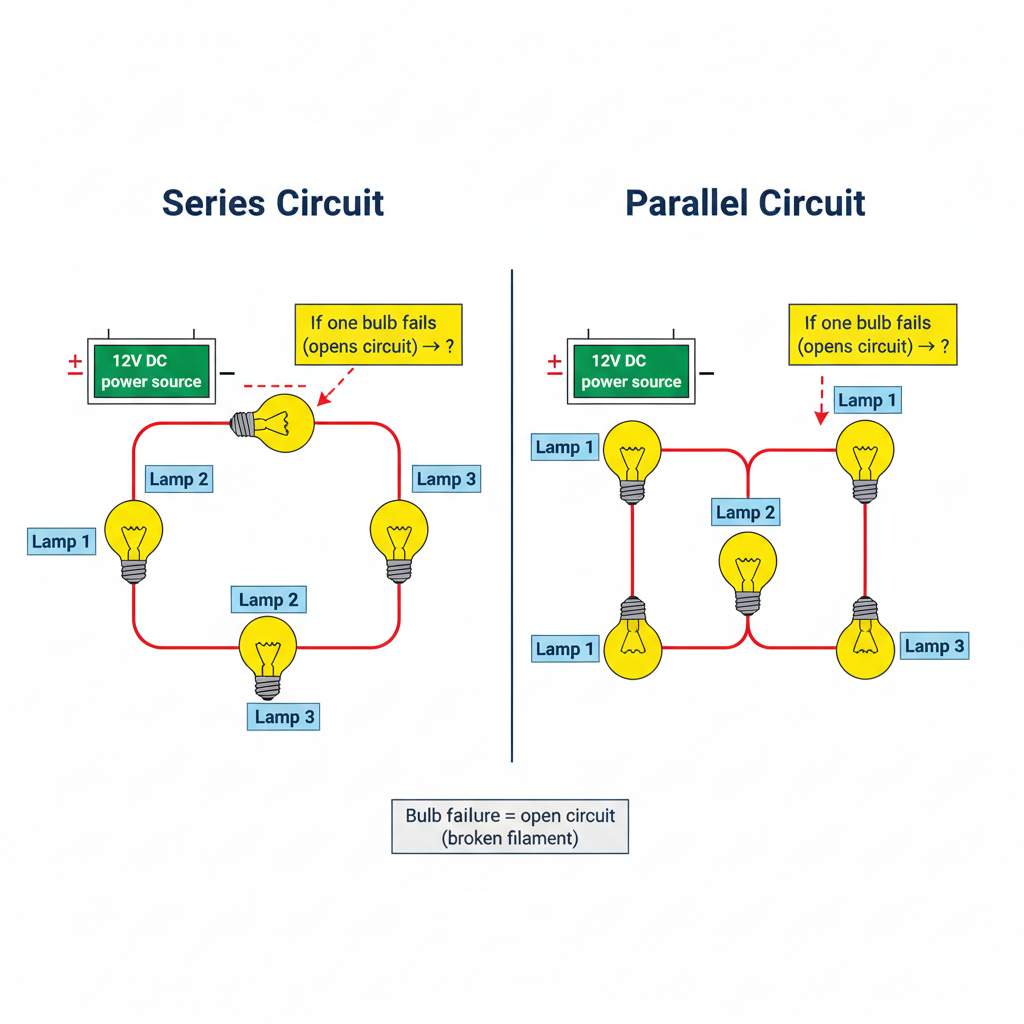
A homeowner wants to wire three identical living room lamps, each with resistance , either all in series or all in parallel across a 12 V supply.
a
Compare how the brightness of each lamp differs between the two configurations when all three lamps are working. [2]
b
Explain what happens to the remaining lamps if one bulb fails (breaks) in each configuration. [1]
c
The series option uses less wire and costs less to install. Evaluate whether this cost saving justifies choosing series wiring for a living room. [2]
Solutions
3QuestionAdvantages and Disadvantages of Each TypeConcept Practice
3 marks~5 minCriterion B
A student builds a series circuit with a battery and identical bulbs. She adds bulbs one at a time and records the total current in the circuit after each addition. Her results are given below:
| Number of bulbs | Total current (A) |
|---|---|
| 1 | 0.50 |
| 2 | 0.25 |
| 3 | 0.17 |
| 4 | 0.13 |
| 5 | 0.10 |
| 6 | 0.08 |
a
Describe the trend in total current as the number of bulbs increases. [1]
b
Explain why adding bulbs in series produces this trend. Use the terms resistance and current in your answer. [1]
c
The battery voltage stays constant throughout. Using , justify why the current reaches nearly zero as many bulbs are added. [1]
Solutions
4QuestionAdvantages and Disadvantages of Each TypeAssessment Practice
6 marks~9 minCriterion C
A student claims: "Parallel circuits always make bulbs brighter than series circuits."
Three identical bulbs (each rated at 6 V, 0.5 A) are connected to a 6 V battery in two configurations. Brightness is measured in arbitrary units (higher = brighter).
Series circuit — Bulb 1: 30, Bulb 2: 30, Bulb 3: 30
Parallel circuit — Bulb 1: 60, Bulb 2: 60, Bulb 3: 60
Three identical bulbs (each rated at 6 V, 0.5 A) are connected to a 6 V battery in two configurations. Brightness is measured in arbitrary units (higher = brighter).
Series circuit — Bulb 1: 30, Bulb 2: 30, Bulb 3: 30
Parallel circuit — Bulb 1: 60, Bulb 2: 60, Bulb 3: 60
a
Calculate the total brightness for each circuit configuration. [2]
b
Explain why the bulbs in the parallel circuit are brighter than those in the series circuit, referring to voltage and current in each type. [2]
c
Analyse the data to decide whether the student's claim is fully supported. Include one real-world factor that could affect the result. [2]

Solutions
That's every free question here — 4 of 77.
+73 more questions, plus Mock Papers & Worksheets, are waiting in Premium.